English (USA) Anatomical and histochemical findings of Andean tuber peels
Potential for their nutraceutical application
Autores
-
Cecilia Hebe Orphèe
Facultad de Bioquímica, Química y Farmacia, Universidad Nacional de Tucumán. Tucumán, Argentina
 https://orcid.org/0000-0001-7556-9558
-
María Inés Mercado
Instituto de Morfología Vegetal, Área Botánica, Fundación Miguel Lillo. Tucumán, Argentina
https://orcid.org/0000-0002-8128-3377
-
Elena Cartagena
Facultad de Bioquímica, Química y Farmacia (UNT). Instituto de Biotecnología Farmacéutica y Alimentaria-INBIOFAL (CONICET-UNT). Tucumán, Argentina
https://orcid.org/0000-0002-8148-0282
DOI:
 https://doi.org/10.30550/j.lil/2281
Palavras-chave:
Oxalis tuberosa, Solanum tuberosum subsp. andigena, Ullucus tuberosus, potencial nutracéutico, productos naturalesResumo
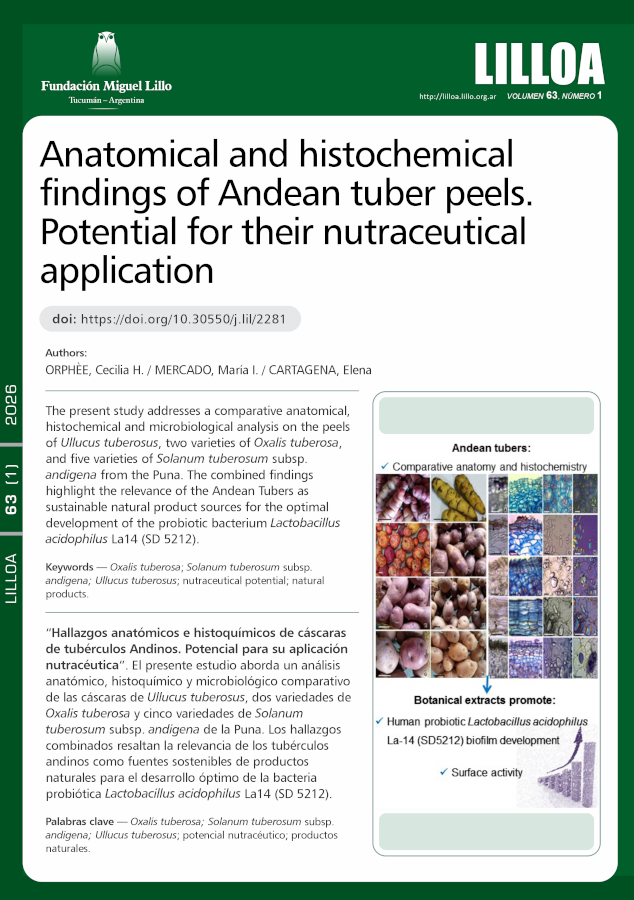
The present study aimed to characterize the anatomical features and histochemical distribution of bioactive natural products in the peels of eight Andean tubers and to evaluate the potential of their extracts to promote the development of the probiotic Lactobacillus acidophilus biofilm, providing evidence of their potential applications. A comparative anatomical and histochemical analysis was conducted on the peels of Ullucus tuberosus Caldas (Basellaceae), two varieties of Oxalis tuberosa Mol. (Oxalidaceae), and five varieties of Solanum tuberosum L. subsp. andigena (Solanaceae) collected from traditional markets in the Argentine Puna. Additionally, aqueous, ethanolic and ethyl acetate extracts from the peels were tested for their ability to promote growth and biofilm formation of Lactobacillus acidophilus La-14 (SD5212). The tuber peels exhibited a thick cuticle, single-layered epidermis and cortical amyliferous parenchyma. In O. tuberosa and U. tuberosus, the vascular system consisted of open, collateral bundles, while S. tuberosum subsp. andigena showed a modified amphiphloic stele with abundant storage parenchyma. Idioblasts containing pigmented compounds such as anthocyanins and carotenoids were associated with tuber coloration. Histochemical assays revealed the presence of phenolic compounds, flavonoids, triterpenes, and proteins stored in epidermal and subepidermal tissues. All extracts promoted dose-dependent biofilm formation of the probiotic bacterium. The results indicate that Andean tuber peels are a natural source of bioactive metabolites with known antioxidant action and potential for the optimal development of the probiotic bacterium L. acidophilus La-14 (SD5212) and the future design of sustainable nutraceutical formulations.
Downloads
Referências
Abedin, M. M., Chourasia, R., Phukon, L. C., Sarkar, P., Ray, R. C., Singh, S. P. & Rai, A. K. (2024). Lactic acid bacteria in the functional food industry: Biotechnological properties and potential applications. Critical Reviews in Food Science and Nutrition 64: 10730-10748. https://doi.org/10.1080/10408398.2023.2227896 DOI: https://doi.org/10.1080/10408398.2023.2227896
Andre, C. M., Ghislain, M., Bertin, P., Oufir, M., Herrera, M. R., Hoffmann, L., Hausman, J. F., Larondelle, Y. & Evers, D. (2007). Andean potato cultivars (Solanum tuberosum L.) as a source of antioxidant and mineral micronutrients. Journal of Agricultural and Food Chemistry 55: 366-378. https://doi: 10.1021/jf062740i DOI: https://doi.org/10.1021/jf062740i
Atencio, H., Ispizúa, N. V., Feingold, S. & Clausen, A. M. (2019). Conservación ex situ de variedades de papas nativas. Caso de estudio de la variedad ‘Collareja’ del noroeste. Revista de Investigaciones Agropecuarias 45: 242-251. https://www.redalyc.org/journal/864/86460707010/html/
Berlanga, M. & Guerrero, R. (2016). Living together in biofilms: the microbial cell factory and its biotechnological implications. Microbial Cell Factories 15: 165-176. https://doi.org/10.1186/s12934-016-0569-5 DOI: https://doi.org/10.1186/s12934-016-0569-5
Camire, M. E., Kubow, S. & Donnelly, D. J. (2009). Potatoes and human health. Critical Reviews in Food Science and Nutrition 49: 823-840. https://doi: 10.1080/10408390903041996 DOI: https://doi.org/10.1080/10408390903041996
Campos, D., Noratto, G., Chirinos, R., Arbizu, C., Roca, W. & Cisneros-Zevallos, L. (2006). Antioxidant capacity and secondary metabolites in four species of Andean tuber crops: native potato (Solanum sp.), mashua (Tropaeolum tuberosum Ruiz & Pavon), oca (Oxalis tuberosa Molina) and ulluco (Ullucus tuberosus Caldas). Journal of the Science of Food and Agriculture 86: 1481-1488. https://doi.org/10.1002/jsfa.2529 DOI: https://doi.org/10.1002/jsfa.2529
Campos, D., Betalleluz-Pallardel, I., Chirinos, R., Aguilar-Galvez, A., Noratto, G. & Pedreschi, R. (2012). Prebiotic effects of yacon (Smallanthus sonchifolius Poepp. & Endl.), a source of fructooligosaccharides and phenolic compounds with antioxidant activity. Food Chemistry 135: 1592-1599. https://doi.org/10.1016/j.foodchem.2012.05.088 DOI: https://doi.org/10.1016/j.foodchem.2012.05.088
Cartagena, E., Orphèe, C. H., Verni, M. C., Arena, M. E.,González, S. N., Argañaraz, M. I. & Bardón, A. (2021). Patent: Medio de Cultivo Promotor y Bacterias No Patógenas Detoxificantes de Compuestos Mutagénicos/Carcinogénicos. Instituto Nacional de la Propiedad Industrial-INPI Nº 20190102418, 25 March 2021.
Clausen, A. M.; Ispizúa V. N. & Digilio A. (2010). Native Andean potatoes varieties in Argentina: conservation and evaluation of an endangered genetic resource. The Americas Journal of Plant Science and Biotechnology 3 (special issue 1), Global Science Books, pp. 72-82.
Cruz, G., Gulotta, C., Bustos, A. Y., Ribotta, P., Ferrero, C. & Iturriaga, L. (2023). Characterization of the starch extracted from an ancestral Andean meal: Chuño. Starch?Stärke, 2300029. DOI: https://doi.org/10.1002/star.202300029
Dable-Tupas, G., Otero, M. C. B. & Bernolo, L. Eds. (2020). Functional Foods and Nutraceuticals: Bioactive Components, Formulations, and Innovations. Springer Nature, Berlin.
David, R. & Carde, J. P. (1964). Coloration differentielle des inclusions lipidique et terpeniques des pseudophylles du pin maritime au moyen du reactif Nadi. Comptes-rendus de l'Académie des Sciences de Paris 258: 1338-1340.
Donaldson, L. (2020). Autofluorescence in plants. Molecules 25: 2393. https://doi.org/10.3390/molecules25102393 DOI: https://doi.org/10.3390/molecules25102393
Erginkaya, Z. & Konuray-Altun, G. (2022). Potential biotherapeutic properties of lactic acid bacteria in foods. Food Bioscience 46: 101544. https://doi.org/10.1016/j.fbio.2022.101544 DOI: https://doi.org/10.1016/j.fbio.2022.101544
Flores, H. E., Walker, T. S., Guimarães, R. L., Bais, H. P. & Vivanco, J. M. (2003). Andean root and tuber crops: Underground rainbows. HortScience 38: 161-168. DOI: https://doi.org/10.21273/HORTSCI.38.2.161
García-Díaz, R. F., Valdez-Hernández, E. F. & Ayvar-Serna, S. (2023). Diversity and distribution of andean tubers: An agrogeographic analysis. Investigaciones y Estudios – UNA 14:59-70. 10.57201/IEUNA2313312 DOI: https://doi.org/10.57201/IEUNA2313312
Gibson, G. R., Hutkins, R., Sanders, M. E., Prescott, S. L., Reimer, R. A., Salminen, S. J., Scott, K., Stanton, C., Swanson, K. S., Cani, P. D., Verbeke, K. & Reid, G. (2017). Expert consensus document: The international scientific association for probiotics and prebiotics (ISAPP) consensus statement on the definition and scope of prebiotics. Nature reviews Gastroenterology & Hepatology 14: 491-502. https://doi.org/10.1038/nrgastro.2017.75 DOI: https://doi.org/10.1038/nrgastro.2017.75
Harborne, J. (1999). Classes and function of secondary products from plants. In: Walton, N.J., Brown, D.E. (Eds.), Chemicals from plants. Imperial College Press, London. DOI: https://doi.org/10.1142/9789812817273_0001
Hernández-Uribe, J. P., Meza-Nieto, M., Palma-Rodríguez, H. M., Navarro-Cortez, R. O., Guzmán-Ortiz, F. A., Bello-Pérez, L. A. & Vargas-Torres, A. (2020). Physicochemical, morphological, and molecular properties of starch isolated from Dioscorea and Oxalis tubers from Hidalgo state, Mexico. Starch?Stärke 72 (11-12). https://www.x-mol.net/paper/article/1271896707781128192 DOI: https://doi.org/10.1002/star.202000074
Heslop-Harrison, J. & Heslop-Harrison, Y. (1981). The pollen-stigma interaction in the grasses. 2. pollen-tube penetration and the stigma response in secale. Acta Botanica Neerlandica 30: 289-307. https://doi.org/10.1111/j.1438-8677.1981.tb00410.x DOI: https://doi.org/10.1111/j.1438-8677.1981.tb00410.x
Johansen, D. A. (1940). Plant Microtechnique. McGraw-Hill, New York, NY, USA.
Lachman, J. & Hamouz, K. (2005). Red and purple coloured potatoes as a significant antioxidant source in human nutrition – a review. Plant Soil Environment 51: 477-482. https://doi.org/10.17221/3620-PSE DOI: https://doi.org/10.17221/3620-PSE
Lanari, M. R. (2022). Balcarce como pionera y futuro de la investigación y conservación de recursos genéticos. Visión Rural 29: 54-56.
Leidi, E. O., Altamirano, A. M., Mercado, G., Rodriguez, J. P., Ramos, A., Alandia, G., Sørensen, M. & Jacobsen, S. E. (2018). Andean roots and tubers crops as sources of functional foods. Journal of Functional Foods 51: 86-93. http://dx.doi.org/10.1016/j.jff.2018.10.007 DOI: https://doi.org/10.1016/j.jff.2018.10.007
Liakopoulos, G., Stavrianakou, S. & Karabourniotis, G. (2001). Analysis of epicuticular phenolics of Prunus persica and Olea europaea leaves: Evidence for the chemical origin of the UV-induced blue fluorescence of stomata. Annals of Botany 87: 641-648. https://doi.org/10.1006/anbo.2001.1387 DOI: https://doi.org/10.1006/anbo.2001.1387
Mercado, M. I. & Ponessa, G. I. (2020). Nuevo soporte para obtención de cortes de material vegetal en micrótomo rotativo. Revista Dominguezia 37: 29-35.
Merck, E. (1980). Reactivos de coloración para cromatografía en capa fina y en papel. Darmstadt, Germany.
Mesurado, M. d. L. A., Chalup, A., Ortiz, J., Puchol, J. D. Z., Feresin, G. E., Bardón, A. & Cartagena, E. (2021). Activity of grindelanes against important maize pest Spodoptera frugiperda and their selectivity of action on non-target environmental bacteria. Entomologia Experimentalis et Applicata 169: 825-837. http://dx.doi.org/10.1111/eea.13067 DOI: https://doi.org/10.1111/eea.13067
Mondolot-Cosson, L., Andary, C., Guang-Hui, D. & Roussel, J. L. (1997). Histolocalisation de substances phenoliques intervenant lors d’interactions plante-pathogene chez le tournesol et la vigne. Acta Botanica Gallica 144: 353-362. http://dx.doi.org/10.1080/12538078.2000.10515850 DOI: https://doi.org/10.1080/12538078.1997.10515380
Nada, H. G., Sudha, T., Darwish, N. H. E. & Mousa, S. A. (2020). Lactobacillus acidophilus and Bifidobacterium longum exhibit antiproliferation, anti-angiogenesis of gastric and bladder cancer: Impact of COX2 inhibition. PharmaNutrition 14: 100219. https://doi.org/10.1016/j.phanu.2020.100219 DOI: https://doi.org/10.1016/j.phanu.2020.100219
Neu, R. (1957). A new reagent for differentiating and determining flavones on paper chromatograms. Naturwissenschaften 43: 82.
Orphèe, C. H., Mercado, M. I., Argañaraz Martínez, F. E., Arena, M. E. & Cartagena, E. (2025). High-mountain tuber products improve selectively the development and detoxifying capacity of Lactobacilli strains as an innovative culture strategy. Fermentation 11: 576. https://doi.org/10.3390/fermentation11100576 DOI: https://doi.org/10.3390/fermentation11100576
O'Toole, G. A. & Kolter, R. (1998). Initiation of biofilm formation in Pseudomonas fluorescens WCS365 proceeds via multiple, convergent signalling pathways: a genetic analysis. Molecular Microbiology 28: 449-461. http://dx.doi.org/ 10.1046/j.1365-2958.1998.00797.x DOI: https://doi.org/10.1046/j.1365-2958.1998.00797.x
Palai, S., Derecho, C. M.P., Kesh, S. S., Egbuna, C. & Onyeike, P. C. (2020). Prebiotics, probiotics, synbiotics and its importance in the management of diseases. Functional Foods and Nutraceuticals: Bioactive Components, Formulations and Innovations 173-196. http://dx.doi.org/10.1007/s13197-015-1921-1 DOI: https://doi.org/10.1007/978-3-030-42319-3_10
Reque, P. M. & Brandelli, A. (2021). Encapsulation of probiotics and nutraceuticals: Applications in functional food industry. Trends in Food Science & Technology 114: 1-10. https://doi.org/10.1016/j.tifs.2021.05.022 DOI: https://doi.org/10.1016/j.tifs.2021.05.022
Roca, W. M., Ynouye, C., Manrique, I., Arbizu, C. & Gomez, R. (2007). Indigenous Andean root and tuber crops: New foods for the new millennium. Chronica Horticulturae 47: 13-19.
Rosas-Cruz, G. P., Silva-Correa, C. R., Calderón-Peña, A. A., Villarreal-La Torre, V. E., Aspajo-Villalaz, C. L., CruzadoRazco, J. L., Rosario-Chávarri, J., Rodríguez-Soto, J., Pretel-Sevillano, O., Sagástegui-Guarniz, W. & González Siccha, A. (2020). Wound healing activity of an ointment from Solanum tuberosum L. “Tumbay yellow potato” on Mus musculus Balb/c. Pharmacognosy Journal 12: 1268-1275. http://dx.doi.org/10.5530/pj.2020.12.175 DOI: https://doi.org/10.5530/pj.2020.12.175
Sabba, R. P. & Lulai, E. C. (2002). Histological analysis of the maturation of native andwound periderm I in potato (Solanum tuberosum L.) tuber. Annals of Botany 90: 1-10. http://dx.doi.org/10.1093/aob/mcf147 DOI: https://doi.org/10.1093/aob/mcf147
Schieber, A. & Aranda Saldaña, M. D. (2009). Potato peels: A source of nutritionally and pharmacologically interesting compounds – a review. Food 3: 23-29. https://doi.org/10.7939/R33T9DM0H
Siemi?ska-Kuczer, A., Szyma?ska-Chargot, M. & Zdunek, A. (2022). Recent advances in interactions between polyphenols and plant cell wall polysaccharides as studied using an adsorption technique. Food Chemistry 373: 131487. https://doi.org/10.1016/j.foodchem.2021.131487 DOI: https://doi.org/10.1016/j.foodchem.2021.131487
Souza, M. A. de Á., Terra, N. N. & Fries, L. L. M. (2009). Antioxidant action of peel extracts from potato (Solanum tuberosum). Higiene Alimentar 23: 176-179.
Stah, B. & Barrangou, R. (2013). Complete genome sequence of probiotic strain Lactobacillus acidophilus La-14. Genome Announcements 1: e00376-13. https://doi.org/10.1128/genomeA.00376-13 DOI: https://doi.org/10.1128/genomeA.00376-13
Tapia-Torres, N. A., Pérez-Olivera, C. P., Román-Guerrero, A., Quintanar-Isaías, A., García-Márquez, E. & Cruz-Sosa, F. (2014). Histochemistry, total phenolic content and antioxidant activity in leaf and wood of Litsea glaucescens Kunth (Lauraceae). Madera Bosques 20: 125-137. https://doi.org/10.21829/myb.2014.203157 DOI: https://doi.org/10.21829/myb.2014.203157
USP-NF (2022). Dietary Supplement Monographs, Lactobacillus acidophilus La-14. USP-NF. Rockville, MD. https://doi.usp.org/USPNF/USPNF_M10464_01_01.html
Valcárcel-Yamani, B., Rondán-Sanabria, G. G. & Finardi-Filho, F. (2013). The physical, chemical and functional characterization of starches from Andean tubers: Oca (Oxalis tuberosa Molina), olluco (Ullucus tuberosus Caldas) and mashua (Tropaeolum tuberosum Ruiz & Pavón). Brazilian Journal of Pharmaceutical Sciences 49: 453-464. https://doi.org/10.1590/S1984-82502013000300007 DOI: https://doi.org/10.1590/S1984-82502013000300007
Verediano, T. A., Viana, M. L., Vaz-Tostes, M. D. G. & Costa, N. (2021). The potential prebiotic effects of yacon (Smallanthus sonchifolius) in colorectal cancer. Current Nutrition & Food Science 17: 167-175. https://doi.org/10.1002/jsfa.10595 DOI: https://doi.org/10.2174/1573401316999200605160433
Verni, M. C., Garay, J. A., Mendoza, L., Bardón, A., Borkosky, S., Arena, M. E. & Cartagena, E. (2020). Chemistry & Biodiversity 17: e1900507. https://doi.org/10.1002/cbdv.201900507 DOI: https://doi.org/10.1002/cbdv.201900507
Verni, M. C., Orphèe C. H., González S. N., Bardón A., Arena M. E. & Cartagena E. (2022). Flourensia fiebrigii S.F. Blake in combination with Lactobacillus paracasei subsp. paracasei CE75. A novel anti-pathogenic and detoxifying strategy. LWT 156: 113023. https://doi.org/10.1016/j.lwt.2021.113023 DOI: https://doi.org/10.1016/j.lwt.2021.113023
Vollmer, R., Villagaray, R., Castro, M., Cárdenas, J., Pineda, S., Espirilla, J., Anglin, N. & Rennó Azevedo, V. C. (2022). The world’s largest potato cryobank at the International Potato Center (CIP)-Status quo, protocol improvement through large-scale experiments and long-term viability monitoring. Frontiers in Plant Science 13: 1059817. https://doi.org/10.3389/fpls.2022.1059817 DOI: https://doi.org/10.3389/fpls.2022.1059817
Wagner, H. & Bladt, S. (1996). Plant drug analysis: A thin layer chromatography atlas. 2nd Edition, Springer-Verlag, Berlin. http://dx.doi.org/10.1007/978-3-642-00574-9 DOI: https://doi.org/10.1007/978-3-642-00574-9
Walter, V., Syldatk, C. & Hausmann, R. (2010). Screening Concepts for the Isolation of Biosurfactant Producing Microorganisms. In: Sen, R. (Eds.) Biosurfactants. Advances in Experimental Medicine and Biology. Springer, New York, vol. 672. 10.1007/978-1-4419-5979-9_1 DOI: https://doi.org/10.1007/978-1-4419-5979-9_1
Zarlavsky, G. E. (2014). Histología vegetal: técnicas simples y complejas. Sociedad Argentina de Botánica, Buenos Aires.
Zhu, F. & Cui, R. (2020). Comparison of physicochemical properties of oca (Oxalis tuberosa), potato, and maize starches. International Journal of Biological Macromolecules 148: 601-607. https://doi.org/10.1016/j.ijbiomac.2020.01.028 DOI: https://doi.org/10.1016/j.ijbiomac.2020.01.028
Downloads
Publicado
Como Citar
Edição
Seção
Licença
Copyright (c) 1900 Lilloa

Este trabalho está licenciado sob uma licença Creative Commons Attribution-NonCommercial-ShareAlike 4.0 International License.