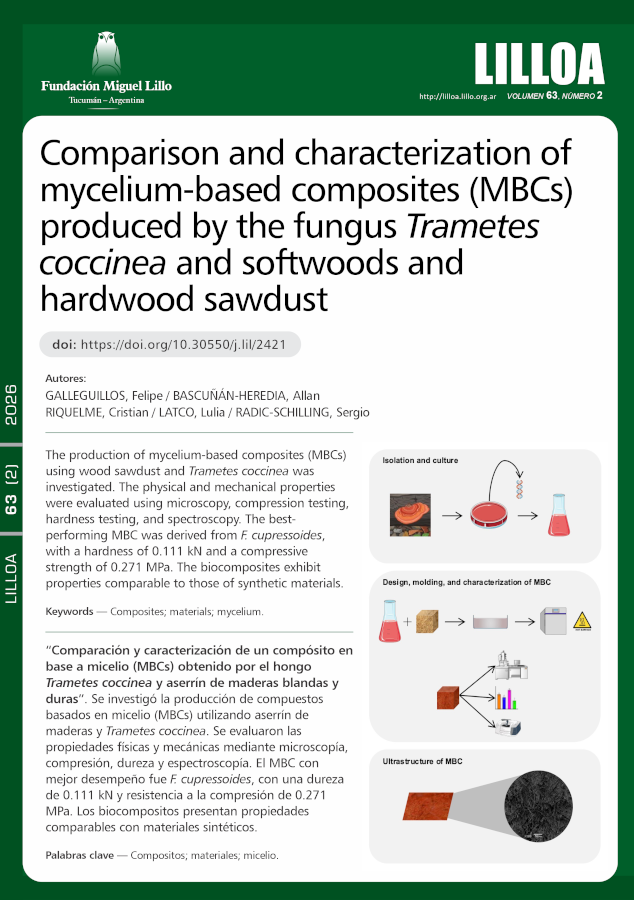
Comparación y caracterización de un compósito en base a micelio (MBCs) obtenido por el hongo Trametes coccinea y aserrín de maderas blandas y duras
Autores/as
-
Felipe Galleguillos
Laboratorio de Química de Productos Naturales, Departamento de Botánica, Universidad de Concepción, Concepción, Concepción, Biobío, Chile.
 https://orcid.org/0000-0002-0374-6161
-
Allan Bascuñán-Heredia
Laboratorio de Química de Productos Naturales, Departamento de Botánica, Universidad de Concepción, Concepción, Concepción, Biobío, Chile.
https://orcid.org/0009-0000-0459-2144
-
Cristian Riquelme
Laboratorio de Química de Productos Naturales, Departamento de Botánica, Universidad de Concepción, Concepción, Concepción, Biobío, Chile.
https://orcid.org/0000-0003-1652-571X
-
Lulia Latco
Institute of Microbiology and Biotechnology of Academy of Sciences of Moldova, Chisinau, Republic of Moldova.
https://orcid.org/0000-0003-0757-7884
-
Sergio Radic-Schilling
Departamento de Ciencias Agropecuarias y Acuícolas, Universidad de Magallanes, Punta Arenas, Chile.
https://orcid.org/0000-0003-1812-9235
DOI:
 https://doi.org/10.30550/j.lil/2421
Palabras clave:
Compositos, materiales, micelioResumen
Existe una creciente demanda de materiales de origen biológico, particularmente aquellos producidos a partir de residuos orgánicos y hongos filamentosos, conocidos como compuestos basados en micelio (MBCs). Este estudio evaluó la producción de MBCs utilizando aserrín de Pinus radiata, Nothofagus obliqua y Fitzroya cupressoides en combinación con un hongo filamentoso identificado como Trametes coccinea en base a su región ITS del rDNA. La microestructura, composición química y las propiedades mecánicas y físicas fueron evaluadas mediante microscopía electrónica de barrido (SEM), ensayos de resistencia a la compresión, pruebas estandarizadas de dureza y espectroscopía FTIR. Los resultados confirmaron la penetración del micelio en distintos niveles estructurales dentro de los sustratos. El MBC con mejor desempeño se obtuvo a partir de F. cupressoides, con una dureza Janka de 0.111 kN y una resistencia a la compresión de 0.271 MPa. T. coccinea mostró una mayor eficiencia en la degradación lignocelulítica en maderas blandas, probablemente asociada a su adaptabilidad enzimática y las características anatómicas del sustrato que favorecieron la colonización. Los biocompositos resultantes presentan propiedades comparables a materiales sintéticos y demuestran un alto potencial de escalamiento.
Descargas
Citas
Altschul, S. F., Gish, W., Miller, W., Myers, E. W. & Lipman, D. J. (1990). Basic Local Alignment Search Tool. Journal of Molecular Biology 215: 403-410. https://doi.org/10.1016/s0022-2836(05)80360-2
Appels, F. V. W., Camere, S., Montalti, M., Karana, E., Jansen, K. M. B., Dijksterhuis, J., Krijgsheld, P. & Wösten, H. A. B. (2019). Fabrication factors influencing mechanical, moisture- and water-related properties of mycelium-based composites. Materials & Design 161: 64-71. https://doi.org/10.1016/j.matdes.2018.11.027
Báder, M., Németh, R., Sandak, J. & Sandak, A. (2020). FTIR analysis of chemical changes in wood induced by steaming and longitudinal compression. Cellulose 27 (12): 6811-6829. https://doi.org/10.1007/s10570-020-03131-8
Bruscato, C., Malvessi, E., Brandalise, R. N. & Camassola, M. (2019). High performance of macrofungi in the production of mycelium-based biofoams using sawdust—Sustainable technology for waste reduction. Journal of Cleaner Production 234: 225-232. https://doi.org/10.1016/j.jclepro.2019.06.150
C16 Committee. (2021). Test Method for Dimensions and Density of Preformed Block and BoardType Thermal Insulation. ASTM International. https://doi.org/10.1520/C0303-21
Cerimi, K., Akkaya, K. C., Pohl, C., Schmidt, B. & Neubauer, P. (2019). Fungi as source for new bio-based materials: A patent review. Fungal Biology and Biotechnology 6 (1): 17. https://doi.org/10.1186/s40694-019-0080-y
Couturier, M., Navarro, D., Chevret, D., Henrissat, B., Piumi, F., Ruiz-Dueñas, F. J., Martinez, A. T., Grigoriev, I. V., Riley, R., Lipzen, A., Berrin, J.-G., Master, E. R. & Rosso, M.-N. (2015). Enhanced degradation of softwood versus hardwood by the white-rot fungus Pycnoporus coccineus. Biotechnology for Biofuels 8 (1): 216. https://doi.org/10.1186/s13068-015-0407-8
D07 Committee. (2023). Test Methods for Small Clear Specimens of Timber. ASTM International. https://doi.org/10.1520/D0143-22
D07 Committee. (2024). Test Methods for Wood-Based Structural Panels in Compression. ASTM International. https://doi.org/10.1520/D3501-24
Doyle, J. & L. Doyle. 1990. Isolation of plant of plant DNA from fresh tissue. Focus 12: 13-15.
Elsacker, E., Vandelook, S., Brancart, J., Peeters, E. & De Laet, L. (2019). Mechanical, physical and chemical characterisation of mycelium-based composites with different types of lignocellulosic substrates. PLOS ONE 14 (7): e0213954. https://doi.org/10.1371/journal.pone.0213954
Fukasawa, Y. (2018). Fungal succession and decomposition of Pinus densiflora snags. Ecological Research 33 (2): 435-444. https://doi.org/10.1007/s11284-017-1557-x
Fukasawa, Y., Osono, T. & Takeda, H. (2011). Fungal decomposition of woody debris of Castanopsis sieboldii in a subtropical old?growth forest. Ecological Research 27 (1): 211-218. https://doi.org/10.1007/s11284-011-0890-8
Islam, M. R., Tudryn, G., Bucinell, R., Schadler, L. & Picu, R. C. (2018). Stochastic continuum model for mycelium-based bio-foam. Materials & Design 160: 549-556. https://doi.org/10.1016/j.matdes.2018.09.046
ISO. (2003). Wood-based panels—Determination of moisture content (International Standard ISO 16979:2003; 1st ed.).
Lange, L., Agger, J. W. & Meyer, A. S. (2020). Fungal biotechnology: Unlocking the full potential of fungi for a more sustainable world. En H. Nevalainen (Ed.), Grand Challenges in Fungal Biotechnology. 1-35.
Li, H., Chen, G., Pang, H., Wang, Q. & Dai, X. (2021). Investigation Into Different Wood Formation Mechanisms Between Angiosperm and Gymnosperm Tree Species at the Transcriptional and Post-transcriptional Level. Frontiers in Plant Science 12: 698602. https://doi.org/10.3389/fpls.2021.698602
Manan, S., Atta, O. M., Shahzad, A., Ul-Islam, M., Ullah, M. W. & Yang, G. (2022). Applications of Fungal Mycelium-Based Functional Biomaterials. In S. K. Deshmukh, M. V. Deshpande & K. R. Sridhar (Eds.), Fungal Biopolymers and Biocomposites (pp. 147–168). Springer Nature Singapore. https://doi.org/10.1007/978-981-19-1000-5_9
Nawawi, D. S., Syafii, W., Akiyama, T. & Matsumoto, Y. (2016). Characteristics of guaiacyl-syringyl lignin in reaction wood in the gymnosperm Gnetum gnemon L. Holzforschung 70 (7): 593-602. https://doi.org/10.1515/hf-2015-0107
Peng, L., Yi, J., Yang, X., Xie, J. & Chen, C. (2023). Development and characterization of mycelium bio-composites by utilization of different agricultural residual byproducts. Journal of Bioresources and Bioproducts 8 (1): 78-89. https://doi.org/10.1016/j.jobab.2022.11.005
Pilapitiya, P. G. C. & Ratnayake, A. S. (2024). The world of plastic waste: A review. Cleaner Materials 11: 100220. https://doi.org/10.1016/j.clema.2024.100220
Reyre, J.-L., Grisel, S., Haon, M., Xiang, R., Gaillard, J.-C., Armengaud, J., Guallar, V., Margeot, A., Arragain, S., Berrin, J.-G. & Bissaro, B. (2023). Insights into peculiar fungal LPMO family members holding a short C-terminal sequence reminiscent of phosphate binding motifs. Scientific Reports 13 (1): 11586. https://doi.org/10.1038/s41598-023-38617-5
Rigobello, A., & Ayres, P. (2023). Design Strategies for Mycelium-Based Composites. In T. Satyanarayana & S. K. Deshmukh (Eds.), Fungi and Fungal Products in Human Welfare and Biotechnology (pp. 605–635). Springer Nature Singapore. https://doi.org/10.1007/978-981-19-8853-0_20
Sachs, I. B., Blanchette, R. A., Cease, K. R. & Leatham, G. F. (1991). Effect of Wood Particle Size on Fungal Growth in a Model Biomechanical Pulping Process. Wood and Fiber Science 23 (3): 363-375.
Saez, D., Grizmann, D., Trautz, M. & Werner, A. (2022). Exploring the binding capacity of mycelium and wood-based composites for use in construction. Biomimetics 7 (2): 78. https://doi.org/10.3390/biomimetics7020078
Santos, I. S., Nascimento, B. L., Marino, R. H., Sussuchi, E. M., Matos, M. P. & Griza, S. (2021). Influence of drying heat treatments on the mechanical behavior and physico-chemical properties of mycelial biocomposite. Composites Part B: Engineering 217: 108870. https://doi.org/10.1016/j.compositesb.2021.108870
Schwanninger, M., Rodrigues, J. C., Pereira, H. & Hinterstoisser, B. (2004). Effects of short-time vibratory ball milling on the shape of FT-IR spectra of wood and cellulose. Vibrational Spectroscopy 36 (1): 23-40. https://doi.org/10.1016/j.vibspec.2004.02.003
Sharma, M., Verma, S., Chauhan, G., Arya, M. & Kumari, A. (2024). Mycelium-based biocomposites: Synthesis and applications. Environmental Sustainability 7 (3): 265-278. https://doi.org/10.1007/s42398-024-00305-w
Sun, W., Tajvidi, M., Hunt, C. G., McIntyre, G. & Gardner, D. J. (2019). Fully Bio-Based Hybrid Composites Made of Wood, Fungal Mycelium and Cellulose Nanofibrils. Scientific Reports 9 (1): 3766. https://doi.org/10.1038/s41598-019-40442-8
Sydor, M., Cofta, G., Doczekalska, B. & Bonenberg, A. (2022). Fungi in Mycelium-Based Composites: Usage and Recommendations. Materials 15 (18): 6283. https://doi.org/10.3390/ma15186283
Van Kuijk, S. J. A., Sonnenberg, A. S. M., Baars, J. J. P., Hendriks, W. H. & Cone, J. W. (2016). The effect of particle size and amount of inoculum on fungal treatment of wheat straw and wood chips. Journal of Animal Science and Biotechnology 7 (1): 39. https://doi.org/10.1186/s40104-016-0098-4
Weng, J.-K., Li, X., Stout, J. & Chapple, C. (2008). Independent origins of syringyl lignin in vascular plants. Proceedings of the National Academy of Sciences 105 (22): 7887-7892. https://doi.org/10.1073/pnas.0801696105
White, T. J., Bruns, T. D., Lee, S. B. & Taylor, J. W. (1990). Amplification and direct sequencing of fungal ribosomal RNA genes for phylogenetics. En M. A. Innis, D. H. Gelfand, J. J. Sninsky, y T. J. White (Eds.), PCR protocols: A guide to methods and applications (pp. 315-322). Academic Press
Descargas
Publicado
Cómo citar
Número
Sección
Licencia
Derechos de autor 1900 Lilloa

Esta obra está bajo una licencia internacional Creative Commons Atribución-NoComercial-CompartirIgual 4.0.