Base de datos para la diversidad fúngica de Chile
Autores/as
-
Felipe Galleguillos
Facultad de ciencias Naturales y Oceanográficas, Universidad de Concepción. Concepción, Chile.
 https://orcid.org/0000-0002-0374-6161
-
Cristian Riquelme
Facultad de ciencias Naturales y Oceanográficas, Universidad de Concepción. Concepción, Chile.
https://orcid.org/0000-0003-1652-571X
- Bastian Zapata Facultad de ciencias Naturales y Oceanográficas, Universidad de Concepción. Concepción, Chile.
-
Víctor Hernández
Facultad de ciencias Naturales y Oceanográficas, Universidad de Concepción. Concepción, Chile.
https://orcid.org/0000-0001-5092-9713
DOI:
 https://doi.org/10.30550/j.lil/2309
Palabras clave:
Macrohongos, bosque, diversidad, medioambienteResumen
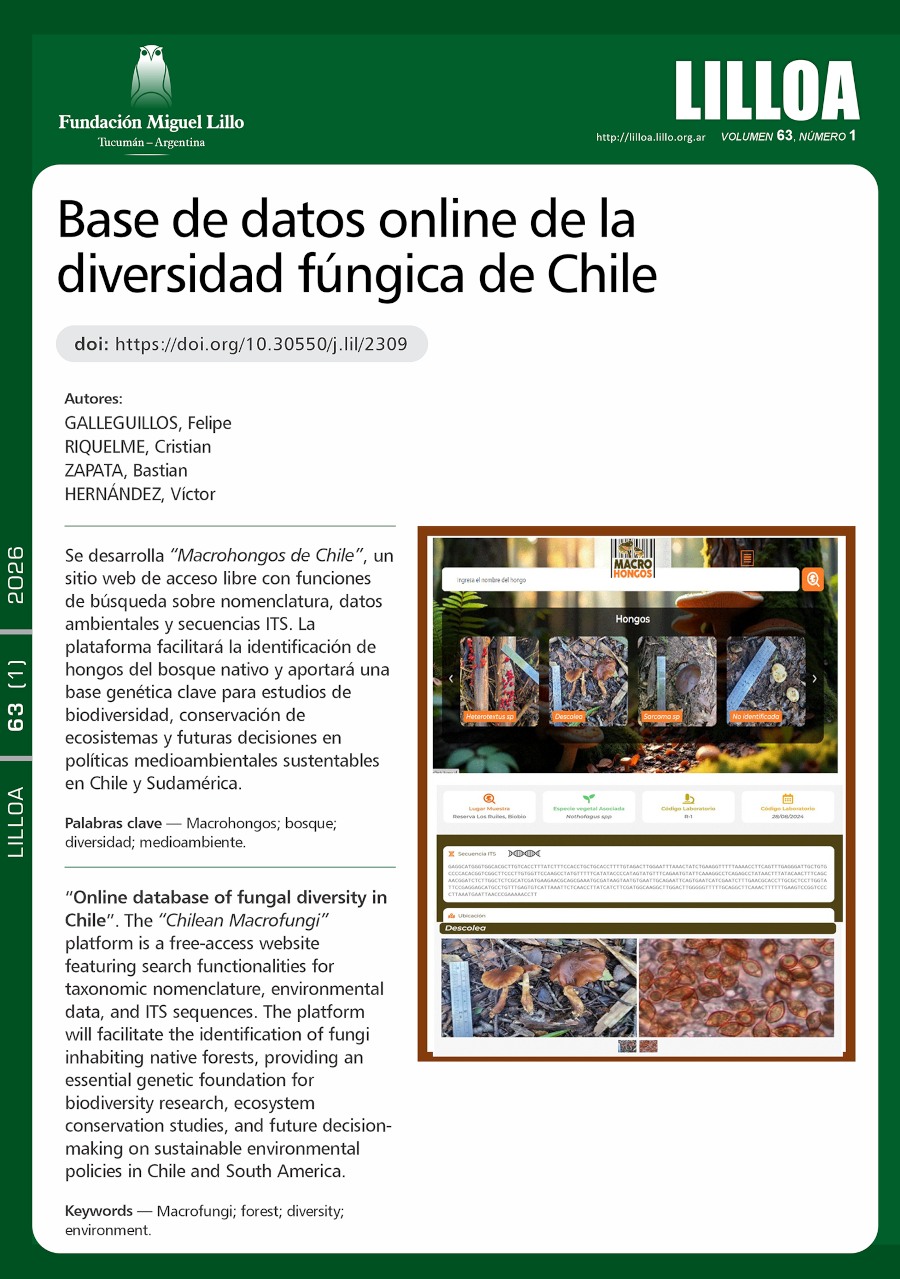
La información existente sobre diversidad de hongos nativos en Chile requiere de una organización y actualización para tener un mejor acceso a los datos. Por esto, se crea ‘’Macrohongos de Chile’’. Un sitio web de acceso libre y funciones de búsqueda que cuenta con información de nomenclatura, datos ambientales y secuencias de marcadores moleculares como el espaciador interno transcrito ITS. Esta información genética permitirá mejorar la identificación de los hongos habitantes del bosque nativo, siendo una importante base para el conocimiento de la impronta genética y un pilar fundamental de futuros estudios en biodiversidad para la toma de decisiones en políticas medioambientales.
Descargas
Citas
Abarenkov, K., Nilsson, R. H., Larsson, K.-H., Taylor, A. F. S., May, T. W., Frøslev, T. G., Pawlowska, J., Lindahl, B., Põldmaa, K., Truong, C., Vu, D., Hosoya, T., Niskanen, T., Piirmann, T., Ivanov, F., Zirk, A., Peterson, M., Cheeke, T. E., Ishigami, Y., … Kõljalg, U. (2023). The UNITE database for molecular identification and taxonomic communication of fungi and other eukaryotes: Sequences, taxa and classifications reconsidered. Nucleic Acids Research 52 (D1): D791-D797. https://doi.org/10.1093/nar/gkad1039
Bánki, O., Roskov, Y., Döring, M., Ower, G., Hernández Robles, D. R., Plata Corredor, C. A., Stjernegaard Jeppesen, T., Örn, A., Pape, T., Hobern, D., Garnett, S., Little, H., DeWalt, R. E., Miller, J. y& Orrell, T. (2025). Catalogue of Life (Version Annual Checklist 2025) [Dataset]. Catalogue of Life Foundation. https://doi.org/10.48580/DGR6N
Danielewski, M., Szalata, M., Nowak, J. K., Walkowiak, J., S?omski, R. y Wielgus, K. (2025). History of Biological Databases, Their Importance, and Existence in Modern Scientific and Policy Context. Genes 16 (1): 100. https://doi.org/10.3390/genes16010100
Garnica, S., Schön, M. E., Abarenkov, K., Riess, K., Liimatainen, K., Niskanen, T., Dima, B., Soop, K., Frøslev, T. G., Jeppesen, T. S., Peintner, U., Kuhnert, R., Brandrud, T. E., Saar, G., Oertel, B. y Ammirati, J. F. (2016). Determining threshold values for barcoding fungi: Lessons from Cortinarius (Basidiomycota), a highly diverse and widespread ectomycorrhizal genus. FEMS Microbiology Ecology 92. https://doi.org/10.1093/femsec/fiw045
Gómez-Espinoza, J., Riquelme, C., Romero-Villegas, E., Ahumada-Rudolph, R., Novoa, V., Méndez, P., Millar, C., Fernández-Alarcón, N., Garnica, S., Rajchenberg, M. y Cabrera-Pardo, J. R. (2023). Diversity of Agaricomycetes in southern South America and their bioactive natural products. Natural Product Research 1-15. https://doi.org/10.1080/14786419.2023.2244126
Heilmayr, R., Echeverría, C. y Lambin, E. F. (2020). Impacts of Chilean forest subsidies on forest cover, carbon and biodiversity. Nature Sustainability 3 (9): 701-709. https://doi.org/10.1038/s41893-020-0547-0
Hyde, K. D., Jeewon, R., Chen, Y. J., Bhunjun, C. S., Calabon, M. S., Hong Bo Jiang, Hong Bo Jiang, Jiang, H.-B., Lin, C. G., Norphanphoun, C., Sysouphanthong, P., Pem, D., Tibpromma, S., Zhang, Q., Doilom, M., Jayawardena, R. S., Liu, J.-K., Maharachchikumbura, S. S. N., Phukhamsakda, C., … Saisamorn Lumyong. (2020). The numbers of fungi: Is the descriptive curve flattening? Fungal Diversity 103 (1): 219-271. https://doi.org/10.1007/s13225-020-00458-2
Kuhar, F., Furci, G., Drechsler-Santos, E. R. y Pfister, D. H. (2018). Delimitation of Funga as a valid term for the diversity of fungal communities: The Fauna, Flora & Funga proposal (FF&F). IMA Fungus 9 (2): A71-A74. https://doi.org/10.1007/BF03449441
Luebert, F. y Pliscoff, P. (2023). Sinopsis bioclimática y vegetacional de Chile (3rd ed.). Editorial Universitaria. https://books.google.cl/books?id=Q6TQdlb6bEwC
Mittermeier, R. A., Robles Gil, P., Hoffman, M., Pilgrim, J., Brooks, T., Goettsch Mittermeier, C., Lamoreux, J. y da Fonseca, G. (Eds.). (2004). Hotspots revisited. Cemex.
Mujica, F., Vergara, C. y Oehrens, E. (1980). Flora fungosa chilena (2nd ed.).
Myers, N., Mittermeier, R. A., Mittermeier, C. G., da Fonseca, G. A. B. y Kent, J. (2000). Biodiversity hotspots for conservation priorities. Nature 403 (6772): 853-858. https://doi.org/10.1038/35002501
Niego, A. G. T., Rapior, S., Thongklang, N., Raspé, O., Hyde, K. D. y Mortimer, P. (2023). Reviewing the contributions of macrofungi to forest ecosystem processes and services. Fungal Biology Reviews 44: 100294. https://doi.org/10.1016/j.fbr.2022.11.002
Niskanen, T., Lücking, R., Dahlberg, A., Gaya, E., Suz, L. M., Mikryukov, V., Liimatainen, K., Druzhinina, I., Westrip, J. R. S., Mueller, G. M., Martins-Cunha, K., Kirk, P., Tedersoo, L. y Antonelli, A. (2023). Pushing the frontiers of biodiversity research: Unveiling the global diversity, distribution, and conservation of fungi. Annual Review of Environment and Resources 48 (1): annurev-environ-112621-090937. https://doi.org/10.1146/annurev-environ-112621-090937
Riquelme, C. (2025). iNaturalist as a platform for documenting Chilean funga. Lilloa 62 (1): 61-88. https://doi.org/10.30550/j.lil/2082
Robert, V., Vu, D., Amor, A. B. H., van de Wiele, N., Brouwer, C., Jabas, B., Szoke, S., Dridi, A., Triki, M., Ben Daoud, S., Chouchen, O., Vaas, L. A. I., de Cock, A., Stalpers, J. A., Stalpers, D., Verkley, G. J. M., Groenewald, M., dos Santos, F. B., Stegehuis, G. J., … Crous, P. W. (2013). MycoBank gearing up for new horizons. IMA Fungus 4 (2): 371-379. https://doi.org/10.5598/imafungus.2013.04.02.16
Salgado Salomón, M. E., Dresch, P., Horak, E., Galleguillos, F., Barroetaveña, C. y Peintner, U. (2018). The enigmatic Cortinarius magellanicus complex occurring in Nothofagaceae forests of the Southern Hemisphere. Fungal Biology 122 (11): 1077-1097. https://doi.org/10.1016/j.funbio.2018.08.009
Sandoval-Leiva, P. A., Calle Valencia, A. E., Pérez Orellana, D. C. y Riquelme, C. (2023). Lista sistemática de macrohongos presentes en Chile [Dataset]. Ministerio del Medio Ambiente de Chile. https://doi.org/10.15468/D7XN8P
Sayers, E. W., Beck, J., Bolton, E. E., Brister, J. R., Chan, J., Comeau, D. C., Connor, R., DiCuccio, M., Farrell, C. M., Feldgarden, M., Fine, A. M., Funk, K., Hatcher, E., Hoeppner, M., Kane, M., Kannan, S., Katz, K. S., Kelly, C., Klimke, W., … Sherry, S. T. (2023). Database resources of the National Center for Biotechnology Information. Nucleic Acids Research 52 (D1): D33-D43. https://doi.org/10.1093/nar/gkad1044
Schoch, C. L., Seifert, K. A., Huhndorf, S. M., Robert, V., Spouge, J. L., Lévesque, C. A., Chen, W., Bolchacova, E., Voigt, K., Crous, P. W., Miller, A. N., Wingfield, M. J., Aime, M. C., An, K. D., Bai, F.-Y., Barreto, R. W., Begerow, D., Bergeron, M. J., Blackwell, M., … Schindel, D. (2012). Nuclear ribosomal internal transcribed spacer (ITS) region as a universal DNA barcode marker for Fungi. PNAS 109 (16): 6241-6246. https://doi.org/10.1073/pnas.1117018109
Soh, E., Chew, Z. Y., Saeidi, N., Javadian, A., Hebel, D. y Le Ferrand, H. (2020). Development of an extrudable paste to build mycelium-bound composites. Materials & Design 195: 109058. https://doi.org/10.1016/j.matdes.2020.109058
Sun, W., Tajvidi, M., Hunt, C. G., McIntyre, G. y Gardner, D. J. (2019). Fully Bio-Based Hybrid Composites Made of Wood, Fungal Mycelium and Cellulose Nanofibrils. Scientific Reports 9 (1): 3766. https://doi.org/10.1038/s41598-019-40442-8
Venil, C. K., Velmurugan, P., Dufossé, L., Renuka Devi, P. y Veera Ravi, A. (2020). Fungal Pigments: Potential Coloring Compounds for Wide Ranging Applications in Textile Dyeing. Journal of Fungi 6 (2): 68. https://doi.org/10.3390/jof6020068
Descargas
Publicado
Cómo citar
Número
Sección
Licencia
Derechos de autor 2026 Lilloa

Esta obra está bajo una licencia internacional Creative Commons Atribución-NoComercial-CompartirIgual 4.0.