Comparison and characterization of mycelium-based composites (MBCs) produced by the fungus Trametes coccinea and softwoods and hardwood sawdust
Authors
-
Felipe Galleguillos
Laboratorio de Química de Productos Naturales, Departamento de Botánica, Universidad de Concepción, Concepción, Concepción, Biobío, Chile.
 https://orcid.org/0000-0002-0374-6161
-
Allan Bascuñán-Heredia
Laboratorio de Química de Productos Naturales, Departamento de Botánica, Universidad de Concepción, Concepción, Concepción, Biobío, Chile.
https://orcid.org/0009-0000-0459-2144
-
Cristian Riquelme
Laboratorio de Química de Productos Naturales, Departamento de Botánica, Universidad de Concepción, Concepción, Concepción, Biobío, Chile.
https://orcid.org/0000-0003-1652-571X
-
Lulia Latco
Institute of Microbiology and Biotechnology of Academy of Sciences of Moldova, Chisinau, Republic of Moldova.
https://orcid.org/0000-0003-0757-7884
-
Sergio Radic-Schilling
Departamento de Ciencias Agropecuarias y Acuícolas, Universidad de Magallanes, Punta Arenas, Chile.
https://orcid.org/0000-0003-1812-9235
DOI:
 https://doi.org/10.30550/j.lil/2421
Keywords:
Composites, materials, myceliumAbstract
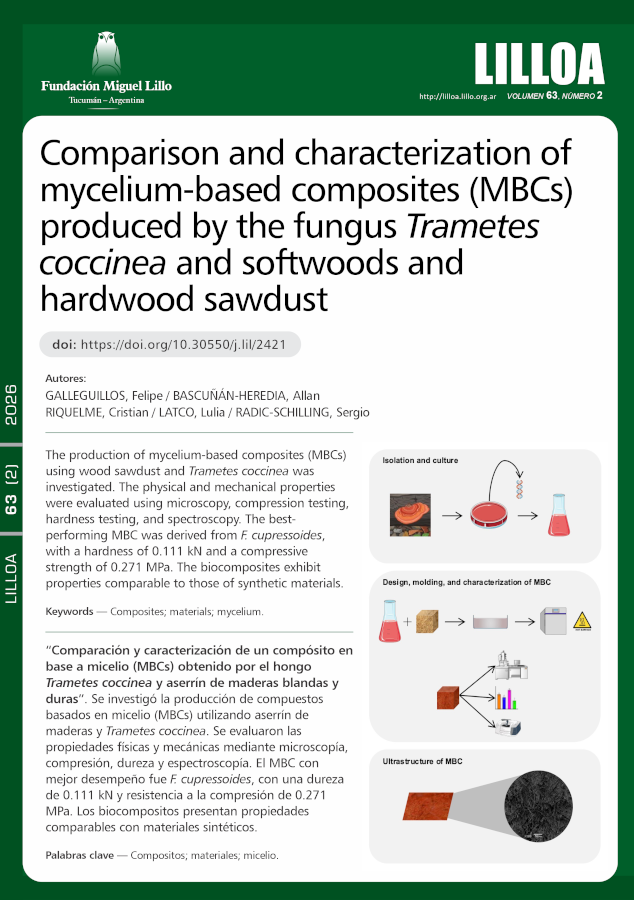
There is a growing demand for materials of biological origin, particularly those derived from organic waste and filamentous fungi, known as mycelium-based composites (MBCs). This study evaluates the production of MBCs using sawdust from Pinus radiata, Nothofagus obliqua, and Fitzroya cupressoides in combination with a filamentous fungus identified as Trametes coccinea based on its rDNA ITS region. Microstructure, chemical composition, and mechanical and physical properties of the composites were assessed using scanning electron microscopy (SEM), compressive strength testing, standardized hardness testing, and FTIR spectroscopy. The results confirmed mycelial penetration at different structural levels within the substrates. The highest-performing MBC was obtained from F. cupressoides, with a Janka hardness of 0.111 kN and a compressive strength of 0.271 MPa. T. coccinea exhibited enhanced lignocellulolytic degradation efficiency in softwoods, likely associated with its enzymatic adaptability to guaiacyl-rich lignin and substrate anatomical features that favored colonization. The resulting biocomposites display properties comparable to synthetic materials and demonstrate strong potential for scalability.
Downloads
References
Altschul, S. F., Gish, W., Miller, W., Myers, E. W. & Lipman, D. J. (1990). Basic Local Alignment Search Tool. Journal of Molecular Biology 215: 403-410. https://doi.org/10.1016/s0022-2836(05)80360-2
Appels, F. V. W., Camere, S., Montalti, M., Karana, E., Jansen, K. M. B., Dijksterhuis, J., Krijgsheld, P. & Wösten, H. A. B. (2019). Fabrication factors influencing mechanical, moisture- and water-related properties of mycelium-based composites. Materials & Design 161: 64-71. https://doi.org/10.1016/j.matdes.2018.11.027
Báder, M., Németh, R., Sandak, J. & Sandak, A. (2020). FTIR analysis of chemical changes in wood induced by steaming and longitudinal compression. Cellulose 27 (12): 6811-6829. https://doi.org/10.1007/s10570-020-03131-8
Bruscato, C., Malvessi, E., Brandalise, R. N. & Camassola, M. (2019). High performance of macrofungi in the production of mycelium-based biofoams using sawdust—Sustainable technology for waste reduction. Journal of Cleaner Production 234: 225-232. https://doi.org/10.1016/j.jclepro.2019.06.150
C16 Committee. (2021). Test Method for Dimensions and Density of Preformed Block and BoardType Thermal Insulation. ASTM International. https://doi.org/10.1520/C0303-21
Cerimi, K., Akkaya, K. C., Pohl, C., Schmidt, B. & Neubauer, P. (2019). Fungi as source for new bio-based materials: A patent review. Fungal Biology and Biotechnology 6 (1): 17. https://doi.org/10.1186/s40694-019-0080-y
Couturier, M., Navarro, D., Chevret, D., Henrissat, B., Piumi, F., Ruiz-Dueñas, F. J., Martinez, A. T., Grigoriev, I. V., Riley, R., Lipzen, A., Berrin, J.-G., Master, E. R. & Rosso, M.-N. (2015). Enhanced degradation of softwood versus hardwood by the white-rot fungus Pycnoporus coccineus. Biotechnology for Biofuels 8 (1): 216. https://doi.org/10.1186/s13068-015-0407-8
D07 Committee. (2023). Test Methods for Small Clear Specimens of Timber. ASTM International. https://doi.org/10.1520/D0143-22
D07 Committee. (2024). Test Methods for Wood-Based Structural Panels in Compression. ASTM International. https://doi.org/10.1520/D3501-24
Doyle, J. & L. Doyle. 1990. Isolation of plant of plant DNA from fresh tissue. Focus 12: 13-15.
Elsacker, E., Vandelook, S., Brancart, J., Peeters, E. & De Laet, L. (2019). Mechanical, physical and chemical characterisation of mycelium-based composites with different types of lignocellulosic substrates. PLOS ONE 14 (7): e0213954. https://doi.org/10.1371/journal.pone.0213954
Fukasawa, Y. (2018). Fungal succession and decomposition of Pinus densiflora snags. Ecological Research 33 (2): 435-444. https://doi.org/10.1007/s11284-017-1557-x
Fukasawa, Y., Osono, T. & Takeda, H. (2011). Fungal decomposition of woody debris of Castanopsis sieboldii in a subtropical old?growth forest. Ecological Research 27 (1): 211-218. https://doi.org/10.1007/s11284-011-0890-8
Islam, M. R., Tudryn, G., Bucinell, R., Schadler, L. & Picu, R. C. (2018). Stochastic continuum model for mycelium-based bio-foam. Materials & Design 160: 549-556. https://doi.org/10.1016/j.matdes.2018.09.046
ISO. (2003). Wood-based panels—Determination of moisture content (International Standard ISO 16979:2003; 1st ed.).
Lange, L., Agger, J. W. & Meyer, A. S. (2020). Fungal biotechnology: Unlocking the full potential of fungi for a more sustainable world. En H. Nevalainen (Ed.), Grand Challenges in Fungal Biotechnology. 1-35.
Li, H., Chen, G., Pang, H., Wang, Q. & Dai, X. (2021). Investigation Into Different Wood Formation Mechanisms Between Angiosperm and Gymnosperm Tree Species at the Transcriptional and Post-transcriptional Level. Frontiers in Plant Science 12: 698602. https://doi.org/10.3389/fpls.2021.698602
Manan, S., Atta, O. M., Shahzad, A., Ul-Islam, M., Ullah, M. W. & Yang, G. (2022). Applications of Fungal Mycelium-Based Functional Biomaterials. In S. K. Deshmukh, M. V. Deshpande & K. R. Sridhar (Eds.), Fungal Biopolymers and Biocomposites (pp. 147–168). Springer Nature Singapore. https://doi.org/10.1007/978-981-19-1000-5_9
Nawawi, D. S., Syafii, W., Akiyama, T. & Matsumoto, Y. (2016). Characteristics of guaiacyl-syringyl lignin in reaction wood in the gymnosperm Gnetum gnemon L. Holzforschung 70 (7): 593-602. https://doi.org/10.1515/hf-2015-0107
Peng, L., Yi, J., Yang, X., Xie, J. & Chen, C. (2023). Development and characterization of mycelium bio-composites by utilization of different agricultural residual byproducts. Journal of Bioresources and Bioproducts 8 (1): 78-89. https://doi.org/10.1016/j.jobab.2022.11.005
Pilapitiya, P. G. C. & Ratnayake, A. S. (2024). The world of plastic waste: A review. Cleaner Materials 11: 100220. https://doi.org/10.1016/j.clema.2024.100220
Reyre, J.-L., Grisel, S., Haon, M., Xiang, R., Gaillard, J.-C., Armengaud, J., Guallar, V., Margeot, A., Arragain, S., Berrin, J.-G. & Bissaro, B. (2023). Insights into peculiar fungal LPMO family members holding a short C-terminal sequence reminiscent of phosphate binding motifs. Scientific Reports 13 (1): 11586. https://doi.org/10.1038/s41598-023-38617-5
Rigobello, A., & Ayres, P. (2023). Design Strategies for Mycelium-Based Composites. In T. Satyanarayana & S. K. Deshmukh (Eds.), Fungi and Fungal Products in Human Welfare and Biotechnology (pp. 605–635). Springer Nature Singapore. https://doi.org/10.1007/978-981-19-8853-0_20
Sachs, I. B., Blanchette, R. A., Cease, K. R. & Leatham, G. F. (1991). Effect of Wood Particle Size on Fungal Growth in a Model Biomechanical Pulping Process. Wood and Fiber Science 23 (3): 363-375.
Saez, D., Grizmann, D., Trautz, M. & Werner, A. (2022). Exploring the binding capacity of mycelium and wood-based composites for use in construction. Biomimetics 7 (2): 78. https://doi.org/10.3390/biomimetics7020078
Santos, I. S., Nascimento, B. L., Marino, R. H., Sussuchi, E. M., Matos, M. P. & Griza, S. (2021). Influence of drying heat treatments on the mechanical behavior and physico-chemical properties of mycelial biocomposite. Composites Part B: Engineering 217: 108870. https://doi.org/10.1016/j.compositesb.2021.108870
Schwanninger, M., Rodrigues, J. C., Pereira, H. & Hinterstoisser, B. (2004). Effects of short-time vibratory ball milling on the shape of FT-IR spectra of wood and cellulose. Vibrational Spectroscopy 36 (1): 23-40. https://doi.org/10.1016/j.vibspec.2004.02.003
Sharma, M., Verma, S., Chauhan, G., Arya, M. & Kumari, A. (2024). Mycelium-based biocomposites: Synthesis and applications. Environmental Sustainability 7 (3): 265-278. https://doi.org/10.1007/s42398-024-00305-w
Sun, W., Tajvidi, M., Hunt, C. G., McIntyre, G. & Gardner, D. J. (2019). Fully Bio-Based Hybrid Composites Made of Wood, Fungal Mycelium and Cellulose Nanofibrils. Scientific Reports 9 (1): 3766. https://doi.org/10.1038/s41598-019-40442-8
Sydor, M., Cofta, G., Doczekalska, B. & Bonenberg, A. (2022). Fungi in Mycelium-Based Composites: Usage and Recommendations. Materials 15 (18): 6283. https://doi.org/10.3390/ma15186283
Van Kuijk, S. J. A., Sonnenberg, A. S. M., Baars, J. J. P., Hendriks, W. H. & Cone, J. W. (2016). The effect of particle size and amount of inoculum on fungal treatment of wheat straw and wood chips. Journal of Animal Science and Biotechnology 7 (1): 39. https://doi.org/10.1186/s40104-016-0098-4
Weng, J.-K., Li, X., Stout, J. & Chapple, C. (2008). Independent origins of syringyl lignin in vascular plants. Proceedings of the National Academy of Sciences 105 (22): 7887-7892. https://doi.org/10.1073/pnas.0801696105
White, T. J., Bruns, T. D., Lee, S. B. & Taylor, J. W. (1990). Amplification and direct sequencing of fungal ribosomal RNA genes for phylogenetics. En M. A. Innis, D. H. Gelfand, J. J. Sninsky, y T. J. White (Eds.), PCR protocols: A guide to methods and applications (pp. 315-322). Academic Press
Downloads
Published
How to Cite
Issue
Section
License
Copyright (c) 1900 Lilloa

This work is licensed under a Creative Commons Attribution-NonCommercial-ShareAlike 4.0 International License.