In vitro development of gametophyte and sporophyte in the epiphytic fern Phlebodium aureum (Polypodiaceae)
Autores
-
Meenam Bhatia
Daulatram College, University of Delhi. Delhi, India.
 https://orcid.org/0009-0004-8531-4136
-
Pratibha Kumari
Daulatram College, University of Delhi. Delhi, India.
https://orcid.org/0000-0002-1738-7526
-
Aradhana Yadav
Daulatram College, University of Delhi. Delhi, India.
https://orcid.org/0009-0002-5399-4072
-
Prem L. Uniyal
Department of Botany, University of Delhi. Delhi, India.
https://orcid.org/0000-0001-6412-1651
DOI:
 https://doi.org/10.30550/j.lil/2346
Palavras-chave:
Epiphyte, genetic load, invasive, mixed mating type, prothallusResumo
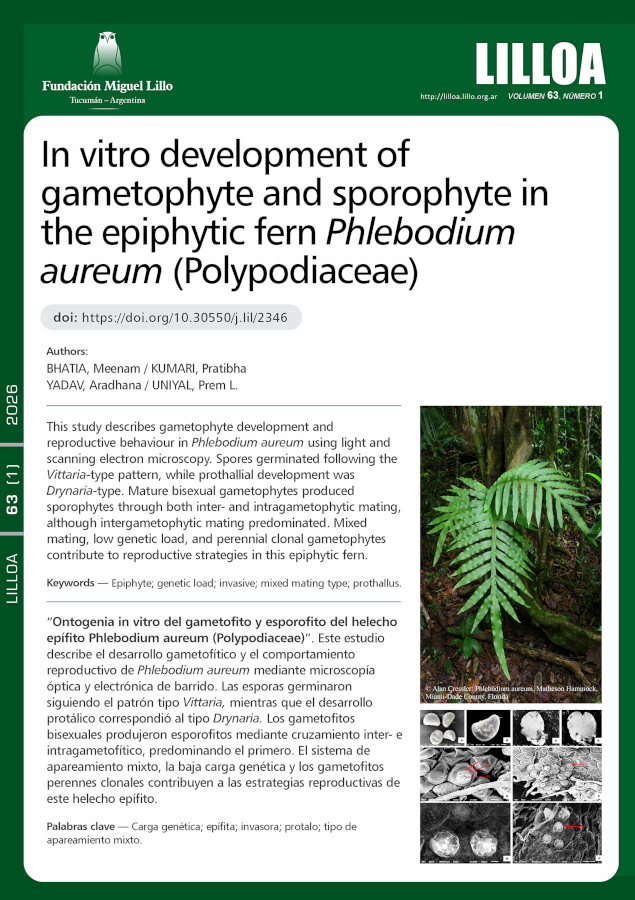
This paper presents the gametophyte development pattern of Phlebodium aureum, examined using light and scanning electron microscopy, covering spore germination, gametophyte development, and reproductive behaviour. Spores are homosporous and monolete, with a straight laesura. The percentage of spore germination is 43.33 ±21.47%, following the Vittaria-type pattern. Prothallial development is Drynaria-type, yielding a laminar gametophyte within 21 days. The mature prothallus is broad, cordate-reniform, and develops by day 56. Antheridial initiation occurs at day 42, followed by archegonial formation at day 49 below the apical notch. Bisexual gametophytes appear by day 63. Sporophytes emerge in both composite populations and the isolated population within 90-120 days through intergametophytic as well as intragametophytic mating. A total of 80% of gametophytes in the composite population produced sporophytes, indicating that intergametophytic mating is predominant. A mixed mating system, low genetic load, and a perennial, clone-forming gametophyte growth habit interact to create effective breeding strategies for this epiphytic species.
Downloads
Referências
Banks, J. A. (1999). Gametophyte Development in Ferns. Annual Review Plant Biology 50: 163-186. https://doi.org/10.1146/annurev.arplant.50.1.163
Bhakuni, K. K., Joshi, S. C., Anderson, O. R. & Punetha, R. (2021). Ferns and lycophytes of Gori Valley, Western Himalaya, Uttarakhand: A case study. American Fern Journal 111 (1): 6-23.
Castillo, E., González-Rosende, M. E. & Martínez-Solís, I. (2023). The Use of Herbal Medicine in the Treatment of Vitiligo: An Updated Review. Planta Medica 89 (5): 468-483. https://doi.org/10.1055/a-1855-1839
Cáceres, A. & Cruz, S. M. (2019). Detection and Validation of Native Plants Traditionally Used as Medicine in Guatemala. Current Traditional Medicine 5: 5-30.
Chiou, W. L. & Farrar, D. R. (1997). Comparative gametophyte morphology of selected species of the family Polypodiaceae. American Fern Journal 87: 77-86.
Chiou, W. L., Farrar, D. R. & Ranker, T. A. (2002). The mating systems of some epiphytic Polypodiaceae. American Fern Journal 92 (2): 65-79.
Dassler, C. & Farrar, D. (1997). Significance of form in fern gametophytes: clonal, gemmiferous gametophytes of Callistopteris baueriana (Hymenophyllaceae). International Journal of Plant Sciences 158: 622-639.
Dassler, C. L. & Farrar, D. (2001). Significance of gametophyte form in longdistance colonization by tropical, epiphytic ferns. Brittonia 53: 352-369.
Davíe, J. H. (1951). The development of the antheridium in the Polypodiaceae. American Journal of Botany 38: 621-628.
Evans, A. M. (1963). New chromosome observations in the polypodies and Grammitidaceae. Caryologia 16: 671-677.
Hartman, N. E. (1931). Antherídíal dehiscence in the Polypodiaceae. Botanical Gazette 91: 252-276.
Haufler, C. H., Pryer, K. M, Schuettpelz, E., Sessa, E., Farrar, D. R., Moran, R. & Schneller, J. J. (2016). Sex and the single gametophyte: Revising the homosporous vascular plant life cycle in light of contemporary research. BioScience 66: 928-937.
Haufler, C. H. & Welling, C. B. (1994). Antheridiogen, dark spore germination, and outcrossing mechanisms in Bommeria (Adiantaceae). American Journal of Botany 81: 616-621.
Jones, E. J., Kraaij, T., Fritz, H. & Moodley, D. (2019). A global assessment of terrestrial alien ferns (Polypodiophyta): species’ traits as drivers of naturalisation and invasion. Biological Invasions 21 (3): 861-873. https://doi.org/10.1007/s10530-018-1866-1
Jones, E. J., Kraaij, T., Guerbois, C. & Moodley, D. (2020). An assessment of the invasion status of terrestrial alien ferns (Polypodiophyta) in South Africa. South African Journal of Botany 131: 64-73.
Joshi, S. C., Bhakuni, K. K., Punetha, R. & Anderson, O. R. (2020). Observations on epiphytic ferns of Kedarnath Wildlife Sanctuary (West Himalaya). Indian Fern Journal 37: 47-58.
Klekowski, E. J. Jr. (1969). Reproductive biology of the Pteridophyta. III. The Blechnaceae. The Journal of Linnean Society 62: 360-377.
Krieg, C. A., Sally M. & Chambers, S. A. (2022). The ecology and physiology of fern gametophytes: A methodological synthesis. Applications in Plant Sciences 10 (2): e11464. https://doi.org/10.1002/aps3.11464
Krishnan, A. & Rekha, K. (2021). Diversity of pteridophytes in Western Ghats- a review. Plant Archives 21 (1): 1115-1129.
Kumari, P., Otaghvari, A. M., Govindapyari, H., Bahuguna, Y. & Uniyal, P. L. (2011). Some Ethno-medicinally important pteridophytes of India. International Journal Medicinal and Aromatic Plants 1 (1): 18-22.
Malati, S. N. L. S., Ratna, K. P. K. & Narasimha, R. G. M. (2022). Distribution and Density of Pteridophytic flora in Galikonda Hills, Andhra Pradesh, Eastern Ghats of India. IOSR Journal of Pharmacy and Biological Sciences 17 (3): 22-27.
Marimuthu, J., Thangaiah, S., Santhanam, A. & George, V. (2021). Evaluation of ytotoxic Effect of Silver Nanoparticles (AgNP) Synthesized from Phlebodium aureum (L.) J. Smith Extracts. Anti-Cancer Agents in Medicinal Chemistry 21 (18): 2603-2609.
Nayar, B. K. & Kaur, S. 1971. Gametophytes of homosporous ferns The Botanical Review 37 (3): 295-396.
Parrado, C., Juarranz, A., Gilaberte, Y., Philips, N. & González, S. (2021). Fern Extract, oxidative Stress, and Skin Cancer. In: Preedy V. & Patel, V. D. (eds). Cancer: Oxidative Stress and Dietary Antioxidants, 2nd Edition. London, UK: Elsevier Pp 387-398
Perez, M. T. L., Pizzolatti, M. G. & Yunes, R. A. (1998). Potencial de atividade alelopática de Gleichenia pectinata Willd (Pr.). Pesquisa Agropecuária Brasileira 33: 131-137.
Randall, R. P. (2017). A global compendium of weeds, 3rd ed. R.P. Randall, Perth, Western Australia.
Ranker, T. A. & Geiger, J. M. O. (2008). Population genetics. In Ranker, T. A. & Haufler, C. H. Biology and Evolution of Ferns and Lycophytes. Cambridge: Cambridge University Press: Pp 107-133.
Segars, K., McCarver, V. & Miller, R. A. (2021). Dermatologic applications of Polypodium leucotomos: A literature review. Journal of Clinical and Aesthetic Dermatology 14 (2): 50-60.
Sessa, E. B., Testo, W. L. & Watkins Jr, J. E. (2016). On widespread capacity for, and functional significance of, extreme inbreeding in ferns. New Phytologist 211: 1108-1119.
Singh, H. B. (1999). Potential medicinal pteridophytes of India and their chemical constituents. Journal of Economic and Taxonomic Botany 23 (1): 63-78.
Van Cotthem, W. R. J. (1973). Stomatal types and systematics. In: A. C. Jermy, J. A. Crabbe and B. A. Thomas (eds.). The Phylogeny and Classification of the Ferns. Academic, New York: Pp 59-71.
Ward, M. (1954). Fertilization in Phlebodium aureum. J. Sm. Phytomorphology 4: 1-17.
Watkins, J. E. Jr. & Cardelús, C. L. (2012). Ferns in an angiosperm world: Cretaceous radiation into the epiphytic niche and diversification on the forest floor. International Journal of Plant Science 173 (6): 695-710.
Watkins, J. E. Jr., Mack, M. C., Sinclair, T. R. & Mulkey, S. S. (2007). Ecological and evolutionary consequences of desiccation tolerance in tropical fern gametophytes. New Phytologist 176: 708-717.
Downloads
Publicado
Como Citar
Edição
Seção
Licença
Copyright (c) 2026 Lilloa

Este trabalho está licenciado sob uma licença Creative Commons Attribution-NonCommercial-ShareAlike 4.0 International License.