Ontogenia in vitro del gametofito y esporofito del helecho epífito Phlebodium aureum (Polypodiaceae)
Autores/as
-
Meenam Bhatia
Daulatram College, University of Delhi. Delhi, India.
 https://orcid.org/0009-0004-8531-4136
-
Pratibha Kumari
Daulatram College, University of Delhi. Delhi, India.
https://orcid.org/0000-0002-1738-7526
-
Aradhana Yadav
Daulatram College, University of Delhi. Delhi, India.
https://orcid.org/0009-0002-5399-4072
-
Prem L. Uniyal
Department of Botany, University of Delhi. Delhi, India.
https://orcid.org/0000-0001-6412-1651
DOI:
 https://doi.org/10.30550/j.lil/2346
Palabras clave:
Carga genética, epífita, invasora, protalo, tipo de apareamiento mixtoResumen
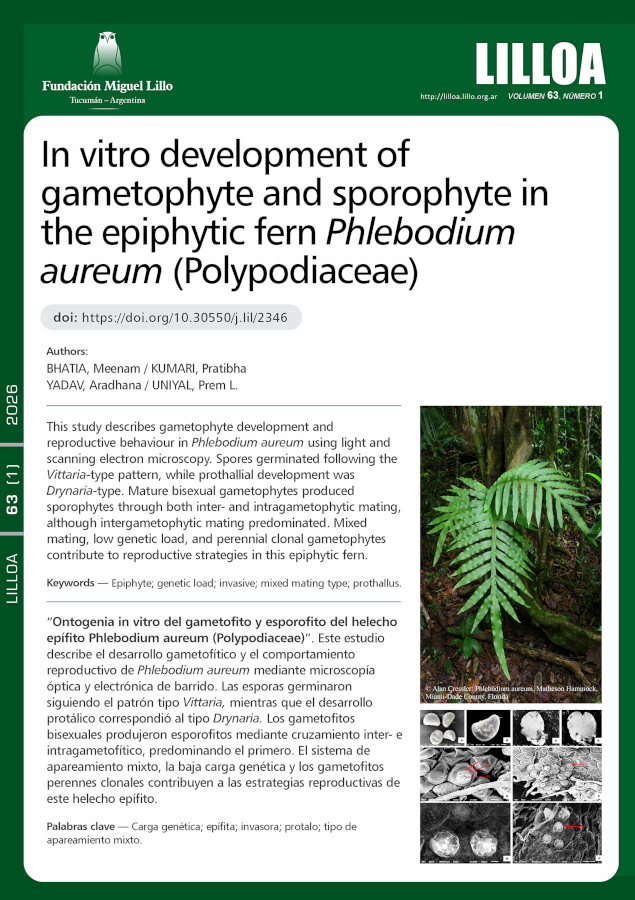
Este artículo presenta el patrón de desarrollo del gametofito de Phlebodium aureum, examinado mediante microscopía óptica y electrónica de barrido, abarcando la germinación de las esporas, el desarrollo del gametofito y el comportamiento reproductivo. Las esporas son homospóricas y monoletes, con una laesura recta. El porcentaje de germinación de las esporas es del 43,33 ± 21,47%, siguiendo el patrón de tipo Vittaria. El desarrollo protálico es de tipo Drynaria, dando lugar a un gametofito laminar en 21 días. El prótalo maduro es ancho, cordado-reniforme, y se desarrolla en 56 días. La iniciación de los anteridios ocurre a los 42 días, seguida por la formación de los arquegonios a los 49 días, por debajo de la escotadura apical. Los gametofitos bisexuales aparecen a los 63 días. Los esporofitos emergen tanto en las poblaciones compuestas como en la población aislada entre los 90 y 120 días, mediante apareamiento tanto intergametofítico como intragametofítico. El 80% de los gametofitos en la población compuesta produjeron esporofitos, lo que indica que el apareamiento intergametofítico es predominante. Un sistema de apareamiento mixto, una baja carga genética y un hábito de crecimiento del gametofito perenne y formador de clones interactúan para generar estrategias reproductivas eficaces para esta especie epífita.
Descargas
Citas
Banks, J. A. (1999). Gametophyte Development in Ferns. Annual Review Plant Biology 50: 163-186. https://doi.org/10.1146/annurev.arplant.50.1.163
Bhakuni, K. K., Joshi, S. C., Anderson, O. R. & Punetha, R. (2021). Ferns and lycophytes of Gori Valley, Western Himalaya, Uttarakhand: A case study. American Fern Journal 111 (1): 6-23.
Castillo, E., González-Rosende, M. E. & Martínez-Solís, I. (2023). The Use of Herbal Medicine in the Treatment of Vitiligo: An Updated Review. Planta Medica 89 (5): 468-483. https://doi.org/10.1055/a-1855-1839
Cáceres, A. & Cruz, S. M. (2019). Detection and Validation of Native Plants Traditionally Used as Medicine in Guatemala. Current Traditional Medicine 5: 5-30.
Chiou, W. L. & Farrar, D. R. (1997). Comparative gametophyte morphology of selected species of the family Polypodiaceae. American Fern Journal 87: 77-86.
Chiou, W. L., Farrar, D. R. & Ranker, T. A. (2002). The mating systems of some epiphytic Polypodiaceae. American Fern Journal 92 (2): 65-79.
Dassler, C. & Farrar, D. (1997). Significance of form in fern gametophytes: clonal, gemmiferous gametophytes of Callistopteris baueriana (Hymenophyllaceae). International Journal of Plant Sciences 158: 622-639.
Dassler, C. L. & Farrar, D. (2001). Significance of gametophyte form in longdistance colonization by tropical, epiphytic ferns. Brittonia 53: 352-369.
Davíe, J. H. (1951). The development of the antheridium in the Polypodiaceae. American Journal of Botany 38: 621-628.
Evans, A. M. (1963). New chromosome observations in the polypodies and Grammitidaceae. Caryologia 16: 671-677.
Hartman, N. E. (1931). Antherídíal dehiscence in the Polypodiaceae. Botanical Gazette 91: 252-276.
Haufler, C. H., Pryer, K. M, Schuettpelz, E., Sessa, E., Farrar, D. R., Moran, R. & Schneller, J. J. (2016). Sex and the single gametophyte: Revising the homosporous vascular plant life cycle in light of contemporary research. BioScience 66: 928-937.
Haufler, C. H. & Welling, C. B. (1994). Antheridiogen, dark spore germination, and outcrossing mechanisms in Bommeria (Adiantaceae). American Journal of Botany 81: 616-621.
Jones, E. J., Kraaij, T., Fritz, H. & Moodley, D. (2019). A global assessment of terrestrial alien ferns (Polypodiophyta): species’ traits as drivers of naturalisation and invasion. Biological Invasions 21 (3): 861-873. https://doi.org/10.1007/s10530-018-1866-1
Jones, E. J., Kraaij, T., Guerbois, C. & Moodley, D. (2020). An assessment of the invasion status of terrestrial alien ferns (Polypodiophyta) in South Africa. South African Journal of Botany 131: 64-73.
Joshi, S. C., Bhakuni, K. K., Punetha, R. & Anderson, O. R. (2020). Observations on epiphytic ferns of Kedarnath Wildlife Sanctuary (West Himalaya). Indian Fern Journal 37: 47-58.
Klekowski, E. J. Jr. (1969). Reproductive biology of the Pteridophyta. III. The Blechnaceae. The Journal of Linnean Society 62: 360-377.
Krieg, C. A., Sally M. & Chambers, S. A. (2022). The ecology and physiology of fern gametophytes: A methodological synthesis. Applications in Plant Sciences 10 (2): e11464. https://doi.org/10.1002/aps3.11464
Krishnan, A. & Rekha, K. (2021). Diversity of pteridophytes in Western Ghats- a review. Plant Archives 21 (1): 1115-1129.
Kumari, P., Otaghvari, A. M., Govindapyari, H., Bahuguna, Y. & Uniyal, P. L. (2011). Some Ethno-medicinally important pteridophytes of India. International Journal Medicinal and Aromatic Plants 1 (1): 18-22.
Malati, S. N. L. S., Ratna, K. P. K. & Narasimha, R. G. M. (2022). Distribution and Density of Pteridophytic flora in Galikonda Hills, Andhra Pradesh, Eastern Ghats of India. IOSR Journal of Pharmacy and Biological Sciences 17 (3): 22-27.
Marimuthu, J., Thangaiah, S., Santhanam, A. & George, V. (2021). Evaluation of ytotoxic Effect of Silver Nanoparticles (AgNP) Synthesized from Phlebodium aureum (L.) J. Smith Extracts. Anti-Cancer Agents in Medicinal Chemistry 21 (18): 2603-2609.
Nayar, B. K. & Kaur, S. 1971. Gametophytes of homosporous ferns The Botanical Review 37 (3): 295-396.
Parrado, C., Juarranz, A., Gilaberte, Y., Philips, N. & González, S. (2021). Fern Extract, oxidative Stress, and Skin Cancer. In: Preedy V. & Patel, V. D. (eds). Cancer: Oxidative Stress and Dietary Antioxidants, 2nd Edition. London, UK: Elsevier Pp 387-398
Perez, M. T. L., Pizzolatti, M. G. & Yunes, R. A. (1998). Potencial de atividade alelopática de Gleichenia pectinata Willd (Pr.). Pesquisa Agropecuária Brasileira 33: 131-137.
Randall, R. P. (2017). A global compendium of weeds, 3rd ed. R.P. Randall, Perth, Western Australia.
Ranker, T. A. & Geiger, J. M. O. (2008). Population genetics. In Ranker, T. A. & Haufler, C. H. Biology and Evolution of Ferns and Lycophytes. Cambridge: Cambridge University Press: Pp 107-133.
Segars, K., McCarver, V. & Miller, R. A. (2021). Dermatologic applications of Polypodium leucotomos: A literature review. Journal of Clinical and Aesthetic Dermatology 14 (2): 50-60.
Sessa, E. B., Testo, W. L. & Watkins Jr, J. E. (2016). On widespread capacity for, and functional significance of, extreme inbreeding in ferns. New Phytologist 211: 1108-1119.
Singh, H. B. (1999). Potential medicinal pteridophytes of India and their chemical constituents. Journal of Economic and Taxonomic Botany 23 (1): 63-78.
Van Cotthem, W. R. J. (1973). Stomatal types and systematics. In: A. C. Jermy, J. A. Crabbe and B. A. Thomas (eds.). The Phylogeny and Classification of the Ferns. Academic, New York: Pp 59-71.
Ward, M. (1954). Fertilization in Phlebodium aureum. J. Sm. Phytomorphology 4: 1-17.
Watkins, J. E. Jr. & Cardelús, C. L. (2012). Ferns in an angiosperm world: Cretaceous radiation into the epiphytic niche and diversification on the forest floor. International Journal of Plant Science 173 (6): 695-710.
Watkins, J. E. Jr., Mack, M. C., Sinclair, T. R. & Mulkey, S. S. (2007). Ecological and evolutionary consequences of desiccation tolerance in tropical fern gametophytes. New Phytologist 176: 708-717.
Descargas
Publicado
Cómo citar
Número
Sección
Licencia
Derechos de autor 2026 Lilloa

Esta obra está bajo una licencia internacional Creative Commons Atribución-NoComercial-CompartirIgual 4.0.