Collybiopsis himalayensis sp. nov. (Omphalotaceae), un nuevo agárico de esporas blancas del Himalaya de la India
Autores/as
-
Shikha Choudhary
Department of Botany, University of Jammu. India
 https://orcid.org/0009-0008-3337-6115
-
Yash Pal Sharma
Department of Botany, University of Jammu, India.
https://orcid.org/0000-0003-3268-5588
-
Priyanka Uniyal
Sri Dev Suman University Uttarakhand
https://orcid.org/0000-0001-8233-5397
DOI:
 https://doi.org/10.30550/j.lil/2003
Palabras clave:
Basidiomycota, filogenia, nrITS, taxonomíaResumen
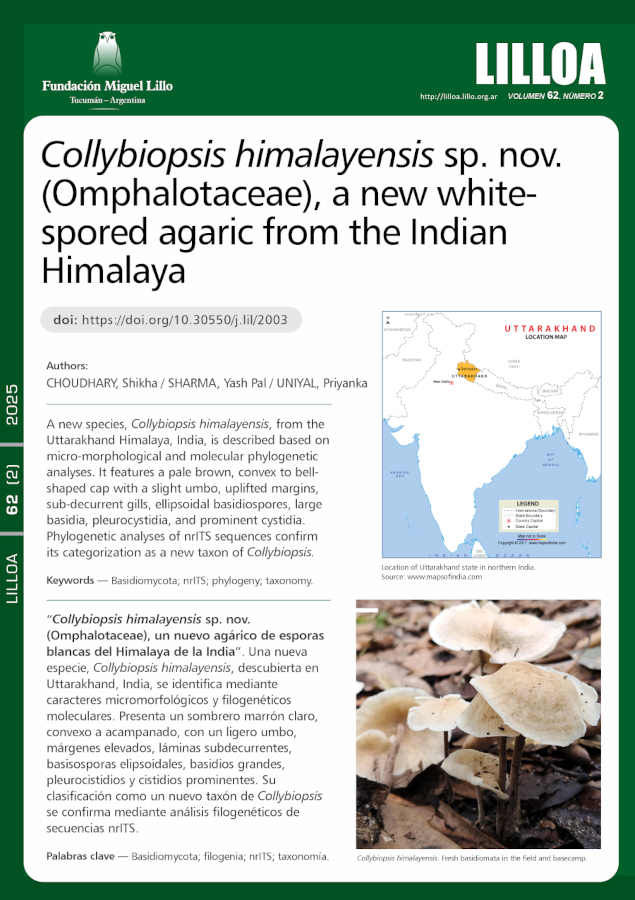
Se describe una nueva especie, Collybiopsis himalayensis, del Himalaya de Uttarakhand, India, basada en análisis micromorfológicos y filogenéticos moleculares. Esta especie se caracteriza por su píleo convexo a campanulado con un pequeño umbo, márgenes elevados, superficie finamente pruinosa, de color marrón claro, láminas subdecurrentes, basidiosporas subelipsoidales, basidios grandes (36-51,5 × 6,6-7,9 µm) y la presencia de pleurocistidios e hifas grandes, similares a los pileocistidios y queilocistidios. Su clasificación como un nuevo taxón de Collybiopsis se confirma mediante análisis filogenéticos de secuencias nrITS.
Descargas
Citas
Altschul, S. F., Madden T. L., Schaffer, A. A., et al. (1997). Gapped BLAST and PSI-BLAST: a new generation of protein database search programs. Nucleic Acids Research 25: 3389-3402. DOI: https://doi.org/10.1093/nar/25.17.3389
Antonín, V. & Herink, J. (1999). Notes on the variability of Gymnopus luxurians (Tricholomataceae). Czech Mycology 52 (1): 41-49. DOI: https://doi.org/10.33585/cmy.52103
Antonín, V. & Noordeloos, M. E. (1993). A Monograph of Marasmius, Collybia, and Related Genera in Europe: Marasmius, Setulipes, and Marasmiellus. Libri botanici 8: 1-229.
Clark, K., Karsch-Mizrachi, I. & Lipman, D. J. (2016). GenBank. (Database issue) Nucleic Acids Research 44 (1): D67-D72. DOI: https://doi.org/10.1093/nar/gkv1276
Desjardin, D. E., Halling, R. E. & Hemmes, D. E. (1999). Agaricales of the Hawaiian Islands. 5. The genera Rhodocollybia and Gymnopus. Mycologia 91 (1): 166-176. DOI: https://doi.org/10.1080/00275514.1999.12061006
Desjardin, D. E. & Perry, B. A. (2017). The gymnopoid fungi (Basidiomycota, Agaricales) from the Republic of São Tomé and Príncipe, West Africa. Mycosphere 8: 1317-1391. DOI: https://doi.org/10.5943/mycosphere/8/9/5
Dutta, A. K., Wilson, A. W., Antonín, V. & Acharya, K. (2015). Taxonomic and phylogenetic study on gymnopoid fungi from Eastern India. I. Mycological Progress 14 (10): 1-18. DOI: https://doi.org/10.1007/s11557-015-1094-3
Earle, F. S. (1909). The genera of the North American gill fungi. Bulletin of the New York Botanical Garden 5: 373-451.
Edler, D., Klein, J. & Antonelli, A. (2021). raxmlGUI 2.0: A graphical interface and toolkit for phylogenetic analyses using RAxML. Methods in Ecology and Evolution 12: 373-377. DOI: https://doi.org/10.1111/2041-210X.13512
Fries, E. (1835). Corpus florarum provincialium Sueciae: I. Floram scanicam (Vol. 1). Typis Palmblad, Sebell & Company. DOI: https://doi.org/10.5962/bhl.title.47083
Hughes, K. W. & Petersen, R. H. (2015), Transatlantic disjunction in fleshy fungi III: Gymnopus confluens. MycoKeys 9: 37-63. DOI: https://doi.org/10.3897/mycokeys.9.4700
Hughes, K. W., Segovia, A. R. & Petersen, R. H. (2014). Transatlantic disjunction in fleshy fungi. I. The Sparassis crispa complex. Mycological Progress 13 (2): 407-427. DOI: https://doi.org/10.1007/s11557-013-0927-1
Katoh, K. & Standley, D. M. (2013). MAFFT multiple sequence alignment software ver. 7: improvement in performance and usability. Molecular Biology and Evolution 30: 772780. DOI: https://doi.org/10.1093/molbev/mst010
Kim, J. S., Cho, Y., Park, K. H., Park, J. H., Kim, M., Kim, C. S. & Lim, Y. W. (2022). Taxonomic study of Collybiopsis (Omphalotaceae, Agaricales) in the Republic of Korea with seven new species. MycoKeys 88: 79-108. DOI: https://doi.org/10.3897/mycokeys.88.79266
Kornerup, A. & Wanscher, J. H. (1978). Methuen handbook of colour, 3rd edn. Reprinted. – Eyre Methuen.
Largent, D., Johnson, D. & Watling, R. (1977). How to identify mushrooms to genus III: microscopic features. Mad River Press Inc., Eureka, California.
Li, J. P., Pan, M. C., Li, Y., Deng, C. Y., Wang, X. M., Zhang, B. X., Li, C. T. & Li, Y. (2022). Morpho-Molecular Evidence Reveals Four Novel Species of Gymnopus (Agaricales, Omphalotaceae) from China. Journal of Fungi 8 (4): 398. DOI: https://doi.org/10.3390/jof8040398
Murrill, W. (1915). Agaricaceae (pars). Flora of North America 9: 286-296.
Oliveira, J. J., Vargas-Isla, R., Cabral, T. S., Rodrigues, D. P. & Ishikawa, N. K. (2019). Progress on the phylogeny of the Omphalotaceae: Gymnopus s. str., Marasmiellus s. str., Paragymnopus gen. nov. and Pusillomyces gen. nov. Mycological Progress 18 (5): 713-739. DOI: https://doi.org/10.1007/s11557-019-01483-5
Petersen, R. H. & Hughes, K. W. (2021). Collybiopsis and its type species, Co. ramealis. Mycotaxon 136 (2): 263-349. DOI: https://doi.org/10.5248/136.263
Retnowati, A. (2018). The species of Marasmiellus (Agaricales: Omphalotaceae) from Java and Bali. Gardens’ Bulletin Singapore 70 (1): 191-258. DOI: https://doi.org/10.26492/gbs70(1).2018-17
Singer, R. (1973). The genera Marasmiellus, Crepidotus and Simocybe in the neotropics. Nova Beih Nova Hedwigia 44: 1-517.
Staude, F. (1857). Die Schwämme Mitteldeutschlands, insbesondere des Herzogthums Coburg. Dietz, Coburg.
Vellinga, E. C. (1988). Glossary. In C Bas, Th W Kuyper, ME Noordeloos, EC Vellinga (eds.). Flora Agaricina Neerlandica 1: 54-64.
Wilson, A. W. & Desjardin, D. E. (2005). Phylogenetic relationships in the gymnopoid and marasmioid fungi (Basidiomycetes, euagarics clade). Mycologia 97 (3): 667-679. DOI: https://doi.org/10.1080/15572536.2006.11832797
Descargas
Publicado
Cómo citar
Número
Sección
Licencia
Derechos de autor 1900 Lilloa

Esta obra está bajo una licencia internacional Creative Commons Atribución-NoComercial-CompartirIgual 4.0.