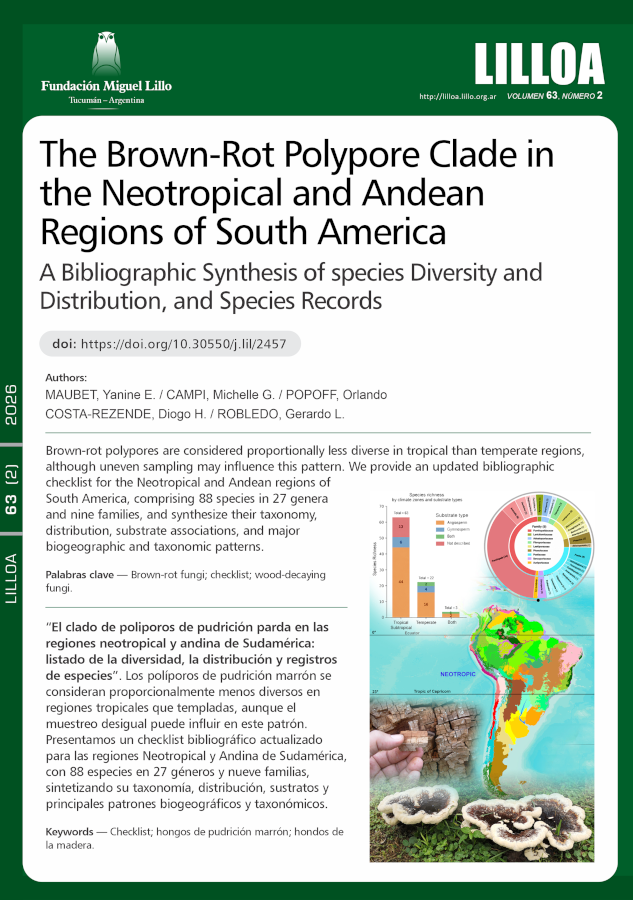
The Brown-Rot Polypore Clade in the Neotropical and Andean Regions of South America: A Bibliographic Synthesis of Species Diversity and Distribution, and Species Records
Autores
-
Yanine E. Maubet
1Universidad Nacional de Asunción, Facultad de Ciencias Exactas y Naturales, Laboratorio de Micología, San Lorenzo, Paraguay.
 https://orcid.org/0000-0002-0322-6238
-
Michelle G. Campi
Universidad Nacional de Asunción, Facultad de Ciencias Exactas y Naturales, Laboratorio de Micología, San Lorenzo, Paraguay
https://orcid.org/0000-0001-8809-0159
-
Orlando Poppof
Universidad Nacional del Nordeste, Facultad de Ciencias Exactas y Naturales y Agrimensura, Laboratorio de Micología, Corrientes, Argentina
https://orcid.org/0000-0001-9109-4118
-
Diogo Costa-Rezende
Universidade Federal do Ceará, Departamento de Biologia, Fortaleza, Brasil
https://orcid.org/0000-0002-7381-6954
-
Gerardo L. Robledo
Universidad Nacional de Córdoba, Facultad de Ciencias Agropecuarias, CeTBIO - Centro de Transferencia de Bioinsumos
https://orcid.org/0000-0002-3840-1104
DOI:
 https://doi.org/10.30550/j.lil/2457
Palavras-chave:
Brown-rot fungi, checklist, wood-decaying fungiResumo
At a global scale, brown-rot fungi are proportionally less diverse than white-rot fungi, a pattern reported in several regional studies. Several studies have further suggested that both species richness and the relative proportion of brown-rot and white-rot fungi follow climatic and latitudinal patterns, with brown-rot polypores generally considered less diverse in tropical regions and proportionally more abundant in temperate and cold climates. However, this apparent pattern may be influenced by uneven sampling effort, particularly the comparatively limited study of brown-rot fungi in tropical regions. The diversity and distribution of brown-rot fungi in the Neotropics therefore remain poorly understood. The present study addresses this gap by providing an updated bibliographic checklist of species belonging to the ‘brown-rot polypore clade’ recorded in the Neotropical and Andean regions of America. We present a curated list of 88 brown-rot polypore species, distributed across 27 genera and 9 families. For each taxon, we synthesize available information on nomenclature, geographic distribution, substrate associations, and ecoregional occurrence, and we discuss broader patterns of taxonomic richness, climatic distribution, substrate use, biogeographic structure, and taxonomic uncertainty. Particular attention is given to historical and extra-continental records, doubtful occurrences, and cases in which current nomenclature does not fully reflect phylogenetic placement. This checklist provides a baseline for future taxonomic, phylogenetic, biogeographic, and ecological studies of brown-rot polypores in South America.
Downloads
Referências
Aime, L., Ryvarden, L. & Henkel, T. W. (2007). Studies in Neotropical polypores 22. Additional new and rare species from Guyana. Synopsis Fungorum 23: 15-31.
Angelini, C. & Losi, C. (2015). Annotaded list of polyporoid fungi in the Dominican Republic. 4th Part. Rivista micologica romana. Bollettino dell’Associazione Micologica Ecologica Romana 96: 3-19.
Angelini, C. & Losi, C. (2021). Fungus flora of the Dominican Republic. VII. Some unrecorded polyporoid, corticioid, stereoid and clavarioid fungi. Bollettino dell’Associazione Micologica Ecologica Romana: 3-33.
Angelini, C. & Losi, C. (2023). Fungus flora of the Dominican Republic. VIII. Some unrecorded polyporoid, corticioid, stereoid and clavarioid fungi. Rivista micologica romana. Bollettino dell’Associazione Micologica Ecologica Romana: 3-18.
Angelini, C., Losi, C. & Vizzini, A. (2026). Podopostia dominicana, a new genus and a new species in the family Postiaceae (Polyporales, Basidiomycota). Phytotaxa 740 (2): 121-137.
Baldoni, D. B., Ortiz-Santana, B., Coelho, G., Antoniolli, Z. I. & Jacques, R. J. (2014). Sarcoporia polyspora (Basidiomycota, Polyporales): a rare wood-decay fungus newly recorded from South America. Nova Hedwigia 1-2: 177-187.
Baltazar, J. M. & Gibertoni, T. B. (2009). A checklist of the aphyllophoroid fungi (Basidiomycota) recorded from the Brazilian Atlantic Forest. Mycotaxon 109 (1): 439-442.
Baltazar, J. M., Trierveiler-Pereira, L. & Loguercio-Leite, C. (2009). A checklist of xylophilous basidiomycetes (Basidiomycota) in mangroves. Mycotaxon 107 (1): 221-224.
Banik, M. T., Lindner, D. L., Ortiz-Santana, B. & Lodge, D. J. (2012). A new species of Laetiporus (Basidiomycota, Polyporales) from the Caribbean basin. Kurtziana 37: 15-21.
Berkeley, M. J. (1856). Decades of fungi. Decades LIX - LX. Rio Negro fungi. Hooker's Journal of Botany and Kew Garden Miscellany 8: 233-241.
Berkeley, M. J. & Curtis, M. A. (1869). Fungi Cubenses (Hymenomycetes). Journal of the Linnean Society. Botany 10: 280-392.
Campi, M. G., Azevedo-Olivera, C., Costa-Rezende, D., Maubet, Y., Morera, G., Urcelay, C., ... & Robledo, G. L. (2022). What are the Laetiporus species present in southern South America?. Lilloa 59 (Suplemento): 193-218. https://doi.org/10.30550/j.lil/2022.59.S/2022.09.19
Campi, M. G., Maubet, Y., Cristaldo, E. & Robledo, G. L. (2025). Funga del Paraguay Tomo I. Hongos degradadores de la madera. (1° Ed). Universidad Nacional de Asunción, Paraguay.
Carranza-Morse, J. (1982). Polypores new to Costa Rica. Mycotaxon 15: 405-408.
Carranza-Morse, J. & Gilbertson, R. L. (1986). Taxonomy of the Fomitopsis rosea complex (Aphyllophorales; Polyporaceae). Mycotaxon 25 (2): 469-486.
Carranza-Morse, J. & Gilbertson, R. L. (1989). Cultural studies on the Fomitopsis rosea complex. Mycologia 81 (1): 85-97.
Carranza-Velázquez, J. & Ryvarden, L. (1998). Additional list of pore fungi of Costa Rica. Lista adicional de hongos poliporos de Costa Rica. Mycotaxon 69: 377-390.
Carranza-Velázquez, J. & Ruiz-Boyer, A. (2005). Checklist of polypores of Costa Rica. Revista Mexicana de Micología 20: 45-52.
Cristaldo, E., Kossmann, T., Campi, M., Maubet, Y., Costa-Rezende, D., Drechsler-Santos, R. & Robledo, G. (2022). Neotropical Daedalea (Basidiomycota, Fomitopsidaceae) revisited: Daedalea rajchenbergiana sp. nov. from Brazil. Lilloa 59: 273-289. https://doi.org/10.30550/j.lil/2022.59.S/2022.09.16
Coelho, G. (2005). A Brazilian new species of Auriporia. Mycologia 97 (1): 263-267.
Cooke, M. C. (1885). Praecursores ad Monographia Polypororum. Grevillea 14 (69): 17-21.
Costa-Rezende, D. H., Robledo, G. L., Drechsler-Santos, E. R., Glen, M., Gates, G., de Madrignac Bonzi, B. R., ... & Góes-Neto, A. (2020). Taxonomy and phylogeny of polypores with ganodermatoid basidiospores (Ganodermataceae). Mycological Progress 19 (8): 725-741. https://doi.org/10.1007/s11557-020-01589-1
Cui, B. K., Li, H. J., Ji, X., Zhou, J. L., Song, J., Si, J., ... & Dai, Y. C. (2019). Species diversity, taxonomy and phylogeny of Polyporaceae (Basidiomycota) in China. Fungal Diversity 97: 137-392. https://doi.org/10.1007/s13225-019-00427-4
Dai, Y. C., Wei, Y. L. & Zhou, L. W. (2015). Polypore richness along an elevational gradient: a case study in Changbaishan Nature Reserve, Northeastern China. Fungal Ecology 13: 226-228. https://doi.org/10.1016/j.funeco.2014.07.002
de Jesus, M. A. & Ryvarden, L. (2010). Studies in neotropical polypores 28. Two new species from Amazonas, Brazil. Synopsis Fungorum 27: 73-77.
Decock, C. A., Ryvarden, L., & Amalfi, M. (2022). Niveoporofomes (Basidiomycota, Fomitopsidaceae) in Tropical Africa: Two additions from Afromontane forests, Niveoporofomes oboensis sp. nov. and N. widdringtoniae comb. nov. and N. globosporus comb. nov. from the Neotropics. Mycological Progress 21 (2): 29. https://doi.org/10.1007/s11557-022-01787-z
Dinerstein, E., Olson, D., Joshi, A., Vynne, C., Burgess, N. D., Wikramanayake, E., ... & Saleem, M. (2017). An ecoregion-based approach to protecting half the terrestrial realm. BioScience 67 (6): 534-545. https://doi.org/10.1093/biosci/bix014
Drechsler-Santos, E. R., Groposo, C. & Loguercio-Leite, C. (2008). Additions to the knowledge of lignocellulolytic Basidiomycetes (Fungi) in forests from Santa Catarina State, Brazil. Mycotaxon 103: 197-200.
Drechsler-Santos, E. R., Demetrio, A. M., Salvador-Montoya, C. A., Souza-Aguiar, C. D., Costa-Rezende, D. H., Mafalda-Freire, F., ... & Ferreira-Lopes, V. (2014). Macrofungos do Parque Nacional de São Joaquim: Aspectos preliminares sobre a micodiversidade. Parque Nacional de São Joaquim: Portal do Conhecimento. Editora Santarém: 23-44.
Erkkilä, R. & Niemelä, T. (1986). Polypores in the parks and forests of the City of Helsinki. Societas Mycologica Fennica. Kartstenia 26: 1-40.
Fidalgo, O. & Fidalgo, M. E. P. K. (1957). Revisão de Fungi São Paulensis. Arquivos do Museu Nacional Rio de Janeiro 43: 157-188.
Fidalgo, O., & Fidalgo, M. E. P. K. (1967). Polyporaceae from Trinidad and Tobago. II. Mycologia 59 (5): 833-869.
Gerber, A. L. & Loguercio-Leite, C. (2000). Polyporoid wood-rotting fungi (Basidiomycetes) II – new records from Southern Brazil. Mycotaxon 76: 175-185.
Gilbertson, R. L. (1980). Wood-rotting fungi of North America. Mycologia 72: 1-49.
Gilbertson, R. L. (1981). North American wood-rotting fungi that cause brown rots. Mycotaxon 12: 372-416.
Gilbertson, R. L. & Ryvarden, L. (1987). North American Polypores. Vol. II. (1° Ed.) Fungiflora, Oslo.
Gibertoni, T. B., Ryvarden, L. & Cavalcanti, M. A. Q. (2004). Poroid fungi (Basidiomycota) of the Atlantic Rain Forest in Northern Brazil. Synopsis Fungorum 18: 33-43.
Gibertoni, T. B., Santos, P. J. P. & Cavalcanti, M. A. Q. (2007). Ecological aspects of Aphyllophorales in the Atlantic rain forest in northeast Brazil. Fungal Diversity 25: 49-67.
Góes-Neto, A. (1999). Polypore diversity in the state of Bahia, Brazil: a historical review. Mycotaxon 72: 43-56.
Gomes-Silva, A. C. & Nogueira-Melo, G. S. (2015). Notes on Fomitopsis (Polyporales, Agaricomycetes) from North and Northeast Brazil. The Journal of the Torrey Botanical Society 142 (2): 179-185. https://doi.org/10.3159/TORREY-D-12-00076.1
Han, M. L., Chen, Y. Y., Shen, L. L., Song, J., Vlasák, J., Dai, Y. C. & Cui, B. K. (2016). Taxonomy and phylogeny of the brown-rot fungi: Fomitopsis and its related genera1. Fungal Diversity 80: 343-373. https://doi.org/10.1007/s11557-011-0758-x
Hennings, P. (1898). Fungi jamaicensis. Hedwigia 37: 277-282.
Hjohtstam, K. & Ryvarden, L. (1985). New and noteworthy Basidiomycetes (Aphyllophorales) from Tierra del Fuego, Argentina. Mycotaxon 22: 159-167.
Holmquist, O., Cadenas, A., Pietrantonio, P., Maggiorani, A. & Bracamonte, L. (2009). Notas sobre Laetiporus sulphureus s. lat. (Aphyllophorales-Basidiomycetes) en Venezuela. La Revista Forestal Venezolana 53 (2): 129-135.
Kaipper-Figueiró, G. (2015). Aspectos taxonômicos e filogenéticos de Antrodia s.l. com a inclusão de espécimes da região Neotropical (Tesis de Maestría), Universdidade Federal de Santa Catarina, Brasil.
Kaipper-Figueiró, G., Robledo, G. L., Reck, M. A., Goes-Neto, A. & Drechsler-Santos, E. R. (2016). Antrodia neotropica sp. nov. (Polyporales, Basidiomycota): a new South American species of Antrodia ss from Brazil based on morphological, molecular and ecological data. Nova Hedwigia 103 (1-2): 125-143. https://doi.org/ 10.1127/nova_hedwigia/2016/0340
Kout, J., Vlasák, J. & Banik, M. T. (2019). Laetiporus lobatus (Basidiomycota, Polyporales), a new fungal species from Costa Rica. Phytotaxa 408 (3): 208-214. https://doi.org/10.11646/phytotaxa.408.3.5
Lindblad, I. & Ryvarden, L. (1999). Studies in neotropical polypores. 3. New and interesting Basidiomycetes (Poriales) from Costa Rica. Mycotaxon 71: 335-359.
Lindner, D. & Banik, M. (2008). Molecular phylogeny of Laetiporus and other brown-rot polypore genera in North America. Mycologia 100 (3): 417-430. https://doi.org/10.3852/07-124R2
Lindner, D., Ryvarden, L. & Baroni, T. (2011). A new species of Daedalea (Basidiomycota) and a synopsis of core species in Daedalea sensu stricto. North American Fungi 6 (4): 1-12. https://doi.org/10.2509/naf2011.006.004
Liu, S., Chen, Y. Y., Sun, Y. F., He, X. L., Song, C. G., Si, J., ... & Cui, B. K. (2023a). Systematic classification and phylogenetic relationships of the brown-rot fungi within the Polyporales. Fungal Diversity 118 (1): 1-94. https://doi.org/10.1007/s13225-022-00511-2
Liu, S., Shen, L. L., Xu, T. M., Song, C. G., Gao, N., Wu, D. M., Sun, Y. F. & Cui, B. K. (2023b). Global diversity, molecular phylogeny and divergence times of the brown-rot fungi within the Polyporales. Mycosphere 14 (1): 1564-1664. https://doi.org/10.5943/mycosphere/14/1/18
Lodge, D. J., Ryvarden, L. & Perdomo Sánchez, O. P. (2001). Studies in neotropical polypores 11: Antrodia aurantia, a new species from the Dominican Republic, Greater Antilles. Mycotaxon 80: 261-266.
Loguercio-Leite, C., Michels, J. & Baltazar, J. M. (2008). New records of lignocellulolytic basidiomycetes (Fungi): Parque Estadual da Serra do Tabuleiro (PEST), Santa Catarina, Brazil. Biotemas 21 (3): 7-14.
Lowe, J. L. (1966). Polyporaceae of North America. The genus Poria. Technical Publication of the State University College of Forestry at Syracuse University 90: 1-183.
Mardones, M., Tenorio, L. U., Montero, M. D. M. G., Mata, M., Hidalgo, A. R. B., Piepenbring, M., ... & Velázquez, J. C. (2024). The first annotated checklist of Costa Rican fungi. Funga Latina 2: V2A7. https://doi.org/10.5281/zenodo.14165034.
Maubet, Y., Campi, M. & Robledo, G. L. (2020). Hymenochaetaceae from Paraguay: revision of the family and new records. Current Research in Environmental and Applied Mycology 10 (1): 242-261. https://doi.org/10.5943/cream/10/1/24
de Meijer, A. A. R. (2006). Preliminary list of the macromycetes from the Brazilian state of Paraná. Boletim do Museu Botânico Municipal 68: 1-55.
Miettinen, O., Vlasák, J., Rivoire, B. & Spirin, V. (2018). Postia caesia complex (Polyporales, Basidiomycota) in temperate northern hemisphere. Fungal Systematics and Evolution 1 (1): 101-129. https://doi.org/10.3114/fuse.2018.01.05
Montagne, J. P. F. C. (1841). Séconde centurie de plantes cellulaires exotiques nouvelles, Décade IX. Annales des Sciences Naturelles. Botanique 16: 108-128.
Montagne, J. P. F. C. (1842). Troisième Centurie de plantes cellulaires exotiques nouvelles, Décades I, II, III et IV. Fungi cubenses. Annales des Sciences Naturelles. Botanique 17: 119-128.
Montagne, J. P. F. C. (1849). Sixièmes Centurie de plantes cellulaires nouvelles, tant indigènes qu'exotiques. Décade VII. Annales des Sciences Naturelles. Botanique 11: 235-246.
Montagne, J. P. F. C. (1854). Cryptogamia Guyanensis seu plantarum cellularium in Guyana gallica annis 1835-1849 a cl. Leprieur collectarum enumeratio universalis. Annales des Sciences Naturelles. Botanique 1: 91-144.
Montagne, J. P. F. C. (1856). Septième centurie de plantes cellulaires nouvelles, tant indigènes qu'exotiques. Annales des Sciences Naturelles. Botanique 5: 333-374.
Motato-Vásquez, V., Pires, R. M. & Gugliotta, A. D. M. (2015). Polypores from an Atlantic rainforest area in southeast Brazil: pileate species. Brazilian Journal of Botany 38: 149-164. https://doi.org/10.1007/s40415-014-0109-7
Motato-Vásquez, V., Vinasco-Diaz, L. K., Londoño-Caicedo, J. M., & Bolaños-Rojas, A. C. (2025). Hidden treasures of Colombia’s Pacific mangrove: new fungal species and records of macrofungi (Basidiomycota). Journal of Fungi 11 (6): 459. https://
doi.org/10.3390/jof11060459
Montoya, C. A., Costa-Rezende, D. H. C., Ferreira-Lopes, V., Borba Silva, M. A. & Popoff, O. F. (2018). Tropicoporus drechsleri (Hymenochaetales, Basidiomycota), a new species in the “Inonotus linteus” complex from northern Argentina. Phytotaxa 338 (1): 075-089. https://doi.org/10.11646/phytotaxa.338.1.6
Morrone, J. J., Escalante, T., Rodríguez-Tapia, G., Carmona, A., Arana, M. & Mercado-Gómez, J. D. (2022). Biogeographic regionalization of the Neotropical region: New map and shapefile. Anais da Academia Brasileira de Ciências 94: e20211167. https://doi.org/10.1590/0001-3765202220211167
Murrill, W. A. (1907). Polyporaceae, Part 1. North American Flora 9 (1): 1-72.
Murrill, W. A. (1910). The Polyporaceae of Jamaica. Mycologia 2: 183-197.
Murrill, W. A. (1919). Cuban polypores and agarics. Mycologia 11 (1): 22-32.
Núñez, M. & Ryvarden, L. (1999). Studies in neotropical polypores 4. New and noteworthy species from Coiba National Park, Panama. Mycotaxon 71: 361-368.
Ortiz-Santana, B., Lindner, D. L., Miettinen, O., Justo, A. & Hibbett, D. S. (2013). A phylogenetic overview of the antrodia clade (Basidiomycota, Polyporales). Mycologia 105 (6): 1391-1411. https://doi.org/10.3852/13-051
Paez, C. A., Kraisitudomsook, N., Smith, J. A., Loyd, A. L., Lindner, D. L. & Smith, M. E. (2023). Revising the taxonomic placement of Laetiporus persicinus within the Laetiporaceae. Mycologia 115 (1): 107-121. https://doi.org/10.1080/00275514.2022.2139144
Parmasto, E. (1968). Conspectus Systematis Corticiacearum. 1-261.
Patouillard, N. T. & Lagerheim, G. de (1892). Champignons de l'Equateur (Pugillus II). Bulletin de la Société Mycologique de France 8 (2): 113-140.
Pildain, M. B. & Rajchenberg, M. (2013). The phylogenetic position of Postia sl (Polyporales, Basidiomycota) from Patagonia, Argentina. Mycologia 105 (2): 357-367. https://doi.org/10.3852/12-088
Pires, R. M., Motato-Vásquez, V. & Gugliotta, A. M. (2016). A new species of Laetiporus (Basidiomycota) and occurrence of L. gilbertsonii Burds. in Brazil. Nova Hedwigia 102 (3-4): 477-490. https://doi.org/10.1127/nova_hedwigia/2016/0320
Pires, R. M., Motato-Vásquez, V., Westphalen, M. C. & Gugliotta, A. D. M. (2017). Polyporales and similar poroid genera (Basidiomycota) from Parque Estadual da Serra do Mar, São Paulo State, Brazil. Hoehnea 44: 145-157. https://doi.org/10.1590/2236-8906-93/2016
Popoff, O. F. & Wright, J. E. (1998). Fungi of Paraguay. I. Preliminary check-list of wood-inhabiting polypores (Aphyllophorales, basidiomycota). Mycotaxon 67: 323-340.
Rajchenberg, M. (1982). El género Poria Pers. en la República Argentina (Tesis doctoral). Facultad de Ciencias Exactas y Naturales, Universidad de Buenos Aires, Argentina.
Rajchenberg, M. (1983). Basidiomicetos xilófilos de los bosques andinopatagónicos. Adiciones y correcciones. I. Boletín de la Sociedad Argentina de Botánica 22 (1-4): 41-56.
Rajchenberg, M. (1986). On Trametes aethalodes and other species of Daedalea (Polyporaceae). Canadian Journal of Botany 64 (9): 2130-2135.
Rajchenberg, M. (1994). A taxonomic study of the subantarctic Piptoporus (Polyporaceae, Basidiomycetes) I. Nordic Journal of Botany 14 (4): 435-449.
Rajchenberg, M. (1995a). A taxonomic study of the subantarctic Piptoporus (Polyporaceae, Basidiomycetes) II. Nordic Journal of Botany 15 (1): 105-119.
Rajchenberg, M. (1995b). New polypores from the Nothofagus forests of Argentina. Mycotaxon 54: 427-453.
Rajchenberg, M. (1996). Wood-rotting fungi of Nothofagus pumilio (lenga): Identification of cultures. Bosque 17 (2): 87-100.
Rajchenberg, M. (2001). Postia minuta sp. nov. from southern Argentina. Harvard Papers in Botany 6 (1): 183-87.
Rajchenberg, M. (2006). Los políporos (Basidiomycetes) de los bosques Andino-Patagónicos de Argentina. (1° Ed). Cramer.
Rajchenberg, M. (2022). An approach to the biogeography of polypore fungi (Agaricomycotina, Basidiomycota) in southern South America. Darwiniana, nueva serie 10 (2): 451-479. https://doi.org/10.14522/darwiniana.2022.102.1058
Rajchenberg, M. & de Meijer, A. (1990). New and noteworthy polypores from Paraná and São Paulo states, Brazil. Mycotaxon 38: 173-185.
Rajchenberg, M. & Buchanan, P. K. (1996). Two newly described polypores from Australasia and southern South America. Australian Systematic Botany 9 (6): 877-885.
Rajchenberg, M., Gorjón, S. P. & Pildain, M. B. (2011). The phylogenetic disposition of Antrodia sl (Polyporales, Basidiomycota) from Patagonia, Argentina. Australian Systematic Botany 24 (2): 111-120. https://doi.org/10.1071/SB11003
Rajchenberg, M. & Robledo, G. (2013). Pathogenic polypores in Argentina. Forest Pathology 43: 171-184. https://doi.org/10.1111/efp.12032
Renvall, P. (1992). Postia lateritia n. sp. and its rust-coloured relatives. Karstenia 32: 43-60.
Rizinde Hakizimana, J. C., Amalfi, M., Balezi, A. & Decock, C. (2024). Laetiporus (Laetiporaceae, Basidiomycota) in tropical Africa is represented by a single Afromontane lineage and four species, including Laetiporus discolor, Laetiporus oboensis, sp. nov., Laetiporus tenuiculus, sp. nov., and Laetiporus sp. 1. Mycologia 116 (6): 1083-1100. https://doi.org/10.1080/00275514.2024.2395688
Robert, V., Vu, D., Amor, A. B. H., van de Wiele, N., Brouwer, C., Jabas, B., Szoke, S., Dridi, A., Triki, M., Ben Daoud, S., Chouchen, O., Vaas, L. A. I., de Cock, A., Stalpers, J. A., Stalpers, D., Verkley, G. J. M., Groenewald, M., dos Santos, F. B., Stegehuis, G. J., … Crous, P. W. (2013). MycoBank gearing up for new horizons. IMA Fungus 4 (2): 371-379. https://doi.org/10.5598/imafungus.2013.04.02.16
Robledo, G., Urcelay, C., Dominguez, L. & Rajchenberg, M. (2006). Taxonomy, ecology, and biogeography of polypores (Basidiomycetes) from Argentinian Polylepis woodlands. Botany 84 (10): 1561-1572. https://doi.org/10.1139/b06-109
Robledo, G. & Rajchenberg, M. (2007). Preliminary polypore mycota (Basidiomyce¬tes) from northwestern Argentinean Yungas. Mycotaxon 100: 5-9.
Robles, C. A., Pildain, M. B., Sautua, F., Carmona, M. A. & Rajchenberg, M. (2021). Fibroporia gossypium isolated from an indoor environment in Argentina. Mycotaxon 136 (3): 645-660.
Romell, L. (1901). Hymenomycetes Austro-Americani in itinere Regnelliano primo collecti 1. Bihang til Kongliga Svenska Vetenskaps-Akademiens Handlingar 26 (16): 3-61(comb. Spirin et al., 2024).
Ryvarden, L. (1988). Type studies in the Polyporaceae. 19. Species described by MC Cooke. Mycotaxon 51: 45-58.
Ryvarden, L. (1991). Genera of Polypores. Nomenclature and Taxonomy. Fungiflora.
Ryvarden, L. (2012). Studies in Neotropical polypores 32. Some new species from Costa Rica. Synopsis Fungorum 30: 33-43.
Ryvarden, L. (2015). Neotropical polypores part 2. Polyporaceae Abortiporus-Nigroporus. Synopsis Fungorum 34: 1-443.
Ryvarden, L. & Guzmán, G. (2001). Studies in neotropical polypores 12. New and noteworthy polypores from Mexico. Mycotaxon 78: 245-256.
Ryvarden, L. & de Meijer, A. D. (2002). Studies in neotropical polypores 14. New species from the state of Paraná, Brazil. Synopsis Fungorum 15 (1): 34-69.
Ryvarden, L. & Iturriaga, T. (2003). Studies in neotropical polypores 10. New polypores from Venezuela. Mycologia 95 (6): 1066-1077.
Ryvarden, L., Aime, M. C. & Baroni, T. J. (2009). Studies in neotropical polypores 26. A new species of Trametes and revisitation of an old. Synopsis Fungorum 26: 27-32.
Sandoval, P. & Rajchenberg, M. (2011). Fomitopsis minutispora Rajchenb., nuevo registro de Polyporales para la micobiota chilena. Gayana. Botánica 68 (2): 319-322. http://dx.doi.org/10.4067/S0717-66432011000200021
Santos, C. D., Silva, R. O., Soares, A. C., Drechsler-Santos, E. R. & Bezerra, J. L. (2018). First record of Daedalea ryvardeniana Drechsler-Santos & Robledo (Agaricomycetes, Polyporales, Fomitopsidaceae) in the Caatinga area of Bahia, Brazil. Check List 14 (1): 173-176. https://doi.org/10.15560/14.1.173
Shen, L. L., Wang, M., Zhou, J. L., Xing, J. H., Cui, B. K. & Dai, Y. C. (2019). Multi-gene phylogeny and taxonomy of the brown-rot fungi: Postia (Polyporales, Basidiomycota) and related genera. Persoonia-Molecular Phylogeny and Evolution of Fungi 42 (1): 101-126. https://doi.org/10.3767/persoonia.2019.42.05
Soares, A. M., Nogueira-Melo, G., Plautz Jr, H. L. & Gibertoni, T. B. (2017). A new species, two new combinations and notes on Fomitopsidaceae (Agaricomycetes, Polyporales). Phytotaxa 331 (1): 75-83. https://doi.org/10.11646/phytotaxa.00.0.0
Spegazzini, C. (1899). Fungi Argentini novi vel critici. Anales del Museo Nacional de Historia Natural de Buenos Aires 6: 81-288.
Species Fungorum (2026). Published on the Internet https://www.speciesfungorum.org, The Royal Botanic Gardens, Kew. [Retrieved 24 September 2026].
Spirin, V., Vlasák, J., Niemelä, T. & Miettinen, O. (2013). What is Antrodia sensu stricto?. Mycologia 105 (6): 1555-1576. https://doi.org/10.3852/13-039
Spirin, V., Runnel, K., Vlasák, J., Miettinen, O. & Põldmaa, K. (2015). Species diversity in the Antrodia crassa group (Polyporales, Basidiomycota). Fungal Biology 119 (12): 1291-1310. https://doi.org/10.1016/j.funbio.2015.09.008
Spirin, V., Runnel, K., Vlasák, J., Viner, I., Barrett, M. D., Ryvarden, L., ... & Miettinen, O. (2024). The genus Fomitopsis (Polyporales, Basidiomycota) reconsidered. Studies in Mycology 107 (1): 149-249. https://doi.org/10.3114/sim.2024.107.03
Stevenson, J. A. & Cash, E. K. (1936). The new fungus names proposed by C. G. Lloyd. Bulletin of the Lloyd Library 35:1-209.
Stokland, J. N., Siitonen, J. & Jonsson, B. G. (2012). Biodiversity in dead wood. (1° Ed), Cambridge University Press.
Tibpromma, S., Hyde, K. D., Jeewon, R., Maharachchikumbura, S. S., Liu, J. K., Bhat, D. J., ... & Karunarathna, S. C. (2017). Fungal Diversity notes 491–602: taxonomic and phylogenetic contributions to fungal taxa. Fungal Diversity 83: 1-261. https://doi.org/10.1007/s13225-017-0378-0
Turland, N. J., Wiersema, J. H., Barrie, F. R., Greuter, W., Hawksworth, D. L., Herendeen, P. S., ... & Smith, G. F. (Eds.) (2018). International Code of Nomenclature for algae, fungi, and plants (Shenzhen Code). Koeltz Botanical Books. https://doi.org/10.12705/Code.2018
Vasaitis, R., Menkis, A., Lim, Y. W., Seok, S., Tomsovsky, M., Jankovsky, L., Lygis, V., Slippers, B. & Stenlid, J. (2009). Genetic variation and relationships in Laetiporus sulphureus s. lat., as determined by ITS rDNA sequences and in vitro growth rate. Mycological Research 113 (3): 326-336. https://doi.org/10.1016/j.mycres.2008.11.009
Valenzuela, R., Palacios-Pacheco, M. R., Raymundo, T. & Bautista-Hernández, S. (2006). Especies de poliporáceos poco conocidas en México. Revista Mexicana de Biodiversidad 77 (1): 35-49.
Valenzuela, R. (2023). Outline of Fungi – Note 810: Austropostia (K. D. Hyde & M. T. Noorabadi, Eds.). Outline of Fungi. https://outlineoffungi.org/pdf/Outlineoffungi.org%20-%20Note%20810%20Austropostia.pdf
Vampola, P., Kotlaba, F. & Pouzar, Z. (1994). Antrodia pini-cubensis, a new polypore from the Caribbean area. Czech Mycology 47 (189): e192.
Velázquez, J. C. & Ruiz-Boyer, A. (2005). Checklist of polypores of Costa Rica. Revista Mexicana de Micología 20: 45-52.
Vlasák, J., Vlasák, J. J. & Ryvarden, L. (2016). Studies in Neotropical polypores 42. New and noteworthy polypores from Costa Rica and two new species Elmerina phellinoides and Melanoporia condensa. Synopsis Fungorum 35: 9-33.
Vlasák, J., Vlasák, J. J. & Ryvarden, L. (2020). Studies in Neotropical polypores 46 Some new and noteworthy polypores from Costa Rica. Synopsis Fungorum 42: 30-33.
Wang, X. C., Xi, R. J., Li, Y., Wang, D. M. & Yao, Y. J. (2012). The species identity of the widely cultivated Ganoderma, ‘G. lucidum’(Ling-zhi), in China. PLOS ONE 7 (7): e40857. https://doi.org/10.1371/journal.pone.0040857
Westphalen, M. C. & Silveira, R. M. B. (2013). Pileate polypores from Araucaria Forests in Southern Brazil. Hoehnea 40: 77-86. https://doi.org/10.1590/S2236-89062013000100003
Wright, J.E., Deschamps, J.R., and Rovetta, G.S. (1973). Basidiomicetos xilófilos de la Región Mesopotámica. I. Revista de investigaciones agropecuarias: Patología vegetal 10: 117-228.
Wright, J. E. & Bolontrade, M. F. (1994). An undesirable immigrant. Mycologist 8: 14-15.
Wu, F., Yuan, H. S., Zhou, L. W., Yuan, Y., Cui, B. K. & Dai, Y. C. (2020). Polypore diversity in South China. Mycosystema 39: 653-681.
Wu, Y., Mao, W. & Yuan, Y. (2021). Comparison of polypore florae and diversity from temperate to subtropical forest zones in China. Biodiversity Science 29 (10): 1369. https://doi.org/10.17520/biods.2021094
Yang, K. L., Lin, J. Y., Li, G. M. & Yang, Z. L. (2025). New and interesting fungi from Guangzhou City, South China. Phytotaxa 707 (1): 1-95. https://doi.org/10.11646/phytotaxa.707.1.1
Yuan, Y., Wu, Y.-D., Wang, Y.-R., Zhou, M., Qiu, J.-Z., Li, D.-W., Vlasák, J., Liu, H.-G. & Dai, Y.-C. (2022). Two new forest pathogens in Phaeolus (Polyporales, Basidiomycota) on Chinese coniferous trees were confirmed by molecular phylogeny. Frontiers in Microbiology 13: 942603. https://doi.org/ 10.3389/fmicb.2022.942603
Zhang, D. Z. (2003). Three brown rot polypores new to Taiwan and their cultural studies. Taiwania 48: 1-5. https://doi.org/10.6165/tai.2003.48(1).1
Zhou, L. W. & Dai, Y. C. (2012). Recognizing ecological patterns of wood-decaying polypores on gymnosperm and angiosperm trees in northeast China. Fungal Ecology 5: 230-235. https://doi.org/10.1016/j.funeco.2011.09.005
Downloads
Publicado
Como Citar
Edição
Seção
Licença
Copyright (c) 1900 Lilloa

Este trabalho está licenciado sob uma licença Creative Commons Attribution-NonCommercial-ShareAlike 4.0 International License.