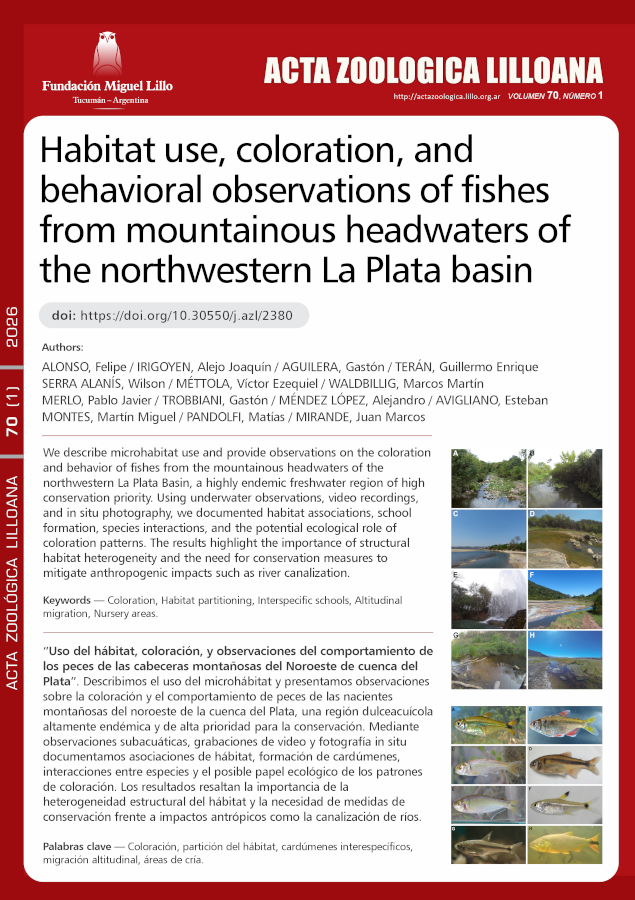
Uso del hábitat, coloración, y observaciones del comportamiento de los peces de las cabeceras montañosas del Noroeste de cuenca del Plata
Autores/as
-
Felipe Alonso
Instituto de Bio y Geociencias del Noroeste Argentino (IBIGEO). Consejo Nacional de Investiga- ciones Científicas y Técnicas (CONICET)
 https://orcid.org/0000-0001-7227-2732
-
Alejo Joaquin Irigoyen
Centro para el Estudio de Sistemas Marinos (CESIMAR), Consejo Nacional de Investigaciones Científicas y Técnicas (CCT CENPAT – CONICET)
https://orcid.org/0000-0002-6082-7398
-
Gaston Aguilera
Unidad Ejecutora Lillo (CONICET) – Fundación Miguel Lillo
https://orcid.org/0000-0002-5486-2787
-
Guillermo Enrique Terán
Unidad Ejecutora Lillo (CONICET) – Fundación Miguel Lillo
https://orcid.org/0000-0002-3795-3345
-
Wilson Sebastián Serra Alanis
Sección Ictiología, Dpto. de Zoología, Museo Nacional de Historia Natural (MNHN), Montevideo, Uruguay
https://orcid.org/0000-0003-0032-9335
-
Victor Ezequiel Mettola
Unidad Ejecutora Lillo (CONICET) – Fundación Miguel Lillo
https://orcid.org/0009-0009-3334-3927
-
Marcos Martín Waldbilling
CONICET – Universidad de Buenos Aires. Instituto de Investigaciones en Producción Animal (INPA)
https://orcid.org/0009-0009-4942-9303
-
Pablo Javier Merlo
Centro para el Estudio de Sistemas Marinos (CESIMAR), Consejo Nacional de Investigaciones Científicas y Técnicas (CCT CENPAT – CONICET)
https://orcid.org/0000-0002-0626-4993
-
Gastón Trobbiani
Centro para el Estudio de Sistemas Marinos (CESIMAR), Consejo Nacional de Investigaciones Científicas y Técnicas (CCT CENPAT – CONICET)
https://orcid.org/0000-0001-7793-7553
-
Alejandro Méndez López
Unidad Ejecutora Lillo (CONICET) – Fundación Miguel Lillo
https://orcid.org/0000-0002-7251-7880
-
Esteban Avigliano
CONICET – Universidad de Buenos Aires. Instituto de Investigaciones en Producción Animal (INPA)
https://orcid.org/0000-0002-3620-2291
-
Martín Miguel Montes
Centro de Estudios Parasitológicos y Vectores (CEPAVE), Consejo Nacional de Investigaciones Científicas y Técnicas, Universidad Nacional de La Plata (CCT, CONICET-UNLP)
https://orcid.org/0000-0002-7177-333X
-
Matías Pandolfi
https://orcid.org/0000-0002-7677-4120
-
Juan Marcos Mirande
Unidad Ejecutora Lillo (CONICET) – Fundación Miguel Lillo
https://orcid.org/0000-0003-4370-3526
DOI:
 https://doi.org/10.30550/j.azl/2380
Palabras clave:
Coloración, partición del hábitat, cardúmenes interespecíficos, migración altitudinal, áreas de críaResumen
Describimos el uso del microhábitat y presentamos observaciones sobre la coloración y el comportamiento de peces de las nacientes montañosas del noroeste de la cuenca del Plata, una región dulceacuícola altamente endémica y de alta prioridad para la conservación. Mediante
observaciones subacuáticas, grabaciones de video y fotografía in situ documentamos asociaciones de hábitat, formación de cardúmenes, interacciones entre especies y el posible papel ecológico de los patrones de coloración. En cursos de agua de las cuencas de los ríos Bermejo y Juramento se acumularon aproximadamente 81,5 h de
observaciones directas y 17 h 36 min de registros en video subacuático. Las asociaciones de peces mostraron una marcada partición del hábitat: especialistas bentónicos (por ejemplo, Trichomycterus spegazzinii, Rineloricaria spp., Characidium spp. y Parodon carrikeri) se concentraron
en rápidos y microhábitats de alta velocidad de corriente, mientras que muchos caraciformes fueron más frecuentes en pozones y sectores de corriente moderada. Los brazos secundarios someros y vegetados funcionaron frecuentemente como áreas de cría al concentrar juveniles.
Descargas
Citas
Abrahams, M. V., & Kattenfeld, M. G. (1997). The role of turbidity as a constraint on predator–prey interactions in aquatic environments. Behavioral Ecology and Sociobiology, 40(3), 169–174. https://doi.org/10.1007/s002650050330 DOI: https://doi.org/10.1007/s002650050330
Agostinho, A. A., Gomes, L. C., Santos, N. C. L., Ortega, J. C., & Pelicice, F. M. (2016). Fish assemblages in Neotropical reservoirs: Colonization patterns, impacts, and management. Fisheries Research, 173, 26–36. https://doi.org/10.1016/j.fishres.2015.04.006 DOI: https://doi.org/10.1016/j.fishres.2015.04.006
Aguilera, G., Terán, G. E., & Alonso, F., & Mirande, J. M. (2016). First record of the banjo catfish Bunocephalus doriae Boulenger, 1902 (Siluriformes: Aspredinidae) in the Bermejo River basin, Salta, Argentina. Check List, 12(3), 1888. https://doi.org/10.15560/12.3.1888 DOI: https://doi.org/10.15560/12.3.1888
Aguilera, G., Terán, G. E., Méndez-López, A., Montes, M. M., & Carvalho, T. P. (2025). A new species of the banjo catfish genus Ernstichthys (Siluriformes: Aspredinidae) from the Bermejo River drainage, La Plata Basin, Argentina. Ichthyology & Herpetology, 113(3), 527–539. https://doi.org/10.1643/i2024072 DOI: https://doi.org/10.1643/i2024072
Aguilera, G., Terán, G. E., Mirande, J. M., Alonso, F., Rometsch, S., Meyer, A., & Torres-Dowdall, J. (2019). Molecular and morphological convergence to sulfide-tolerant fishes in a new species of Jenynsia (Cyprinodontiformes: Anablepidae), the first extremophile member of the family. PLoS ONE, 14(7), e0218810. https://doi.org/10.1371/journal.pone.0218810 DOI: https://doi.org/10.1371/journal.pone.0218810
Akkaynak, D., Chan, E., Allen, J. J., & Hanlon, R. T. (2011). Using spectrometry and photography to study color underwater. In Oceans’11 MTS/IEEE Kona (pp. 1–8). IEEE. DOI: https://doi.org/10.23919/OCEANS.2011.6106936
Alexandrou, M. A., Oliveira, C., Maillard, M., McGill, R. A., Newton, J., Creer, S., & Taylor, M. I. (2011). Competition and phylogeny determine community structure in Müllerian co-mimics. Nature, 469(7328), 84–88. https://doi.org/10.1038/nature09660 DOI: https://doi.org/10.1038/nature09660
Allan, J. D. (1995). Stream ecology: Structure and function of running waters. Dordrecht: Kluwer Academic Publishers. DOI: https://doi.org/10.1007/978-94-011-0729-7
Alonso, F., Terán, G. E., Aguilera, G., & Mirande, J. M. (2016). First record of Hypostomus boulengeri (Siluriformes: Loricariidae) from Río Bermejo basin. Revista del Museo Argentino de Ciencias Naturales, 18(1), 85–88. https://bit.ly/3ecwVg4https://bit.ly/3ecwVg4 DOI: https://doi.org/10.22179/REVMACN.18.440
Alonso, F., Terán, G., Calviño, P., Aguilera, G., & Mirande, J. M. (2018). Geographical distribution of Corydoras micracanthus Regan, 1912 (Siluriformes: Callichthyidae), with comments on its behavior and type locality. Revista del Museo Argentino de Ciencias Naturales, 20(1), 45–50. http://revista.macn.gob.ar/ojs/index.php/RevMus/article/view/564/482 DOI: https://doi.org/10.22179/REVMACN.20.564
Alonso, F. (2022a). Andromakhe latens. The IUCN Red List of Threatened Species 2022: e.T176408492A176408750. Retrieved June 9, 2023, from https://www.iucnredlist.org/species/176408492/176408750
Alonso, F. (2022b). Corydoras gladysae. The IUCN Red List of Threatened Species 2022: e.T176403220A176403237. https://doi.org/10.2305/IUCN.UK.2022-2.RLTS.T176403220A176403237.en DOI: https://doi.org/10.2305/IUCN.UK.2022-2.RLTS.T176403220A176403237.en
Alonso, F. (2022c). Corydoras micracanthus. The IUCN Red List of Threatened Species 2022: e.T176403416A176403509. Retrieved June 9, 2023, from https://www.iucnredlist.org/species/176403416/176403509
Alonso, F. (2022d). Corydoras petracinii. The IUCN Red List of Threatened Species 2022: e.T176403555A176403560. https://doi.org/10.2305/IUCN.UK.2022-2.RLTS.T176403555A176403560.en DOI: https://doi.org/10.2305/IUCN.UK.2022-2.RLTS.T176403555A176403560.en
Alonso, F. (2022e). Jenynsia alternimaculata. The IUCN Red List of Threatened Species 2022: e.T176393457A176393581. Retrieved June 9, 2023, from https://www.iucnredlist.org/species/176393457/176393581
Alonso, F. (2022f). Jenynsia maculata. The IUCN Red List of Threatened Species 2022: e.T176397604A176397609. Retrieved June 9, 2023, from https://www.iucnredlist.org/species/176397604/176397609
Alonso, F. (2022g). Jenynsia sulfurica. The IUCN Red List of Threatened Species 2022: e.T177559508A177559594. https://doi.org/10.2305/IUCN.UK.2022-2.RLTS.T177559508A177559594.en DOI: https://doi.org/10.2305/IUCN.UK.2022-2.RLTS.T177559508A177559594.en
Alonso, F. (2022h). Microglanis nigrolineatus. The IUCN Red List of Threatened Species 2022: e.T177559680A177559686. Retrieved June 9, 2023, from https://www.iucnredlist.org/species/177559680/177559686
Alonso, F. (2022i). Nantis indefessus. The IUCN Red List of Threatened Species 2022: e.T176430546A176431109. Retrieved June 9, 2023.
Alonso, F. (2022j). Oligosarcus itau. The IUCN Red List of Threatened Species 2022: e.T176431169A176431177. Retrieved June 9, 2023, from https://www.iucnredlist.org/species/176431169/176431177
Alonso, F. (2022k). Piabina thomasi. The IUCN Red List of Threatened Species 2022: e.T176425465A176425494. Retrieved June 9, 2023, from https://www.iucnredlist.org/species/176425465/176425494
Alonso, F. (2022l). Psalidodon chico. The IUCN Red List of Threatened Species 2022: e.T176406187A176406344. Retrieved June 9, 2023, from https://www.iucnredlist.org/species/176406187/176406344
Alonso, F. (2022m). Psalidodon endy. The IUCN Red List of Threatened Species 2022: e.T176407048A176407166. Retrieved June 9, 2023, from https://www.iucnredlist.org/species/176407048/176407166
Alonso, F., Terán, G. E., Serra Alanís, W. S., Calviño, P., Montes, M. M., García, I. D., ... & Casciotta, J. (2023). From the mud to the tree: phylogeny of Austrolebias killifishes, new generic structure and description of a new species (Cyprinodontiformes: Rivulidae). Zoological Journal of the Linnean Society, 199(1), 280-309. https://doi.org/10.1093/zoolinnean/zlad032 DOI: https://doi.org/10.1093/zoolinnean/zlad032
Alonso, F., Terán, G. E., Calviño, P., Serra Alanís, W. S., Montes, M. M., García, I. D., ... & Casciotta, J. (2024). Expect the unexpected: a new species of killifish from a highly stochastic temporary wetland near Iguazú Falls (Cyprinodontiformes: Rivulidae). Canadian Journal of Zoology, 102(3), 298-314. https://doi.org/10.1139/cjz-2023-0132 DOI: https://doi.org/10.1139/cjz-2023-0132
Alonso, F., Teran, G. E., Aguilera, G., Montes, M. M., Alanis, W. S. S., Calvino, P., ... & Mirande, J. M. (2025a). Integrative phylogeny of Corydoradinae (Siluriformes: Callichthyidae) with an emphasis on northwestern La Plata species, including descriptions of a new genus and species. Zoologischer Anzeiger, 314, 10-23. https://doi.org/10.1016/j.jcz.2024.11.006https://doi.org/10.1016/j.jcz.2024.11.006 DOI: https://doi.org/10.1016/j.jcz.2024.11.006
Alonso, F., Terán, G. E., Aguilera, G., Serra Alanís, W. S., & Mirande, J. M. (2025b). Morphofunctional anatomy, swimming behavior, and conservation of Corydoradine species from Northwestern La Plata basin. Acta Zoológica Lilloana, 69(1), 51–57. https://doi.org/10.30550/j.azl/2076https://doi.org/10.30550/j.azl/2076 DOI: https://doi.org/10.30550/j.azl/2076
Alonso, F., Terán, G. E., Alanís, W. S. S., Waldbillig, M. M., Montes, M. M., Bugeau, B., ... & Almeida, M. J. (2025c). The rise of a Titan: a new species of the giant Titanolebias killifishes, and its phylogeny (Cyprinodontiformes: Rivulidae). Zoologischer Anzeiger, 316, 253-265. https://doi.org/10.1016/j.jcz.2025.04.009 DOI: https://doi.org/10.1016/j.jcz.2025.04.009
Arnold, S. J. (2003). Too much natural history, or too little? Animal Behaviour, 65, 1065–1068. https://doi.org/10.1006/anbe.2003.2152 DOI: https://doi.org/10.1006/anbe.2003.2143
Bates, H. W. (1863). The naturalist on the river Amazons. London: John Murray.
Beddard, F. E. (1892). Animal coloration: An account of the principal facts and theories relating to the colours and markings of animals. London: Swan Sonnenschein. DOI: https://doi.org/10.5962/bhl.title.1793
Bessa, E., Carvalho, L. N., Sabino, J., & Tomazzelli, P. (2011). Juveniles of the piscivorous dourado Salminus brasiliensis mimic the piraputanga Brycon hilarii as an alternative predation tactic. Neotropical Ichthyology, 9(2), 351–354. https://doi.org/10.1590/S1679-62252011005000010 DOI: https://doi.org/10.1590/S1679-62252011005000016
Calviño, P. A., & Alonso, F. (2010). Two new species of genus Corydoras (Ostariophysi: Siluriformes: Callichthyidae) from northwest Argentina, and redescription of C. micracanthus Regan, 1912. Revista del Museo Argentino de Ciencias Naturales, 11(2), 199–214. https://bit.ly/2xnsYEDhttps://bit.ly/2xnsYED DOI: https://doi.org/10.22179/REVMACN.11.260
Casatti, L., & Castro, R. (2006). Testing the ecomorphological hypothesis in a headwater riffles fish assemblage of the Rio São Francisco, southeastern Brazil. Neotropical Ichthyology, 4, 203–214. https://doi.org/10.1590/S1679-62252006000200006 DOI: https://doi.org/10.1590/S1679-62252006000200006
Casciotta, J. R., & Almirón, A. E. (2004). Astyanax chico sp. n.—A new species from the Río San Francisco basin, northwest of Argentina (Teleostei: Characiformes: Characidae). Zoologische Abhandlungen Staatliches Museum für Tierkunde Dresden, 54, 11–20.
Ceneviva-Bastos, M., & Casatti, L. (2014). Shading effects on community composition and food web structure of a deforested pasture stream: A manipulative experiment. Limnologica, 46, 9–21. https://doi.org/10.1016/j.limno.2013.11.005 DOI: https://doi.org/10.1016/j.limno.2013.11.005
Cott, H. B. (1940). Adaptive coloration in animals. London: Methuen.
Darwin, C. (1888). The descent of man, and selection in relation to sex (Vol. 1). London: John Murray. DOI: https://doi.org/10.5962/bhl.title.106688
Davis, M. P., Sparks, J. S., & Smith, W. L. (2016). Repeated and widespread evolution of bioluminescence in marine fishes. PLoS ONE, 11(6), e0155154. https://doi.org/10.1371/journal.pone.0155154 DOI: https://doi.org/10.1371/journal.pone.0155154
Dayton, P. K. (2003). The importance of the natural sciences to conservation. The American Naturalist, 162, 1–13. https://doi.org/10.1086/376578 DOI: https://doi.org/10.1086/376572
Di Santo, V., & Goerig, E. (2025). Swimming smarter, not harder: fishes exploit habitat heterogeneity to increase locomotor performance. Journal of Experimental Biology, 228, jeb247918. https://doi.org/10.1242/jeb.247918 DOI: https://doi.org/10.1242/jeb.247918
Endler, J. A. (1983). Natural and sexual selection on color patterns in poeciliid fishes. Environmental Biology of Fishes, 9(2), 173–190. https://doi.org/10.1007/BF00690861 DOI: https://doi.org/10.1007/BF00690861
Endler, J. A. (1993). The color of light in forests and its implications. Ecological Monographs, 63(1), 1–27. https://doi.org/10.2307/2937121 DOI: https://doi.org/10.2307/2937121
Engeszer, R. E., Patterson, L. B., Rao, A. A., & Parichy, D. M. (2007). Zebrafish in the wild: A review of natural history and new notes from the field. Zebrafish, 4(1), 21–40. https://doi.org/10.1089/zeb.2006.9997 DOI: https://doi.org/10.1089/zeb.2006.9997
Feilich, K. L. (2016). Correlated evolution of body and fin morphology in the cichlid fishes. Evolution, 70(11), 2247–2261. https://doi.org/10.1111/evo.13021 DOI: https://doi.org/10.1111/evo.13021
Futuyma, D. J. (1998). Wherefore and whither the naturalist? The American Naturalist, 151(1), 1–6. https://doi.org/10.1086/286099 DOI: https://doi.org/10.1086/286097
Gould, S. J., & Vrba, E. S. (1982). Exaptation—A missing term in the science of form. Paleobiology, 8(1), 4–15. https://doi.org/10.1017/S0094837300004310 DOI: https://doi.org/10.1017/S0094837300004310
Greene, H. W. (2005). Organisms in nature as a central focus for biology. Trends in Ecology & Evolution, 20(1), 23–27. https://doi.org/10.1016/j.tree.2004.11.005 DOI: https://doi.org/10.1016/j.tree.2004.11.005
Hammerschlag, N., Martin, R. A., & Fallows, C. (2006). Effects of environmental conditions on predator–prey interactions between white sharks (Carcharodon carcharias) and Cape fur seals (Arctocephalus pusillus pusillus). Environmental Biology of Fishes, 76(2–4), 341–350. https://doi.org/10.1007/s10641-006-9038-z DOI: https://doi.org/10.1007/s10641-006-9038-z
Hynes, H. B. N. (1970). The ecology of running waters. New Jersey: The Blackburn Press.
Irigoyen, A. J., Trobbiani, G., De Wysiecki, A. M., Aguilera, G., Terán, G., Bugeau, B. H., Casalinuovo, M., & Alonso, F. (2023). Efecto del Parque Nacional El Rey y de una crecida sobre peces de interés pesquero en un río subandino del noroeste de la Argentina. Ecología Austral, 33(3), 909–922. https://doi.org/10.25260/EA.23.33.3.0.2168 DOI: https://doi.org/10.25260/EA.23.33.3.0.2168
Kemp, D. J., Herberstein, M. E., Fleishman, L. J., Endler, J. A., Bennett, A. T. D., Dyer, A. G., et al. (2015). An integrative framework for the appraisal of coloration in nature. The American Naturalist, 185(6), 705–724. https://doi.org/10.1086/681021 DOI: https://doi.org/10.1086/681021
Lima, F. C., & Sousa, L. M. (2009). A new species of Hemigrammus from the upper Rio Negro basin, Brazil, with comments on the presence and arrangement of anal-fin hooks in Hemigrammus and related genera (Ostariophysi: Characiformes: Characidae). Aqua, International Journal of Ichthyology, 15(3), 153–169.
Malmqvist, B., & Rundle, S. (2002). Threats to the running water ecosystems of the world. Environmental Conservation, 29(2), 134–153. https://doi.org/10.1017/S0376892902000097 DOI: https://doi.org/10.1017/S0376892902000097
Manna, L. R., Rezende, C. F., & Mazzoni, R. (2025). One for all and all for one: two mixed-species schooling of stream fish. Biota Neotropica, 25(4), e20241730. https://doi.org/10.1590/1676-0611-BN-2024-1730 DOI: https://doi.org/10.1590/1676-0611-bn-2024-1730
Marinho, M. M. F., Dagosta, F. C. P., Camelier, P., & Oyakawa, O. T. (2016). A name for the “blueberry tetra,” an aquarium trade popular species of Hyphessobrycon Durbin (Characiformes, Characidae), with comments on fish species descriptions lacking accurate type locality. Journal of Fish Biology, 89(3), 1082–1093. https://doi.org/10.1111/jfb.12991 DOI: https://doi.org/10.1111/jfb.12991
McRobert, S. P., & Bradner, J. (1998). The influence of body coloration on schooling preferences in fish. Animal Behaviour, 56(3), 611–615. https://doi.org/10.1006/anbe.1998.0793 DOI: https://doi.org/10.1006/anbe.1998.0846
Mirande, J. M., Aguilera, G., & Azpelicueta, M. D. L. M. (2004). A new species of Astyanax (Characiformes, Characidae) from the upper río Bermejo basin, Salta, Argentina. DOI: https://doi.org/10.5962/bhl.part.80235
Mirande, J. M., Aguilera, G., & Azpelicueta, M. D. L. M. (2006). Astyanax endy (Characiformes: Characidae), a new fish species from the upper Río Bermejo basin, northwestern Argentina. Zootaxa, 1286(1), 57-68. DOI: https://doi.org/10.11646/zootaxa.1286.1.6
Mirande, J. M., Aguilera, G., & Azpelicueta, M. D. L. M. (2004). A new genus and species of small characid (Ostariophysi, Characidae) from the upper río Bermejo basin, northwestern Argentina. Revue suisse de Zoologie, 111. DOI: https://doi.org/10.5962/bhl.part.80265
Mirande, J. M. (2009). Weighted parsimony phylogeny of the family Characidae (Teleostei: Characiformes). Cladistics, 25(6), 574–613. https://doi.org/10.1111/j.1096-0031.2009.00263.x DOI: https://doi.org/10.1111/j.1096-0031.2009.00262.x
Mirande, J. M. (2010). Phylogeny of the family Characidae (Teleostei: Characiformes): From characters to taxonomy. Neotropical Ichthyology, 8(3), 385–568. https://doi.org/10.1590/S1679-62252010000300001 DOI: https://doi.org/10.1590/S1679-62252010000300001
Mirande, J. M., Aguilera, G., & Azpelicueta, M. D. L. M. (2011). A threatened new species of Oligosarcus and its phylogenetic relationships, with comments on Astyanacinus (Teleostei: Characidae). Zootaxa, 2994(1), 1-20. DOI: https://doi.org/10.11646/zootaxa.2994.1.1
Mirande, J. M. (2019). Morphology, molecules and the phylogeny of Characidae (Teleostei, Characiformes). Cladistics, 35(3), 282-300. https://doi.org/10.1111/cla.12345 DOI: https://doi.org/10.1111/cla.12345
Nilsson Sköld, H., Aspengren, S., & Wallin, M. (2013). Rapid color change in fish and amphibians: Function, regulation, and emerging applications. Pigment Cell & Melanoma Research, 26(1), 29–38. https://doi.org/10.1111/pcmr.12040 DOI: https://doi.org/10.1111/pcmr.12040
Packer, C., & Ruttan, L. (1988). The evolution of cooperative hunting. The American Naturalist, 132(2), 159–198. https://doi.org/10.1086/284844 DOI: https://doi.org/10.1086/284844
Poulton, E. B. (1890). The colours of animals. London: Kegan Paul.
Sabino, J., & Castro, R. M. C. (1990). Alimentação, período de atividade e distribuição espacial dos peixes de um riacho da floresta atlântica (sudeste do Brasil). Revista Brasileira de Biologia, 50(1), 23–36.
Sabino, J., Andrade, L. P., Sazima, I., Teresa, F. B., Floeter, S. R., Sazima, C., et al. (2016). Following fish feeding associations in marine and freshwater habitats. Marine and Freshwater Research, 67(7), 925–930. https://doi.org/10.1071/MF15294 DOI: https://doi.org/10.1071/MF15294
Sazima, I. (1977). Possible case of aggressive mimicry in a Neotropical scale-eating fish. Nature, 270, 510–512. https://doi.org/10.1038/270510a0 DOI: https://doi.org/10.1038/270510a0
Sazima, I. (2002a). Juvenile snooks (Centropomidae) as mimics of mojarras (Gerreidae), with a review of aggressive mimicry in fishes. Environmental Biology of Fishes, 65, 37–45. DOI: https://doi.org/10.1023/A:1019654721236
Seehausen, O., Terai, Y., Magalhaes, I. S., Carleton, K. L., Mrosso, H. D., Miyagi, R., et al. (2008). Speciation through sensory drive in cichlid fish. Nature, 455(7213), 620–626. https://doi.org/10.1038/nature07285 DOI: https://doi.org/10.1038/nature07285
Soares, I. M., Lima, F. C., Bastos, D. A., & Py-Daniel, L. H. R. (2019). A new species of Moenkhausia Eigenmann, 1903 (Characiformes, Characidae) from the upper Rio Negro basin, Brazil. Copeia, 107(3), 509–517. https://doi.org/10.1643/CI-18-140https://doi.org/10.1643/CI-18-140 DOI: https://doi.org/10.1643/CI-18-149
Terán, G. E., Alonso, F., Aguilera, G., & Mirande, J. M. (2016). First record of Aphyocharax anisitsi Eigenmann & Kennedy, 1903 in the upper Bermejo River basin, northwestern Argentina. Ichthyological Contributions PecesCriollos, 44, 1–3. https://bit.ly/3cbG46Y
Terán, G. E., Ballen, G. A., Alonso, F., Aguilera, G., & Mirande, J. M. (2019). A new species of Farlowella (Siluriformes: Loricariidae) from the upper Bermejo River, La Plata River basin, northwestern Argentina. Neotropical Ichthyology, 17(2), e180114. https://doi.org/10.1590/1982-0224-20180114 DOI: https://doi.org/10.1590/1982-0224-20180114
Terán, G. E., Jarduli, L. R., Alonso, F., Mirande, J. M., & Shibatta, O. A. (2016). Microglanis nigrolineatus, a new species from northwestern Argentina (Ostariophysi: Pseudopimelodidae). Ichthyological Exploration of Freshwaters, 27(3), 193–202. https://bit.ly/39UXHX2
Terán, G. E., A. Méndez-López, M. F. Benitez, W. S. Serra, S. Bogan, and G. Aguilera. 2024. Re-description of Xyliphius barbatus (Siluriformes, Aspredinidae), with comments on osteology and distribution. Zoosystematics and Evolution 100:1085–1097. DOI: https://doi.org/10.3897/zse.100.121396
Thayer, G. H., & Thayer, A. H. (1918). Concealing-coloration in the animal kingdom: An exposition of the laws of disguise through color and pattern. New York: Macmillan.
Tricas, T. C. (1985). Feeding ethology of the white shark, Carcharodon carcharias. Memoirs of the Southern California Academy of Sciences, 9, 81–91.
Tricas, T. C., Taylor, L. R., & Naftel, G. M. (1985). Diel behavior of the tiger shark, Galeocerdo cuvier, at French Frigate Schools, Hawaiian Islands. Copeia, 1985(4), 964–976. https://doi.org/10.2307/1445245 DOI: https://doi.org/10.2307/1445245
Vari, R. P., Melo, B. F., & Oliveira, C. (2016). Protocheirodon, a new genus of Characidae (Teleostei: Characiformes) with the redescription of the poorly known Protocheirodon pi. Neotropical Ichthyology, 14(2), e150108. https://doi.org/10.1590/1982-0224-20150108 DOI: https://doi.org/10.1590/1982-0224-20150154
Vieira, C. S., Bartolette, R., & Brito, M. F. (2016). Comparative morphology of bony hooks of the anal and pelvic fins in six Neotropical characid fishes (Ostariophysi: Characiformes). Zoologischer Anzeiger, 260, 57–62. https://doi.org/10.1016/j.jcz.2016.02.004 DOI: https://doi.org/10.1016/j.jcz.2016.01.003
Wallace, A. R. (1895). Natural selection and tropical nature. London: Macmillan.
Weitzman, S. H., Menezes, N. A., Evers, H. G., & Burns, J. R. (2005). Putative relationships among inseminating and externally fertilizing characids, with a description of a new genus and species of Brazilian inseminating fish bearing an anal-fin gland in males (Characiformes: Characidae). Neotropical Ichthyology, 3(3), 329–360. https://doi.org/10.1590/S1679-62252005000300001 DOI: https://doi.org/10.1590/S1679-62252005000300001
Winemiller, K. O., McIntyre, P. B., Castello, L., Fluet-Chouinard, E., Giarrizzo, T., Nam, S., et al. (2016). Balancing hydropower and biodiversity in the Amazon, Congo, and Mekong. Science, 351(6269), 128–129. https://doi.org/10.1126/science.aac7082 DOI: https://doi.org/10.1126/science.aac7082
Wolf, P., Marques, P., & Mazzoni, R. (2025). Larger fish upstream in a small stream: What are the causes of this longitudinal pattern? bioRxiv. https://doi.org/10.1101/2025.XXXX DOI: https://doi.org/10.1101/2025.01.28.635151
Zhang, Y., Ko, H., Calicchia, M. A., Ni, R., & Lauder, G. V. (2024). Collective movement of schooling fish reduces the costs of locomotion in turbulent conditions. PLoS Biology, 22(6), e3002501. https://doi.org/10.1371/journal.pbio.3002501 DOI: https://doi.org/10.1371/journal.pbio.3002501
Descargas
Archivos adicionales
Publicado
Cómo citar
Número
Sección
Licencia
Derechos de autor 2026 Acta Zoológica Lilloana

Esta obra está bajo una licencia internacional Creative Commons Atribución-NoComercial-SinDerivadas 4.0.