Removing stripes from the zebra: Two new species of Characidium (Characiformes: Crenuchidae) from the Paraná and Uruguay River basins
Authors
-
Victor Ezequiel Mettola
Fundación Miguel Lillo, Unidad Ejecutora Lillo (UEL), Consejo Nacional de Investigaciones Científicas y Técnicas (CONICET)
 https://orcid.org/0009-0009-3334-3927
-
Guillermo Enrique Terán
Fundación Miguel Lillo, Unidad Ejecutora Lillo (UEL), Consejo Nacional de Investigaciones Científicas y Técnicas (CONICET)
https://orcid.org/0009-0009-3334-3927
-
Wilson Sebastián Serra
Sección Ictiología, Dpto. de Zoología, Museo Nacional de Historia Natural (MNHN)
https://orcid.org/0000-0003-0032-9335
-
Gastón Aguilera
Fundación Miguel Lillo, Unidad Ejecutora Lillo (UEL), Consejo Nacional de Investigaciones Cien- tíficas y Técnicas (CONICET)
https://orcid.org/0000-0002-5486-2787
-
Martin Miguel Montes
Centro de Estudios Parasitológicos y de Vectores [CCT-CONICET – La Plata], Centro Científico Tecnológico Conicet, La Plata
https://orcid.org/0000-0002-7177-333X
-
Mauricio Fabián Benitez
Instituto de Biología Subtropical (UNaM-CONICET)
https://orcid.org/0000-0002-8608-4297
-
Felipe Alonso
Instituto de Bio y Geociencias del NOA (IBIGEO). Facultad de Ciencias Naturales, Universidad Nacional Salta (UNSa)
https://orcid.org/0000-0001-7227-2732
-
Federico Ruíz Díaz
Instituto de Ictiología del Nordeste, Facultad de Ciencias Veterinarias, Universidad Nacional del Nordeste, UNNE
https://orcid.org/0000-0002-3403-6533
-
Juan Marcos Mirande
Fundación Miguel Lillo, Unidad Ejecutora Lillo (UEL), Consejo Nacional de Investigaciones Cien- tíficas y Técnicas (CONICET)
https://orcid.org/0000-0003-4370-3526
DOI:
 https://doi.org/10.30550/j.azl/2374
Keywords:
Characidiinae, cryptic species, La Plata basin, integrative taxonomy, NeotropicalAbstract
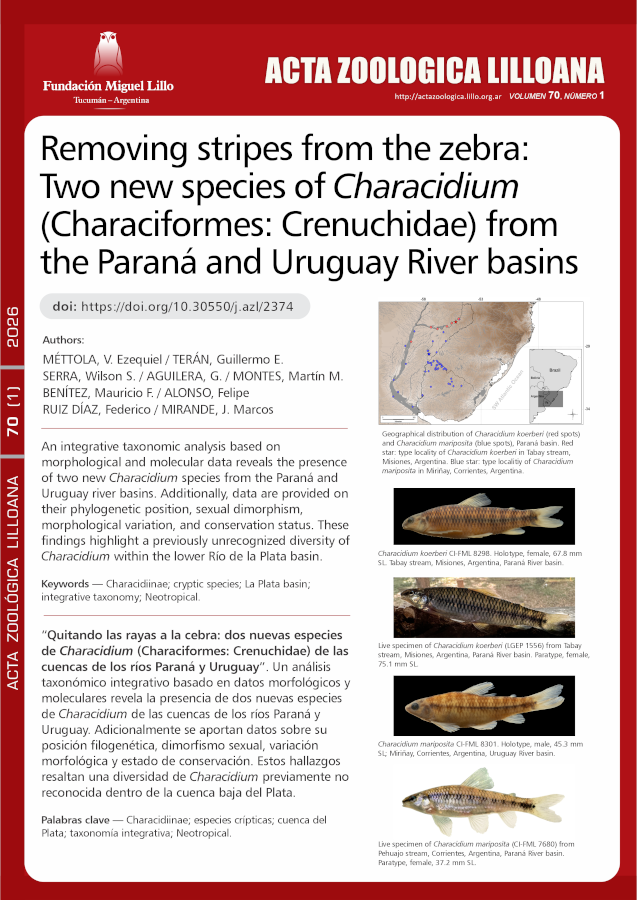
An integrative taxonomic analysis based on morphological and molecular data reveals the presence of two new species of Characidium from the Paraná and Uruguay River basins. These new taxa were historically identified as Characidium cf. zebra or Characidium fasciatum. However, biogeographic, morphological, and molecular evidence indicates that they are phylogenetically closer to C. borellii than to the species of the complex C. zebra. Both species are distinguished from their congeners by a unique combination of characters: a completely scaled isthmus, a complete lateral line, 14 scales around the caudal peduncle, two rows of dentary teeth, mostly hyaline fins, regular dark transverse bars on the body, the presence of the parietal branch of the supraorbital canal, and specific osteological traits. The new species are distinguished to each other by their pectoral-fin ray counts (13–14 vs. 12 or fewer), coloration patterns (a diffuse vs. a well-defined longitudinal stripe), and internal anatomical features, specifically the number of pseudotympanum openings, swimbladder size, and vertebral counts. Additionally, we provide data regarding their phylogenetic position, sexual dimorphism, morphological variation, and conservation status. These findings highlight a previously unrecognized diversity of Characidium within the lower La Plata basin.
Downloads
References
Abell, R., Thieme, M.L., Revenga, C., Bryer, M., Kottelat, M., Bogutskaya, N., ... & Petry, P. (2008). Freshwater ecoregions of the world: a new map of biogeographic units for freshwater biodiversity conservation. BioScience, 58(5), 403–414.
Agudelo-Zamora, H. D., Ortega-Lara, A., & Taphorn, D. C. (2020a). Characidium chancoense, a new species of South American darter from the Río Cauca drainage, Colombia (Characiformes: Crenuchidae). Zootaxa, 4768(2), 249-263. https://doi.org/10.11646/zootaxa.4768.2.6
Agudelo?Zamora, H. D., Tavera, J., Murillo, Y. D., & Ortega?Lara, A. (2020b). The unknown diversity of the genus Characidium (Characiformes: Crenuchidae) in the Chocó biogeographic region, Colombian Andes: two new species supported by morphological and molecular data. Journal of Fish Biology, 97(6), 1662–1675. https://doi.org/10.1111/jfb.14527
Almirón, A. E., Casciotta, J. R., Ciotek, L. & Giorgis, P. (2015). Guía de los peces del Parque Nacional Pre-delta. Ciudad Autónoma de Buenos Aires, Administración de Parques Nacionales. https://sib.gob.ar/archivos/bfa004429.pdf
Alonso, F., Terán, G. E., Aguilera, G., Montes, M. M., Serra Alanís, W. S., Calviño, P., Vera-Alcaraz, H. S., Cardoso, Y., Koerber, S. & Mirande, J. M. (2024). Integrative phylogeny of Corydoradinae (Siluriformes: Callichthyidae) with an emphasis on northwestern La Plata species, including descriptions of a new genus and species. Zoologischer Anzeiger, 314, 10–23. https://doi.org/10.1016/j.jcz.2024.11.006
Buckup, P. A. (1992). Redescription of Characidium fasciatum, type species of the Characidiinae (Teleostei, Characiformes). Copeia, 1066-1073. 10.2307/1446639
Buckup, P. A (1993a). Review of the characidiin fishes (Teleostei: Characiformes), with description of four new genera and ten new species. Ichthyological Exploration of Freshwaters, 4, 97–154.
Buckup, P. A. (1993b). Phylogenetic interrelationships and reductive evolution in Neotropical characidiin fishes (Characiformes, Ostariophysi). Cladistics, 9 (3), 305–341. https://doi.org/10.1111/j.1096-0031.1993.tb00227.x
Buckup, P.A., & Hahn, L. (2000). Characidium vestigipinne: a new species of Characidiinae (Teleostei, Characiformes) from Southern Brazil. Ichthyology & Herpetology, 2000(1), 150–155.
Buckup, P. A. & Reis, R. E. (1997). Characidiin genus Characidium (Teleostei, Characiformes) in southern Brazil, with description of three new species. Copeia, 531–548. https://doi.org/10.2307/1447557
Cancino, F. & Aguilera, G. (2016). Ictiofauna. In: Antelo, C., Bulacio, E., Cancino, F., Marigliano, N., Peralta, M., Ramallo, G., & Romero, F. Biodiversidad y fronteras: cuenca del río Bermejo (Salta, Argentina). Fundación Miguel Lillo. pp. 40–44. https://www.lillo.org.ar/revis/cnaturaleza/2016-scn-21.pdf
Casciotta, J. R., Almirón, A. E., Ciotek, L., Giorgis, P., ?í?an, O., Lubomír, P., Klára, D., Croci, Y., Montes, M. M., Iwaszkiw, J. M., & Puentes, A. (2016). Visibilizando lo invisible: un relevamiento de la diversidad de peces del Parque Nacional Iguazú, Misiones, Argentina. Revista Historia Natural, 6 (2), 5–77. https://naturalis.fcnym.unlp.edu.ar/entities/publication/675c5eee-e6f5-465f-bbdc-774337b36a83
Casciotta, J. R., Almirón, A. E., Doubnerová K., L. Piálek, L., & ?í?an, O. (2015). First records of Characidium heirmostigmata and C. serrano (Characiformes: Crenuchidae) from freshwaters of Argentina. Ichthyological Contributions of PecesCriollos 34, 1–3. available as pdf-file at www.pecescriollos.de since 02.Mar.2015
Chernomor, O., Von Haeseler, A. & Minh, B. Q. (2016). Terrace aware data structure for phylogenomic inference from supermatrices. Systematic biology, 65 (6), 997–1008. https://doi.org/10.1093/sysbio/syw037
Dagosta, F. C. P., Monção, M. S., Nagamatsu, B. A., Pavanelli, C. S., Carvalho, F. R., Lima, F. C., Langeani, F., Dutra, G. M., Ota, R. R., Seren, T. J., Tagliacollo, V., Menezes, N. A., Britski, H. A., & Pinna, M. D. (2024). Fishes of the upper rio Paraná basin: diversity, biogeography and conservation. Neotropical Ichthyology, 22(1), e230066. https://doi.org/10.1590/1982-0224-2023-0066
Díaz, J., Villanova, G. V., Brancolini, F., del Paso, F., Posner, V. M., Grimberg, A. & Arranz, S. E. (2016). First DNA barcode reference library for the identification of South American freshwater fish from the lower Paraná river. PLoS One, 11(7), e0157419.
Dománico, R. L., Arrieta, P. M., & Colautti, D. C. (2021). Análisis espacio temporal de las capturas de peces en el río Uruguay en el tramo compartido entre Argentina y Uruguay, mediante la utilización de redes agalleras, red de arrastre, trampa y espinel. Brazilian Journal of Animal and Environmental Research, 4(3), 4596–4617.
Edgar, R. C. (2004). MUSCLE: multiple sequence alignment with high accuracy and high throughput. Nucleic acids research, 32 (5), 1792–1797. https://doi.org/10.1093/nar/gkh340
Eigenmann, C. H. (1909). Reports on the expedition to British Guiana of the Indiana University and the Carnegie museum, 1908. Report no. 1. Some new genera and species of fishes from British Guiana. Annals of the Carnegie Museum, 6 (1), 4–54. https://www.biodiversitylibrary.org/page/39791370#page/58/mode/1up
Fricke, R., Eschmeyer, W. N., & Van der Laan, R. (editors). (2019). Eschmeyer´s catalog of fishes: genera, species, references. San Francisco: California Academy of Science. Available from : https://researcharchive.calacademy.org/research/ichthyology/catalog/fishcatmain.asp (accessed 24 June 2025)
Goloboff, P. A. (1993). Estimating character weights during tree search. Cladistics, 9(1), 83–91. https://doi.org/10.1111/j.1096-0031.1993.tb00209.x
Goloboff, P. A. (2014). Extended implied weighting. Cladistics: the international journal of the Willi Hennig Society, 30 (3), 260–272. https://doi.org/10.1111/cla.12047
Goloboff, P. A, Farris, J. S., Källersjö, M., Oxelman, B., Ramiréz, M. J. & Szumik, C. A. (2003). Improvements to resampling measures of group support. Cladistics, 19 (4), 324–332. https://doi.org/10.1111/j.1096-0031.2003.tb00376.x
Goloboff, P. A., Farris, J. S. & Nixon, K. C. (2008). TNT, a free program for phylogenetic analysis. Cladistics, 24 (5), 774–786. https://doi.org/10.1111/j.1096-0031.2008.00217.x
Hammer, Ø., & Harper D. A. (2001). Past: Paleontological statistics software package for education and data analysis. Palaeontologia electronica, 4 (1), 1. https://palaeo-electronica.org/2001_1/past/issue1_01.htm
Hoang, D. T., Chernomor, O., Von Haeseler, A., Minh, B. Q. & Vinh, L. S (2018). UFBoot2: improving the ultrafast bootstrap approximation. Molecular biology and evolution, 35 (2), 518–522. https://doi.org/10.1093/molbev/msx281
IUCN Red List. Categories & Criteria: Version 3.1. IUCN Species Survival Commission, Gland, Switzerland. 2001. Accessed at https://www.iucnredlist.org/
Kalyaanamoorthy, S., Minh, B. Q., Wong, T. K., Von Haeseler, A. & Jermiin, L. S. (2017). ModelFinder: fast model selection for accurate phylogenetic estimates. Nature methods, 14 (6), 587–589. https://doi.org/10.1038/nmeth.4285
Kumar, S., Stecher, G., Li, M., Knyaz, C. & Tamura, K. (2018). Mega X: molecular evolutionary genetics analysis across computing platforms. Molecular biology and evolution, 35(6), 1547–1549. doi:10.1093/molbev/msy096
Langeani, F., Castro, R. M. C., Oyakawa, O. T., Shibatta, O. A., Pavanelli, C. S., & Casatti, L. (2007). Ichthyofauna diversity of the upper rio Paraná: present composition and future perspectives. Biota Neotropica, 7(3). https://www.biotaneotropica.org.br/BN/article/view/350
Larsson, A. (2014). AliView: a fast and lightweight alignment viewer and editor for large datasets. Bioinformatics, 30 (22), 3276-3278. https://doi.org/10.1093/bioinformatics/btu531
Leitão, R. P & Buckup P. A. (2014). A New Species of Characidium(Characiformes: Crenuchidae) from Coastal Basins of Serra do Mar, Southeastern Brazil. Copeia, 2014(1):14–22. 10.1643/CI-12-137
Liotta, J. R. (2006). Distribución geográfica de los peces de aguas continentales de la República Argentina. Serie Documentos-ProBiota; http://sedici.unlp.edu.ar/bitstream/handle/10915/10949/Documento_completo.pdf?sequence=1&isAllowed=y
Loureiro, M., González-Bergonzoni, I., Teixeira de Melo, F. (2023). Peces de Agua Dulce de Uruguay. Segunda Edición. Laboratorio Zoología de Vertebrados, Facultad de Ciencias, Universidad de la República. https://udelar.edu.uy/retema/wp-content/uploads/sites/30/2023/10/Peces-de-agua-dulce-de-Uruguay.-Segunda-Edicion.pdf
Loureiro, M., de Sa, R., Serra, W. S., Alonso, F., Krause Lanes, L. E., Vieira Volcan, M., Calviño, P., Nielsen, D., Duarte, A. & Garcia, G. (2018). Review of the family Rivulidae (Cyprinodontiformes, Aplocheiloidei) and a molecular and morphological phylogeny of the annual fish genus Austrolebias Costa 1998. Neotropical Ichthyology, 16 (3), e180007. https://doi.org/10.1590/1982-0224-20180007
Malanski, E., Sarmento-Soares, L. M., Silva-Malanski, A. C. G., Lopes, M. M., Ingenito, L. F. D. S., & Buckup, P. A. (2019). A new species of Characidium (Characiformes: Crenuchidae) from coastal basins in the Atlantic Rainforest of eastern Brazil, with phylogenetic and phylogeographic insights into the Characidium alipioi species group. Neotropical Ichthyology, 17(2), e180121. https://doi.org/10.1590/1982-0224-20180121
Melo, M.R.S. (2001). Sistemática, filogenia e biogeografia do grupo Characidium lauroi Travassos, 1949 (Characiformes, Crenuchidae). Unpublished M. Sc. Thesis, Universidade Federal do Rio de Janeiro, Rio de Janeiro, 95p.
Melo, M. R. S, & Espíndola, V. C. (2016). Description of a new species of Characidium Reinhardt, 1867 (Characiformes: Crenuchidae) from the Chapada Diamantina, Bahia, and redescription of Characidium bimaculatum Fowler, 1941. Zootaxa, 4196(4):552. 10.11646/zootaxa.4196.4.5
Melo, M. R. S. & Oyakawa, O. T (2015). A new species of Characidium Reinhardt (Characiformes, Crenuchidae) with a distinctively dimorphic male. Copeia, 103 (2), 281–289. https://doi.org/10.1643/CI-14-073
Mendonca, M. B., & Netto-Ferreira, A. L. (2015). New species of Characidium (Characiformes: Crenuchidae) from the rio Tapajós and rio Xingu drainages, Pará, Brazil. Zootaxa, 4021(1), 187-194. 10.11646/zootaxa.4021.1.9
Méttola, V. E., Terán, G. E., Aguilera, G., Montes, M. M., Alonso, F. & Mirande, J. M. (2025). Integrative study of Characidium borellii (Characiformes: Crenuchidae): phylogenetic relationships and geographic distribution. Neotropical Ichthyology, 23(3): https://doi.org/10.1590/1982-0224-2025-0022
Miquelarena, A. M., Protogino, L. C., Filiberto, R., & López, H. L. (2002). A new species of Bryconamericus (Characiformes: Characidae) from the Cuña-Pirú creek in north-eastern Argentina, with comments on accompanying fishes. aqua, 6. https://sedici.unlp.edu.ar/handle/10915/88573
Mirande, J. M. (2017). Combined phylogeny of ray?finned fishes (Actinopterygii) and the use of morphological characters in large?scale analyses. Cladistics, 33(4), 333–350. https://doi.org/10.1111/cla.12171
Mirande, J. M. & Koerber, S. (2020). Checklist of the Freshwater Fishes of Argentina. 2nd edition. (CLOFFAR-2). Ichthyological Contributions of PecesCriollos, 72, 1–181. https://pecescriollos.de/wp-content/uploads/2020/12/ICP-72-Mirande-Koerber-2020-CLOFFAR-2.pdf
Mirande, J. M., Baicere?Silva, C. M., Santana, J. C., & Quagio?Grassiotto, I. (2023). Sperm phylogeny of Characidae (teleostei, Characiformes). Zoologica Scripta, 52(2), 117-135. https://doi.org/10.1111/zsc.12577
Netto-Ferreira, A. L., Birindelli, J. L. O. & Buckup, P. A. (2013). A new miniature species of Characidium Reinhardt (Ostariophysi: Characiformes: Crenuchidae) from the headwaters of the rio Araguaia, Brazil. Zootaxa. 2013; 3664(3):361. 10.11646/zootaxa.3664.3.6
Oliveira-Silva, L., Batalha-Filho, H., Camelier, P., & Zanata, A. M. (2024). Underestimated diversity in Characidium (Characiformes: Crenuchidae) from Neotropical rivers revealed by an integrative approach. Systematics and Biodiversity, 22(1), 2346510. DOI: 10.1080/14772000.2024.2346510
Oliveira-Silva, L., Britzke, R., Meza-Vargas, V., Hidalgo, H. M., Faustino-Fuster, D., Oliveira, C. & Zanata, A. M. (2025). Morphological and molecular evidence reveals a new species of Characidium from the Ucayali-Urubamba Piedmont, Peru, and novel molecular clades are proposed within the genus. Journal of Fish Biology, 1–12. https://doi.org/10.1111/jfb.70261
Oliveira-Silva, L., Santos, S. A. D., Lopes, M. M., & Zanata, A. M. (2022). A new species of Characidium (Characiformes: Crenuchidae) from the rio Doce basin, Brazil. Neotropical Ichthyology, 20(01), e210125. https://doi.org/10.1590/1982-0224-2021-0125
Ota, R. R., Deprá, G. D. C., Graça, W. J. D., & Pavanelli, C. S. (2018). Peixes da planície de inundação do alto rio Paraná e áreas adjacentes: revised, annotated and updated. Neotropical Ichthyology, 16, e170094. https://doi.org/10.1590/1982-0224-20170094
Paullier D'Acosta, S., Bessonart Rodríguez, J. M., Brum, E., & Loureiro Barrella, M. (2019). Lista de especies de peces de la cuenca del Río Queguay, Río Uruguay bajo. Boletín de la Sociedad Zoológica del Uruguay, 2019, 28 (2): 66-78.
Palumbi, S., Martin, A., Romano, S., McMillan, W. O., Stice, L. & Grabowski, G. (1991). The simple fool’s guide to PCR. Honolulu: Department of Zoology and Kewalo Marine Laboratory, Univ Hawaii. https://stacks.stanford.edu/file/druid:yh393jm6703/Simple_Fool%27s_Master%20PCR.pdf
Pasquini, A. L. & Depetris, P. J. (2006). Discharge trends and flow dynamics of South American rivers draining the southern Atlantic seaboard: An overview. Journal of hydrology, 333 (2-4), 385–399. https://doi.org/10.1016/j.jhydrol.2006.09.005
Pereira, L. H., Hanner, R., Foresti, F., & Oliveira, C. (2013). Can DNA barcoding accurately discriminate megadiverse Neotropical freshwater fish fauna?. BMC genetics, 14(1), 20. https://doi.org/10.1186/1471-2156-14-20
Serra, W. S., Bessonart, J., Teixeira de Mello, F., Duarte, A., Malabarba, L. & Loureiro, M. (2014). Peces del Río Negro. Montevideo, MGAP-DINARA. https://www.researchgate.net/publication/263735043_Peces_del_Rio_Negro
Sabaj, M. H. (2025). Codes for Natural History Collections in Ichthyology and Herpetology (online supplement). Version 9.7 (3 Mar 2025). Electronically accessible at https://asih.org, American Society of Ichthyologists and Herpetologists, Washington, DC. 2025
Serra, W., Scarabino, F., Méttola, V. E., Montes, M. M., Terán, G. E., Moncada, M., Sanguinetti, G., Duarte, A., & García, M. (2025). Characidium serrano Buckup & Reis, 1997 (Characiformes, Crenuchidae): insights into phylogenetic relationships, and comments on distribution. Fundación Miguel Lillo, Acta Zoológica Lilloana, 69, 1–28. http://dx.doi.org/10.30550/j.azl/2097
Silveira, L. G., Langeani, F., Graça, W. J. D., Pavanelli, C. S., & Buckup, P. A. (2008). Characidium xanthopterum (Ostariophysi: Characiformes: Crenuchidae): a new species from the central Brazilian Plateau. Neotropical Ichthyology, 6, 169-174. https://doi.org/10.1590/S1679-62252008000200003
Souza-Shibatta, L., Tonini, J. F. R., Abrahao, V. P., Jaarduli, L. R., Oliveira, C., Malabarba, L. R., Sofia, S. H. & Shibatta, O. A. (2018). Reappraisal of the systematics of Microglanis cottoides (Siluriformes, Pseudopimelodidae), a catfish from southern Brazil. PLoS ONE, 13 (7), e0199963. https://doi.org/10.1371/journal.pone.0199963
Taylor, W. & Van Dyke, G. C. (1985). Revised procedures for staining and clearing small fishes and other vertebrates for bone and cartilage study. Cybium, 9 (2), 107–119. https://sfi-cybium.fr/en/node/2423
Teixeira, T. F. & Melo, M. R. S. (2020). A new species of Characidium Reinhardt (Characiformes: Crenuchidae) from the Río Huallaga, central Peruvian Amazon, with a review on secondary sexual characters in the genus. Journal of Fish Biology, 98 (1), 178–188. https://doi.org/10.1111/jfb.14568
Terán, G. E., Benitez, M. F., & Mirande, J. M. (2020). Opening the Trojan horse: phylogeny of Astyanax, two new genera and resurrection of Psalidodon (Teleostei: Characidae). Zoological Journal of the Linnean Society, 190(4), 1217-1234. https://doi.org/10.1093/zoolinnean/zlaa019
Terán, G. E., Jarduli, L., Alonso, F., Mirande, J. M. & Shibatta, O. A. (2016). Microglanis nigrolineatus, a new species from northwestern Argentina (Ostariophysi: Pseudopimelodidae). Ichthyological Exploration Of Freshwaters, 27 (3), 193–202. https://www.researchgate.net/publication/310603805_Microglanis_nigrolineatus_a_new_species_from_northwestern_Argentina_Ostariophysi_Pseudopimelodidae
Terán, G. E., Ferrer J., Benitez M., Alonso F., Aguilera G. & Mirande J. M. (2017).
Living in the waterfalls: A new species of Trichomycterus (Siluriformes: Trichomycteridae) from Tabay stream, Misiones, Argentina.
Plos One, 12(6), e0179594. https://doi.org/10.1371/journal.pone.0179594
Trifinopoulos, J., Nguyen, L. T., von Haeseler, A., & Minh, B. Q. (2016). W-IQ-TREE: a fast online phylogenetic tool for maximum likelihood analysis. Nucleic acids research, 44(1), 232–235.
Ward, R. D., Zemlak, T. S., Innes, B. H., Last, P. R., & Hebert, P. D. (2005). DNA barcoding Australia's fish species. Philosophical Transactions of the Royal Society B Biological Science, 360 (1462), 1847–57. https://doi.org/10.1098/rstb.2005.1716
Zanata, A. M., Britzke, R., Meza-Vargas, V., Hidalgo, M. H., Faustino-Fuster, D. & Oliveira-Silva, L. (2025). A remarkable new Characidium (Characiformes: Crenuchidae) from tributaries of río Marañón, Loreto, Peru, with unique fin bony processes in both sexes. Neotropical Ichthyology, 23(3): e250047. https://doi.org/10.1590/1982-0224-2025-0047
Zanata, A. M., & Camelier, P. (2015). Two new species of Characidium Reinhardt (Characiformes: Crenuchidae) from northeastern Brazilian coastal drainages. Neotropical Ichthyology, 13(03), 487–498. https://doi.org/10.1080/14772000.2024.2346510
Zanata, A. M., Oliveira, C., & Oliveira?Silva, L. (2024). Integrative taxonomy reveals a new species of Characidium (Characiformes: Crenuchidae) shared by tributaries of upper Tapajós and Xingu river basins, Brazil. Journal of Fish Biology, 105(6), 1929–1938. DOI: 10.1111/jfb.15938
Zanata, A. M., Oliveira-Silva, L., & Ohara, W. M. (2023). A new sexually dichromatic miniature Characidium (Characiformes: Crenuchidae) from the rio Guaporé, rio Madeira basin, Brazil, with remarkable morphological novelties to the genus. Neotropical Ichthyology, 21, e220059. https://doi.org/10.1590/1982-0224-2022-0059
Downloads
Additional Files
Published
How to Cite
Issue
Section
License
Copyright (c) 2026 Acta Zoológica Lilloana

This work is licensed under a Creative Commons Attribution-NonCommercial-NoDerivatives 4.0 International License.