Contraction or expansion? Modeling the response of South American Hedeoma (Lamiaceae) species to future climate shifts
Autores
-
Marina L. Arce
Escuela Superior de Ciencias Exactas y Naturales, Universidad de Morón. Buenos Aires, Argentina.
 https://orcid.org/0009-0009-3064-5655
-
Federico O. Robbiati
Facultad de Ciencias Exactas, Físicas y Naturales. Instituto Multidisciplinario de Biología Vegetal, CONICET - Universidad Nacional de Córdoba. Córdoba, Argentina.
https://orcid.org/0000-0002-6841-1872
-
Patricia Peralta
Escuela Superior de Ciencias Exactas y Naturales, Universidad de Morón. Buenos Aires, Argentina.
https://orcid.org/0000-0003-1099-4275
DOI:
 https://doi.org/10.30550/j.lil/2479
Palavras-chave:
Climate, endemism, MaxEnt, soilResumo
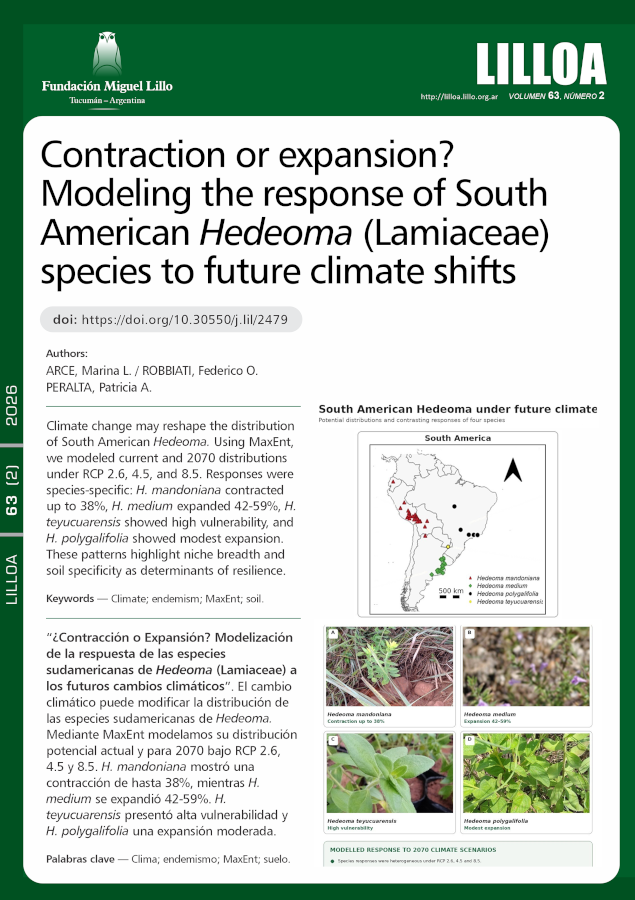
Climate change is driving significant shifts in the geographic distribution of plant species, particularly affecting those with medicinal and cultural value. In this study, we modeled the current and future (2070) potential distributions of four South American Hedeoma species (H. mandoniana, H. medium, H. polygalifolia, and the micro-endemic H. teyucuarensis) using MaxEnt and three climate scenarios (RCP 2.6, 4.5, and 8.5). Our results reveal heterogeneous responses: H. mandoniana is projected to undergo a significant range contraction (up to 38%) and an upslope displacement in the Andes, driven by elevation and clay content. In contrast, H. medium showed a robust expansion potential (42-59%) toward Uruguay, likely favored by greater climate stability and its edaphic generalist nature. The micro-endemic H. teyucuarensis species exhibited high vulnerability due to its extremely narrow thermal tolerance and dependence on specific sandy soils in Misiones, Argentina. The present study emphasizes that niche breadth and soil specificity are critical determinants of climate change resilience. The Misiones Province Law XVI–No. 185 declares Hedeoma teyucuarensis a “Natural Monument and of Public Interest” for the purposes of preservation, conservation, and reproduction. We propose urgent in situ conservation priority for H. teyucuarensis, currently under IUCN assessment, to mitigate the risks posed by environmental shifts and overexploitation.
Downloads
Referências
Barboza, G. E., Cantero, J. J., Núñez, C. O., Pacciaroni, A. & Ariza Espinar, L. (2006). Flora Medicinal de la Provincia de Córdoba (Argentina). Museo Botánico, Universidad Nacional de Córdoba.
Bastien, J. W. (1983). Pharmacopeia of Qollahuaya Andeans. Journal of Ethnopharmacology 8 (1): 97-111.
Bean, W. T., Stafford, R. & Brashares, J. S. (2012). The effects of small sample size and sample bias on threshold selection and accuracy assessment of species distribution models. Ecography 35 (3): 250-258. https://doi.org/10.1111/j.1600-0587.2011.06545.x
Bedair, H., Hazzazi, Y., Abo Hatab, A., Halmy, M. W. A., Dakhil, M. A., Alghariani, M. S., Sumayli, M., El-Shabasy, A. & El-Khalafy, M. M. (2025). Predicting climate-driven shift of the East Mediterranean endemic Cynara cornigera Lindl. Frontiers in Plant Science 16. https://doi.org/10.3389/fpls.2025.1461639
Cabrera, A. L. & Willink, A. (1980). Biogeografía de América Latina. (2.ª ed. corregida). Secretaría General de la Organización de los Estados Americanos.
Cárdenas-Valdovinos J. G., Mena-Violante H. G., Rosas-Cárdenas F. F., Angoa-Pérez M. V. & Luna-Suárez S. (2025). Phytochemistry and Biological Activities of Hedeoma piperita Benth. (Quiensabe). International Journal of Molecular Sciences 26 (4): 1640. https://doi.org/10.3390/ijms26041640
Di Rienzo, J. A., Casanoves, F., Balzarini, M., González, L., Tablada, M. & Robledo, C. (2020). InfoStat (Version 2020) [Software]. Universidad Nacional de Córdoba. https://www.infostat.com.ar/
De Diego, F. C., Nores, M. J., Anton, A. M., Fortunato, R. H. & Robbiati, F. O. (2026). Climate change could negatively affect the distribution of xerophytic legume shrubs (Senna series Aphyllae, Caesalpinioideae) in southern South America drylands. New Zealand Journal of Botany 64 (1): e70062
Elith, J. & Leathwick, J. R. (2009). Species distribution models: Ecological explanation and prediction across space and time. Annual Review of Ecology, Evolution, and Systematics 40: 677-697. https://doi.org/10.1146/annurev.ecolsys.110308.120159
Fick, S. E. & Hijmans, R. J. (2017). WorldClim 2: new 1km spatial resolution climate surfaces for global land areas. International Journal of Climatology 37: 4302-4315. https://doi.org/10.1002/joc.5086
Flora e Funga do Brasil (2025). Jardim Botânico do Rio de Janeiro. Retrieved from http://floradobrasil.jbrj.gov.br/
Fournet, A., Ferreira, M. E., Arias, A. R., Ortiz, S. T., Fuentes, S., Nakayama, H., Schinini, A. & Hocquemiller, R. (1996). Insecticidal activity of medicinal plants of the Paraguayan Chaco against Triatoma infestans. Journal of Ethnopharmacology 52: 145-149.
Galindo, G., Armenteras, D. & Alamaraz, J. S. (2010). Modelamiento de la distribución de especies: estado del arte e implicaciones en la conservación de la biodiversidad. Gestión y Ambiente 13: 69-80.
García, S. A., Nores, M. J., De Diego, F., Bach, H. G., Peralta, P. A. & Robbiati, F. O. (2025). Climate change and shifting distributions of medicinal and aromatic Lippia and Salimenaea species (Verbenaceae) in southern South America: a species distribution modelling approach. Plant Ecology and Evolution 158: 403-417. https://doi.org/10.5091/plecevo.157560
Gilani, H., Goheer, M. A., Ahmad, H. & Hussain, K. (2020). Under predicted climate change: distribution and ecological niche modelling of six native tree species in Gilgit-Baltistan, Pakistan. Ecological Indicators 111: 106049. https://doi.org/10.1016/j.ecolind.2019.106049
Girault, L. (1984). Kallawaya: Guérisseurs itinérants des Andes. Recherches sur les pratiques médicinales et magiques (Collection Mémoires, 107). Institut Français de Recherche Scientifique pour le Développement en Coopération (ORSTOM).
Grimm, A. M. (2011). Interannual climate variability in South America: Impacts on seasonal precipitation, extreme events, and possible effects of climate change. Stochastic Environmental Research and Risk Assessment 25: 537-554.
Grossi, M. A., Draper, D., Apodaca, M. A., Katinas, L. & Gutiérrez, D. G. (2017). The road to 2020 targets and the learnings from the emblematic South American plant genus Nassauvia (Asteraceae). Biodiversity and Conservation 26: 329-351.
Hengl, T., Mendes de Jesus, J., Heuvelink, G. B., Ruiperez Gonzalez, M., Kilibarda, M., Blagoti?, A., Shangguan, W., Wright, M. N., Geng, X., Bauer-Marschallinger, B., Guevara, M. O., Vargas, R., MacMillan, R. A., Batjes, N. H., Leenaars, J. G. B., Ribeiro, E., Wheeler, I., Mante, S. & Kempen, B. (2017). SoilGrids250m: global gridded soil information based on machine learning. PLoS ONE 12: e0169748. https://doi.org/10.1371/journal.pone.0169748
Hernández, P. A., Graham, C. H., Master, L. L. & Albert, D. L. (2006). The effect of sample size and species characteristics on performance of different species distribution modeling methods. Ecography 29 (5): 773-785. https://doi.org/10.1111/j.0906-7590.2006.04700.x
Herrando-Moraira, S., Vitales, D., Nualart, N., Gómez-Bellver, C., Ibáñez, N., Massó, S., Cachón-Ferrero, P., González-Gutiérrez, P. A., Guillot, D., Herrera, I., Shaw, D., Stinca, A., Wang, Z. & López-Pujol, J. (2020). Global distribution patterns and niche modelling of the invasive Kalanchoe × houghtonii (Crassulaceae). Scientific Reports 10: 3143. https://doi.org/10.1038/s41598-020-60079-2
Huaman Espinoza, W. W. & Zurita Valdez, E. Y. (2020). Evaluación bioconservante del aceite esencial de Pacha Muña (Hedeoma Wedd), en la vida útil de la lechuga (Lactuca sativa L.) mínimamente procesada, Palcamayo-Tarma. (Bachelor thesis), Universidad Nacional del Centro del Perú, Perú. Retrieved from http://www.uncp.edu.pe
Huang, Q., Liu, H., Li, C., Zhu, X., Yuan, Z., Lai, J., Cao, M., Huang, Z., Yang, Y., Zhuo, S., Lü, Z. & Zhang, G. (2024). Predicting the geographical distribution and niche characteristics of Cotoneaster multiflorus based on future climate change. Frontiers in Plant Science 15. https://doi.org/10.3389/fpls.2024.1360190
Intergovernmental Panel on Climate Change (IPCC). (2023). Climate Change 2023: Synthesis Report. Contribution of Working Groups I, II and III to the Sixth Assessment Report of the Intergovernmental Panel on Climate Change [Core Writing Team, H. Lee & J. Romero, eds.]. IPCC, Geneva, Switzerland. https://doi.org/10.59327/IPCC/AR6-9789291691647
Kang, Y., Lin, F., Yin, J., Han, Y., Zhu, M., Guo, Y., Tang, F. & Li, Y. (2025). Projected distribution patterns of Alpinia officinarum in China under future climate scenarios: insights from optimized Maxent and Biomod2 models. Frontiers in Plant Science 16. https://doi.org/10.3389/fpls.2025.1517060
Kass, J. M., Vilela, B., Aiello-Lammens, M. E., Muscarella, R., Merow, C., Kawohl, T., Kreft, H., Soria-Auza, R. W., Zimmermann, N. E., Linder, H. P. & Kessler, M. (2018). Wallace: a flexible platform for reproducible modeling of species niches and distributions built for community expansion. Methods in Ecology and Evolution 9: 1151-1156. https://doi.org/10.1111/2041-210X.12945
Keller, H. A. & Tressens, S. G. (2016). Hedeoma teyucuarensis (Lamiaceae), una especie nueva de Misiones, Argentina. Darwiniana, nueva serie 4: 5-11. https://doi.org/10.14522/darwiniana.2016.41.692
Larsen, T. H., Brehm, G., Navarrete, H., Franco, P., Gómez, H., Mena, J. L., Morales, V., Argollo, J., Blacutt, L. & Canhos, V. (2012). Desplazamientos de los rangos de distribución y extinciones impulsados por el cambio climático en los Andes tropicales: síntesis y orientaciones. In: S. K. Herzog, R. Martínez, P. M. Jørgensen, H. Tiessen (Eds.), Cambio climático y biodiversidad en los Andes tropicales (pp. 57–78). Instituto Interamericano para la Investigación del Cambio Global (IAI) & Scientific Committee on Problems of the Environment (SCOPE).
Laupa Roman, J. & Vengoa Valdiglesias, B. (2013). Efecto de tres especies de lamiáceas y tubérculos verdeados de papa sobre Symmetrischema tangolias (Gyen) en condiciones de laboratorio. Cantua 15: 41-47.
Lobo, J. M., Jiménez-Valverde, A. & Real, R. (2008). AUC: a misleading measure of the performance of predictive distribution models. Global Ecology and Biogeography 17: 145-151. https://doi.org/10.1111/j.1466-8238.2007.00358.x
Meinshausen, M., Smith, S. J., Calvin, K., Daniel, J. S., Kainuma, M.L., Lamarque, J. F., Matsumoto, K., Montzka, S. A., Raper, S. C. B., Riahi, K., Thomson, A., Velders, G. J. M. & van Vuuren, D. P. (2011). The RCP greenhouse gas concentrations and their extensions from 1765 to 2300. Climatic Change 109: 213-241. https://doi.org/10.1007/s10584-011-0156-z
Nagahama, N. & Bonino, E. E. (2020). Modeling the potential distribution of Valeriana carnosa Sm. in Argentinean Patagonia: a proposal for conservation and in situ cultivation considering climate change projections. Journal of Applied Research on Medicinal and Aromatic Plants 16: 100240. https://doi.org/10.1016/j.jarmap.2020.100240
Neto dos Santos, G., Silva, A. & Higuchi, P. (2023). Subtropical high-montane forest climate refuges in Brazil. Scientia Agricola 80. https://doi.org/10.1590/1678-992X-2022-0044
Peralta, P. A., Guariniello, J. & Escandón, A. S. (2020). Revisión de la situación de Hedeoma multiflora Benth. (Peperina de las Lomas): especie aromática medicinal argentina en riesgo. Boletín Latinoamericano y del Caribe de Plantas Medicinales y Aromáticas 19: 1-14.
Peralta, P. A., Nores, M. J., Bach, H. G. & Robbiati, F. O. (2024). Facing climate change: Range dynamics and chromosome diversity in Hedeoma multiflora Benth., a South American aromatic-medicinal plant at risk. Flora 315: 152519.
https://doi.org/10.1016/j.flora.2024.152519
Pestalozzi, H. U. & Torrez, M. A. (1998). Flora ilustrada altoandina: La relación entre hombre, planta y medio ambiente en el Ayllu Majasaya Mujlli (Prov. Tapacarí, Depto. Cochabamba, Bolivia). Editorial Herbario Nacional de Bolivia - Herbario Forestal Nacional “Martín Cárdenas”.
Peterson, A. T. (2007). Why not WhyWhere: the need for more complex models of simpler environmental spaces. Ecological Modelling 203: 527-530. https://doi.org/10.1016/j.ecolmodel.2006.12.023
Peterson, A. T., Papes, M. & Soberón, J. (2008). Rethinking receiver operating characteristic analysis applications in ecological niche modeling. Ecological Modelling 213: 63-72. https://doi.org/10.1016/j.ecolmodel.2007.11.008
Phillips, S. J., Anderson, R. P., Dudík. M., Schapire, R. E. & Blair, M. E. (2017). Opening the black box: an open source release of Maxent. Ecography, 40: 887-893. https://doi.org/10.1111/ecog.03049
QGIS Development Team. (2021). QGIS Geographic Information System (Version 3.x) [Software]. Open Source Geospatial Foundation. http://qgis.osgeo.org
R Core Team. (2024). R: A language and environment for statistical computing [Software]. R Foundation for Statistical Computing. https://www.R-project.org
Robbiati, F. O., Amarilla, L. D., Anton, A. M., & Fortunato, R. H. (2017). Phenotypic variation in arid and semi-arid zones of southern South America: the case of Senna series Aphyllae (Fabaceae, Caesalpinioideae) Botanical Journal of the Linnean Society 183 (3): 454-473. https://doi.org/10.1093/botlinnean/bow012
Rodríguez-Cravero, J. F., Grossi, M. A., Fuentes-Castillo, T. & Gutiérrez, D. G. (2017). Cambio climático y modelado de distribución de especies de Stevia (Asteraceae) en el noroeste de la Argentina. Ecología Austral 27: 462-473. https://doi.org/10.25260/EA.17.27.3.0.588
Rohde, R. F., Hoffman, M. T., Durbach, I., Venter, Z. & Jack, S. (2019). Vegetation and climate change in the Pro-Namib and Namib Desert based on repeat photography: insights into climate trends. Journal of Arid Environments 165: 119-131. https://doi.org/10.1016/j.jaridenv.2019.01.007
Román-Palacios, C. & Wiens, J. J. (2020). Recent responses to climate change reveal the drivers of species extinction and survival. Proceedings of the National Academy of Sciences 117: 4211-4217. https://doi.org/10.1073/pnas.191300711
Scrivanti, L. R. & Anton, A. M. (2020). Spatial distribution of Poa scaberula (Poaceae) along the Andes. Heliyon 6: e05220. https://doi.org/10.1016/j.heliyon.2020.e05220
Scrivanti, L. R. & Anton, A. M. (2021). Impact of climate change on the Andean distribution of Poa scaberula (Poaceae). Flora 278: 151805. https://doi.org/10.1016/j.flora.2021.151805
Shcheglovitova, M. & Anderson, R. P. (2013). Estimating optimal complexity for ecological niche models: A jackknife approach for species with small sample sizes. Ecological Modelling 269: 9-17. https://doi.org/10.1016/j.ecolmodel.2013.08.011
Siqueira, S., Higuchi, P. & Da Silva, A. (2019). Contemporary and future potential geographic distribution of Cedrela fissilis Vell. under climate change scenarios. Revista Árvore 43: e430303.
Slanis, A. C. & Bulacio, E. (2005). Hedeoma mandonianum (Lamiaceae) en Argentina. Boletín de la Sociedad Argentina de Botánica 40: 285-287.
Soberón, J. & Peterson, A. T. (2005). Interpretation of models of fundamental ecological niches and species’ distributional areas. Biodiversity Informatics 2: 1-10. https://doi.org/10.17161/bi.v2i0.4
Thiers, B. (continuously updated). Index Herbariorum: A global directory of public herbaria and associated staff. New York Botanical Garden's Virtual Herbarium. Retrieved from http://sweetgum.nybg.org/science/ih/
Thuiller, W. (2007). Biodiversity: Climate change and the ecologist. Nature 448: 550-552.
Torresin, J. (2023). Distribución y estado de conservación de especies del género Hedeoma en la provincia de Misiones. Revista Biomas 14: 83-88.
Uribe Botero, E. (2015). El cambio climático y sus efectos en la biodiversidad en América Latina. Documentos de Proyectos, LC/W.693. CEPAL, Santiago, Chile. Retrieved from https://hdl.handle.net/11362/39855
van Vuuren, D. P., Edmonds, J. A., Kainuma, M., Riahi, K. & Weyant, J. (2011). A special issue on the RCPs. Climatic Change 109: 1-4. https://doi.org/10.1007/s10584-011-0157-y
Vercelli, N., Entraigas, I., Scaramuzzino, R., Migueltorena, V. & Alfonso, C. D. (2013). Plantas medicinales de los bajos alcalinos de la cuenca del arroyo del Azul (provincia de Buenos Aires, Argentina). Revista de la Facultad de Ciencias Agrarias Uncuyo 45: 285-298.
Vilaseca, A., Guy, I., Charles, B., Guinaudeau, H., de Arias, A. R. & Fournet, A. (2004). Chemical composition and insecticidal activity of Hedeoma mandoniana essential oils. Journal of Essential Oil Research 16 (4): 380-383. https://doi.org/10.1080/10412905.2004.9698749
Villamonte Cuneo, G. (2018). Modelamiento del efecto del cambio climático en el nicho ecológico fundamental de especies de podocarpáceas peruanas en Sudamérica. (Bachelor thesis), Universidad Ricardo Palma, Perú. Retrieved from https://hdl.handle.net/20.500.14138/1694
Viveros-Valdez, E., Rivas-Morales, C., Carranza-Rosales, A., Mendoza, S. & Schmeda-Hirschmann, G. (2008). Free radical scavengers from the Mexican herbal tea “poleo” (Hedeoma drummondii). Zeitschrift für Naturforschung C 63 (5-6): 341-346.
Wisz, M., Hijmans, R., Jin, L., Peterson, A., Graham, C. & Guisan, A. (2008). Effects of sample size on the performance of species distribution models. Diversity and Distributions 14: 763-773. https://doi.org/10.1111/j.1472-4642.2008.00482.x
Xifreda, C. C. (1999). Lamiaceae. In F. O. Zuloaga & O. Morrone (Eds.), Catálogo de las plantas vasculares de la República Argentina II. Monographs in Systematic Botany from the Missouri Botanical Garden 74: 779-800.
Zhao, Z., Guo, Y., Wei, H., Zhang, Z., & Wang, J. (2018). Responses of two endemic Rhodiola species to climate change on the Tibetan Plateau. Scientific Reports 8: 12693. https://doi.org/10.1038/s41598-018-24360-9
Downloads
Publicado
Como Citar
Edição
Seção
Licença
Copyright (c) 1900 Lilloa

Este trabalho está licenciado sob uma licença Creative Commons Attribution-NonCommercial-ShareAlike 4.0 International License.