Microorganisms associated with epiphytic orchids in southern Ecuador (Loja and Zamora-Chinchipe provinces)
Autores
-
Ximena Galván
Universidad Técnica Particular de Loja (UTPL), Carrera de Bioquímica y Farmacia, Loja, provincia de Loja, Ecuador.
 https://orcid.org/0009-0008-5592-0601
-
María de los Ángeles Paute
Universidad Técnica Particular de Loja (UTPL), Carrera de Bioquímica y Farmacia. Loja, provincia de Loja, Ecuador.
https://orcid.org/0009-0001-9452-5101
-
Stefania Cevallos
Universidad Técnica Particular de Loja (UTPL), Departamento de Ciencias Biológicas y Agropecuarias, Microbial Systems Ecology and Evolution (MS2E) Research Group. Loja, provincia de Loja, Ecuador.
https://orcid.org/0000-0001-5638-5112
DOI:
 https://doi.org/10.30550/j.lil/2360
Palavras-chave:
Epiphytic orchids, microbial isolation, rootsResumo
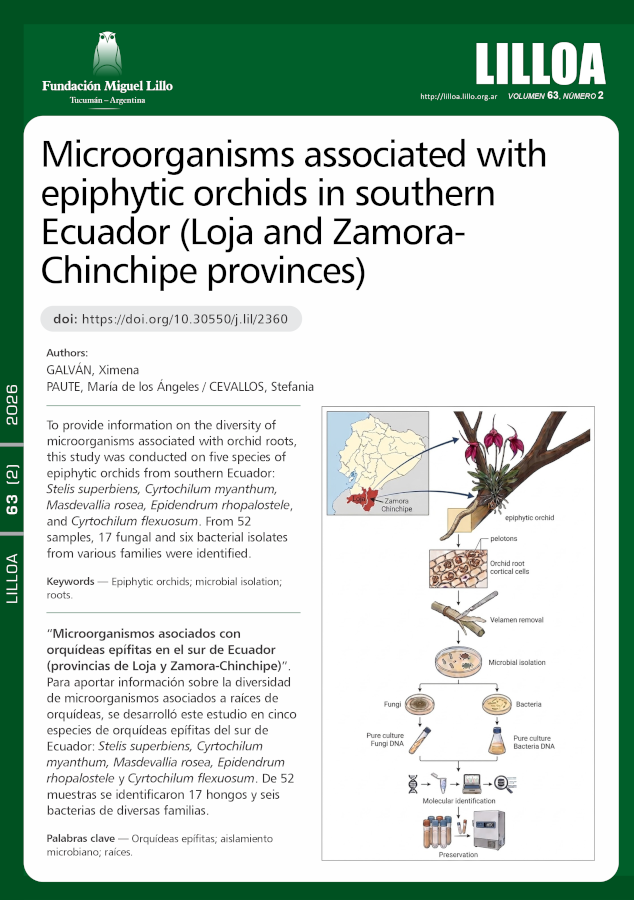
Orchids (Orchidaceae) are one of the most diverse groups of vascular plants, owing their ability to form mutualistic associations with various microorganisms present in their roots. The objective of this study was to isolate and taxonomically identify fungi and bacteria colonizing the roots of five species of epiphytic orchids from southern Ecuador: Stelis superbiens Lindl., Cyrtochilum myanthum (Lindl.) Kraenz, Masdevallia rosea Lindl., Epidendrum rhopalostele Hágsater & Dodson, and Cyrtochilum flexuosum Kunth. A total of 52 samples were collected at two sites in southern Ecuador. Seventeen fungal isolates were obtained, belonging to the families Dermateaceae, Aspergillaceae, Herpotrichiellaceae, Nectriaceae, and Polyporaceae. In addition, six bacteria belonging to the families Pseudomonadaceae, Burkholderiaceae, and Comamonadaceae were also isolated. The results provide information on the diversity of microorganisms harbored by the roots of the studied species and may serve as a baseline for future research on their ecological interactions and potential application in orchid conservation programs.
Downloads
Referências
Alghamdi, S. A. (2019). Influence of mycorrhizal fungi on seed germination and growth in terrestrial and epiphytic orchids. Saudi Journal of Biological Sciences 26 (3): 495-502. https://doi.org/10.1016/j.sjbs.2017.10.021
Arifin, A. R., May, T. W. & Linde, C. C. (2021). New species of Tulasnella associated with Australian terrestrial orchids in the Cryptostylidinae and Drakaeinae. Mycologia 113: 212-230. https://doi.org/10.1080/00275514.2020.1813473
Artursson, V., Finlay, R. D., & Jansson, J. K. (2006). Interactions between arbuscular mycorrhizal fungi and bacteria and their potential for stimulating plant growth. Environmental Microbiology 8 (1): 1-10. https://doi.org/10.1111/j.1462-2920.2005.00942.x
Chaverri, P., Salgado, C., Hirooka, Y., Rossman, A. Y. & Samuels, G. J. (2011). Delimitation of Neonectria and Cylindrocarpon (Nectriaceae, Hypocreales, Ascomycota) and related genera with Cylindrocarpon-like anamorphs. Studies in Mycology 68: 57-78. https://doi.org/10.3114/sim.2011.68.03
Chen, C., Verkley, G. J. M., Sun, G., Groenewald, J. Z. & Crous, P. W. (2016). Redefining common endophytes and plant pathogens in Neofabraea, Pezicula, and related genera. Fungal Biology 120 (11): 1291-1322. https://doi.org/10.1016/j.funbio.2015.09.013
Cueva, A. (2014). Caracterización molecular de hongos micorrízicos aislados a partir de cuatro especies de orquídeas epífitas, en dos pisos altitudinales de bosque montano. (Undergraduate thesis). Universidad Técnica Particular de Loja, Ecuador. http://dspace.utpl.edu.ec/handle/123456789/10242
Durán. C., Rivero, M. & Seemann, P. (2007). Identification of endomycorrhizae in the native Gavilea araucana (Phil.) Correa. Agro Sur 35 (2): 67-69. https://doi.org/10.4206/agrosur.2007.v35n2-32
Esmaeel, Q., Miotto, L., Rondeau, M., Leclère, V., Clément, C., Jacquard, C., Sanchez, L. & Barka, E. A. (2018). Paraburkholderia phytofirmans PsJN-plants interaction: From perception to the induced mechanisms. Frontiers in Microbiology 9. https://doi.org/10.3389/fmicb.2018.02093
Etesami, H. & Glick, B. R. (2024). Bacterial indole-3-acetic acid: A key regulator for plant growth, plant-microbe interactions, and agricultural adaptive resilience. Microbiological Research 281. https://doi.org/10.1016/j.micres.2024.127602
Herpell, J. B., Vanwijnsberghe, S., Peeters, C., Schindler, F., Fragner, L., Bejtovi?, M., Weckwerth, W. & Vandamme, P. (2021). Paraburkholderia dioscoreae sp. Nov., a novel plant associated growth promotor. International Journal of Systematic and Evolutionary Microbiology 71 (9). https://doi.org/10.1099/ijsem.0.004969
Karadži?, D., Stanivukovi?, Z., Milanovi?, S., Sikora, K., Radulovi?, Z., Ra?ko, V., Kardošová, M., ?urkovi?, J. & Milenkovi?, I. (2020). Development of Neonectria punicea pathogenic symptoms in juvenile Fraxinus excelsior trees. Frontiers in Plant Science 11. https://doi.org/10.3389/fpls.2020.592260
Kim, Y. N., Khan, M. A., Kang, S. M., Hamayun, M. & Lee, I. J. (2020). Enhancement of drought-stress tolerance of Brassica oleracea var. italica L. by newly isolated Variovorax sp. YNA59. Journal of Microbiology and Biotechnology 30 (10): 1500-1509 https://doi.org/10.4014/JMB.2006.06010
Kochkina, G. A., Ivanushkina, N. E., Pinchuk, I. P. & Ozerskaya, S. M. (2022). Endophytic Fungi Pezicula radicicola in the root nodules of actinorhizal Plants. Microbiology (Russian Federation) 91 (6): 750-756. https://doi.org/10.1134/S0026261722601622
Malcolm, G. M., Kuldau, G. A., Gugino, B. K. & Jiménez-Gasco, M. D. M. (2013). Hidden host plant associations of soilborne fungal pathogens: An ecological perspective. Phytopathology 103 (6): 538-544. https://doi.org/10.1094/PHYTO-08-12-0192-LE
Natsagdorj, O., Sakamoto, H., Santiago, D. M. O., Santiago, C. D., Orikasa, Y., Okazaki, K., Ikeda, S. & Ohwada, T. (2019). Variovorax sp. Has an optimum cell density to fully function as a plant growth promoter. Microorganisms 7 (3). https://doi.org/10.3390/microorganisms7030082
Novotná, A. & Suárez, J. P. (2018). Molecular detection of bacteria associated with Serendipita sp., a mycorrhizal fungus from the orchid Stanhopea connata Klotzsch in southern Ecuador. Botany Letters 165 (2): 307-313. https://doi.org/10.1080/23818107.2018.1436087
Pangastuti, A., Pitoyo, A., Susilowati, A., Meisari, R., Yuliana, I., Aulia, K., Puspitasari, L. P., Rusiani & Prasojo, H. (2023). Diversity of root bacterial community associated with seven orchid species from Mount Merbabu National Park, Central Java, Indonesia. Biodiversitas 24 (10): 5676-5684. https://doi.org/10.13057/biodiv/d241050
Ramos, E., Salgado, T. & Hernández, A. (2007). Estudio de Bacterias asociadas a orquídeas (Orchidaceae). Lankesteriana International Journal on Orchidology 7: 322-325. http://www.redalyc.org/articulo.oa?id=44339813067
Rasmussen, H. N. & Rasmussen, F. N. (2018). The epiphytic habitat on a living host: reflections on the orchid-tree relationship. Botanical Journal of the Linnean Society 186: 456-472. https://academic.oup.com/botlinnean/articleabstract/186/4/456/4920859
Riofrío, M. L., Cruz, D., Torres, E., de La Cruz, M., Iriondo, J. M. & Suárez, J. P. (2013). Mycorrhizal preferences and fine spatial structure of the epiphytic orchid Epidendrum rhopalostele. American Journal of Botany 100 (12): 2339-2348. https://doi.org/10.3732/ajb.1300069
Saikia, J. & Thakur, D. (2024). A review on endophytic bacteria of orchids: functional roles toward synthesis of bioactive metabolites for plant growth promotion and disease biocontrol. Planta 260 (70). https://doi.org/10.1007/s00425-024-04501-3
Salazar, S. (2018). Aislamiento e identificación de cepas fúngicas de Stanhopea tigrina productoras de giberelinas con efecto benéfico para la orquídea. (Doctoral dissertation). Benemérita Universidad Autonóma de Puebla, México. https://hdl.handle.net/20.500.12371/7956
Salazar, J., Pomavilla, M., Pollard, A., Chicca, E. & Peña, D. (2020). Endophytic fungi associated with roots of epiphytic orchids in two Andean forests in southern Ecuador and their role in germination. Lankesteriana 20 (1): 37-47. https://doi.org/10.15517/LANK.V20I1.41157
Salgado, C. & Crouch, J. A. (2019). Genome resources for the stem and bark canker pathogens Corinectria fuckeliana, Neonectria hederae and N. punicea. Plant Disease 103 (3): 389-391. https://doi.org/10.1094/PDIS-05-18-0904-A
Sarabia, M., Madrigal, R. & Martínez Miguel. (2010). Plantas, hongos micorrízicos y bacterias: su compleja red de interacciones. Biológicas 12: 65-71.
Selosse, M., Petrolli, R., Mujica, M. I., Laurent, L., Perez, B., Figura, T., Bourceret, A., Jacquemyn, H., Li, T., Gao, J., Minasiewicz, J. & Martos, F. (2022). The Waiting Room Hypothesis revisited by orchids: Were orchid mycorrhizal fungi recruited among root endophytes? Annals of Botany 129 (3): 259-270. https://doi.org/10.1093/aob/mcab134
Soto, J. (2018). Biochemical and molecular characterization of bacteria associated with nodules from four legumes in the province of Santa Elena, Ecuador. Ciencia Ergo Sum 25 (1). http://cienciaergosum.uaemex.mx/article/view/9173
Sun, S.-L., Yang, W.-L., Fang, W.-W., Zhao, Y.-X., Guo, L. & Dai, Y.-J. (2018). The plant growth-promoting rhizobacterium Variovorax boronicumulans CGMCC 4969 regulates the level of Indole-3-Acetic acid synthesized from Indole-3-acetonitrile. Applied and Environmental Microbiology 84 (16). https://doi.org/10.1128/aem.00298-18
Tian, F., Liao, X.-F., Wang, L.-H., Bai, X.-X., Yang, Y.-B., Luo, Z.-Q. & Yan, F.-X. (2022). Isolation and identification of beneficial orchid mycorrhizal fungi in Paphiopedilum barbigerum (Orchidaceae). Plant Signaling & Behavior 17: e2005882. https://doi.org/10.1080/15592324.2021.2005882
Tsavkelova, E., Cherdyntseva, T., Botina, S. & Netrusov, A. (2007). Bacteria associated with orchid roots and microbial production of auxin. Microbiological Research 162 (1): 69-76. https://doi.org/10.1016/j.micres.2006.07.014
Varela, L. & Trejo, D. (2001). Los hongos micorrizógenos arbusculares como componentes de la biodiversidad del suelo en México. Acta Zoológica Mexicana (n.s.): 39-51. https://doi.org/10.21829/azm.2001.8401845
Weisburg, W. G., Barns, S. M., Pelletier, D. A. & Lane, D. J. (1991). 16S ribosomal DNA amplification for phylogenetic study. Journal of Bacteriology 173 (2): 697-703. https://doi.org/10.1128/jb.173.2.697703.1991
White, T., Bruns, T., Lee, S. & Taylor, J. (1990). Amplification and Direct Sequencing of Fungal Ribosomal RNA Genes for Phylogenetics. En M. A. Innis, D. H. Gelfand, J. J. Sninsky y T. J. White (Eds.), PCR Protocols: A Guide to Methods and Applications (pp. 315-322). Academic Press.
Yue, Q., Li, Y., Chen, L., Zhang, X., Liu, X., An, Z. & Bills, G. (2018). Genomics-driven discovery of a novel self-resistance mechanism in the echinocandin-producing fungus Pezicula radicicola. Environmental Microbiology 20 (9): 3154-3167. https://doi.org/10.1111/1462-2920.14089
Zhao, Z., Yang, L., Wang, Y., Qian, X., Ding, G., Jacquemyn, H. & Xing, X. (2024). Shifts in bacterial community composition during symbiotic seed germination of a terrestrial orchid and effects on protocorm development. Microbiology Spectrum 12 (12). https://doi.org/10.1128/spectrum.02185-24
Downloads
Publicado
Como Citar
Edição
Seção
Licença
Copyright (c) 1900 Lilloa

Este trabalho está licenciado sob uma licença Creative Commons Attribution-NonCommercial-ShareAlike 4.0 International License.