Conjunto de datos de microscopía óptica sobre la diversidad de polen de angiospermas del distrito de Sirmaur, Himachal Pradesh (India)
Autores/as
-
Rubal Kumari
Department of Botany, Eternal University (EU), Himachal Pradesh-173101, India.
 https://orcid.org/0009-0004-7885-4716
-
Devendra Kumar Srivastava
Department of Botany, Eternal University (EU), Himachal Pradesh-173101, India
https://orcid.org/0000-0003-2971-8502
-
Pallvi Kumari
Department of Botany, Eternal University (EU), Himachal Pradesh-173101, India.
https://orcid.org/0009-0000-5436-7674
-
Gauri Dhiman
Department of Botany, Eternal University (EU), Himachal Pradesh-173101, India
https://orcid.org/0009-0001-7821-977X
-
Kamlesh Kumari Negi
Department of Botany, Daulat Ram College (DRC), University of Delhi, Old Delhi – 110007, India
https://orcid.org/0009-0002-3829-0085
DOI:
 https://doi.org/10.30550/j.lil/2409
Palabras clave:
Morfometría del polen, simetría, tipos de aperturas, viabilidadResumen
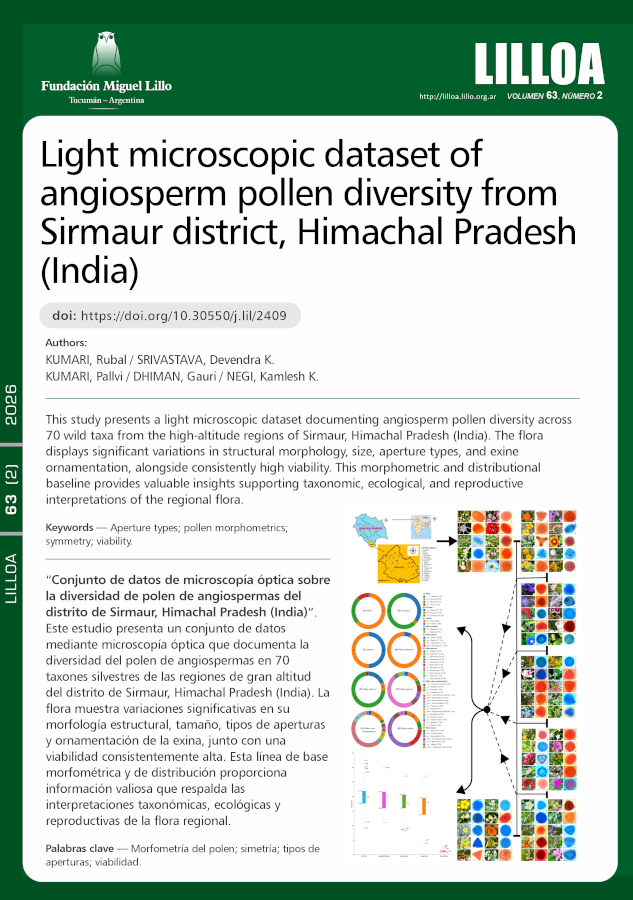
El presente estudio documenta la diversidad de polen de angiospermas de las regiones de gran altitud relativamente inexploradas del distrito de Sirmaur, Himachal Pradesh (India), utilizando un conjunto de datos de microscopía óptica. Comprende análisis morfométricos, de viabilidad y de distribución de 70 taxones silvestres que representan 40 familias. Las hierbas dominan la flora muestreada, seguidas por arbustos, árboles y una planta trepadora. Se observó una variación considerable en el tamaño y la forma del polen, la relación P/E, la simetría, la polaridad, los tipos de aperturas y la ornamentación de la exina. Se identificaron siete categorías de formas, siendo las más comunes las formas esferoidales y prolato-esferoidales. Los granos de polen fueron en su mayoría radialmente simétricos e isopolares, con casos limitados de simetría bilateral y heteropolaridad. Se registraron once tipos de aperturas, predominantemente tri-colpadas. Los patrones de exina variaron desde formas simples hasta complejas. La mayor parte del polen se encontró dentro de un rango de tamaño moderado, con extremos ocasionales que indican adaptación a nivel de especie. A pesar de la diversidad estructural, la viabilidad permaneció consistentemente alta. Este conjunto de datos proporciona información básica sobre la diversidad del polen, apoyando interpretaciones taxonómicas, ecológicas y reproductivas de la flora regional.
Descargas
Citas
Chaya, P. & Kumar, M. J. (2025). Pollen characterization of some tropical flora of Kollapur revenue division of Nagarkurnool district of Telangana State, South India. Annals of Plant Sciences 14 (5): 6832-6840. https://doi.org/ 10.5281/zenodo.15578776
Chowdhery, H. J. & Wadhwa, B. M. (1984a). Flora of Himachal Pradesh: Analysis. Vol. 1. New Delhi: Botanical Survey of India.
Chowdhery H. J. & Wadhwa, B. M. (1984b). Flora of Himachal Pradesh: Analysis. Vol. 2. New Delhi: Botanical Survey of India.
Devi, A. & Mattu, V. K. (2017). Preparation of floral calendar of honey plants of Kangra and adjoining areas of Himachal Pradesh. International Journal of Science and Research 6 (2): 371-378.
Dwarka, S. G., Ghugal, N. C., Panday, A. K. & Tripathi, S. K. (2025). Foraging behaviour of honeybee in Niger (Guizotia abyssinica (L.f.) Cass.): A review. Journal of Biology and Nature 17 (1): 102-111. https://doi.org/10.56557/joban/2025/v17i19236
Effiom, A. C., Neumann, F. H., Scott, L. & Bamford, M. K. (2025). Morphology and ecological significance of Holocene palynomorphs from the Indian Ocean coastal belt biome of South Africa. Palynology 49 (3): 2428382. https://doi.org/10.1080/01916122.2024.2428382
Erdtman, G. (1952). Pollen morphology and plant taxonomy. Geologiska Föreningen i Stockholm Förhandlingar, 74 (4): 526-527. https://doi.org/10.1080/11035895209453507
Erdtman, G. (1960). The acetolysis method: A revised description. Svensk Botanisk Tidskrift 54: 561-564.
Fyfe, R. M., Edwards, K. J. & Scoble, L. (2025). Palynology, landscape and land use: Retrospect, prospect and research agendas. Journal of Archaeological Science 179: 106233. https://doi.org/10.1016/j.jas.2025.106233
Gill, M. C. & Walters K. F. A. (2022). Potential use of floral nectar sugar characteristics in plant selection for pollinator habitats. Journal of Apicultural Research 62 (2): 266-273. https://doi.org/10.1080/00218839.2022.2081443
Halbritter, H., Ulrich, S., Grímsson, F., Weber, M., Zetter, R., Hesse, M., Buchner, R., Svojtka, M. & Frosch-Radivo, A. (2018). Illustrated pollen Terminology. (2° Ed). Springer International Publishing. https://doi.org/10.1007/978-3-319-71365-6
Hooker, J. D. (1875–1897). The flora of British India. Vols 1-7. London: L. Reeve. https://doi.org/10.5962/bhl.title.678
Huang, X., Wu, R., Xiong, Z. & Ma, Z. (2023). Pollen morphology of Clerodendrum L. (Lamiaceae) from China and its systematic implications. PhytoKeys 235: 53-68. https://doi.org/10.3897/phytokeys.235.111516
Ige, O. E. & Essien, B. C. (2021). The role of non-pollen palynomorphs in Quaternary palaeoecological study of Akoko environment, Ondo State, Nigeria. International Journal of Innovative Agriculture and Biology Research 9 (1): 1-10.
Iravani, S. & Varma, R. S. (2021). Plant pollen grains: A move towards green drug and vaccine delivery. Journal of Pharmacological Sciences 545: 286-294. https://doi.org/10.1007/s40820-021-00654-y
Jamwal, R. (2021). Pollen morphology of some selected bee floral resources of Apis cerana F. and Apis mellifera L. using scanning electron microscopy from Himachal Pradesh, India. Uttar Pradesh Journal of Zoology 42 (17): 8-16.
Javed, M., Prasad, N., Farooqui, A., Quamar, M. F. & Singh M. (2024). Taxonomic insights into medicinal plants pollen using advanced microscopy techniques from the Western Ghats, India. Grana 63 (4): 275-288. https://doi.org/10.1080/00173134.2024.2391515
Kaur, H. & Sharma, M. (2004). Flora of Sirmaur (Himachal Pradesh). Dehradun: Bishen Singh Mahendra Pal Singh.
Kaur, H., Sharma, S. K. & Sharma, P. C. (2019). Palynological study of pollens of some important bee floral plants in Kangra district of Himachal Pradesh. Himachal Journal of Agricultural Research 45: 66-75. https://doi.org/10.11609/jott.8647.15.12.24402-24408
Khaiwal, R., Goyal, A., Kumar, S., Aggarwal, A. & Mor, S. (2021). Pollen calendar to depict seasonal periodicities of airborne pollen species in a city situated in Indo-Gangetic plain, India. Atmospheric Environment 262: 118649. https://doi.org/10.1016/j.atmosenv.2021.118649
Kremp, G. O. W. (1965). Morphologic encyclopaedia of palynology. Tucson: University of Arizona Press, 185 pp.
Kumar, B., Singh, K., Kumar, P., Batool, Z., Dhiman, S. K. & Gairola, S. (2022). Palynological diversity of highly medicinal rare, endangered, and threatened plants from Western Himalaya, India. Notulae Botanicae Horti Agrobotanici Cluj-Napoca 50 (3): 12787. https://doi.org/10.15835/nbha50312787
Lun, H. N. & Yang, C. F. (2025). Quantitative analyses reveal interactions of community plants and insect flower visitors associated with nectar amino acids. Plant Ecology 226: 451-463. https://doi.org/10.1007/s11258-025-01506-0
Makra, L., Coviello, L., Gobbi, A., Jurman, G., Furlanello, C., Brunato, M., Ziska, L. H., Hess, J. J., Damialis, A., Plaza Garcia, M. P., Tusnády, G., Czibolya, L., Ihász, I., Deák, Á. J., Mikó, E., Dorner, Z., Harry, S. K., Bruffaerts, N., Packeu, A., ... Traidl-Hoffmann, C. (2024). Forecasting daily total pollen concentrations on a global scale. Allergy 79: 2173-2185. https://doi.org/10.1111/all.16227
Mark, G. F. (1954). An aceto-carmine glycerol jelly for use in pollen-fertility counts. Stain Technology 29 (5): 277. https://doi.org/10.3109/10520295409115483
Mudavath, C. N., Kailas, J. G., Sugali, S., Ravula, D., Hari, R. & Boyina, R. P. R. (2016). The non-arboreal diversity of the Andaman Islands based on pollen analysis. Palynology 41 (4): 441-461. https://doi.org/10.1080/01916122.2016.1257517
Nair, P. K. K. (1991). Pollen morphology, plant taxonomy and evolution. Rheedea 1: 78-83. https://doi.org/10.22244/rheedea.1991.01.1-2.13
Parul, K. 2021. Pollen calendar: Tracking airborne pollen to prevent allergy. The Indian Express, September 8.
Pham-Thi, N. & Demoly, P. (2025). Pollen allergy and climate change: Perceptions by physicians and patients. Exploration of Asthma and Allergy 3: 100986. https://doi.org/10.37349/eaa.2025.100986
Pratignya, S., Ganneshwar, S., Manjusha, T., Saisravya, T., Umarani, K. & Rajesh, D. (2022). Pollen diversity of Sri Ram Narayan Khedia government degree college Banswada, Telangana State, India. International Journal of Scientific Research in Science Engineering and Technology 9 (4): 104-111. https://doi.org/10.32628/IJSRSET229419
Quamar, M. F. & Stivrins, N. (2021). Modern pollen and non-pollen palynomorphs along an altitudinal transect in Jammu and Kashmir, India. Palynology 45 (4): 669-684. https://doi.org/10.1080/01916122.2021.1915402
Quamar, M. F., Ali, S. N., Pandita, S. K. & Singh, Y. (2017). Modern pollen rain from Udhampur, India. Palynology 42 (1): 55-65. https://doi.org/10.1080/01916122.2017.1306811
Quamar, M. F., Singh, P., Garg, A., Tripathi, S., Farooqui, A., Shukla, A. N. & Prasad, N. (2022). Pollen characters and their evolutionary significance using light and confocal microscopy. Palynology 46 (4): 1-13. https://doi.org/10.1080/01916122.2022.2070294
Ragho, K. S. (2020). Role of pollen morphology in taxonomy and detection of adulterations in crude drugs. Journal of Plant Science and Phytopathology 4 (1): 24-27. https://doi.org/10.29328/journal.jpsp.1001046
Rauf, T. & Perveen, A. (2024). Palynological investigations of tribe Coreopsideae (Asteraceae) from Pakistan and Kashmir. Pakistan Journal of Botany 56 (2): 567-575. https://doi.org/10.30848/PJB2024-2(15)
Saklani, S. & Mattu, V. K. (2020). SEM study on pollens of bee floral resources from Kangra Hills. International Journal of Biotech Trends and Technology 10 (1): 67–71. https://doi.org/10.14445/22490183/IJBTT-V10I1P611
Saklani, S., Jamwal, R. & Mattu, V. K. (2018). SEM study on pollens from Hamirpur Hills. Journal of Experimental Biology and Agricultural Sciences 6 (6): 1004-1009. https://doi.org/10.18006/2018.6(6).1004.1009
Sarkar, S. & Prasad, V. (2002). Ocimum pollen grains from the Subathu formation, Himachal Pradesh. Journal of Palaeosciences 5: 165-167. https://doi.org/10.54991/jop.2002.1746
Saxena, R. K. & Bhattacharyya, A. P. (1986). Palynology of the Siwalik sediments of Kala Amb–Nahan area, Himachal Pradesh. Palaeobotanist 35 (2): 187-195. https://doi.org/10.54991/jop.1986.1528
Sharma, V. K., Goswami, M., Sharma, S. D. & Attri, K. (2021). Pollen viability and germination in low chill peach cultivars. Biological Forum 13 (1): 746-750.
Singh, N., Rana, K., Sharma, H. K., Thakur, M. & Thakur, R. K. (2017). Palynological studies of Bombus haemorrhoidalis. International Journal of Current Microbiology Sciences 6 (9): 2590-2602. https://doi.org/10.20546/ijcmas.2017.609.319
Siraw, V. P. (2022). A study on pollen irrigated parts of Ganganagar. Journal of Phytological Research 35 (2): 151-154.
Trivedi, A., Morthekai, P., Shukla, A., Nag, A. & Singh, D. S. (2023). Recent pollen spectra from Shimla catchment sanctuary. Journal of the Palaeontological Society of India 68 (2): 217-229. https://doi.org/10.1177/05529360231205149
Tsymbalyuk, Z. M., Ivanova, D. & Nitsenko, L. M. (2024). Taxonomic significance of pollen morphology of African Oreobliton. South African Journal of Botany 169: 134-145. https://doi.org/10.1016/j.sajb.2024.04.017
Wu, D., Liang, Y., Pei, Y., Li, B. & Liang, H. (2020). Plant exine capsules-based encapsulation strategy. Food Research International 127: 108691. https://doi.org/10.1016/j.foodres.2019.108691
Xie, S., Li, K., Li, F., Yang, X. & Reitalu, T. (2024). Modern pollen–plant diversity relationships. Ecological Indicators 167: 112739. https://doi.org/10.1016/j.ecolind.2024.112739
Descargas
Publicado
Cómo citar
Número
Sección
Licencia
Derechos de autor 1900 Lilloa

Esta obra está bajo una licencia internacional Creative Commons Atribución-NoComercial-CompartirIgual 4.0.