Anatomical and histochemical characterization of vegetative organs of Urera caracasana (Urticaceae)
Authors
-
Graciela Natividad Avila Hael
Instituto de Morfología Vegetal, Dirección Botánica, Fundación Miguel Lillo. Tucumán, Argentina.
 https://orcid.org/0009-0004-4772-3174
-
María de los A. Álvarez
Instituto de Morfología Vegetal, Dirección Botánica, Fundación Miguel Lillo. Tucumán, Argentina.
https://orcid.org/0000-0003-4505-438X
-
María. I. Mercado
Instituto de Morfología Vegetal, Dirección Botánica, Fundación Miguel Lillo. Tucumán, Argentina.
https://orcid.org/0000-0002-8128-3377
-
Patricia L. Albornoz
Investigadora autónoma. T4107 Yerba Buena. Tucumán. Argentina.
https://orcid.org/0000-0001-7399-1982
DOI:
 https://doi.org/10.30550/j.lil/2493
Keywords:
Anatomy, histochemistry, Urera, Urticaceae, trichomesAbstract
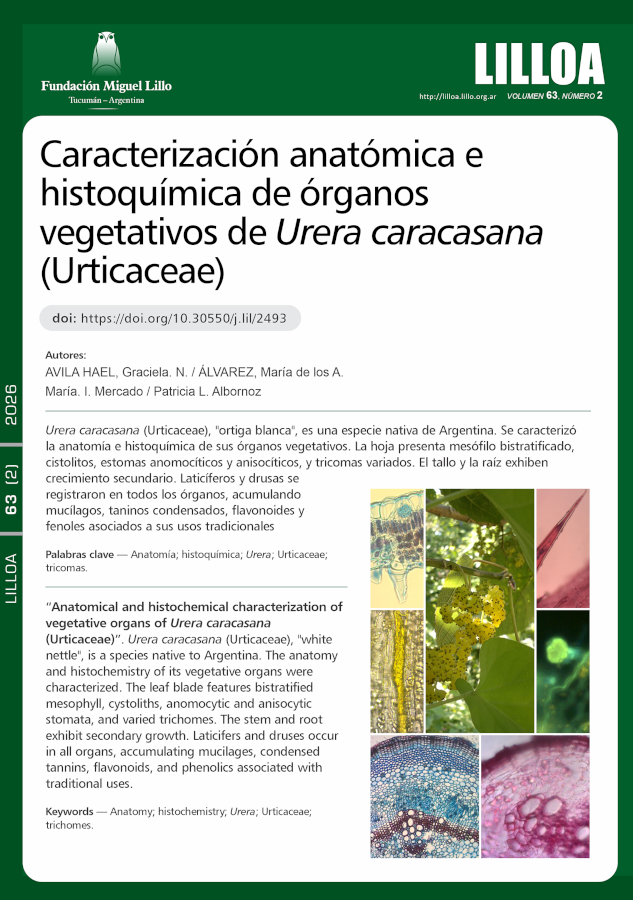
Urera caracasana (Jacq.) Gaudich. ex Griseb. (Urticaceae), commonly known as "white nettle", is native to the Yungas of northwestern Argentina and has recognized food, textile, and medicinal uses; however, its anatomy and histochemistry remain poorly studied. This study characterized the anatomy and histochemistry of its vegetative organs to identify diagnostic traits of taxonomic and pharmacognostic value and to localize metabolites potentially associated with traditional uses. Leaves, stems, and roots from five individuals collected in Tucumán, Argentina, were examined using leaf clearing, freehand and microtome sectioning, histological staining, and histochemical tests evaluated by bright-field, polarized-light, and fluorescence microscopy. The leaf blade is dorsiventral and hypostomatic, with anomocytic and anisocytic stomata, abundant simple, glandular, and stinging trichomes, and numerous cystoliths. The stem exhibits early secondary growth, subepidermal collenchyma, and sclerenchymatous reinforcements associated with the xylem, whereas the root develops periderm and incipient secondary growth. Laticifers and calcium oxalate druses were recorded in all vegetative organs. Histochemical analyses revealed mucilages, neutral polysaccharides, phenolic compounds, tannins, flavonoids, triterpenes, and steroids, mainly localized in laticifers, trichomes, and parenchymatous tissues. These findings broaden the anatomical and histochemical knowledge of U. caracasana, provide diagnostic characters of taxonomic and pharmacognostic significance, and establish a basis for future phytochemical, evolutionary, and applied research on this species.
Downloads
References
Anton, A. M. y Zuloaga, F. O. (2026). Flora Argentina. 24 de abril, consulta on-line<http://www.floraargentina.edu.ar>
Avila Hael, G. N. y Albornoz, P. L. (2013). Anatomía foliar de Urera altissima (Urticaceae) en la provincia de Tucumán. Lilloa 50(1): 3-9. https://lillo.org.ar/revis/lilloa/2013-50-1/v50n1a01.pdf
Borsuk, A. M., Roddy, A. B., Théroux?Rancourt, G. y Brodersen, C. R. (2022). Structural organization of the spongy mesophyll. New Phytologist 234 (3): 946-960. https://doi.org/10.1111/nph.17971
Cosa, M. T., Dottori, M. A., Stiefkens, N., Hadid, I., de Lalla, N. L. y Bernardello, G. E. (2014). Técnicas de histoquímica y citoquímica vegetal. Universidad Nacional de Córdoba.
D'Ambrogio de Argüeso, A. (1986). Manual de técnicas en histología vegetal. Hemisferio Sur, Buenos Aires.
Di Rienzo, J. A., Casanoves. F., Balzarini, M.G., González, L., Tablada, M. y Robledo, C.W. (2020) InfoStat v2020. Centro de Transferencia InfoStat, FCA, Universidad Nacional de Córdoba, Argentina.
de Souza Lindenmaier, D. y Putzke, J. (2011). Estudo etnobotânico em três comunidades Mbyá/Guarani na região central do Rio Grande do Sul, Brasil. Caderno de Pesquisa 23 (3): 3-18. https://doi.org/10.17058/cp.v23i3.5885
DeFilipps, R. A., Maina, S. L., y Crepin, J. (2004). Medicinal Plants of the Guianas (Guyana, Surinam, French Guiana). Biological Diversity of the Guiana Shield Program, Smithsonian Museum.
Digilio, A. P. y Legname, P. R. (1966). Los árboles indígenas de la provincia de Tucumán. Opera Lilloana 10: 1-159.
Dilcher, D. L. (1974). Approaches to the identification of angiosperm leaf remains. The Botanical Review 40 (1): 1-157. https://doi.org/10.1007/BF02860067
Dizeo De Strittmatter, C. (1973). Nueva técnica de diafanización. Boletín de la Sociedad Argentina de Botánica 15: 126-129.
Dutra, H. P., Fernandes, G. W. y Fernandes, D. C. (2006). Dual ant attraction in the Neotropical shrub Urera baccifera (Urticaceae): The role of ant-plant-herbivore interactions. Functional Ecology 20 (2): 252-260. https://doi.org/10.1111/j.1365-2435.2006.01096.x
Ellis, B., Daly, D. C., Hickey, L. J., Johnson, K. R., Mitchell, J. D., Wilf, P. y Wing S. L. (2009). Manual of leaf architecture. Cornell University Press, New York.
Ensikat, H. J., Wessely, H., Engeser, M. y Weigend, M. (2021). Distribution, ecology, chemistry and toxicology of plant stinging hairs. Toxins 13 (2): 141. https://doi.org/10.3390/toxins13020141
Esau, K. (1977). Anatomy of seed plants (2nd ed.). Wiley.
Evert, R. F. (2006). Esau's plant anatomy: meristems, cells, and tissues of the plant body: their structure, function, and development. John Wiley y Sons.
Fahn, A. (1982). Plant anatomy. Pergamon Press, Oxford.
Gindri, A. L. (2012). Análise fitoquímica das raizes e folhas, e morfo-anatômica dos caules e folhas de Urera baccifera Gaudich. Universidade Federal de Santa Maria, Brasil.
Gindri, A. L., de Souza, L. B., Cruz, R. C., Boligon, A. A., Machado, M. M. y Athayde, M. L. (2014). Genotoxic evaluation, secondary metabolites and antioxidant capacity of leaves and roots of Urera baccifera Gaudich. (Urticaceae). Natural Product Research 28 (23): 2214-2216. https://doi.org/10.1080/14786419.2014.920333
Glas, J. J., Schimmel, B. C. J., Alba, J. M., Escobar-Bravo, R., Schuurink, R. C. y Kant, M. R. (2012). Plant glandular trichomes as targets for breeding or engineering of resistance to herbivores. International Journal of Molecular Sciences 13 (12): 17077-17103. https://doi.org/10.3390/ijms131217077
Karabourniotis, G., Horner, H. T., Bresta, P., Nikolopoulos, D. y Liakopoulos, G. (2020). New insights into the functions of carbon-calcium inclusions in plants. New Phytologist 228 (3): 845-854. https://doi.org/10.1111/nph.16763
Khan, M. I., Pandith, S. A., Shah, M. A. y Reshi, Z. A. (2023). Calcium oxalate crystals, the plant ‘Gemstones’: insights into their synthesis and physiological implications in plants. Plant and Cell Physiology 64 (10): 1124-1138. https://doi.org/10.1093/pcp/pcad081
Kim, C., Deng, T., Chase, M., Zhang, D. G., Nie, Z. L. y Sun, H. (2015). Generic phylogeny and character evolution in Urticeae (Urticaceae) inferred from nuclear and plastid DNA regions. Taxon 64 (1): 65-78.
Lawson, T. y Leakey, A. D. (2024). Stomata: custodians of leaf gaseous exchange. Journal of Experimental Botany 75 (21): 6677-6682. https://doi.org/10.1093/jxb/erae425
Leroux, O. (2012). Collenchyma: a versatile mechanical tissue with dynamic cell walls. Annals of Botany 110 (6): 1083-1098. https://doi.org/10.1093/aob/mcs186
Marrassini, C., Peralta, I. y Anesini, C. (2018). Comparative study of the polyphenol content-related anti-inflammatory and antioxidant activities of two Urera aurantiaca specimens from different geographical areas. Chinese Medicine 13: 22. https://doi.org/10.1186/s13020-018-0181-1
Marrassini, C., Cogoi, L., Sülsen, V. y Anesini, C. (2020). Apigenin-7-glucuronide from Urera aurantiaca inhibits tumor necrosis factor alpha and total nitrite release in lipopolysaccharide-activated macrophages. Evidence-Based Complementary and Alternative Medicine 2020: 6638764. https://doi.org/10.1155/2020/6638764
Mercado, M. I. y Ponessa, G. I. (2021). Nuevo soporte para obtención de cortes de material vegetal en micrótomo rotativo. Dominguezia 37 (1): 29-35.
Lillo, M. (1919). Contribuciones al conocimiento de la flora tucumana. Universidad Nacional de Tucumán, Tucumán.
Merck, E. (1980). Reactivos De Coloración Para Cromatografía En Capa Fina Y En Papel. Darmstadt, Germany.
Metcalfe, C. R. y Chalk, L. (1950). Anatomy of the dicotyledons: Leaves, stem, and wood in relation to taxonomy with notes on economic uses (Vol. 1). Clarendon Press, Oxford.
Metcalfe, C. R. y Chalk, L. (1979). Anatomy of the dicotyledons (2.ª ed.). Clarendon Press, Oxford.
Mnich, E., Bjarnholt, N., Eudes, A., Harholt, J., Holland, C., Jørgensen, B., Larsen, F. H., Liu, M., Manat, R., Meyer, A. S., Mikkelsen, J. D., Motawia, M. S., Muschiol, J., Møller, B. L., Møller, S. R., Perzon, A., Petersen, B. L., Ravn, J. L., Ulvskov, P. y Willats, W. G. T. (2020). Phenolic cross-links: building and de-constructing the plant cell wall. Natural Product Reports 37 (7): 919-961. https://doi.org/10.1039/C9NP00028C
Mondolot-Cosson, L., Andary, C., Guang-Hui, D. y Roussel, J. L. (1997). Histolocalisation de substances phénoliques intervenant lors d’interactions plante-pathogène chez le tournesol et la vigne. Acta Botanica Gallica 144: 353-362. https://doi.org/10.1080/12538078.1997.10515380
Monro, A. K. y Rodríguez, A. (2009). Three New Species and a Nomenclatural Synopsis of Urera (Urticaceae) from Mesoamerica1. Annals of the Missouri Botanical Garden 96 (2): 268-285. https://doi.org/10.3417/2006121
Mustafá, A., Ensikat, H. J. y Weigend, M. (2018). Stinging hair morphology and wall biomineralization across five plant families: Conserved morphology versus divergent cell wall composition. American Journal of Botany 105 (7): 1109-1122. https://doi.org/10.1002/ajb2.1136
Niklas, K. J. (1992). Plant biomechanics: an engineering approach to plant form and function. University of Chicago press.
Nultsch, W. (1995). Botanik. Gustav Fischer Verlag, Stuttgart.
Orozco-Segovia, A., Vázquez-Yanes, C., Coates-Estrada, R., y Pérez-Nasser, N. (1987). Ecophysiological characteristics of the seed of the tropical forest pioneer Urera caracasana (Urticaceae). Tree Physiology 3 (4): 375-386.
Ortiz, M., Simoni, A., Armella, M., Luque, A. C., Debes, M. A., Albornoz, P. L. y Arias, M. E. (2014). Crecimiento secundario anómalo de tallo y raíz de Urera altissima (Urticaceae) de la provincia de Tucumán, Argentina. Lilloa 51 (2): 218-225. https://www.lillo.org.ar/journals/index.php/lilloa/article/view/350
Pedersoli, G. D., Staedtler, Y. M., Schoenenberger, J. y Texeira, S. P (2022). A comparative approach reveals diversity of floral developmental processes in Urticaceae. Botanical Journal of the Linnean Society 200 (4): 465-490.
Pierantoni, M., Tenne, R., Rephael, B., Brumfeld, V., van Casteren, A., Kupczik, K., Weiner, S. y Addadi, L. (2018). Mineral deposits in Ficus leaves: morphologies and locations in relation to function. Plant Physiology 176 (2): 1751-1763. https://doi.org/10.1104/pp.17.01516
POWO (2026). Plants of the World Online. Facilitated by the Royal Botanic Gardens, Kew. Recuperado de https://powo.science.kew.org/
Riedel, R., Marrassini, C., Anesini, C. y Gorzalczany, S. (2015). Antiinflammatory and antinociceptive activity of Urera aurantiaca. Phytotherapy research 29 (1): 59-66. https://doi.org/10.1002/ptr.5226
Ruzin, S. E. (1999). Plant microtechnique and microscopy. Oxford University Press, New York.
Sánchez, M. S., Giannini, N. P. y Barquez, R. M. (2012). Bat frugivory in two subtropical rain forests of Northern Argentina: testing hypotheses of fruit selection in the Neotropics. Mammalian Biology 77 (1): 22-31. https://doi.org/10.1016/j.mambio.2011.06.002
Solereder, H. (1908). Systematic anatomy of the dicotyledons (Vol. 1). Clarendon Press, Oxford.
Sorarú, S. (1972). Flora de interés económico de la Argentina (Vol. 2). Hemisferio Sur, Buenos Aires.
Steggerda, M. (1944). Some ethnological data concerning one hundred Yucatan plants. Anthropological papers, 29. Smithsonian Institution. Bureau of American Ethnology Bulletin 136. 229 pp. Recuperado de: https://repository.si.edu/server/api/core/bitstreams/ccacc6a8-0ea8-4e1e-bcf6-e76054e6f27a/content
Suchoronczek, A. (2019). Taxonomia e filogenia de Urera (Urticaceae) ocorrentes no bioma mata atlântica. Universidade Estadual do Centro-Oeste, Paraná.
Ventrella, M. C., Almeida, A. L., Nery, L. A., y Coelho, V. P. D. M. (2013). Métodos histoquímicos aplicados às sementes. Universidad Federal de Viçosa. Reitoria. Coordenadoria de Educação Aberta a Distância. Viçosa.
Vickers, W. T. y Plowman, T. (1984). Useful plants of the Siona and Secoya Indians of eastern Ecuador. Field Museum of History. USA. 63 pp.
Wallis, C. M. y Galarneau, E. R.-A. (2020). Phenolic compound induction in plant-microbe and plant-insect interactions: a meta-analysis. Frontiers in Plant Science 11: 580753. https://doi.org/10.3389/fpls.2020.580753
Wagner. H. y Bladt, S. (1996). Plant Drug Analysis: A Thin-Layer Chromatography Atlas, 2nd ed. Springer Verlag, New York, NY, 400 pp.
Wells, T. (2017). Grasping the nettle. Untangling a complex of Urticaceae genera from the Tropics. Universidad de Edimburgo, Escocia.
Wells, T., Maurin, O., Dodsworth, S., Friis, I., Cowan, R., Epitawalage, N. y Monro, A. K. (2021). Combination of Sanger and target-enrichment markers supports revised generic delimitation in the problematic ‘Urera clade' of the nettle family (Urticaceae). Molecular Phylogenetics and Evolution 158: 107008. https://doi.org/10.1016/j.ympev.2020.107008
Zarlavsky, G. E. (2014). Histología vegetal: técnicas simples y complejas. Sociedad Argentina de Botánica, Buenos Aires, Argentina.
Downloads
Published
How to Cite
Issue
Section
License
Copyright (c) 1900 Lilloa

This work is licensed under a Creative Commons Attribution-NonCommercial-ShareAlike 4.0 International License.