Life in the canopy: Liana diversity and interactions with host trees in the Jardín Botánico Lillo
Authors
-
María Jimena Astrada Poviña
Instituto de Ecología Regional (UNT- CONICET). Edificio Las Cúpulas, Residencia Universitaria Horco Molle. Yerba Buena, Tucumán, Argentina.
 https://orcid.org/0009-0005-3900-0811
- Sergio Javier Ceballos Instituto de Ecología Regional (UNT- CONICET). Edificio Las Cúpulas, Residencia Universitaria Horco Molle. Yerba Buena, Tucumán. Facultad de Ciencias Naturales e Instituto Miguel Lillo (UNT). San Miguel de Tucumán, Tucumán, Argentina.
DOI:
 https://doi.org/10.30550/j.lil/2431
Keywords:
Lianas, botanical, dynamics, interaction, arboretumAbstract
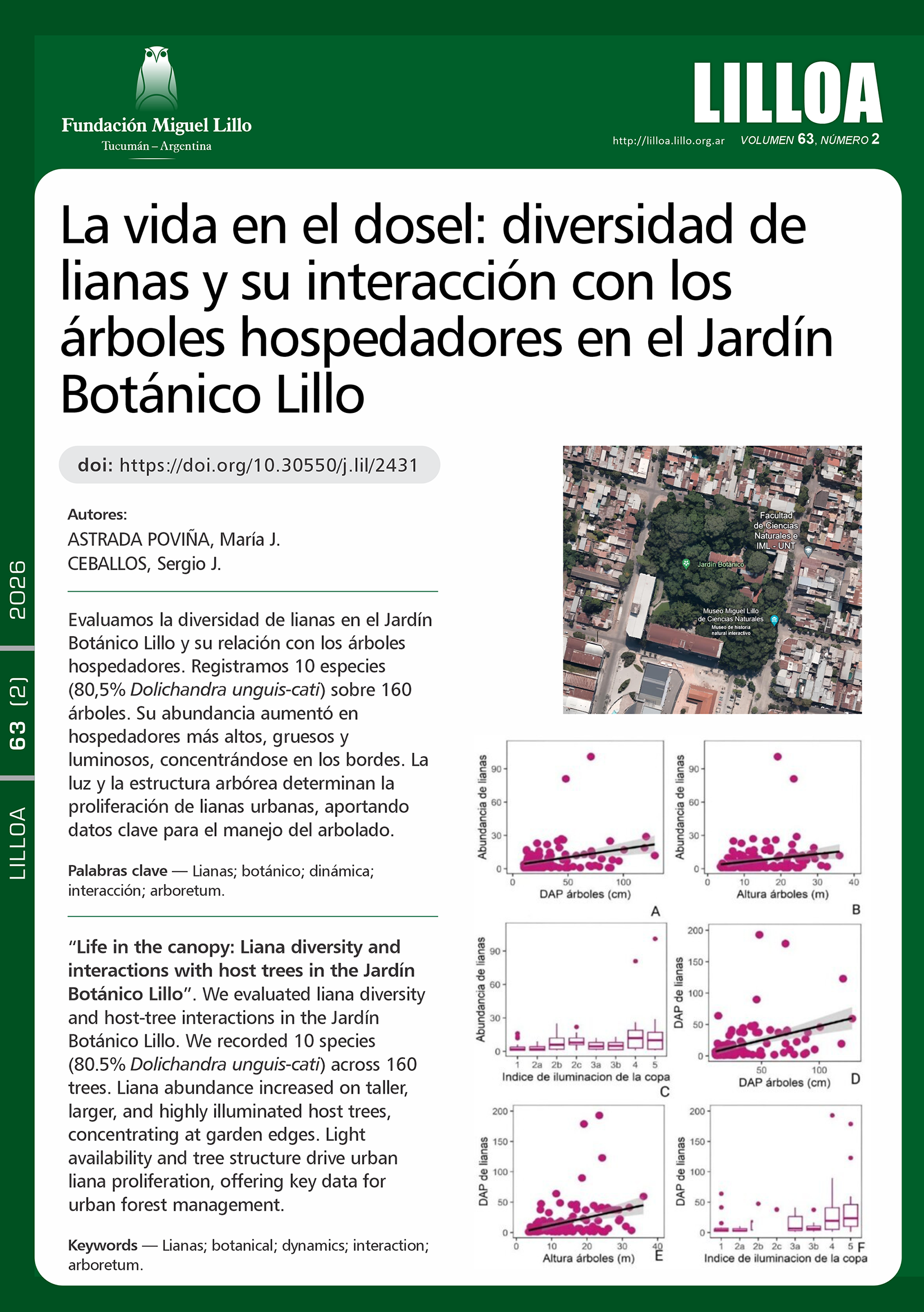
Lianas are woody climbing plants that compete with trees for soil and canopy resources. Although their ecology has been extensively studied in forest environments, knowledge remains limited regarding their diversity and interactions with host trees in urban settings. Urban green spaces, and botanical gardens in particular, act as biodiversity refuges and offer unique scenarios for investigating ecological interactions. In this study, we describe the liana diversity present in the Jardín Botánico Lillo (JBL) in Tucumán, Argentina, analyze its relationship with host tree traits, and evaluate how liana richness and abundance vary according to host spatial distribution within the garden. We surveyed 987 liana stems with a diameter ? 0.5 cm, belonging to 10 species, 9 genera, and 8 families, with Dolichandra unguis-cati being the most abundant (80.5% of individuals). Lianas colonized a total of 160 trees with a diameter at breast height (DBH) ? 10 cm, spanning 37 species. Liana abundance and diameter increased with host tree DBH, height, and crown illumination index. Furthermore, spatial location within the garden dramatically influenced colonization: edge trees (adjacent to the sidewalk) exhibited significantly higher liana abundance and colonization levels compared with interior trees. These findings demonstrate that the combination of host structure and higher light availability at the edges acts as the main driver of liana proliferation. Consequently, this study contributes to our understanding of climbing plant ecology in urban ecosystems and provides key data for designing tree management and conservation strategies in this botanical garden.
Downloads
References
Addo-Fordjour, P., Anning, A. K., Atakora, E. A. y Agyei, P. S. (2008). Diversity and distribution of climbing plants in a semi-deciduous rain forest, KNUST botanic garden, Ghana.
Ayarde, H. y Lillo, F. M. (2019). Sacha huasca (Dolichandra cynanchoides) / Uña de gato (Dolichandra unguis-cati). Universo Tucumano 25: 1-4.
Bongers, F. J. J. M., Schnitzer, S. A. y Traore, D. (2002). The importance of lianas and consequences for forest management in West Africa. BioTerre, Special edition: 59-70.
Bulacio, E., Muruaga, N. y Cristobal de Hinojo, M. E. (2001). Árboles del jardín Botánico. Guías Botánicas N.º 1. Tucumán: Jardín Botánico. Fundación Miguel Lillo.
Cabanillas, P. A. y Hurrell, J. A. (2012). Plantas trepadoras: tipo biológico y clasificación. Revista Ciencias Morfológicas 14 (2): 1-10.
Campanello, P. I., Villagra, M., Garibaldi, J. F., Ritter, L. J., Araujo, J. J. y Goldstein, G. (2012). Liana abundance, tree crown infestation, and tree regeneration ten years after liana cutting in a subtropical forest. Forest Ecology and Management 284: 213-221.
Campbell, M. J., Edwards, W., Magrach, A., Alamgir, M., Porolak, G., Mohandass, D. y Laurance, W. F. (2018). Edge disturbance drives liana abundance increase and alteration of liana–host tree interactions in tropical forest fragments. Ecology and Evolution 8(8): 4237-4251.
Carrizo, J. I., Gomez, S. E. y Aceñolaza, P. G. (1991). Guía de árboles del Jardín Botánico Miguel Lillo. San Miguel de Tucumán: Universidad Nacional de Tucumán, Facultad de Ciencias Naturales.
Ceballos, S. J. (2019). Dinámica de las comunidades de lianas y epífitas en bosques sucesionales de las yungas australes (Sierra de San Javier, Tucumán, Argentina) (Tesis Doctoral). Universidad Nacional de Tucumán, Argentina.
Ceballos, S. J. y Malizia, A. (2017). Liana density declined and basal area increased over 12 y in a subtropical montane forest in Argentina. Journal of Tropical Ecology 33 (4): 241-248.
Chao, A., Gotelli, N. J., Hsieh, T. C., Sander, E. L., Ma, K. H., Colwell, R. K. y Ellison, A. M. (2014). Rarefaction and extrapolation with Hill numbers: a framework for sampling and estimation in species diversity studies. Ecological Monographs 84 (1): 45-67. https://doi.org/10.1890/13-0133.1
Coelho-Duarte, A. P., Daniluk-Mosquera, G., Gravina, V., Vallejos-Barra, Ó. y Ponce-Donoso, M. (2021). Tree risk assessment: Component analysis of six visual methods applied in an urban park, Montevideo, Uruguay. Urban Forestry & Urban Greening 59: 127005.
Dorofeyeva, L. (2021). Lianas collection from the Botanical Garden and its science-practice utilization. In BIO Web of Conferences (Vol. 38, p. 00025). EDP Sciences.
Dosil Hiriart, F., Cabanillas, P. A., Apodaca, M. J., Benedictto, M., Barral, L. y Guerrero, E. L. (2018). Listado comentado de las plantas vasculares trepadoras y epífitas de la costa rioplatense del Partido de Quilmes (Buenos Aires, Argentina). Boletín de la Sociedad Argentina de Botánica 53 (1): 1-10.
Downey, P. O. y Turnbull, I. (2007). The biology of Australian weeds 48. Macfadyena unguis-cati (L.) AH Gentry. Plant Protection Quarterly 22 (3): 82.
Furtado, S. G. y Menini Neto, L. (2015). Diversity of vascular epiphytes in urban environment: A case study in a biodiversity hotspot, the Brazilian Atlantic Forest. CES Revista 29 (2): 82-101.
Gallego, Y. A., Carmona-Higuita, M. J. y Benavides, A. M. (2025). Resilient diversity, vascular epiphytes in the urban forest of Medellín, Colombia.
García León, M. M., Martínez Izquierdo, L., Mello, F. N. A., Powers, J. S. y Schnitzer, S. A. (2018). Lianas reduce community?level canopy tree reproduction in a Panamanian forest. Journal of Ecology 106 (2): 737-745. https://doi.org/10.1111/1365-2745.12807
Garrido-Perez, E. I. y Burnham, R. J. (2010). The evolution of host specificity in liana-tree interactions. Puente Biologico 3: 145-157.
Gerwing, J. J. y Farias, D. L. (2000). Integrating liana abundance and forest stature into an estimate of total aboveground biomass for an eastern Amazonian forest. Journal of Tropical Ecology 16 (3): 327-335. https://doi.org/10.1017/S0266467400001437
Gerwing, J. J., Schnitzer, S. A., Burnham, R. J., Bongers, F., Chave, J., DeWalt, S. J., ... y Thomas, D. W. (2006). A standard protocol for liana censuses 1. Biotropica: The Journal of Biology and Conservation 38 (2): 256-261.
González, M. V. y Ceballos, S. J. (2021). Las epífitas vasculares en un ambiente urbano están influidas por características del arbolado, el clima y las fuentes de propágulos. Ecología Austral 31 (2): 357-371.
Hill, M. O. (1973). Diversity and evenness: a unifying notation and its consequences. Ecology 54 (2): 427-432. https://doi.org/10.2307/1934352
Hurrell, J. A., Cabanillas, P. y Delucchi, G. (2011). Wisteria sinensis (Leguminosae) adventicia en la Argentina: Primer registro y mecanismos de expansión. Revista del Museo Argentino de Ciencias Naturales 13 (2): 125-130.
Hurrell, J. A., Cabanillas, P. A., Buet Costantino, F. y Delucchi, G. (2012a). Bignoniaceae adventicias en la Argentina: primera cita de Podranea ricasoliana y nuevos registros de Campsis radicans. Revista del Museo Argentino de Ciencias Naturales 14 (1): 15-22.
Hurrell, J. A., Delucchi, G. y Cabanillas, P. (2012b). Primera cita de Parthenocissus tricuspidata y nuevo registro de P. quinquefolia (Vitaceae) adventicias en la Argentina. Revista del Museo Argentino de Ciencias Naturales 14 (2): 235-242.
Hurrell, J. A., Cabanillas, P., Guerrero, E. L. y Delucchi, G. (2014). Naturalización y etnobotánica de Vitis labrusca L.(Vitaceae) en la región rioplatense, Argentina. Revista del Museo Argentino de Ciencias Naturales 16 (1): 13-18.
Ingwell, L. L., Joseph Wright, S., Becklund, K. K., Hubbell, S. P. y Schnitzer, S. A. (2010). The impact of lianas on 10 years of tree growth and mortality on Barro Colorado Island, Panama. Journal of Ecology 98 (4): 879-887. https://doi.org/10.1111/j.1365-2745.2010.01676.x
Jost, L. (2006). Entropy and diversity. Oikos 113 (2): 363-375. https://doi.org/10.1111/j.2006.0030-1299.14714.x
Kalmykova, A., Guseva, Y. y Tereshkin, A. (2022). Assessment of decorative features of lianas when using them for landscaping purposes of the Saratov-Engels agglomeration. In BIO Web of Conferences (Vol. 43, p. 01026). EDP Sciences.
Krömer, T., Einzmann, H. J., Mendieta-Leiva, G. y Zotz, G. (2025). Impact of land-use change on vascular epiphytes: a review. Plants 14 (8): 1188.
Lahitte, H. B. y Hurrell, J. A. (2000). Plantas trepadoras nativas y exóticas. Buenos Aires: LOLA (Literature of Latin America).
Liu, H. (2013). The application of lianas to uban vertical planting-A case study of Haizhu district of Guangzhou city, China. Advanced Materials Research 807: 1852-1855.
Malizia, A. (2003). Host Tree Preference of Vascular Epiphytes and Climbers in a Subtropical Montane Cloud Forest of Northwest Argentina. Selbyana 24 (2): 196-205. http://www.jstor.org/stable/41760133
Malizia, A. (2007). Interacciones entre lianas y árboles en una selva montana madura de las yungas argentinas (Tesis Doctoral). Universidad Nacional de Tucumán, Argentina.
Malizia, A., Campanello, P. I., Villagra, M. y Ceballos, S. (2015). Geographical, Taxonomical and Ecological Aspects of Lianas in Subtropical Forests of Argentina. En: N. Parthasarathy (Ed.), Biodiversity of Lianas. Sustainable Development and Biodiversity, vol 5 (pp. 31-48). Cham: Springer. https://doi.org/10.1007/978-3-319-14592-1_3
Martínez?Izquierdo, L., García, M. M., Powers, J. S. y Schnitzer, S. A. (2016). Lianas suppress seedling growth and survival of 14 tree species in a Panamanian tropical forest. Ecology 97 (1): 215-224. https://doi.org/10.1890/14-2261.1
Martins, P. L. S. S., Furtado, S. G. y Menini Neto, L. M. (2020). Could epiphytes be xenophobic? Evaluating the use of native versus exotic phorophytes by the vascular epiphytic community in an urban environment. Community Ecology 21 (1): 91-101.
McCullagh, P. y Nelder, J. A. (1989). Generalized Linear Models. (2° Ed.). Londres: Chapman & Hall.
Nabe-Nielsen, J. (2001). Diversity and distribution of lianas in a neotropical rain forest, Yasuní National Park, Ecuador. Journal of Tropical Ecology 17 (1): 1-19.
Osunkoya, O. O., Pyle, K., Scharaschkin, T. y Dhileepan, K. (2009). What lies beneath? The pattern and abundance of the subterranean tuber bank of the invasive liana cat’s claw creeper, Macfadyena unguis-cati (Bignoniaceae). Australian Journal of Botany 57 (2): 132-138.
Parthasarathy, N., Muthuramkumar, S., Muthumperumal, C., Vivek, P., Ayyappan, N. y Sridhar Reddy, M. (2015). Liana composition and diversity among tropical forest types of peninsular India. En: S. A. Schnitzer, F. Bongers, R. J. Burnham y F. E. Putz (Eds.), Ecology of Lianas (pp. 36-49). Oxford: Wiley-Blackwell. https://doi.org/10.1002/9781118392409.ch4
Pavlenko, L., Mashkovska, S. y Marynenko, N. (2017). Introductory Evaluation of Species of Ornamental Herbal Lianas in the Conditions of MM Gryshko National Botanical Garden of NAS of Ukraine. Agrobiodiversity for Improving Nutrition, Health and Life Quality, (1).
Pérez, T. M., Valverde-Barrantes, O., Bravo, C., Taylor, T. C., Fadrique, B., Hogan, J. A., ... y Feeley, K. J. (2018). Botanic gardens are an untapped resource for studying the functional ecology of tropical plants. Philosophical Transactions of the Royal Society B: Biological Sciences 374: 1763.
Putz, F. E. (1984). The natural history of lianas. Biotropica 16 (2): 79-92.
Putz, F. E. y Mooney, H. A. (Eds.). (1991). The Biology of Vines. Cambridge: Cambridge University Press.
Putz, F. E., Sist, P., Fredericksen, T. y Dykstra, D. (2008). Reduced-impact logging: challenges and opportunities. Forest Ecology and Management 256 (7): 1427-1433.
R Core Team. (2024). R: A language and environment for statistical computing. R Foundation for Statistical Computing. Recuperado de https://www.R-project.org
RAINFOR. (2018). Índice de Liana Infestación de la Copa / Índice de Iluminación de la Copa (Protocolo técnico). Amazon Forest Inventory Network. Recuperado de https://rainfor.org/wp-content/uploads/sites/129/2022/07/CrownLianaProtocols_ES.pdf
Roeder, M., Slik, J. F., Harrison, R. D., Paudel, E. y Tomlinson, K. W. (2015). Proximity to the host is an important characteristic for selection of the first support in lianas. Journal of Vegetation Science 26 (6): 1054-1060.
Schnitzer, S. A., Dalling, J. W. y Carson, W. P. (2006). The impact of lianas on tree regeneration in tropical forest canopy gaps: evidence for an alternative pathway of gap-phase regeneration. Journal of Ecology 88 (4): 655-666.
Schnitzer, S. A. (2015). Increasing liana abundance in neotropical forests: causes and consequences. Ecology of lianas: 451-464.
Schnitzer, S. A., DeFilippis, D. M., Visser, M., Estrada?Villegas, S., Rivera?Camaña, R., Bernal, B., ... y García?León, M. (2021). Local canopy disturbance as an explanation for long?term increases in liana abundance. Ecology Letters 24 (12): 2635-2647.
Shukurova, M., Khaydarov, K., Ashurov, M., Shernazarov, S. y Alavdinov, M. (2024). The use of perennial decorative lianas in vertical landscaping in the city of Samarkand. In E3S Web of Conferences (Vol. 577, p. 03008). EDP Sciences.
Tang, Y., Kitching, R. L. y Cao, M. (2012). Lianas as structural parasites: a re-evaluation. Chinese Science Bulletin 57 (4): 307-312.
Utomo, I. H. A., Istomo, y Putra, E. I. (2025). Tree vitality assessment in lawn a and b of the Singapore Botanic Gardens. In IOP Conference Series: Earth and Environmental Science 1571 (1): 012013. IOP Publishing.
Downloads
Published
How to Cite
Issue
Section
License
Copyright (c) 1900 Lilloa

This work is licensed under a Creative Commons Attribution-NonCommercial-ShareAlike 4.0 International License.