Anatomical, histochemical, and compositional study of an underutilized native fruit: Salpichroa origanifolia (Solanaceae)
Authors
-
Erica Mandón
Área Biología Vegetal. Facultad de Ciencias Bioquímicas y Farmacéuticas. Rosario. Santa Fé, Argentina.
 https://orcid.org/0009-0009-9161-422X
-
Virginia Stähli
Área Biología Vegetal. Facultad de Ciencias Bioquímicas y Farmacéuticas. Rosario. Santa Fé, Argentina.
https://orcid.org/0009-0004-6377-4238
-
Silvia López
Farmacognosia, Facultad de Ciencias Bioquímicas y Farmacéuticas. Rosario. Santa Fé, Argentina.
https://orcid.org/0000-0003-0173-1166
-
Maria Victoria Castelli
Farmacognosia, Facultad de Ciencias Bioquímicas y Farmacéuticas. Rosario. Santa Fé, Argentina.
https://orcid.org/0000-0002-8420-5622
-
Maria Laura Martinez
Área Biología Vegetal. Facultad de Ciencias Bioquímicas y Farmacéuticas. Rosario. Santa Fé, Argentina.
https://orcid.org/0000-0003-4014-0959
-
Maria Noel Campagna
Área Biología Vegetal. Facultad de Ciencias Bioquímicas y Farmacéuticas. Rosario. Santa Fé, Argentina.
https://orcid.org/0000-0002-4754-5644
DOI:
 https://doi.org/10.30550/j.lil/2366
Keywords:
Fatty acids, huevito de gallo, non-conventional foods, Salpichroa origanifoliaAbstract
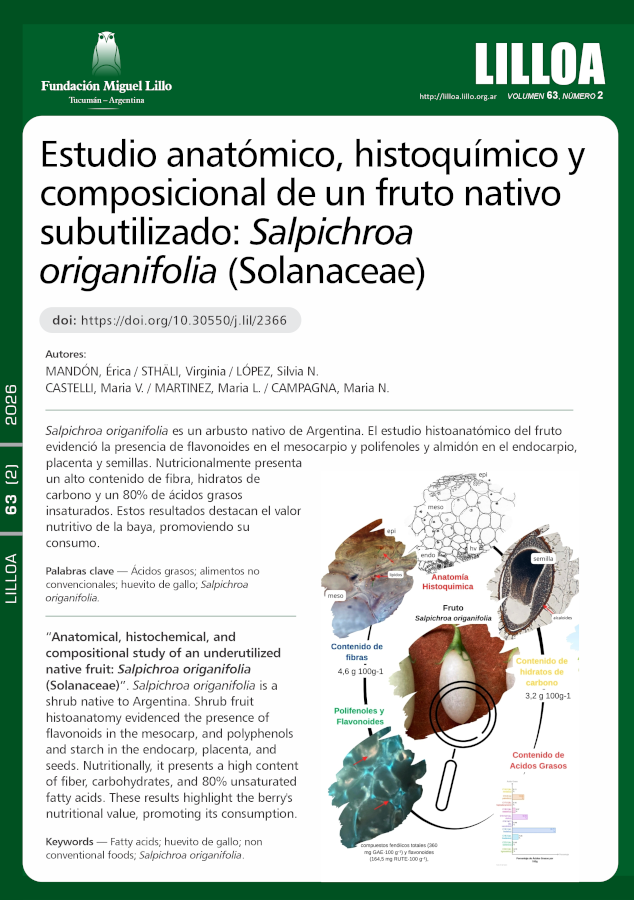
Salpichroa origanifolia (Lam.) Baill. is a climbing shrub belonging to the family Solanaceae, native to Argentina and widely distributed throughout the country. Although its fruit is an edible berry, it is not widely consumed, probably due to a lack of knowledge regarding its nutritional properties or concerns over potential toxicity. To promote its use as a food source, this study analyzed the histoanatomy of the fruit and its proximate composition (moisture, minerals, fibers, carbohydrates, proteins, and lipids). Moreover, the fatty acid profile and the presence of specialized metabolites such as polyphenols, flavonoids, terpenes, and alkaloids were also determined, with emphasis on their localization within fruit tissues. Both fresh and paraffin-embedded fruits were examined using different histochemical staining techniques to determine specialized metabolites. The presence of lipids was demonstrated in the epicarp; flavonoids and caffeoylquinic acids were localized in large, globose, thin-walled parenchymal cells forming the mesocarp, while polyphenols and starch were observed in the endocarp, placenta, and seeds. The fiber (4.6 g 100 g?¹) and carbohydrate (3.2 g 100 g?¹) contents were comparable to those reported for other widely consumed berries, and the percentage of unsaturated fatty acids (80%) was remarkably higher than that of saturated ones (20%). This study highlights the nutritional potential of S. origanifolia fruits as a nutritious food for human consumption.
Downloads
References
Abdelsalam, A., Mahran, E., Mohamed, E. T., Boroujerdi, A. y Aly, H. (2025). Maturity related metabolomic analysis of Balanites aegyptiaca fruits with in vitro and in silico cytotoxicity evaluation. Scientific Reports 15 (1): 31035.
Arias Toledo, B., Trillo, C., Saur Palmieri, V., Torrico Chalabe, J. K., Battistón, L. V., Cittadini, M. C. y Garello, M. J. (2023). Breve recorrido por alimentos silvestres de los ambientes naturales de Córdoba: Incluye recetas, valores nutricionales y técnicas de reproducción. ISBN: 978-987-3701-29-0
Asociación Oficial de Químicos Orgánicos (AOAC) Official Methods (1998). http://www.aoacofficialmethod.org/
Baldermann, S., Blagojevi?, L., Frede, K., Klopsch, R., Neugart, S., Neumann, A. y Schreiner, M. (2016). Are neglected plants the food for the future?. Critical Reviews in Plant Sciences 35 (2): 106-119.
Badria, F. A. y Aboelmaaty, W. S. (2019). Plant Histochemistry: A versatile and indispensible tool in localization of gene expression, enzymes, cytokines, secondary metabolites and detection of plants infection and pollution. Acta Scientific Pharmaceutical Sciences 3 (7): 88-100.
Barboza, G., Zuloaga, F. O., Belgrano, M. J. y Anton, A. M. (2013). Flora Argentina- Vol. 13 Dicotyledoneae Solanaceae. IBODA ImBIV, Conicet, Buenos Aires.
Bligh, E. G. y Dyer, W. J. (1959). A rapid method of total lipid extraction and purification. Canadian Journal of Biochemistry and Physiology 37 (8): 911-917.
Burkart, A. E. (1979). Flora ilustrada de Entre Rios (Argentina): Dicotiledo?neas metaclamideas (gamope?talas), A: Primulales a plantaginales (Vol. 6). República Argentina. Secretaria de Estado de Agricultura y Ganadería de la Nación. Instituto Nacional de Tecnología Agropecuaria.
Bustos, G. R., Paez, M. E., Hirsch, M., Marina, M. y Villarreal, N. M. (2026). Quality and bioactive compound dynamics during ripening of Salpichroa origanifolia fruit: A South American native species with nutraceutical value. Journal of Berry Research 16 (2): 103-114.
Combrinck, S., Du Plooy, G. W., McCrindle, R. I. y Botha, B. M. (2007). Morphology and histochemistry of the glandular trichomes of Lippia scaberrima (Verbenaceae). Annals of Botany 99 (6): 1111-1119.
D´Ambrogio de Argüeso, A. (1986). Manual de técnicas en histología vegetal.1er Ed., editorial Hemisferio Sur.
De Nucci, G., Diez de Ulzurrun, F., López Méndez, P. y Dajil, A., (2022) Malezas comestibles: participación ciudadana en la valoración de especies vegetales
de crecimiento espontáneo con potencial alimenticio 1aed. Mar del Plata: Universidad Nacional de Mar del Plata.
Jilani, A., Legseir, B., Soulimani, R., Dicko, A. y Younos, C. (2006). New extraction technique for alkaloids. Journal of the Brazilian Chemical Society 17 (3): 518-520. https://doi.org/10.1590/S0103-50532006000300013
FAO. (2018). Future smart food – Rediscovering hidden treasures of neglected and underutilized species for Zero Hunger in Asia. X. Li & K. H. M. Siddique (Eds.). Rome, Italy: Food and Agriculture Organization of the United Nations.
FAO. (2012). Grasas y ácidos grasos en nutrición humana: consulta de expertos. Granada: Fundación Iberoamericana de Nutrición (FINUT). Estudios FAO de alimentación y nutrición, 91.
Gattuso, M. A. y Gattuso, S. J. (2002). Técnicas Histológicas en Material Vegetal. UNR editora, Rosario pp. 62-74.
Gill, S. K., Rossi, M., Bajka, B. y Whelan, K. (2021). Dietary fibre in gastrointestinal health and disease. Nature Reviews Gastroenterology & Hepatology 18 (2): 101-116.
Hartman, L. y Lago, R. C. A. (1973). Rapid determination of fatty acid methyl esthers from lipids. Laboratory Practice 22 (7): 475-476.
Harvard T.H. Chan School of Public Health. (2026). Dietary Guidelines for Americans 2025-2030. The Nutrition Source. https://nutritionsource.hsph.harvard.edu/2026/01/09/dietary-guidelines-for-americans-2025-2030/
Hunter, D. y Heywood, V. (Eds.) (2011), Parientes silvestres de los cultivos: Manual para la Conservación In Situ. Bioversity International, Roma, Italia. 1ª. ed. ISBN 978-92-9043-886-1
Kario, K., Okura, A., Hoshide, S. y Mogi, M. (2024). The WHO Global report 2023 on hypertension warning the emerging hypertension burden in globe and its treatment strategy. Hypertension Research 47 (5): 1099-1102.
Kinupp, V. (2007). Plantas alimentícias não-convencionais da região metropolitanade Porto Alegre, RS. Tesis doctoral Fac. Agronomia, Univ. Fed. Rio Grande do Sul, 562 pp.
Lahitte, H. B., Hurrel, J. A., Mehltreter, K. y Belgrano, M. J. (2004). Plantas de la costa: las plantas nativas y naturalizadas más comunes de las costas del Delta del Parana, Isla Martin Garcia y Ribera Platense. Buenos Aires: Literature of Latin America (L.O.L.A.).
Li, D., Li, B., Ma, Y., Sun, X., Lin, Y. y Meng, X. (2017). Polyphenols, anthocyanins, and flavonoids contents and the antioxidant capacity of various cultivars of highbush and half-high blueberries. Journal of Food Composition and Analysis 62: 84-93.
Martinez Crovetto, R. (1981). Las plantas utilizadas en medicina en el noroeste de Corrientes (República Argentina).
Milner, S. E., Brunton, N. P., Jones, P. W., O’Brien, N. M., Collins, S. G. y Maguire, A. R. (2011). Bioactivities of glycoalkaloids and their aglycones from Solanum species. Journal of Agricultural and Food Chemistry 59 (8): 3454-3484.
Organización Mundial de la Salud (OMS). (2023). Saturated fatty acid and trans-fatty acid intake for adults and children: WHO guideline. World Health Organization.
Perez, A. N. y Tomasi, V. H. (2002). Tinción con azul brillante de cresilo en secciones vegetales con parafina. Boletín de la Sociedad Argentina de Botánica 37 (3-4): 211-215.
Peter, E. L., Kaligirwa, A. y Lukwago, T. (2019). Stability indicating high-performance thin-layer chromatography method for estimation of ascorbic acid in Hibiscus sabdariffa L. aqueous extract. Journal of Complementary Medicine Research 10: 50-57.
Pilarski, B., Wyrzykowski, D. y M?odzianowski, J. (2023). A New Approach for Studying the Stability and Degradation Products of Ascorbic acid in Solutions. Journal of Solution Chemistry 52: 639-657.
Rajput, A., Sharma, R. y Bharti, R. (2022). Pharmacological activities and toxicities of alkaloids on human health. Materials Today: Proceedings 48: 1407-1415.
Rapoport, E., Marzocca, A. y Drausal, B. (2009). Malezas comestibles del Cono sur. Ediciones INTA, Buenos Aires, Argentina.
Roth, I. (1977). Fruits of angiosperms. Encyclopedia of plant anatomy. Gebrüder Borntraeger, Berlin.
Rudrapal, M., Rakshit, G., Singh, R. P., Garse, S., Khan, J. y Chakraborty, S. (2024). Dietary polyphenols: review on chemistry/sources, bioavailability/metabolism, antioxidant effects, and their role in disease management. Antioxidants 13 (4): 429.
Ruzin, S. E. (1999). Plant microtechnique and microscopy (Vol. 198, p. 322). New York: Oxford University Press.
Singleton, V. L. y Rossi, J. A. (1965). Colorimetry of total phenolics with phosphomolybdic-phosphotungstic acid reagents. American journal of Enology and Viticulture 16 (3): 144-158.
Strittmatter, C. (1979). Modificación de una técnica de coloración Safranina-Fast green. Boletín de la Sociedad Argentina de Botánica 18: 121-122.
Sun, S., Liu, Z., Lin, M., Gao, N. y Wang, X. (2024). Polyphenols in health and food processing: Antibacterial, anti-inflammatory, and antioxidant insights. Frontiers in Nutrition 11: 1456730.
Tardío, J., Pardo-de-Santayana, M. y Morales, R. (2006). Ethnobotanical review of wild edible plants in Spain. Botanical journal of the Linnean Society 152 (1): 27-71.
Termote, C., Bwama Meyi, M., Dhed'a Djailo, B., Huybregts, L., Lachat, C., Kolsteren, P. y Van Damme, P. (2012). A biodiverse rich environment does not contribute to a better diet: a case study from DR Congo. PloS one 7 (1): e30533.
Turner, N. J. y Von Aderkas, P. (2009). The North American guide to common poisonous plants and mushrooms. Timber Press.
United State Department of Agriculture (USDA) Food Data Central (2024). https://fdc.nal.usda.gov/
Wagner, H. y Bladt, S. (1996). Plant drug analysis: a thin layer chromatography atlas. Berlin, Heidelberg: Springer Berlin Heidelberg.
Wiemer, A. P., Cosa, M. T. y Dottori, N. (2004). Desarrollo y estructura de fruto y semilla de Salpichroa origanifolia (Solanaceae). Boletín de la Sociedad Argentina de Botánica 39 (1-2): 41-50.
Zagoskina, N. V., Zubova, M. Y., Nechaeva, T. L., Kazantseva, V. V., Goncharuk, E. A., Katanskaya, V. M., Baranova, E. N. y Aksenova, M. A. (2023). Polyphenols in Plants: Structure, Biosynthesis, Abiotic Stress Regulation, and Practical Applications (Review). International Journal of Molecular Sciences 24 (18): 13874. https://doi.org/10.3390/ijms241813874
Zarlavsky, G. E. (2014). Histología Vegetal: técnicas simples y complejas. Sociedad Argentina de Botánica, Buenos Aires, 198.
Zhishen, J., Mengcheng, T. y Jianming, W. (1999). The determination of flavonoid contents in mulberry and their scavenging effects on superoxide radicals. Food chemistry 64 (4): 555-559.
Downloads
Published
How to Cite
Issue
Section
License
Copyright (c) 1900 Lilloa

This work is licensed under a Creative Commons Attribution-NonCommercial-ShareAlike 4.0 International License.