Anatomical characters of contractile root, floral scape and leaf blade of Zephyranthes bifida (Amaryllidaceae)
Authors
-
Juan Manuel Goyenetche
Facultad de Agronomía, Universidad Nacional del Centro de la Provincia de Buenos Aires. Buenos Aires, Argentina.
 https://orcid.org/0000-0001-7473-817X
-
Rosa Lourdes Scaramuzzino
Facultad de Agronomía, Universidad Nacional del Centro de la Provincia de Buenos Aires. Buenos Aires, Argentina.
https://orcid.org/0000-0002-6878-9998
DOI:
 https://doi.org/10.30550/j.lil/2365
Keywords:
Anatomy, Argentina, Buenos Aires Province, Hippeastreae, morphology, native species, South AmericaAbstract
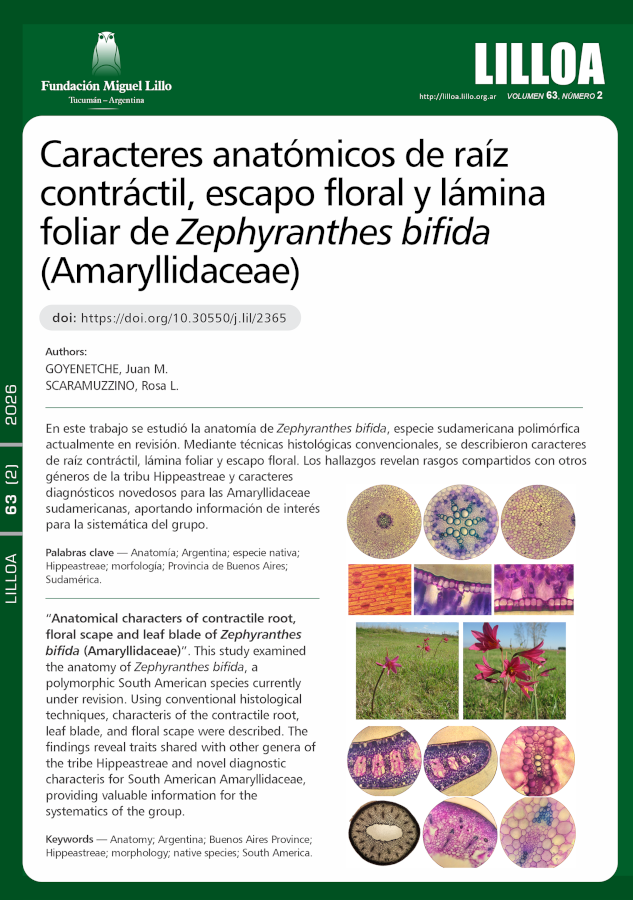
Zephyranthes bifida (Hippeastreae, Amaryllidaceae) is a South American species with a complex taxonomic history and marked polymorphism, for which detailed anatomical descriptions have been lacking until now. The objective of this study was to examine and describe the anatomy of the contractile root, leaf blade, and floral scape of individuals from a population in central Buenos Aires Province (Argentina), evaluating its usefulness in the characterization of the taxon. Three individuals were analyzed using freehand cross-sections of the aforementioned organs, which were processed following conventional histological techniques and observed under light microscopy. The contractile root exhibits a single-layered epidermis, a uniseriate exodermis with irregularly alternating long and short cells, heterogeneous cortical parenchyma in three regions, an endodermis with evident Casparian strips, and a polyarch central cylinder. The leaf blade is bifacial, amphistomatic, with anomocytic stomata, an isobilateral mesophyll, abundant interfascicular aerenchyma, and no supporting tissues. The floral scape is cylindrical and fistulose, with discontinuous subepidermal collenchyma, collateral vascular bundles of increasing size towards the interior, and sclerenchyma fibers associated with the phloem. The results reveal shared characteristics with other genera of the tribe Hippeastreae, as well as potentially diagnostic and novel features for South American Amaryllidaceae, providing anatomical information of interest for the systematics and future comparative studies of the group.
Downloads
References
Acosta, M. C., Alcaraz, M. L., Scaramuzzino, R. L. y Manfreda, V. T. (2021). Fisiología de la germinación de Rhodophiala bifida. FAVE Sección Ciencias Agrarias 20 (1): 159-173.
Alves-Araujo, A. y Alves, M. (2005). Anatomical features of three species of Amaryllidaceae from northeastern Brazil. Herbetia 59: 94-106.
Alves-Araújo, A., Pessoa, E. y Alves, M. (2012). Caracterização morfoanatômica de espécies de Amaryllidaceae s.s. e Alliaceae s.s. do Nordeste brasileiro. Revista Caatinga 25 (4): 68-81.
Alzate, F., Lesmes, M., Cortés, N., Varela, S. y Osorio, E. (2019). Sinopsis de la familia Amaryllidaceae en Colombia. Biota colombiana 20 (1): 2-20. https://doi.org/10.21068/c2019.v20n01a01
Anton, A. M. y Zuloaga F. O. (Dir.). (2026). Flora Argentina. Instituto de Botánica Darwinion. Recuperado de http://buscador.floraargentina.edu.ar/
Angiosperm Phylogeny Group (APG). (2016). An update of the Angiosperm Phylogeny Group classification for the orders and families of flowering plants: APG IV. Botanical Journal of the Linnean Society 181: 1-20. https://doi.org/10.1111/boj.12385
Arroyo, S. C. y Cutler, D. F. (1984). Evolutionary and taxonomic aspects of the internal morphology in Amaryllidaceae from South America and Southern Africa. Kew Bulletin 39 (3): 467-498. https://doi.org/10.2307/4108592
Castilhos, T. S., Giordani, R. B., Henriques, A. T., Menezes, F. S. y Zuanazzi, J. Â. S. (2007). Avaliação in vitro das atividades antiinflamatória, antioxidante e antimicrobiana do alcalóide montanina. Revista Brasileira de Farmacognosia 17 (2): 209-214. https://doi.org/10.1590/S0102-695X2007000200013
D´Ambrogio de Argüeso, A. (1986). Manual de técnicas en histología vegetal. Hemisferio Sur.
Davis, A. P. y Barnett, J. R. (1997). The leaf anatomy of the genus Galanthus L. (Amaryllidaceae J. St.-Hil.). Botanical Journal of the Linnean Society 123 (4): 333-352. https://doi.org/10.1111/j.1095-8339.1997.tb01423.x
Echeverría, M. L. y Alonso, S. I. (2010). Germinación y crecimiento inicial de Habranthus gracilifolius y Rhodophiala bifida, amarilidáceas nativas con potencial ornamental. Revista de la Facultad de Ciencias Agrarias 42 (1): 23-37.
Endress, P. K., Baas, P. y Gregory, M. (2000). Systematic plant morphology and anatomy ? 50 years of progress. Taxon 49 (3): 401-434. https://doi.org/10.2307/1224342
Facciuto, G., Coviella, A. y Bugallo, V. (2021). Biología reproductiva de Rhodophiala bifida (Amaryllidaceae): aspectos de aplicación en el mejoramiento genético. FAVE Sección Ciencias Agrarias 20 (1): 147-157.
Farinon, M., Clarimundo, V. S., Pedrazza, G. P., Gulko, P. S., Zuanazzi, J. A., Xavier, R. M. y de Oliveira, P. G. (2017). Disease modifying anti-rheumatic activity of the alkaloid montanine on experimental arthritis and fibroblast-like synoviocytes. European Journal of Pharmacology 799: 180-187. https://doi.org/10.1016/j.ejphar.2017.02.013
García, N., Meerow, A. W., Arroyo?Leuenberger, S., Oliveira, R. S., Dutilh, J. H., Soltis, P. S. y Judd, W. S. (2019). Generic classification of Amaryllidaceae tribe Hippeastreae. Taxon 68 (3): 481-498. https://doi.org/10.1002/tax.12062
González-Atabales, L., Naulin, P. I. y García, N. (2024). Rasgos morfoanatómicos foliares en especies de Phycella (Amaryllidaceae). Gayana Botanica 81 (2): 83-92. https://doi.org/10.4067/S0717-66432024000200083
Goyenetche, J. M., Acosta, M. C., Alcaraz, M. L., Manfreda, V. T. y Scaramuzzino, R. L. (2022). Caracterización de semillas y plántulas de Zephyranthes bifida (Amaryllidaceae). Boletín de la Sociedad Argentina de Botánica 57 (4): 1-15. https://doi.org/10.31055/1851.2372.v57.n4.37812
Goyenetche, J. M., Scaramuzzino, R. L. y Arroyo-Leuenberger, S. C. (2023). Historia taxonómica de Zephyranthes bifida (Neorhodophiala, Amaryllidaceae). Boletín de la Sociedad Argentina de Botánica 58 (3): 421-438. Número especial de Amaryllidaceae. https://doi.org/10.31055/1851.2372.v58.n3.40276
Hurrell, J. A. y Roitman, G. (2009). Rhodophiala. En: J. A. Hurrell (Ed.), Flora Rioplatense (pp. 132-136). Lola.
Kauff, F., Rudall, P. J. y Conran, J. G. (2000). Systematic root anatomy of Asparagales and other monocotyledons. Plant Systematics and Evolution 223: 139-154. https://doi.org/10.1007/BF00985275
Marques, G. G. L. (2015). Anatomia do escapo floral e da folha de espécies de Hippeastrum Herb. e Habranthus Herb. (Amaryllidaceae J. St.-Hil.) ocorrentes no Distrito Federal, Brasil. Tesis de maestría, Universidade de Brasília, Brasil.
Mashayekhi, S. y Columbus, J. T. (2014). Evolution of leaf blade anatomy in Allium (Amaryllidaceae) subgenus Amerallium with a focus on the North American species. American Journal of Botany 101 (1): 63-85. https://doi.org/10.3732/ajb.1300053
Meerow, A. W. y Snijman, D. A. (1998). Amaryllidaceae. In: Kubitzki, K. (Eds.), Flowering Plants Monocotyledons: Lilianae (except Orchidaceae) (pp. 83-110). Berlin, Heidelberg: Springer Berlin Heidelberg. https://doi.org/10.1007/978-3-662-03533-7_11
Meerow, A. W., Fay, M. F., Guy, C. L., Li, Q. B., Zaman, F. Q. y Chase, M. W. (1999). Systematics of Amaryllidaceae based on cladistic analysis of plastid sequence data. American Journal of Botany 86 (9): 1325-1345.
Metcalfe, C. R. (1963). Comparative anatomy as a modern botanical discipline: With special reference to recent advances in the systematic anatomy of monocotyledons. Advances in botanical research 1: 101-147. https://doi.org/10.1016/S0065-2296(08)60180-9
Morello, J., Matteucci, S. D., Rodriguez, A. F., Silva, M. E., Mesopotámica, P. y Llana, P. (2012). Ecorregiones y complejos Ecosistémicos de Argentina. Orientación Gráfica Editora.
Oliveira, R. S. d. (2006). Flora da Cadeia do Espinhaço: Zephyranthes Herb. & Habranthus Herb. (Amaryllidaceae). Tesis Doctoral, Universidade de São Paulo, Brasil.
Reis, A., Magne, K., Massot, S., Tallini, L. R., Scopel, M., Bastida, J., Ratet, P. y Zuanazzi, J. A. (2019). Amaryllidaceae alkaloids: identification and partial characterization of montanine production in Rhodophiala bifida plant. Scientific reports 9 (1): 8471. https://doi.org/10.1038/s41598-019-44746-7
Schwedersky, M. B., Scopel, M., Tallini, L. R., Bastida, J., Souza-Chies, T. T., Oleas, N. H. y Zuanazzi, J. A. S. (2020). Genetic diversity and chemical profile of Rhodophiala bifida populations from Brazil. Revista Brasileira de Farmacognosia 30 (3): 427-431. https://doi.org/10.1007/s43450-020-00041-5
Shah, G. L. y Gopal, B. V. (1970). Structure and development of stomata on the vegetative and floral organs of some Amaryllidaceae. Annals of Botany 34 (3): 737-749. https://doi.org/10.1093/oxfordjournals.aob.a084406
Thiers, B. (2026). Index Herbariorum: a global directory of public herbaria and associated staff. New York Botanical Garden's Virtual Herbarium. Recuperado de http://sweetgum.nybg.org/science/ih/
Valicenti, R. O. y Cachenaut, L. (2018). Cambios en la vegetación de un flechillar a causa de la labranza de una franja cortafuegos. Revista de la Asociación Argentina de Ecología de Paisajes 8 (1): 17-26.
Downloads
Published
How to Cite
Issue
Section
License
Copyright (c) 1900 Lilloa

This work is licensed under a Creative Commons Attribution-NonCommercial-ShareAlike 4.0 International License.