Evaluation of substrate formulations for the reproductive structures production of entomopathogenic fungi of the family Cordycipitaceae (Hypocreales, Ascomycota)
Authors
-
Dra.
Universidad Nacional de San Antonio Abad del Cusco (UNSAAC). Cusco, Perú.
 https://orcid.org/0000-0002-2285-8679
-
Adriana Condori-Osorio
Universidad Nacional de San Antonio Abad del Cusco (UNSAAC). Cusco, Perú.
https://orcid.org/0009-0009-5217-3628
-
Jackeline G. Meza Calvo
Universidad Nacional de San Antonio Abad del Cusco (UNSAAC). Cusco, Perú.
https://orcid.org/0000-0002-4068-8861
-
Francisco Ascue
Universidad Nacional de San Antonio Abad del Cusco (UNSAAC). Cusco, Perú.
https://orcid.org/0000-0002-5036-4190
-
Ruth Lazarte-Lovatón
Universidad Nacional de San Antonio Abad del Cusco (UNSAAC). Cusco, Perú.
https://orcid.org/0000-0002-7124-3275
-
Rosana Leonor Aranzabal-Carrasco
Universidad Nacional de San Antonio Abad del Cusco (UNSAAC). Cusco, Perú.
https://orcid.org/0000-0002-6694-4616
-
Jorge Acurio-Saavedra
Universidad Nacional de San Antonio Abad del Cusco (UNSAAC). Cusco, Perú.
https://orcid.org/0000-0001-9184-1662
-
Mijail Cjuno-Quispe
Universidad Nacional de San Antonio Abad del Cusco (UNSAAC). Cusco, Perú.
https://orcid.org/0000-0002-0202-3084
DOI:
 https://doi.org/10.30550/j.lil/2319
Keywords:
Beauveria bassiana, Cordyceps, Isaria, Synnema, Stroma, SubstrateAbstract
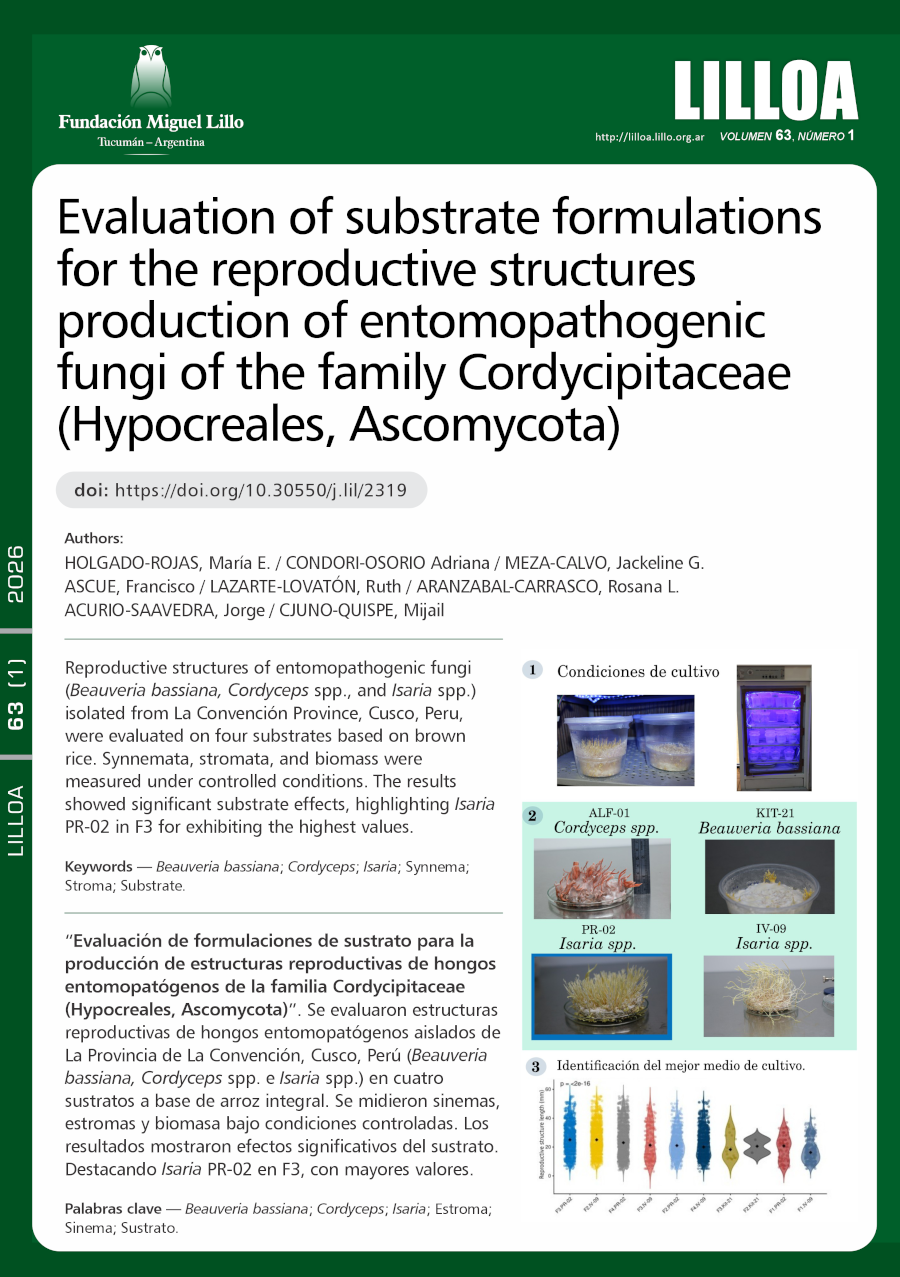
The production of reproductive structures of entomopathogenic fungi was evaluated using strains isolated from the province of La Convención, Cusco, Peru: Beauveria bassiana (KIT-21), Cordyceps spp. (ALF-01), and two strains of Isaria spp. (IV-09 and PR-02). Four solid substrate formulations based on brown rice were incubated under controlled conditions, with the developmental phase of the reproductive structures occurring under blue LED light at 20 °C and 88% relative humidity. Synnemata and stromata length and fresh biomass were measured as response variables at 30 and 120 days, respectively. Because the data showed deviations from normality and heteroscedasticity, inferential analysis was conducted using a two-way ANOVA with Welch’s correction, complemented by non-parametric tests (Kruskal-Wallis), which revealed significant effects of the substrate and substrate-strain interactions. Comparatively, the reproductive structures of Isaria showed the highest values. In particular, the greatest mean synnemata length was recorded in formulation F3, with PR-02 (26 mm) standing out, followed by F4 (25 mm), while IV-09 showed its best performance in F2 (25.7 mm). Fresh biomass followed a similar trend, with higher values observed for Isaria, especially PR-02 in F3 (1.14 g). Overall, the results indicate that brown rice substrate supplemented according to formulation F3 constitutes a viable and scalable substrate for the production of reproductive structures.
Downloads
References
Angelo, I. C., Ramírez, J. L., Pérez de León, A. Á. & Gôlo, P. S. (2025). Editorial: Current perspectives on the use of entomopathogenic fungi for pest control. Frontiers in Fungal Biology 6: 1609506. https://doi.org/10.3389/ffunb.2025.1609506
Arrubla, P., Cárdenas, M. & Posada, F. (2010). Efecto de la humedad relativa sobre la germinación de las esporas de Beauveria bassiana y la patogenicidad a la broca del café Hypothenemus hampei. Revista UDCA Actualidad & Divulgación Científica 13 (1): 67-76. https://doi.org/10.31910/rudca.v13.n1.2010.710
Céspedes, Y., del Pozo, E., García, I. & Méndez, A. (2008). Efecto de la temperatura sobre el hongo entomopatógeno Nomuraea rileyi (Farlow) Samson y su efectividad sobre Spodoptera frugiperda J. E. Smith. Revista de Protección Vegetal 23 (3): 176-182.
Chhetri, D. R., Chhetri, A., Shahi, N., Tiwari, S., Karna, S. K. L., Lama, D. & Pokharel, Y. R. (2020). Isaria tenuipes Peck, an entomopathogenic fungus from Darjeeling Himalaya: Evaluation of in-vitro antiproliferative and antioxidant potential of its mycelium extract. BMC Complementary Medicine and Therapies 20: 185. https://doi.org/10.1186/s12906-020-02973-w
Castillo, L., Restrepo, S. & Sanjuan, T. (2013). Evaluación de medios de cultivo para la producción de sinemas y conidios del hongo entomopatógeno Isaria tenuipes Peck. Repositorio Institucional Séneca, Universidad de los Andes.
Cortez-Madrigal, H. (2007). Producción de Lecanicillium (= Verticillium) lecanii en diferentes sustratos y patogenicidad. Agricultura técnica en México 33 (1): 83-87.
Feng, Y., Zhu, Y., Li, Y., Li, J., Sun, Y., Shen, H., Wang, A., Lin, Z. & Zhu, J. (2018). Effect of strain separated parts, solid-state substrates and light condition on yield and bioactive compounds of Cordyceps militaris fruiting bodies. CyTA - Journal of Food 16 (1): 916-922. https://doi.org/10.1080/19476337.2018.1498130
Fox, J., Weisberg, S., Price, B., Adler, D., Bates, D., Baud-Bovy, G., Bolker, B., Ellison, S., Firth, D., Friendly, M., Gorjanc, G., Graves, S., Heiberger, R., Krivitsky, P., Laboissiere, R., Maechler, M., Monette, G., Murdoch, D., Nilsson, H., Ogle, D., Proctor, I., Ripley, B., Short, T., Venables, W., Walker, S., Winsemius, D. & Zeileis, A. (2026). R-Core. car: Companion to Applied Regression. R package version 3.1-5. https://doi.org/10.32614/CRAN.package.car
Garza-López, Paul M., Konigsberg, M., Saucedo-Castañeda, G. & Loera, O. (2011). Perfiles diferenciales de Beauveria bassiana (Bals.-Criv.) Vuill. en respuesta al CO2: producción de conidios y amilasas. Agrociencia 45 (7): 761-770.
Godoy, J. C., Valera, R. E., Guédez, C., Cañizalez, L. M. & Castillo, C. (2007). Determinación de temperatura y humedad óptima para la germinación y esporulación de cinco aislamientos de Beauveria bassiana. Revista de la Facultad de Agronomía 24 (3): 415-425.
Gutiérrez-Cárdenas, O. G., Cortez-Madrigal, H. & Garzón, A. (2024). Use and impact of endophytic entomopathogenic fungi: Their potential in the context of agricultural sustainability. Biotecnia 26:e1986. https://doi.org/10.18633/biotecnia.v26.1986
Hu, Y., Lu, G., Lin, D., Luo, H., Hatungimana, M., Liu, B. & Lin, Z. (2024). Endophytic Fungi in Rice Plants and Their Prospective Uses. Microbiology Research 15 (2): 972-993. https://doi.org/10.3390/microbiolres15020064
Ji, S. B. & Ra, C. H. (2021). Coproduction of Enzymes and Beta-Glucan by Aspergillus oryzae Using Solid-State Fermentation of Brown Rice. Journal of Microbiology and Biotechnology 31 (7): 1028-1034. https://doi.org/10.4014/jmb.2105.05005
Kassambara, A. (2025). rstatix: Pipe-friendly framework for basic statistical tests. R package version 0.7.3. https://doi.org/10.32614/CRAN.package.rstatix
Kassambara, A. (2026). ggpubr: ‘ggplot2’ based publication ready plots. R package version 0.6.3. https://doi.org/10.32614/CRAN.package.ggpubr
Lee, K. M., Hong, I.P., Nam, S. H., Sung, G. B. & Bae, Y. H. (2008). The Cultural Characteristics and Antibacterial Activities of Cordyceps militaris and Paecilomyces tenuipes. Korean journal of applied entomology 47 (4): 479-486.
Lenth, R. V. & Piaskowski, J. (2026). Estimated Marginal Means, aka Least-Squares Means. R package version 2.0.3. https://doi.org/10.32614/CRAN.package.emmeans
Liu, K., Wang, F., Liu, G. & Dong, C. (2019). Effect of Environmental Conditions on Synnema Formation and Nucleoside Production in Cicada flower, Isaria cicadae (Ascomycetes). International Journal of Medicinal Mushrooms 21 (1): 59-69. https://doi.org/10.1615/intjmedmushrooms.2018029506
Lucero, J., Manzano, J., Loaiza, I. & Orellana, Y. (2024). Producción de Beauveria bassiana para la formulación de bioplaguicidas. La Granja. Revista de Ciencias de la Vida 40 (2): 113-129. https://doi.org/10.17163//lgr.n40.2024.08
Luz, C. & Fargues, J. (1999). Dependence of the entomopathogenic fungus, Beauveria bassiana, on high humidity for infection of Rhodnius prolixus. Mycopathologia 146 (1): 33-41. https://doi.org/10.1023/a:1007019402490
Madhavi, V., Kalpana, M., Prasad, Y. & Hameeda, B. (2020). Mass production of Entomopathogenic fungi Beauveria bassiana, Metarhizium anisopliae, Verticillum lecanii and Paecilomyces fumosoroseus by using broken rice as substrate. International Journal of Entomology Research 5: 151-155.
Mair, P. & Wilcox, R. (2020). Robust statistical methods in R using the WRS2 package. Behavior Research Methods 52(2): 464-488. https://doi.org/10.3758/s13428-019-01246-w
Méndez, A., del Pozo, E., García, I. & González, A. (2010). Evaluación de Sustratos Sólidos para la Producción masiva de Nomuraea rileyi (FARLOW) Samson. Revista de Protección Vegetal 25 (2): 108-112.
Pöggeler, S., Nowrousian, M., Teichert, I., Beier, A. & Kück, U. (2018). Fruiting-Body Development in Ascomycetes. En T. Anke & A. Schüffler (Eds.), Physiology and Genetics: Selected Basic and Applied Aspects 15: 1-56. https://doi.org/10.1007/978-3-319-71740-1_1
Rangel, D. E. N., Acheampong, M. A., Bignayan, H. G., Golez, H. G. & Roberts, D. W. (2023). Conidial mass production of entomopathogenic fungi and tolerance of their mass-produced conidia to UV-B radiation and heat. Fungal Biology 127 (12): 1524-1533. https://doi.org/10.1016/j.funbio.2023.07.001
Reyes-Haro, L. E. (2018). Developing a strain improvement system for the entomopathogenic fungus Beauveria basssiana: a way to get better biocontrol agents? (Doctoral dissertation, University of Warwick).
Shrestha, B., Lee, W. H., Han, S. K. & Sung, J. M. (2006). Observations on Some of the Mycelial Growth and Pigmentation Characteristics of Cordyceps militaris Isolates. Mycobiology 34 (2): 83-91.
Tang, H. (2001). Effects of environmental factors on virulence of the entomopathogenic fungus, Nomuraea rileyi, against the corn earworm, Helicoverpa armigera (Lep., Noctuidae). Journal of Applied Entomology 125 (5): 243-248.
Taylor, A., Vagany, V., Barbara, D. J., Thomas, B., Pink, D. A. C., Jones, J. E. & Clarkson, J. P. (2013). Identification of differential resistance to six Fusarium oxysporum f. sp. cepae isolates in commercial onion cultivars through the development of a rapid seedling assay. Plant Pathology 62: 103-111. https://doi.org/10.1111/j.1365-3059.2012.02624.x
Toledo, A. V., De Remes Lenikov A. M. & López Lastra C. C. (2008). Host Range Findings on Beauveria Bassiana and Metarhizium Anisopliae (Ascomycota: Hypocreales) in Argentina. Boletín de la Sociedad Argentina de Botánica 43 (3-4): 211-220.
Vimala Devi, P. S., Chowdary, A. & Prasad, Y. G. (2001). Cost-effective multiplication of the entomopathogenic fungus Nomuraea rileyi (F) Samson. Mycopathologia 151: 35-39. https://doi.org/10.1023/A:1010953319092
Wickham, H., Averick, M., Bryan, J., Chang, W., McGowan, L. D., François, R., Grolemund, G., Hayes, A., Henry, L., Hester, J., Kuhn, M., Pedersen, T. L., Miller, E., Bache, S. M., Müller, K., Ooms, J., Robinson, D., Seidel, D. P., Spinu, V., Takahashi, K., Vaughan, D., Wilke, C., Woo, K. & Yutani, H. (2019). Welcome to the Tidyverse. Journal of Open Source Software 4 (43): 1686. https://doi.org/10.21105/joss.01686
Wu, C. Y., Liang, C. H. & Liang, Z. C. (2023). Effect of LED light on the production of fruiting bodies and nucleoside compounds of Cordyceps militaris at different growth stages of solid-state fermentation. Journal of the Taiwan Institute of Chemical Engineers 153: 105190. https://doi.org/10.1016/j.jtice.2023.105190
Yadav, S., Tandan, N. & Kumar, K. (2013). Mass production of entomopathogens Beauveria bassiana and Metarhizium anisopliae using rice as a substrate by diphasic liquid-solid fermentation technique. International Journal of Advanced Biological Research 3 (3): 331-335.
Downloads
Published
How to Cite
Issue
Section
License
Copyright (c) 2026 Lilloa

This work is licensed under a Creative Commons Attribution-NonCommercial-ShareAlike 4.0 International License.