Physiological response of Trichoderma spp. (Ascomycota, Hypocreales) to the pesticide chlorpyrifos
Authors
-
Facundo Guillermo Alberto Carrizo
Grupo de Ecologia Urbana y Disturbios, Instituto de Ecorregiones Andinas, Universidad Nacional de Jujuy, CONICET
 https://orcid.org/0009-0008-3387-5010
-
Florencia Romina Cruz
Instituto de Investigación, Desarrollo y Transferencia para la producción de alimentos, Universidad Nacional de Jujuy. San Salvador de Jujuy, Jujuy, Argentina
https://orcid.org/0009-0005-9396-2667
-
Analía Belén Estrada
Instituto de Investigación, Desarrollo y Transferencia para la producción de alimentos, Universidad Nacional de Jujuy. San Salvador de Jujuy, Jujuy, Argentina
https://orcid.org/0009-0008-7606-3020
-
Natalia María Elisa Avila Carreras
Instituto de Investigación, Desarrollo y Transferencia para la producción de alimentos, Universidad Nacional de Jujuy. San Salvador de Jujuy, Jujuy, Argentina
https://orcid.org/0000-0003-4943-1736
-
Luciano Matias Yañez
Instituto de Investigación, Desarrollo y Transferencia para la producción de alimentos, Universidad Nacional de Jujuy. San Salvador de Jujuy, Jujuy, Argentina
https://orcid.org/0000-0002-1488-3129
-
Marcos Javier Maldonado
Instituto de Investigación, Desarrollo y Transferencia para la producción de alimentos, Universidad Nacional de Jujuy. San Salvador de Jujuy, Jujuy, Argentina Instituto de Estudios Celulares, Genéticos y Moleculares - Universidad Nacional de Jujuy. San Salvador de Jujuy, Jujuy, Argentina. Cátedra Microbiología, Facultad de Ciencias Agrarias, Universidad Nacional de Jujuy, Humahuaca, Jujuy, Argentina
https://orcid.org/0009-0004-8819-554X
-
Alejandra Eunice Romero
Instituto de Investigación, Desarrollo y Transferencia para la producción de alimentos, Universidad Nacional de Jujuy. San Salvador de Jujuy, Jujuy, Argentina
https://orcid.org/0009-0003-1996-8185
DOI:
 https://doi.org/10.30550/j.lil/2313
Keywords:
Bioremediation, environmental biotechnology, organophosphate degradationAbstract
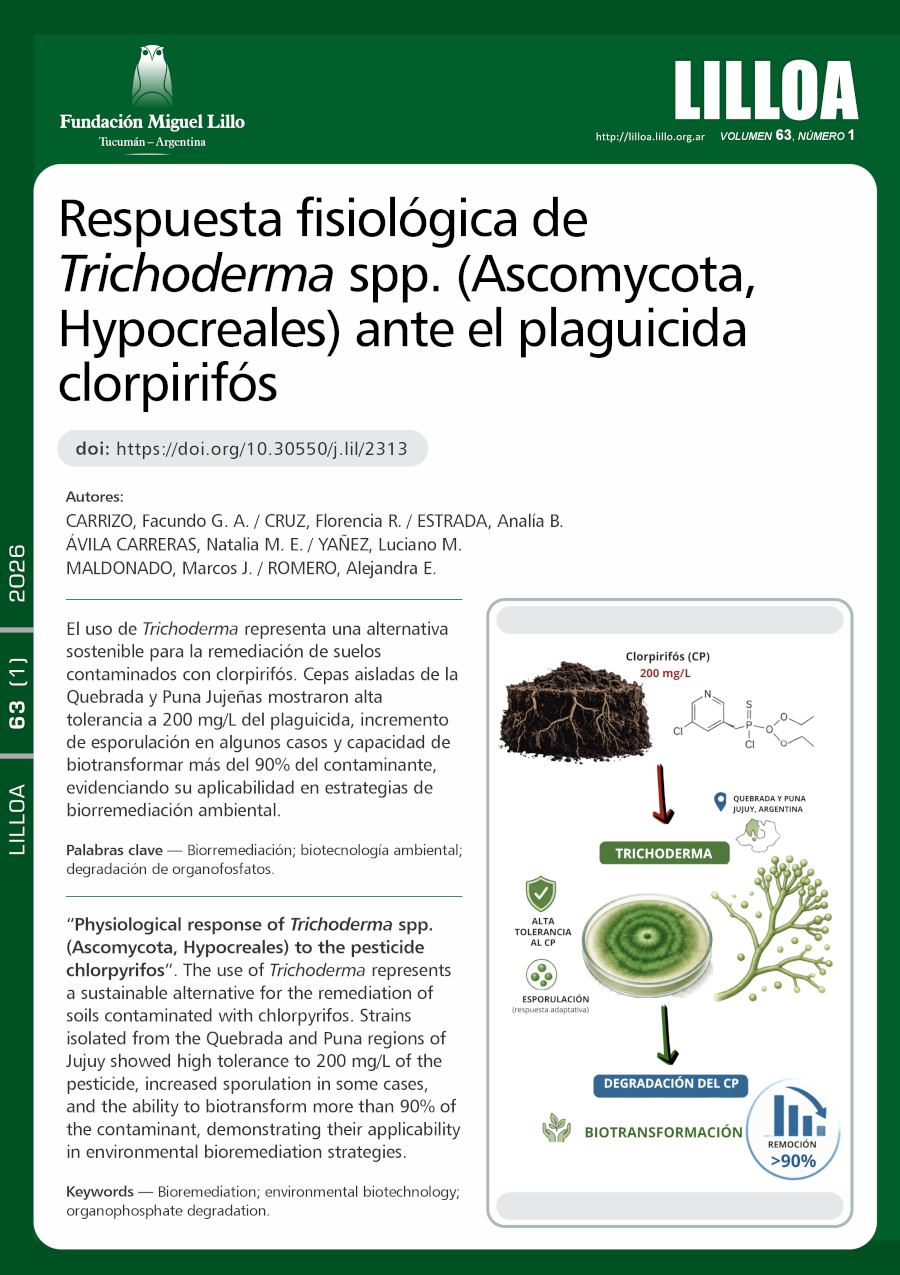
Chlorpyrifos (CP) is a chlorinated organophosphate pesticide widely used in agricultural crops, characterized by its environmental persistence and toxic effects on flora and fauna. The treatment of CP-contaminated soils aims to reduce contaminant concentrations; to this end, the use
of microorganisms represents a sustainable and economical alternative compared to physicochemical methods. Among filamentous fungi with potential for this purpose, the genus Trichoderma stands out due to its genetic diversity, ecological plasticity, high enzymatic capacity for degrading of complex compounds, versatile metabolism, and resistance to microbial inhibitors. The objective of this study was to evaluate the physiological responses of 11 native Trichoderma strains, isolated from soils of the Quebrada and Puna regions of Jujuy Province, to CP
exposure, and to determine their ability to degrade it under controlled laboratory conditions. For this purpose, the strains were exposed to contaminated media with 200 mg/L of CP, and variables such as mycelial growth, growth rate, percentage of mycelial growth inhibition, conidia production, and percentage of CP removal were measured. The results showed that the strains tolerated the presence of CP without significant effects on their growth or on the production of reproductive structures, and some exhibited increased sporulation, which could represent
an adaptive response to chemical stress. Differences in CP removal
efficiency were observed among strains, with several reaching removal rates exceeding 90%. These results demonstrat the potential of native Trichoderma strains for application in bioremediation strategies in CPcontaminated soils.
Downloads
References
Abuhena, M., Kabir, M., Azim, M., Al-Rashid, J., Rasul, N. y Huq, M. (2022). A stredding method for producing high-density Trichoderma spores in a dual-layer by utilizing a starch-based medium in a reconditioning approach. Bioresource Technology 19. https://doi.org/10.1016/j.biteb.2022.101165
Angulo Pinedo, S. J. y García Arirama, J. M. (2022). Aplicación de microorganismos eficientes (EM) y Trichoderma harzianum para la biorremediación de suelos de arroz contaminados con Carbofuran, Morales–Cacatachi, 2022. (Tesis de grado), Universidad César Vallejo, Facultad de Ingeniería y Arquitectura, Escuela Profesional de Ingeniería Ambiental.
Alansary, N. (2024). Chlorpyrifos biodegradation study in Egyptian agricultural soil. Al-Azhar Journal of Agricultural Research.
Amerio, N. S., Castrillo, M. L., Bichi, G. A., Zapata, P. D. y Villalba, L. L. (2020). Trichoderma en la Argentina: estado del arte. Ecología Austral 30: 113-124.
Argumedo-Delira, R., Alarcón, A., Ferrera-Cerrato, R. y Peña-Cabriales, J. (2009). El género fúngico Trichoderma y su relación con contaminantes orgánicos e inorgánicos. Revista Internacional de Contaminación Ambiental 25 (4): 257-269.
Azabache, J. e Iannacone, J. (2024). Compatibilidad de los bioplaguicidas Clibadium sylvestre y Trichoderma harzianum como alternativa en el control ecológico de plagas. Scientia 25 (25). Recuperado de https://revistas.urp.edu.pe/index.php/Scientia/article/view/6299
Barberis, C., Carranza, C. S., Magnoli, K., Benito, N. y Magnoli C. E. (2019) Development an removal ability of non-toxigenic Aspergillus section Flavi in presence of atrazine, chlorpyrifos and endosulfan. Revista Argentina de Microbiología 51 (1): 3-11. http://doi.org/10.1016/j.ram.2018.03.002
Beldomenico, H. (2021). Impacto de los plaguicidas en los alimentos, el ambiente y la salud en Argentina: revisión bibliográfica y propuestas superadoras. Rafaela: Santa Fe.
Bhende, R., Jhariya, U., Srivastava, S., Bombaywala, S., Das, S. y Dafale, N. A. (2022). Environmental distribution, metabolic fate, and degradation mechanism of chlorpyrifos: recent and future perspectives. Applied Biochemistry and Biotechnology 194: 2301-2335.
Bose, S., Kumar, P. S. y Vo, D. V. (2021). A review on the microbial degradation of chlorpyrifos and its metabolite TCP. Chemosphere 283: 131447.
Elzakey, E. M., El-Sabbagh, S. M., Eldeen, E., Adss, I. A. y Nassar, A. M. (2023). Bioremediation of chlorpyrifos residues using some indigenous species of bacteria and fungi in wastewater. Environmental Monitoring and Assessment 195: 779.
Guisan, A. y Zimmermann, N. E. (2000). Predictive habitat distribution models in ecology. Ecological Modelling 135: 147-186.
Gómez Gómez, A. M. (2021). Degradación del insecticida clorpirifós por Pseudomonas aeruginosa, rizobacteria aislada de cultivo de papa (Solanum tuberosum). (Tesis de grado), Universidad Antonio Nariño, Facultad de Ciencias.
Guo, R., Li, G., Zhang, Z. y Peng, X. (2022). Structures and biological activities of secondary metabolites from Trichoderma harzianum. Marine Drugs 20: 701.
Kumar, G., Lal, S., Soni, S. K., Maurya, S. K., Shukla, P. K., Chaudhary, P., Bhattacherjee, A. K. y Garg, N. (2022). Mechanism and kinetics of chlorpyrifos co-metabolism by using environment restoring microbes isolated from rhizosphere of horticultural crops under subtropics. Frontiers in Microbiology 13: 891870.
Mahalle, P. N., Waghmode, M. S. y Jadhav, J. P. (2025). Chlorpyrifos degradation potential of Bacillus aryabhattai: pathway elucidation and enzyme kinetics. Chemosphere 354: 151947. https://doi.org/10.1016/j.chemosphere.2025
Malla, M. A., Dubey, A., Kumar, A., Yadav, S. y Kumari, S. (2023). Modeling and optimization of chlorpyrifos and glyphosate biodegradation using RSM and ANN. Ecotoxicology and Environmental Safety 252.
Mayo-Prieto, S., Squarzoni, A., Carro-Huerga, G., Porteous-Álvarez, A. J. y Casquero, P. A. (2022). Organic and conventional bean pesticides in development of autochthonous Trichoderma strains. Journal of Fungi 8: 603.
Matúš, P., Littera, P., Farkas, B. y Urík, M. (2023). Review on performance of Aspergillus and Penicillium species in biodegradation of organochlorine and organophosphorus pesticides. Microorganisms 11: 1485.
Muñoz Ríos, M. A., Rojas Villacorta, W. A. y Malqui Ramos, I. L. (2019). Crecimiento de Trichoderma asperellum en medio sólido utilizando plaguicidas como fuente de carbono. Scientia 11 (2).
Oyege, I., Wasswa, J., Bhaskar, M., Nkedi-Kizza, P. y Kasozi, G. (2024). Mixed-solvent sorption and moisture-regime-dependent degradation of chlorpyrifos in tropical soils. International Journal of Environmental Research 18.
Romero, A. E., Yañez, L. M., Tschambler, J. A. y Bovi Mitre, M. G. (2015). Producción conidial y viabilidad de cepas de Trichoderma sp. en suelos de Maimará (Jujuy). En: X Reunión Nacional Científico-Técnica de Biología del Suelo (REBIOS), San Salvador de Jujuy.
Sabogal Vargas, A. M., Wilson Krugg, J., Rojas Villacorta, W., De La Cruz Noriega, M., Otiniano, N. M., Rojas Flores, S. y Mendoza Villanueva, K. (2023). In vitro compatibility of native isolates of Trichoderma with chlorpyrifos. Applied Sciences 13: 811.
Saengsanga, T. y Phakratok, N. (2023). Biodegradation of chlorpyrifos by soil bacteria and effects on rice seedlings. Plant, Soil and Environment 69: 210-220.
Solomon, K., Williams, W., Mackay, D., Purdy, J., Giddings, J. y Giesy, J. (2014). Properties and uses of chlorpyrifos in the United States. Reviews of Environmental Contamination and Toxicology 231: 13-34.
Seididamyeh, M., Netzel, M. E., Mereddy, R., Harmer, J. R. y Sultanbawa, Y. (2023). Photodynamic inactivation of Botrytis cinerea spores by curcumin. Food and Bioprocess Technology.
Serbent, M. P., Guimarães, D. K. S., Drechsler-Santos, E. R., Helm, C. V., Giongo, A. y Tabares, L. B. B. (2020). Growth and enzymatic production of Lentinus crinitus under herbicide exposure. International Journal of Environmental Science and Technology 17: 2995-3012.
Sivila, N. y Álvarez, S. (2013). Producción artesanal de Trichoderma. San Salvador de Jujuy: Universidad Nacional de Jujuy.
Soesanto, L., Mugiastuti, E. y Somowiyarjo, S. (2022). Biodegradation of chlorpyrifos by Trichoderma harzianum metabolites in soils. Agronomy 12 (8): 1972.
Stamatiu-Sánchez, K., Alarcón, A., Ferrera-Cerrato, R., Nava Díaz, C., Sánchez-Escudero, J., Cruz-Sánchez, J. S. y Castillo, M. P. (2015). Tolerancia de hongos filamentosos a plaguicidas en condiciones in vitro. Revista Internacional de Contaminación Ambiental 31 (1): 23-37.
Sud, D., Kumar, J., Kaur, P. y Bansal, P. (2020). Toxicity and degradation of chlorpyrifos. Journal of the Chilean Chemical Society 65 (2): 4807-4816.
Yadav, R., Tripathi, P., Singh, R. P. y Khare, P. (2023). Soil enzymatic resilience in chlorpyrifos-contaminated soils. Environmental Science and Pollution Research 30: 7040-705.
Zehra, A., Aamir, M., Dubey, M. K., Ansari, W. A., Meena, M., Swapnil, P., Upadhyay, R. S., Ali, M. A., Al-Ghamdi, A. A. y Lee, J. (2023). Enhanced protection of tomato against Fusarium wilt using Trichoderma harzianum. Journal of King Saud University. Science 35: 102466.
Downloads
Published
How to Cite
Issue
Section
License
Copyright (c) 2026 Lilloa

This work is licensed under a Creative Commons Attribution-NonCommercial-ShareAlike 4.0 International License.