Spatial and temporal distribution of epilithic diatom species from the Apatlaco River, Morelos (Mexico)
Authors
-
Adrián Rojas-Romero
Facultad de Ciencias Biológicas, Universidad Autónoma del Estado de Morelos. Cuernavaca Morelos, México
 https://orcid.org/0009-0001-1734-7313
-
Judith García Rodríguez
Centro de Investigaciones Biológicas, Universidad Autónoma del Estado de Morelos Cuernavaca Morelos, México.
https://orcid.org/0000-0002-5412-7483
-
Migdalia Díaz-Vargas
Centro de Investigaciones Biológicas, Universidad Autónoma del Estado de Morelos. Cuernavaca Morelos, México
https://orcid.org/0000-0002-0510-8358
-
Elsah Arce
Centro de Investigaciones Biológicas, Universidad Autónoma del Estado de Morelos. Cuernavaca Morelos, México
https://orcid.org/0000-0002-9815-2525
-
Olivia De los Santos
Centro de Investigaciones Biológicas, Universidad Autónoma del Estado de Morelos. Cuernavaca Morelos, México
https://orcid.org/0000-0003-0222-6962
-
Marco P. Franco
Centro de Investigaciones Biológicas, Universidad Autónoma del Estado de Morelos. Cuernavaca Morelos, México
https://orcid.org/0000-0003-4954-5100
DOI:
 https://doi.org/10.30550/j.lil/2296
Keywords:
Bioindicator, diversity, physicochemical parametersAbstract
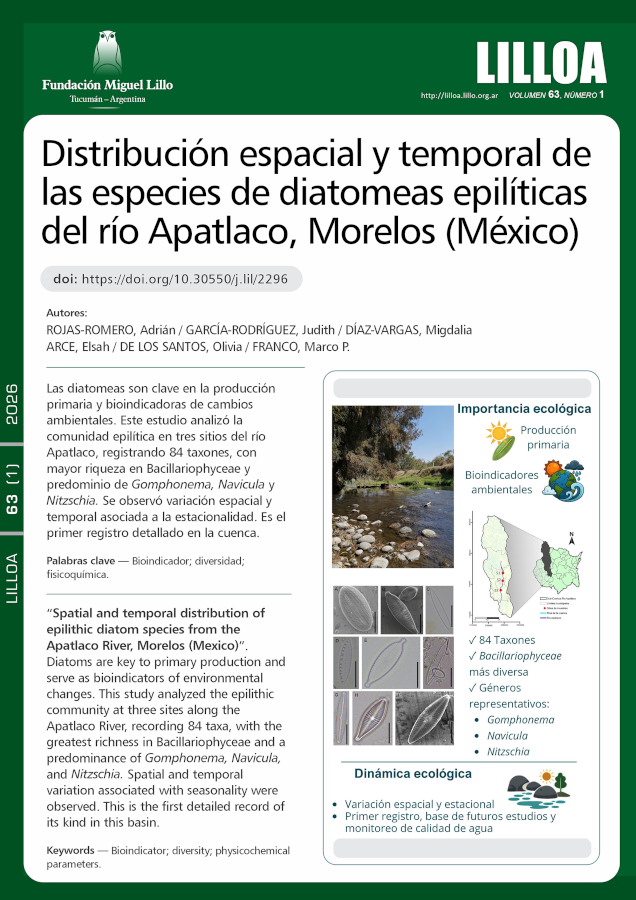
Diatoms play a crucial role in aquatic ecosystems by significantly contributing to global primary production. Their high sensitivity to the physicochemical conditions of water makes them bioindicators of environmental changes, such as eutrophication, pollution, and variations in light and temperature regimes. This study enhances our understanding of the epilithic diatom community and its distribution at three sites along the Apatlaco River in Morelos, Mexico. The samples were collected from rock surfaces using a soft-bristled brush and analyzed under a microscope for taxonomic identification. A total of 84 taxa belonging to three classes and 35 genera were recorded. The class Bacillariophyceae exhibited the highest species richness, with pennate diatoms being the most diverse. The genera with the greatest number of species were Gomphonema (14 species), Navicula (11 species), and Nitzschia (8 species). The epilithic diatom community displayed significant spatial and temporal variation, with species widely distributed throughout the study sites. The physicochemical parameters of the water exhibited seasonal fluctuations. This work represents the first detailed record of diatoms in the Apatlaco River basin and is a significant contribution to future ecological research and water quality monitoring in the region.
Downloads
References
American Public Health Association (APHA). (1992). Standard methods for the examination of water and wastewater. American Water Works Association and Water Pollution Control Federation. Washington, D. C. USA.
Arce, E. y Alcaraz, G. (2011). Shell use by the hermit crab Calcinus californiensis at different levels of the intertidal zone. Scientia Marina 75: 121-128. https://doi.org/10.3989/scimar.2011.75n1121 DOI: https://doi.org/10.3989/scimar.2011.75n1121
Badylak, S., Phlips, E., Dix, N., Hart, J., Srifa, A., Haunert, D., He, Z., Lockwood, J., Stofella, P., Sun, D. y Yang, Y. (2016). Phytoplankton dynamics in a subtropical Tidal creek: Influences of rainfall and water residence time on composition and biomass. Marine and Freshwater Research 67: 466-482. https://doi.org/10.1071/MF14325 DOI: https://doi.org/10.1071/MF14325
B-Béres, V., Stenger-Kovács, C., Buczkó, K., Padisák, J., Selmeczy, G.B., Lengyel, E. y Tapolczai, K. (2023). Ecosystem services provided by freshwater and marine diatoms. Hydrobiologia 850: 2707-2733. https://doi.org/10.1007/s10750-022-04984-9 DOI: https://doi.org/10.1007/s10750-022-04984-9
Benoiston, A. S, Ibarbalz, F. M., Bittner, L., Guidi, L., Jahn, O., Dutkiewicz, S. y Bowler, C. (2017). The evolution of diatoms and their biogeochemical functions. Philosophical Transactions of the Royal Society B 372: 20160397. http://dx.doi.org/10.1098/rstb.2016.0397 DOI: https://doi.org/10.1098/rstb.2016.0397
Blanco, L. S., Alvarez, B. I., Cejudo, F. C. y Bécares, M. E. (2010). Guía de las diatomeas de la cuenca del Duero. Confederación Hidrográfica del Duero.
Blanco J. F. y Scatena, N. F. (2006). Hierarchical contribution of river-ocean connectivity, water chemistry, hydraulics, and substrate to the distribution of diadromous snails in Puerto Rican streams. Journal of the North American Benthological Society 25: 82-98. https://doi.org/10.1899/0887-3593(2006)25[82:hcorcw]2.0.co;2 DOI: https://doi.org/10.1899/0887-3593(2006)25[82:HCORCW]2.0.CO;2
Bojorge-García, M., Carmona, J. y Ramírez, R. (2014). Species richness and diversity of benthic diatoms communities in tropical mountain streams of Mexico. Inland Waters 4: 279-292. https://doi.org/10.5268/IW-4.3.568 DOI: https://doi.org/10.5268/IW-4.3.568
Breton-Deval, L., Sanchez-Flores, A., Juárez, K. y Vera-Estrella R. (2019). Integrative study of microbial community dynamics and water quality along The Apatlaco River. Environmental Pollution 255: 113158. https://doi.org/10.1016/j.envpol.2019.113158 DOI: https://doi.org/10.1016/j.envpol.2019.113158
Cabarcas-Mier, A. y Tamaris-Turizo, C. E. (2015). Lista de microalgas epilíticas de la parte alta y media del río Gaira, Sierra Nevada de Santa Marta. Revista Intropica 10: 103-108. DOI: https://doi.org/10.21676/23897864.1653
Cantoral-Uriza, E. A. (1997). Diatomeas (Bacillariophyceae) de ambientes lóticos en la cuenca baja de la Huasteca Potosina. (Tesis Doctoral), México: Facultad de Ciencias. Universidad Nacional Autónoma de México.
Chakraborty, S. K. (2021). Trophic interactions and biogeochemical cycles in River ecosystem. Riverine Ecology https://doi.org/10.1007/978-3-030-53897-2_4 DOI: https://doi.org/10.1007/978-3-030-53897-2_4
CONAGUA (Comisión Nacional del Agua). (2012). El saneamiento del río Apatlaco. De lo crítico a lo sustentable. Secretaría de Medio Ambiente y Recursos Naturales. México, D F. 50 p.
Contino, L., Taboada, M. de los A., Gultemirian, M. de L. (2024). Comparación espacial de la ficoflora y el estado ecológico del agua en la cuenca baja del río Colorado (Tucumán, Argentina). Lilloa 61 (2): 435-458. https://doi.org/10.30550/j.lil/1991 DOI: https://doi.org/10.30550/j.lil/1991
De Wolf, H. (1982). Method de coding of ecological data from diatoms for computer utilization. Mededelingen Rijks Geologische Dienst 36: 95-98.
Fuentes, F. y Massol-Deyá, A. (2002). Manual de laboratorios. Ecología de microorganismos. Universidad de Puerto Rico. Puerto Rico.
García-Rodríguez, J., Molina-Astudillo, F. I., Quiroz, C. H., Trujillo, J. P. y Díaz, V. M. (2011). Distribución y sistemática del fitoplancton a lo largo del río Amacuzac (Morelos, México). Acta Universitaria 21: 11-23. https://doi.org/10.15174/au.2011.23 DOI: https://doi.org/10.15174/au.2011.23
Gómez, F. J. (2017). Aspectos ecológicos de las diatomeas epilíticas y fitoplanctónicas en la microcuenca Coaxitlán (Morelos- Guerrero), México. (Tesis Licenciatura), Universidad Autónoma del Estado de Morelos, Morelos, México.
Gualtero, L. D. M. (2007). Composición y abundancia de las algas bénticas de Cinco sistemas lóticos de Puerto Rico. (Tesis Maestría), Universidad de Puerto Rico.
Guiry, M. D. y Guiry, G. M. (2025). AlgaeBase. World-wide electronic publication, National University of Ireland, Galway. https://www.algaebase.org
Johansen, J. R., Rushforth, S. R., Orbendorfer, R., Fungladda, N. y Grimes, J. A. (1983). The Algal Floral of Selected wetwalls in Zion National Park, Utah, USA. Nova Hedwigia 38: 765-808.
Jüttner, I., Carter, C., Cox, E.J., Ector, L., Jones, V., Kelly, M. G., Kennedy, B., Mann, D. G., Turner, J. A., Van de Vijver, B., Wetzel, C. E. y Williams, D. M. (2025). Freshwater Diatom Flora of Britain and Ireland. Amgueddfa Cymru - National Museum Wales. Available online at https://naturalhistory.museumwales.ac.uk/diatoms.
Kelly, M. G., Cazaubon, A., Coring, E., dell’Uomo, A., Ector, L., Orfebre, B., Guasch, H., Hürlimann, J., Jarlman, A., Kawecka, B., Kwandrans, J., Laugaste, R., Lindstrom, E. A., Leitao, M., Marvan, P., Padisák, J., Pipp, E., Prygiel, J., Rott, E., Sabater, S., Vandan, H. y Vizinet, J. (1998). Recommendations for the routine sampling of diatoms for water quality assessments in Europe. Journal of Applied Phycology 10: 215-224. https://doi.org/10.1023/A:1008033201227 DOI: https://doi.org/10.1023/A:1008033201227
Krammer, K. y Lange-Bertalot, H. (1998). Bacillariophyceae 2. Bacillariaceae, Ephitemiaceae, Surirellaceae. Band 2/2. Die Süsswasserflora von Mitteleuropa. Pascher, A; Ettl, H.; Gerloff, J.; Heyning, H.; Mollenhauer, D. (Eds.) Stuttgart. Gustav Fischer Verlag.
Landa, M. M. (2012). Comunidad epilítica y fisícoquímica del agua en el Río Amacuzac, Morelos, México. (Tesis Licenciatura), Universidad Autónoma del Estado de Morelos, Morelos, México.
Liu, L., Yang, J., Yu, X., Chen, G. y Yu, Z. (2013). Patterns in the composition of microbial communities from a subtropical River: effects of environmental, spatial and temporal factors. PLoS ONE 8: e81232. https://doi.org/10.1371/journal.pone.0081232 DOI: https://doi.org/10.1371/journal.pone.0081232
Lobo, E. A., Heinrich, C. G., Schuch, M., Wetzel, C. E. y Ector, L. (2016). Diatoms as bioindicators in Rivers. In: Necchi JR, O. (eds) River Algae. Springer, Cham. https://doi.org/10.1007/978-3-319-31984-1_11 DOI: https://doi.org/10.1007/978-3-319-31984-1_11
Luque, E. M. y Martínez de Fabricius, A. L. (2003). Distribución temporal del fitoplancton y epiliton en el río Piedra Blanca (Córdoba, Argentina). Limnetica 22: 19-34. DOI: https://doi.org/10.23818/limn.22.16
Medeiros, G., Padial, A. A., Wedig, A. M. W., Ludwig, T. A. V. y Bueno, N. C. (2020). Environmental variables likely influence the periphytic diatom community in a subtropical lotic environment. Limnologica 80: 125718. https://doi.org/10.1016/j.limno.2019.125718 DOI: https://doi.org/10.1016/j.limno.2019.125718
Montoya, M. Y., Ramírez-Restrepo, J. y Segecin-Moro, R. (2010). Diatomeas perifíticas de la zona de ritral del río Medellín (Antioquia), Colombia. Actualidades Biológicas 30: 181-192. DOI: https://doi.org/10.17533/udea.acbi.4744
Mora, D., Carmona, J. y Cantoral-Uriza E. A. (2015). Diatomeas epilíticas de la cuenca del río Laja, Guanajuato, México. Revista Mexicana de Biodiversidad 86: 1024-1040. https://doi.org/10.1016/j.rmb.2015.09.004 DOI: https://doi.org/10.1016/j.rmb.2015.09.004
Mora, D., Carmona, J., Jahn, R., Zimmermann, J. y Abarca, N. (2017). Epilithic diatom communities of selected streams from the Lerma-Chapala Basin, Central Mexico, with the description of two new species. PhytoKeys 88: 39-69. https://doi.org/10.3897/phytokeys.88.14612 DOI: https://doi.org/10.3897/phytokeys.88.14612
Moreno-Franco, D. P., Quintero-Manzano, J. y López-Cuevas, A. (2010). Métodos para identificar, diagnosticar y evaluar el grado de eutrofia. Contactos 78: 25-33.
Necchi, J. O. (2017). River Algae. São José do Rio Preto, SP, Brazil: Springer.
Novelo, E., Tavera, R. y Ibarra, C. (2007). Bacillariophyceae from Karstic Wetlands in México. Bibliotheca Diatomologica. Band 54. J. Cramer in der Gebrüder Borntraeger Verlagsbuchhandlung. Berlin. Stuttgart.
Olmstead, P. S. y Tukey, J. W. (1947). A corner test for association. Annals of Mathematical Statistics 18: 495-513. DOI: https://doi.org/10.1214/aoms/1177730341
Pacheco, A. J. y Cabrera, S. A. (2003). Fuentes principales de nitrógeno y nitratos en aguas subterráneas. Ingeniería 7: 47-54.
Park, H., Lee, H., Heo, J., Yun, J., Kim, Y., Kim, H., Hong, D. y Lee, I. (2021). Deciphering the key factors determining spatio-temporal heterogeneity of cyanobacterial bloom dynamics in the Nakdong River with consecutive large weirs. Science of The Total Environment 755: 143079. https://doi.org/10.1016/j.scitotenv.2020.143079 DOI: https://doi.org/10.1016/j.scitotenv.2020.143079
Penalta-Rodríguez, M. y López-Rodríguez, M. (2007). Diatomeas y calidad del agua de los ríos del Macizo Central Gallego (Ourense, N.O. España) mediante la aplicación de índices diatomológicos. Limnetica 26: 351-358. DOI: https://doi.org/10.23818/limn.26.30
Potapova, M. G. y Charles, D. F. (2002). Benthic diatoms in USA rivers: distributions along spatial and environmental gradients. Journal of Biogeography 29: 167-187. https://doi.org/10.1046/j.1365-2699.2002.00668.x DOI: https://doi.org/10.1046/j.1365-2699.2002.00668.x
Ramírez, G. A. (2006). Ecología. Métodos de muestreo y análisis de poblaciones y comunidades. Editorial Pontificia Universidad Javeriana.
Ramírez, A. M. y Plata, D. Y. (2008). Diatomeas perifíticas en diferentes tramos de dos sistemas lóticos de alta montaña (Páramo de Santurbán, Norte De Santander, Colombia) y su relación con las variables ambientales. Acta Biológica Colombiana 13: 199-216.
Rimet, F. (2012). Recent views on river pollution and diatoms. Hydrobiologia 683: 1-24. https://doi.org/10.1007/s10750-011-0949-0 DOI: https://doi.org/10.1007/s10750-011-0949-0
Romero, R. J. A. (1999). Calidad del agua. Alfa-Omega Grupo Editorial S.A. de C.V. y Editorial Escuela Colombiana de Ingeniería.
Salinas-Camarillo, V. H. (2015). Taxonomía y distribución de las diatomeas epilíticas de ríos en la Cuenca de México. (Tesis Licenciatura), Facultad de Ciencias. Universidad Nacional Autónoma de México.
Segura-García, V., Almanza Álvarez, J. S. y Ponce-Saavedra, J. (2016). Diversidad en comunidades de diatomeas epilíticas con relación a los parámetros fisicoquímicos en la cabecera del río Zinapécuaro, México. Hidrobiológica 26: 187-202. DOI: https://doi.org/10.24275/uam/izt/dcbs/hidro/2016v26n2/Segura
Soininen, J., Paavola, R. y Muokta, T. (2004). Benthic diatom communities in boreal streams: community structure in relation to environmental and spatial gradients. Ecography 27: 330-342. https://doi.org/10.1111/j.0906-7590.2004.03749.x DOI: https://doi.org/10.1111/j.0906-7590.2004.03749.x
Spaulding, S. y Edlund, M. (2025). In Diatoms of North America from https://diatoms.org/genera/
Starmach, K. (1985). SüBwasserflora von MittelEuropa. Pascher, A., Ettl, H., Gerloff, J., 60 Heyning, H. y Mollenhauer, D. (Eds.). Stuttgart. Gustav Fischer Verlag. 537 p.
Taboada, M. de los Á., Alderete, M., Bustos, M. S. y Gultemirian, M. de L. (2023). Dinámica y composición de los ensambles diatomológicos de dos arroyos del Noroeste Argentino en relación con variables ambientales. Bonplandia 32 (1): 39-56. http://dx.doi.org/10.30972/bon.3216372 DOI: https://doi.org/10.30972/bon.3216372
Tapia, M. E. (2002). Estudio de las comunidades del fitoplancton en los ríos Daule, Guayas y Estero Salado. Acta Oceanográfica del Pacífico 11: 79-90.
Tavira, C. L. (2010). Utilización de las diatomeas como bioindicadoras de la calidad del agua en el río Amacuzac, Morelos, México. (Tesis Licenciatura), Universidad Autónoma del Estado de Morelos.
Tudesque, L., Rimet, F. y Ector, L. (2008). A new Taxon of the section Nitzschia lanceolata grunow: Nitzschia costei sp. nov. compared to N. fonticola grunow, N. macedonia hustedt, N. tropica hustedt and related species. Diatom Research 23: 483-501. https://doi.org/10.1080/0269249X.2008.9705771 DOI: https://doi.org/10.1080/0269249X.2008.9705771
Valadez-Cruz, F., Carmona-Jiménez, J. y Cantoral-Uriza, E. A. (1996). Algas de ambientes lóticos en el estado de Morelos, México. Anales del Instituto de Biología, Universidad Nacional Autónoma de México, Serie Botánica 67: 227-282.
Van Dam, H., Mertens, A. y Sinkeldam, J. (1994). A coded checklist and ecological indicator values of freshwater diatoms from the Netherlands. Netherlands Journal of Aquatic Ecology 28: 117-133. https://doi.org/10.1007/BF02334251 DOI: https://doi.org/10.1007/BF02334251
Vázquez, G., Aké-Castillo, J. A. y Favila, M. E. (2011). Algal assemblages and their relationship with water quality in tropical Mexican streams with different land uses. Hydrobiologia 667: 173-189. https://doi.org/10.1007/s10750-011-0633-4 DOI: https://doi.org/10.1007/s10750-011-0633-4
Velázquez-Machuca, M. A.; Pimentel-Equihua, J. L. y Ortega-Escobar, H. M. (2010). Longitudinal and temporal hydrochemical variations in the Duero River. Agrociencia 44: 599-609.
Vidales, P. R. (2010). Estudio limnológico y ficológico en los ríos Apatlaco, Puebla y Amatzinac, Morelos. (Tesis Licenciatura), Universidad Nacional Autónoma de México, México.
Ward, J. V. (1989). The four-dimensional nature of lotic ecosystem. Journal of the North American Benthological Society 8: 2-8. https://doi.org/10.2307/1467397 DOI: https://doi.org/10.2307/1467397
Wehr, D. J., Sheath, G. R. y Patrick, K. J. (2015). Freshwater Algae of North America: Ecology and Classification. 2nd ed. San Diego:Academia Press: Elsevier Inc. 1-11 DOI: https://doi.org/10.1016/B978-0-12-385876-4.00001-3
Zarazúa, G., Ávila-Pérez, P., Tejeda, S., Valdivia-Barrientos, M., Zepeda-Gómez, C. y Macedo-Miranda, G. (2013). Evaluación de los metales pesados Cr, Mn, Fe, Cu, Zn y Pb en sombrerillo de agua (Hydrocotyle ranunculoides) del curso alto del río Lerma, México. Revista Internacional de Contaminación Ambiental 29: 17-24. DOI: https://doi.org/10.20937/RICA.36519
Downloads
Published
How to Cite
Issue
Section
License
Copyright (c) 1900 Lilloa

This work is licensed under a Creative Commons Attribution-NonCommercial-ShareAlike 4.0 International License.