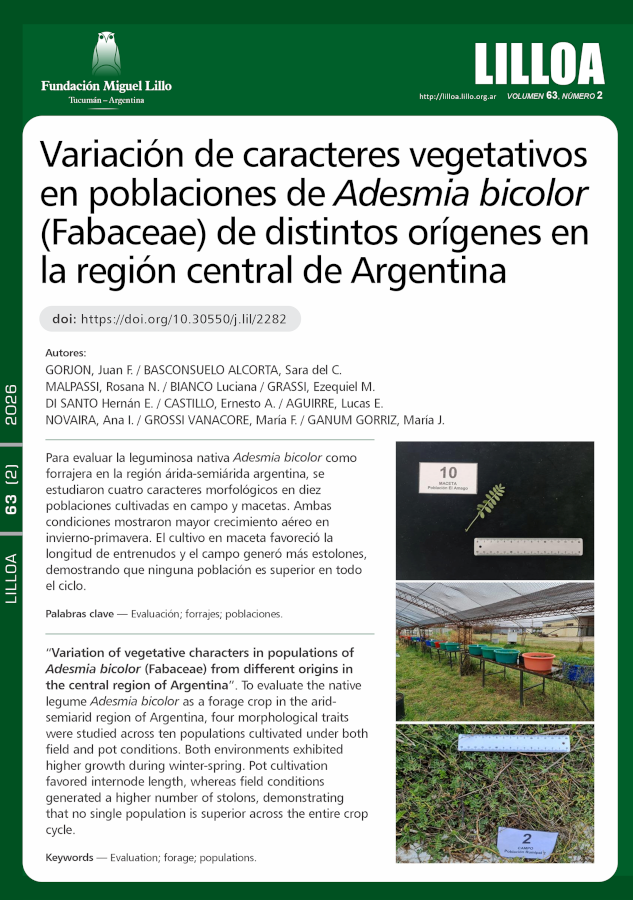
Variation of vegetative characters in populations of Adesmia bicolor (Fabaceae) from different origins in the central region of Argentina
Authors
-
Juan Florencio Gorjon
Universidad Nacional de Río Cuarto (UNRC), Facultad de Agronomía y Veterinaria. Río Cuarto, Córdoba, Argentina.
 https://orcid.org/0000-0003-2020-7255
-
Sara del Carmen Basconsuelo Alcorta
Universidad Nacional de Río Cuarto (UNRC), Facultad de Agronomía y Veterinaria. Río Cuarto, Córdoba, Argentina.
https://orcid.org/0000-0001-6379-3851
-
Rosana Noemí Malpassi
Universidad Nacional de Río Cuarto (UNRC), Facultad de Agronomía y Veterinaria. Río Cuarto, Córdoba, Argentina.
https://orcid.org/0000-0001-5064-0055
-
Luciana Bianco
Universidad Nacional de Río Cuarto (UNRC), Facultad de Agronomía y Veterinaria. Río Cuarto, Córdoba, Argentina.
https://orcid.org/0000-0003-3951-0916
-
Ezequiel Martín Grassi
Universidad Nacional de Río Cuarto (UNRC), Facultad de Agronomía y Veterinaria. Río Cuarto, Córdoba, Argentina.
https://orcid.org/0000-0002-6833-4520
-
Hernán Elías di Santo
Universidad Nacional de Río Cuarto (UNRC), Facultad de Agronomía y Veterinaria. Río Cuarto, Córdoba, Argentina.
https://orcid.org/0000-0001-9358-468X
-
Ernesto Ariel Castillo
Universidad Nacional de Río Cuarto (UNRC), Facultad de Agronomía y Veterinaria. Río Cuarto, Córdoba, Argentina.
https://orcid.org/0000-0002-5830-5136
-
Lucas Emanuel Aguirre
Universidad Nacional de Río Cuarto (UNRC), Facultad de Agronomía y Veterinaria. Río Cuarto, Córdoba, Argentina.
https://orcid.org/0009-0002-8228-7123
-
Ana Inés Novaira
Universidad Nacional de Río Cuarto (UNRC), Facultad de Agronomía y Veterinaria. Río Cuarto, Córdoba, Argentina.
https://orcid.org/0000-0003-3286-9993
-
María Fiamma Grossi Vanacore
Universidad Nacional de Río Cuarto (UNRC), Facultad de Agronomía y Veterinaria. Río Cuarto, Córdoba, Argentina.
https://orcid.org/0000-0002-9253-7774
-
María José Ganum Gorriz
Universidad Nacional de Río Cuarto (UNRC), Facultad de Agronomía y Veterinaria. Río Cuarto, Córdoba, Argentina.
https://orcid.org/0009-0007-4494-8011
DOI:
 https://doi.org/10.30550/j.lil/2288
Keywords:
Evaluation, forage, populationsAbstract
In the central arid-semiarid region of Argentina, the incorporation of native legumes as crops has been considered, mainly those of autumn-winter growth due to their forage potential and ability to fix atmospheric nitrogen. Among these species, Adesmia bicolor stands out a perennial herbaceous, creeping, stoloniferous plant with indefinite and predominantly winter growth that thrives both in fertile and impoverished soils. To further evaluate its potential as a forage crop, the variation of four vegetative morphological characters was studied in 10 populations originating from the provinces of Córdoba, Entre Ríos, and San Luis. The samples were cultivated under field and pot conditions. The experimental design consisted of random blocks with three replications, using a field plot of 63 m2 divided into subplots of 4 m2. For the pot growth condition, 52 L containers were placed in an open culture cage, with a single population transplanted into each. The quantified characters were: number of stolons m-2, internode length in stolons (cm), and leaflet length and width (cm). When comparing each variable throughout a one-year crop cycle, both pot and field, the highest values of aerial biomass components were recorded in spring under both treatments, suggesting the inference of a higher growth pattern during the winter-spring period. Conversely, the plants grown in pots presented more favorable conditions for intermode length, while those grown in the field favored the development of a higher number of stolons. This study demonstrated the influence of growing conditions on traits associated with growth habit. Likewise, among the studied populations, one exhibited advantages across all its attributes throughout the entire crop cycle; therefore it is necessary to evaluate each variable at each phenological stage and under each crop condition.
Downloads
References
Barreto Dias, P. M., Dall’Agnol, M. y Schifino-Wittmann, M. T. (2004). Genetic diversity in the Brazilian species of Adesmia DC. (Leguminosae) as assessed by RAPD. Plant Genetic Resources 2 (1): 43-50. https://doi.org/10.1079/PGR200429
Basconsuelo, S., Grosso, M., Kraus, T., Bianco, C., Bianco, L., Vileta, D. y Malpassi, R. (2013). Leguminosas nativas con potencial forrajero: Adesmia bicolor. UniRío Editora. http://www.unirioeditora.com.ar/wp-content/uploads/2021/09/978-987-688-038-1.pdf
Bedoussac, L., Journet, E. P., Hauggaard-Nielsen, H., Naudin, C., Corre-Hellou, G., Jensen, E. S., Prieur, L. y Justes, E. (2015). Ecological principles underlying the increase of productivity achieved by cereal-grain legume intercrops in organic farming. Agronomy for Sustainable Development 35 (3): 911-935. https://doi.org/10.1007/s13593-014-0277-7
Bemhaja, M. y Risso, D. F. (2006). Cultivares de forrajeras seleccionados, evaluados y liberados para areniscas. En Serie Técnica N° 159. INIA Tacuarembó (pp. 39-56). Instituto Nacional de Investigación Agropecuaria. http://www.ainfo.inia.uy/digital/bitstream/item/7503/1/ST-159-39-55.pdf
Bianco, C. A. (2002). Growth forms, taxonomy, distribution and uses of Adesmia species (Leguminosae) in Central Argentina. J. Cramer.
Bianco, C. A. y Weberling, F. (1999). A new species of the genus Adesmia DC. (Fabaceae) from southern Córdoba, Argentina. Feddes Repertorium 110 (7-8): 515-520. https://doi.org/10.1002/fedr.19991100713
Bianco, C. A. y Kraus, T. A. (2005). Desarrollo y estructura de la semilla y el fruto de Adesmia bicolor (Poir.) DC. (Fabaceae). ?yton 54: 71-77. https://doi.org/10.32604/phyton.2005.54.071
Bianco, L. (2014). Rhizobial infection in Adesmia bicolor (Fabaceae) roots. Archives of Microbiology 196 (9): 675-679. https://doi.org/10.1007/s00203-014-1004-0
Cardozo Cabanelas, G. A. (2019). Causas y consecuencias de la entrada de nitrógeno por fijación biológica en campo natural Tesis de maestría inédita. Universidad de la República. https://hdl.handle.net/20.500.12008/29814
Coll, J. y Zarza, A. (1992). Leguminosas nativas promisorias: Trébol polimorfo y babosita (Boletín de divulgación N° 22). INIA.
Dall’Agnol, M., Scheffer-Basso, S. M., Do Nascimento, J. A. L., Silveira, C. A. M. y Fischer, R. G. (2004). Produção de forragem de capim-elefante sob clima frio. Curva de crescimento e valor nutritivo. Revista Brasileira de Zootecnia 33 (5): 1110-1117. https://doi.org/10.1590/S1516-35982004000500002
Di Rienzo, J. A., Casanoves, F., Balzarini, M. G., Gonzalez, L., Tablada, M. y Robledo, C. W. (2020). InfoStat. Universidad Nacional de Córdoba. http://www.infostat.com.ar/
Fitzimons, D., Gorjon, J., Poliotto, T., Valdés, W., Panzitta, M., Pérez, V., Basconsuelo, S., Malpassi, R. y Bianco, L. (2020). Evaluación de caracteres vegetativos y reproductivos de Adesmia bicolor en cultivo bajo fertilización con fósforo. Ab Intus 5 (2): 1-7.
Gorjon, J., Fitzimons, D., Panzitta, M., Pérez, V., Malpassi, R., Bianco, L., Novaira, A. y Basconsuelo, S. (2022). Movilización de carbohidratos totales y contenido de proteína bruta en cultivo de Adesmia bicolor (Poir.) DC. bajo fertilización con fósforo. Chilean Journal of Agricultural & Animal Sciences 38 (1): 74-83. https://doi.org/10.29393/CHJAAS38-7MCJS80007
Grassi, E., Malpassi, R., Basconsuelo, S., di Santo, H., Castillo, E., Vega, D. J., Bianco, L., Novaira, M., Novaira, A., Aguirre, L., Gorjon, J., Ferreira, A., Ferreira, V. y Riesgo, G. (2023). Establecimiento y persistencia de babosita (Adesmia bicolor) consociada con festuca (Festuca arundinacea). Idesia 41 (1): 111-120. https://doi.org/10.4067/S0718-34292023000100111
Hakl, J., Šantr?cek, J. y Kocourkovà, D. (2007). The effect of the soil compaction on the contents on alfalfa root reserve nutrients in relation to the stand density and the amount of root biomass. Soil and Water Research 2 (2): 54-58. https://doi.org/10.17221/2117-SWR
Izaguirre, P. (2005). Uruguay y sus recursos fitogenéticos en Leguminosas. Agrociencia 9 (1-2): 77-83.
Muir, J. P., Tedeschi, L. O., Dubeux, J. C. B., Peters, M. y Burkart, S. (2017). Enhancing food security in Latin America with forage legumes. Archivos Latinoamericanos de Producción Animal 25 (3-4): 113-131. https://doi.org/10.53588/alpa.2534113
Panzitta, M., Malpassi, R., Basconsuelo, S., Pérez, V., Gorjon, J., Fitzimons, D. y Bianco, L. (2019). Ensayos preliminares para determinar la fijación biológica de nitrógeno de Adesmia bicolor a través del método de abundancia natural. Idesia 37 (1): 61-65. https://doi.org/10.4067/S0718-34292018005002301
Pereira Machín, M. (2011). Manejo y conservación de pasturas naturales del Basalto. Instituto Plan Agropecuario.
Pérez, V., Panzitta, M., Vidal, C., Basconsuelo, S., Gorjon, J., Fitzimons, D., Malpassi, R. y Bianco, L. (2020). Ritmo de crecimiento, producción de biomasa y dinámica de movilización de carbohidratos en Adesmia bicolor (Poir.) DC (Leguminosae) en cultivo. Chilean Journal of Agricultural & Animal Sciences 36 (3): 171-180. https://doi.org/10.29393/CHJAAS36-15RCVP80015
Reynoso, A., Gorjon, J., Castillo, E., Malpassi, R., Bianco, L., Novaira, A., Grassi, E., Aguirre, L., Di Santo, H. y Basconsuelo, S. (2023). Caracterización morfológica de poblaciones de Adesmia bicolor (Poir.) DC de la región semiárida central de Argentina. Idesia 41 (3): 15-23. https://doi.org/10.4067/S0718-34292023000300015
Scheffer-Basso, S. M., Vendrusculo, M. C., Barea, K., Beninca, R. C., Lubenow, R. y Cecchetti, D. (2002). Comportamento de Leguminosas (Adesmia, Lotus, Trifolium) em mistura com festuca. Revista Brasileira de Zootecnia 31 (6): 2197-2203. https://doi.org/10.1590/S1516-35982002000800007
Ulibarri, E. A. y Burkart, A. (2000). Synopsis of the species of Adesmia (Leguminosae, Papilionoideae) of Argentina. Darwiniana 38 (1-2): 59-126. https://doi.org/10.14522/darwiniana.2014.381-2.162
Veneciano, J. H., Frasinelli, C. A., Kraus, T. A. y Bianco, C. A. (2005). Domesticación de especies forrajeras. Universidad Nacional de Río Cuarto.
Vicondo, M. y Faule, L. (2019). Carta de suelos de Córdoba- Hoja 3363-19 Río Cuarto. Ministerio de Agricultura y Ganadería, Gobierno de la Provincia de Córdoba.
Vidal, C., Ibañez, M., Boito, G., Crenna, C. y Basconsuelo, S. (2016). Sistema reproductivo de Adesmia bicolor (Leguminosae). Interciencia 41 (11): 765-770. https://doi.org/10.17063/inter.41.11.5
Vileta, D. G., Grosso, M. y Fondevila, M. (2014). Nutritive value for ruminants of two herbaceous South-American native legumes: Adesmia bicolor and A. macrostachya. Animal Production Science 54 (2): 158-164. https://doi.org/10.1071/AN12371
Volenec, J. J., Boyce, P. J. y Hendershot, K. L. (1991). Carbohydrate metabolism in taproots of Medicago sativa L. during winter adaptation and spring regrowth. Plant Physiology 96 (3): 786-793. https://doi.org/10.1104/pp.96.3.786
Downloads
Published
How to Cite
Issue
Section
License
Copyright (c) 1900 Lilloa

This work is licensed under a Creative Commons Attribution-NonCommercial-ShareAlike 4.0 International License.