Floral morpho-anatomy, sporogenesis and gametogenesis in Ligaria cuneifolia (Loranthaceae)
Authors
-
Stella Maris Solís
Facultad de Ciencias Exactas, Naturales y Agrimensura, Universidad Nacional del Nordeste (UNNE). Instituto de Botánica del Nordeste (UNNE-CONICET). Corrientes, Argentina.
 https://orcid.org/0000-0002-8823-6282
-
Maria Silvia Ferrucci
Instituto de Botánica del Nordeste (UNNE-CONICET). Corrientes, Argentina.
https://orcid.org/0000-0003-4917-1188
DOI:
 https://doi.org/10.30550/j.lil/2258
Keywords:
Hemiparasites, hypostase, mamelon, megagametophytes, vascularizationAbstract
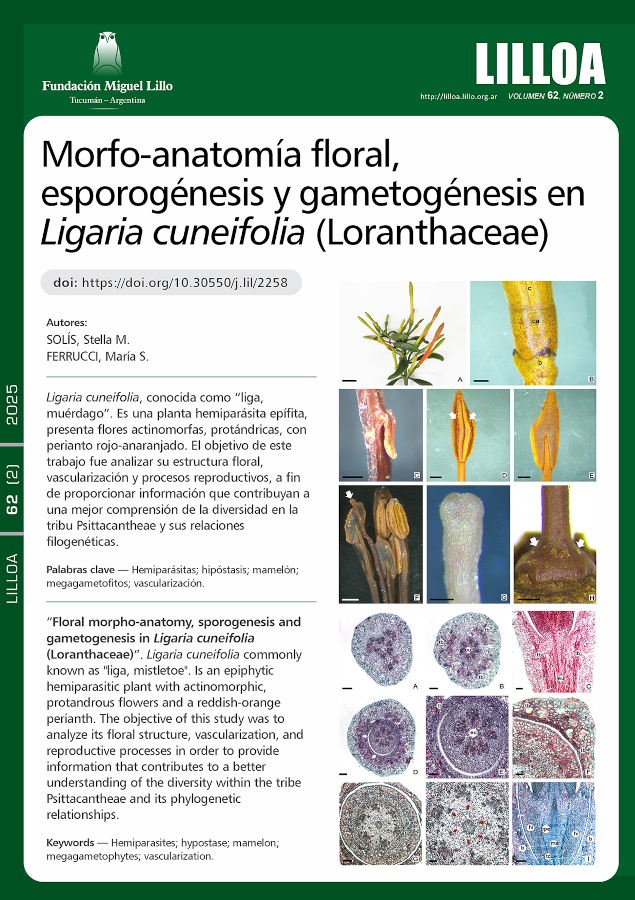
Loranthaceae comprises hemiparasitic, cosmopolitan plants. To provide information that contributes to a better understanding of the diversity in the Psittacantheae tribe and its phylogenetic relationships, the floral morpho-anatomy, vascularization, and formation of the microgametophyte and megagametophyte in Ligaria cuneifolia (Ruiz & Pav.) Tiegh. (subtribe Ligarinae) were analyzed. It has bisexual, heteroclamydeous flowers with a red-orange perianth, arranged in solitary inflorescences; rudimentary calyx, and tubular hexamerous corolla. The vascularization pattern is simple; traces and complexes branch off from a central eustele to innervate the parts of the different floral whorls. The mesophyll of the perianth segments shows cells
containing phenolic compounds and abundant sclereids. The androecium is tridynamous. The young anther has a monocotyledonous-type of antheral wall, formed by an exothecium, an endothecium with fibrillar thickenings, parietal layers, and a secretory tapetum with the presence of orbicules. Microsporogenesis and microgametogenesis are normal, pollen grains are two-celled when shed. The dehiscence of the three superior anthers occurs before anthesis, while the style exceeds the length of the stamens, preventing self-pollination. The stylar nectary is structured, lacks innervation, and the nectar is secreted through nectarostomata. The gynoecium exhibits an inferior, syncarpous, unilocular ovary. Internally, the hypostase is centrally located and supports the mamelon. This structure is constituted by amyliferous and sporogenous tissue. Successive divisions of this tissue give rise to numerous Polygonum-type megagametophytes. These extend along the stylar canal, accompanied by amyliferous tissue, when the flower is in pre-anthesis. The style is straight, filiform, and the stigma is papillose. The presence of an ovary reduced to a single placenta with an independent mamelon appears to be associated with an evolutionary trait that does not compromise the fertility or viability of the embryo sacs. The results are discussed in relation to what is known about the family Loranthaceae.
Downloads
References
Abbiatti, D. (1946). Las Lorantáceas Argentinas. Revista del Museo Argentino de Ciencias Naturales nueva serie 7: 1-110.
Aizen, M. A. (2005). Breeding system of Tristerix corymbosus (Loranthaceae), a winter-flowering mistletoe from the southern Andes. Australian Journal of Botany 53: 357-361. https://doi.org/10.1071/BT04088 DOI: https://doi.org/10.1071/BT04088
Amico, G. C., Vidal-Russell, R. y Nickrent, D. L. (2007). Phylogenetic relationships and ecological speciation in the mistletoe Tristerix (Loranthaceae): The influence of pollinators, dispersers, and hosts. American Journal of Botany 94 (4): 558-567. https://doi.org/10.3732/ajb.94.4.558 DOI: https://doi.org/10.3732/ajb.94.4.558
Bhatnagar, S. P. y Johri, B. M. (1983). Embryology of Loranthaceae. En: M. Calder, P. Bernhardt. (Eds.), The biology of mistletoes (pp. 47-66). London: Academic Press.
Brown, R. H., Nickrent, D. L. y Gasser, C. G. (2010). Expression of ovule and integument-associated genes in reduced ovules of Santalales. Evolution and Development 12 (2): 231-240. https://doi.org/10.1111/j.1525-142X.2010.00407.x DOI: https://doi.org/10.1111/j.1525-142X.2010.00407.x
Cid-Villamil, R. M. (2006). Biología del desarrollo de Cladocolea loniceroides (Van Tieghem) Kuijt (Loranthaceae). (Tesis Doctoral), Universidad Nacional Autónoma de México, México, DF.
Cocucci, A. E. (1983). New evidence from embryology in Angiosperm classification. Nordic Journal of Botany 3 (1): 67-73. https://doi.org/10.1111/j.1756-1051.1983.tb01445.x DOI: https://doi.org/10.1111/j.1756-1051.1983.tb01445.x
Cocucci, A. E. y Venturelli, M. (1982). El óvulo y el gineceo en Loranthaceae. Boletín de la Sociedad Argentina de Botánica 21 (1-4): 131-141.
Cocucci, A. E. y Venturelli, M. (1984). Sexualidad en especies con vacuoma oosférico de polaridad invertida (Struthanthus, Loranthaceae). Kurtziana 17: 9-24.
Davis, G. L. (1966). Systematic embryology of the angiosperms. John Wiley & Sons, New York.
Eichler, A. W. (1868). Loranthaceae. En: K. F. P. Martius (Ed.). Flora Brasiliensis 5 (2): 1-136. Leipzig: Fleischer. https://doi.org/10.5962/bhl.title.454 DOI: https://doi.org/10.5962/bhl.title.454
Eichler, A. W. (1878). Blüthendiagramme. Vol II. Engelmann, Leipzig.
Faegri, K. y Van der Pijl, L. (1971). The Principles of Pollination Ecology. (2nd rev. Ed.). Pergamon Press, Oxford.
Feuer, S. M. y Kuijt, J. (1980). Fine structure of mistletoe pollen. III. Large-flowered neotropical Loranthaceae and their Australian relatives. American Journal of Botany 67 (1): 34-50. DOI: https://doi.org/10.1002/j.1537-2197.1980.tb07622.x
Galati, B. G. (2003). Ubisch bodies in Angiosperms. En: A. K. Pandey, M. R. Dhakal. (Eds.), Advances in plant reproductive biology Vol II. (pp. 1-21). Narendra. Delhi.
Galati, B. G., Gotelli, M., Rosenfeldt, S., Torretta, J. P. y Zarlavsky, G. (2010). Orbicules in relation to the pollination modes. En: B. J. Kaiser. (Ed.), Pollen: Structure, Types and Effects (pp. 1-15). New York: Nova Science Publisher.
Galetto, L., Bernardello, L. y Juliani, H. R. (1990). Acerca del nectario, néctar y visitantes florales en Ligaria cuneifolia (Loranthaceae). Darwiniana 30: 155-161. http://www.jstor.org/stable/23222525
Gonzalez, A. M. y Cristóbal, C. L. (1997). Anatomía y ontogenia de semillas de Helicteres Lhotzkyana (Sterculiaceae). Bonplandia 9 (3): 287-294. https://doi.org/10.30972/bon.93-41497 DOI: https://doi.org/10.30972/bon.93-41497
González, F. y Pabón-Mora, N. (2017). Inflorescence and floral traits of the Colombian species of Tristerix (Loranthaceae) related to hummingbird pollination. Anales del Jardín Botánico de Madrid 74 (2): 1-14. http://dx.doi.org/10.3989/ajbm.2474 DOI: https://doi.org/10.3989/ajbm.2474
González, F. y Rudall, P. J. (2010). Flower and fruit characters in the early divergent lamiid family Metteniusaceae, with particular reference to the evolution of pseudomonomery. American Journal of Botany 97: 191-206. http://dx.doi.org/10.3732/ajb.0900194 DOI: https://doi.org/10.3732/ajb.0900194
Gotelli, M., Lattar, E., Zini, L. M., Rosenfeldt, S. y Galati, B. G. (2023). Revisión sobre la ultraestructura tapetal en angiospermas. Planta 257 (6): 100. http://dx.doi:10.1007/s00425-023-04138-8 DOI: https://doi.org/10.1007/s00425-023-04138-8
Johansen, D. J. (1940). Plant Microtechnique. New York: McGraw-Hill Book.
Johri, B. M. (1963). Embryology and taxonomy. En: P. Maheshwari. (Ed.), Recent advances in the embryology of angiosperms. International Society of Plant Morphologists (pp. 395-444). University of Delhi. India.
Johri, B. M., Agrawal, J. S. y Garg, S. (1957). Morphological and embryological studies in the family Loranthaceae. I. Helicanthes elastica (Desr.) Dans. Phytomorphology 7: 336-354.
Johri, B. M., Ambegaokar, K. B. y Srivastava, P. S. (1992). Comparative embryology of angiosperms. Springer-Verlag, Heidelberg. DOI: https://doi.org/10.1007/978-3-642-76395-3
Kirkup, D. (1998). Pollination mechanisms in African Loranthaceae. En: R. Polhill, D. Wiens. (Eds.), Mistletoes of Africa (pp. 37-60). Royal Botanic Gardens, Kew, UK.
Kuijt, J. (1990). A second species of Ligaria (Loranthaceae). Brittonia 42 (1): 66-69. https://doi.org/10.2307/2807033 DOI: https://doi.org/10.2307/2807033
Kuijt, J. (2009). Monograph of Psittacanthus (Loranthaceae). Systematic Botany Monographs 86: 1-361. https://www.jstor.org/stable/i25592349
Kuijt, J. (2013). Prophyll, calyculus, and perianth in Santalales. Blumea-Biodiversity, Evolution and Biogeography of Plants 57 (3): 248-252. https://doi.org/10.3767/000651913X664009 DOI: https://doi.org/10.3767/000651913X664009
Kuijt, J. (2015). Santalales. En: J. Kuijt, B. Hansen. (Eds.), The families and genera of vascular plants 12: 1-189. Springer. https://doi.org/10.1080/0028825X.1997.10410160 DOI: https://doi.org/10.1080/0028825X.1997.10410160
Lamilla, L. A., Robayo, C. A., Castaño, F., Marquínez-Casas, X. y Raz, L. (2020). Floral anatomy of Tristerix longebracteatus (Loranthaceae). Revista de Biología Tropical 68 (1): 87-98. https://doi.org/10.15517/rbt.v68i1.36991 DOI: https://doi.org/10.15517/rbt.v68i1.36991
Lattar, E., Galati, B. G. y Ferrucci, M. S. (2021). Ultrastructural study of pollen and anther development in Luehea divaricata (Malvaceae, Grewioideae) and its systematic implications: role of tapetal transfer cells, orbiculae and male germinal unit. Flora 207 (12): 888-894. https://doi.org/10.1016/j.flora.2012.10.005 DOI: https://doi.org/10.1016/j.flora.2012.10.005
Luque, R., Sousa, H. C. y Kraus, J. E. (1996). Métodos de coloração de Roeser (1972) - modifcado - E. Kropp (1972) visando a substituição do azul de astra por azul de alcião 8GS ou 8GX. Acta Botanica Brasilica 10: 199-212. DOI: https://doi.org/10.1590/S0102-33061996000200001
Mathiasen, R. L., Nickrent, D. L., Shaw, D. C. y Watson, D. M. (2008). Mistletoes: pathology, systematics, ecology and management. Plant Disease 92 (7): 988-1006. https://doi.org/10.1094/PDIS-92-7-0988 DOI: https://doi.org/10.1094/PDIS-92-7-0988
Maheshwari, P., Johri, B. M. y Dixit, S. N. (1957). The floral morphology and embryology of the Loranthoideae (Loranthaceae). Journal of the Madras University 27: 121-136.
Narayana, R. (1956). Morphological and embryological studies in the Loranthaceae-Loranthoideae. III. Dendrophthoe neelgherrensis (W. & A.) Van Tiegh. Journal of the Mysore University 16: 185-205.
Nickrent, D. L., Malécot, V., Vidal-Russell, R. y Der, J. P. (2010). A revised classification of Santalales. Taxon 59 (2): 538-558. https://doi.org/10.2307/25677612 DOI: https://doi.org/10.1002/tax.592019
Pacini, E. (1990). Tapetum and microspore function. En: S. Blackmore, R. B. Knox. (Eds.), Microspores, evolution and ontogeny (pp. 213-237). Academic Press, London. DOI: https://doi.org/10.1016/B978-0-12-103458-0.50014-6
Pacini, E. y Franchi G. G. (1993). Role of the tapetum in pollen and spore dispersal. Plant Systematics and Evolution 7: 1-11. DOI: https://doi.org/10.1007/978-3-7091-6661-1_1
Pacini, E., Franchi, G. G. y Hesse, M. (1985). The tapetum: its form, function, and possible phylogeny in Embryophyta. Plant Systematics and Evolution 149:155-185. DOI: https://doi.org/10.1007/BF00983304
Pandey, A. K. (1997). Introduction to the embryology of Angiosperms. CBS, New Delhi. pp. 453.
Press, M. C. y Phoenix, G. K. (2005). Impacts of parasitic plants on natural communities. New Phytologist 166 (3): 737-751. https://doi.org/10.1111/j.1469-8137.2005.01358.x DOI: https://doi.org/10.1111/j.1469-8137.2005.01358.x
Robayo, C. A., Marquínez-Casas, X., Raz, L. y Nickrent, D. L. (2020). Floral anatomy of the plant Psittacanthus schiedeanus (Loranthaceae). Revista de Biología Tropical 68 (1): 1-11. https://doi.org/10.15517/rbt.v68i1.37433 DOI: https://doi.org/10.15517/rbt.v68i1.37433
Robles, A., Raz, L. y Marquínez-Casas, X. (2016). Anatomía floral de Peristethium leptostachyum (Loranthaceae). Revista de Biología Tropical 64 (1): 357-368. https://doi.org/10.15517/rbt.v64i1.18416 DOI: https://doi.org/10.15517/rbt.v64i1.18416
Suárez, H. D., Robayo, C. A., Marquínez-Casas, X. y Raz, L. (2021). Floral ontogeny and anatomy of the shrub Gaiadendron punctatum and a comparison of floral characters in the tribes Gaiadendrinae and Nuytsiae (Loranthaceae). Revista de Biología Tropical 69 (3): 787-810. https://doi.org/10.15517/rbt.v69i3.46054 DOI: https://doi.org/10.15517/rbt.v69i3.46054
Suaza-Gaviria, V., Pabón-Mora, N. L. y González, F. (2016). Development and morphology of flowers in Loranthaceae. International Journal of Plant Sciences 177 (7): 559-578. https://doi.org/10.1086/687280 DOI: https://doi.org/10.1086/687280
Van Tieghem, P. (1893). Sur la structure de la fleur des Nuytsia et Gaiadendron, comparée à celle des Loranthacées parasites. Bulletin de la Société botanique de France 40: 341-361. DOI: https://doi.org/10.1080/00378941.1893.10830516
Venturelli, M. (1981). Embriología de Struthanthus vulgaris (Loranthaceae-Loranthoideae). Kurtziana 14: 73-100.
Venturelli, M. (1983). Estudos embriologicos em Loranthaceae: Gênero Tripodanthus. Kurtziana 16: 71-90.
Venturelli, M. (1984a). Morfologia e anatomia floral de Struthanthus vulgaris Mart. (Loranthaceae). Revista Brasileira de Botânica 7: 121-128.
Venturelli, M. (1984b). Estudos embriologicos em Loranthaceae: Struthanthus flexicaulis Mart. Revista Brasileira de Botânica 7: 107-119.
Vidal-Russell, R. (2025). Loranthaceae. En: F. O. Zuloaga, C. A. Zanotti, P. D. Moroni. (Eds.), Flora Vascular de la República Argentina 18 (1): 101-111. Buenos Aires. Estudio Sigma S.R.L.
Wanntorp, L. y Ronse De Craene, L. P. (2009). Perianth evolution in the sandalwood order Santalales. American Journal of Botany 96 (7): 1361-1371. https://doi.org/10.3732/ajb.0800236 DOI: https://doi.org/10.3732/ajb.0800236
Watson, D. M. (2001). Mistletoe-a keystone resource in forests and woodlands worldwide. Annual Review Ecology and Systematic 32 (1): 219-249. https://doi.org/10.1146/annurev.ecolsys.32.081501.114024 DOI: https://doi.org/10.1146/annurev.ecolsys.32.081501.114024
Zarlavsky, G. (2014). Histología vegetal: Técnicas simples y complejas. Gráfica Arte, Buenos Aires.
Downloads
Published
How to Cite
Issue
Section
License
Copyright (c) 1900 Lilloa

This work is licensed under a Creative Commons Attribution-NonCommercial-ShareAlike 4.0 International License.