Morphoanatomy, palynology, and characterization of the ITS2 sequence of Cuscuta grandiflora (Convolvulaceae)
Authors
-
Valeria de los Angeles Paez
Instituto de Genética y Microbiología. Fundación Miguel Lillo. Tucumán, Argentina.
 https://orcid.org/0000-0002-3213-3890
-
Ana Ines Ruiz
Instituto de Morfología Vegetal, Fundación Miguel Lillo. Tucumán, Argentina.
https://orcid.org/0000-0002-0760-4582
-
Aldo Ruben Andrada
Instituto de Genética y Microbiología. Fundación Miguel Lillo. Tucumán, Argentina.
https://orcid.org/0000-0002-3520-1406
-
Nora Julieta Francisca Reyes
Instituto de Taxonomía Fanerogámica y Palinología. Fundación Miguel Lillo. Tucumán, Argentina.
https://orcid.org/0000-0001-6324-9901
-
Maria Laura Espeche
nstituto de Taxonomía Fanerogámica y Palinología. Fundación Miguel Lillo. Tucumán, Argentina.
https://orcid.org/0000-0002-4599-3128
-
Patricia Liliana Albornoz
Investigadora independiente
https://orcid.org/0000-0001-7399-1982
DOI:
 https://doi.org/10.30550/j.lil/2394
Keywords:
Dodders, flower, morphoanatomy, stemAbstract
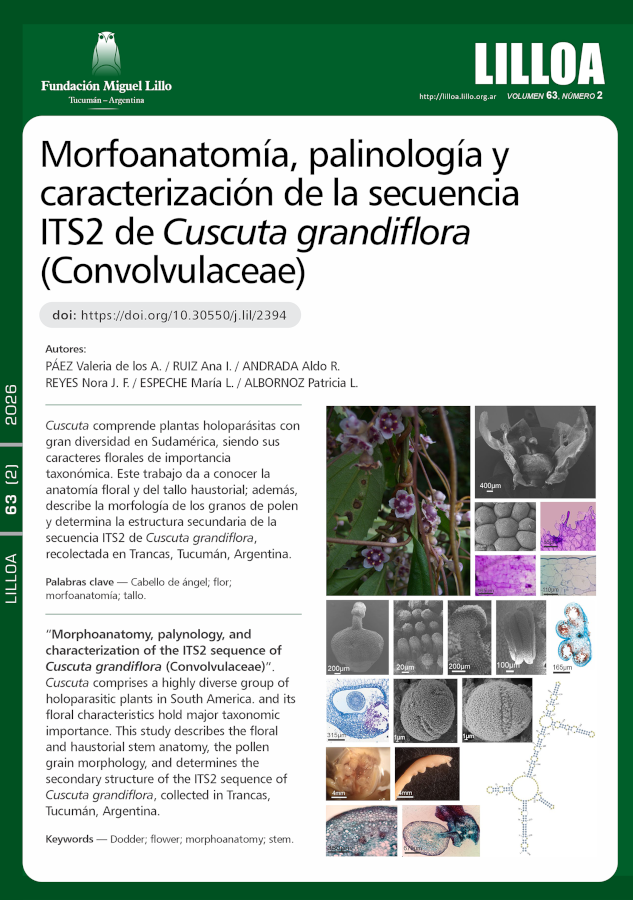
The genus Cuscuta comprises holoparasitic plants with a high degree of diversity in South America, some of which are major agricultural weeds. Cuscuta grandiflora is native to northwestern Argentina and has been poorly characterized from a morphoanatomical perspective, though not from a molecular phylogenetic standpoint. The objective of this study is to provide a description of its floral and vegetative anatomy, pollen morphology, and the characterization of the secondary structure of the ITS2 ribosomal RNA marker. The plant material was analyzed using standard histological, palynological, and molecular techniques. C. grandiflora has pentamerous flowers, with gamosepals and gamopetals bearing fringed marginal lobes. The perianth has a unistratified epidermis, a striated cuticle, stomata, glandular trichomes, a homogeneous mesophyll, and articulated lactifers. Notable floral characteristics include an ovary with two styles whose epidermis is papillate, stigmas with glandular hairs, and a structured, annular nectary with a smooth cuticle and nectarostomes. The haustorial stems have a unistratified epidermis, elevated stomata, and six to nine collateral vascular bundles with secretory channels; the haustorial connection involves both xylem and phloem. The pollen grains are isopolar and radially symmetrical, with shapes ranging from prolate spheroidal to suboblate and with four to five colpates. The exine is microreticulated and heterobroched with nanospinules. The ITS2 sequence (212 bp) folds to form a secondary structure with four helices, although not all of them originate from the central ring. These findings establish an interdisciplinary foundation for future taxonomic and phylogenetic research within the genus.
Downloads
References
Andrada, A. R., Páez, V. de los A. , Silenzi Usandivaras, G. M., Tebbitt, M. C., Albornoz P. L. y Vellicce G. R. (2022). Genetic characterization and pollen viability of a natural hybrid of Begonia boliviensis × B. micranthera (Begoniaceae) from Argentina. Botany Letters 170 (2):1-17. https://doi.org/10.1080/23818107.2022.213502
Ankenbrand, M. J., Keller, A., Wolf, M., Schultz, J. y Förster, F. (2015). ITS2 database V: Twice as much. Molecular Biology and Evolution 32 (11): 3030-3032. https://doi.org/10.1093/molbev/msv174
Braukmann, T., Kuzmina, M. y Stefanovi?, S. (2013). Plastid genome evolution across the genus Cuscuta (Convolvulaceae): two clades within subgenus Grammica exhibit extensive gene los. Journal of Experimental Botany 64 (4): 977-989. https://doi.org/10.1093/jxb/ers391
Byun, Y. y Han, K. (2009). PseudoViewer3: generating planar drawings of large-scale RNA structures with pseudoknots. Bioinformatics 25 (11): 1435-1437. http://doi.org/10.1093/bioinformatics/btp252
Chen, S. L., Yao, H., Han, J. P., Liu, C., Song, J. Y., Shi, L., Zhu, Y., Ma, X., Gao, T.,
Pang, X., Luo, K., Li, Y., Jia, X., Lin, Y. y Leon, C. (2010). Validation of the ITS2 region as a novel DNA barcode for identifying medicinal plant species. PLoS ONE 5: e8613. https://doi.org/10.1371/journal.pone.0008613
Chitralekha, P., Rani, A., Katyal, R., Mathur, R. y Gulati, S. (2022). Cuscuta reflexa Roxb. Parasitism: The Development of Haustorium. Phytomorphology 72 (3&4): 55-68. https://doi.org/10.56024/ispm.72.3&4.2022/55-68
Chitralekha, P. (2024). Hyperparasitism in Cuscuta reflexa Roxb.: A structural study. Phytomorphology 74: 21-39. https://doi.org/1010.56024/ispm.74.1ampersand2.2024/21-39
Clayson, C., García-Ruiz, I. y Costea, M. (2014). Diversity, evolution, and function of stomata bearing structures in Cuscuta (dodders, Convolvulaceae): From extrafloral nectar secretion to transpiration in arid conditions. Perspectives in Plant Ecology, Evolution and Systematics 16 (6): 310-321. https://doi.org/10.1016/j.ppees.2014.08.004
Costea, M. y Tardif, F. J. (2006). The biology of Canadian weeds. 133. Cuscuta campestris Yuncker, C. gronovii Willd. ex Schult., C. umbrosa Beyr. ex Hook., C. epithymum (L.) and C. epilinum Weihe. Biology Faculty Publications 86 (1): 293-316. https://doi.org/10.4141/P04-077
Costea, M. y Stefanovi?, S. (2010) Evolutionary history and taxonomy of Cuscuta umbellata complex (Convolvulaceae): evidence of extensive hybridization from discordant nuclear and plastid phylogenies. Taxon 59 (6):1783-1800. https://doi.org/10.1002/tax.596011
Costea, M., García, M. A. y Stefanovi?, S. (2015). A phylogenetically based infrageneric classification of the parasitic plant genus Cuscuta (dodders, Convolvulaceae). Systematic Botany 40 (1): 269-285. https://10.1600/036364415X686567
Costea, M., Soares da Silva, S., Simao-Bianchini, R., Simoes, A. R. G. y Stefanovic, S. (2021). Notes on the systematics of Cuscuta sect. Subulatae (subg. Grammica) with the description of Cuscuta mantiqueirana, a new species from Brazil. PhytoKeys 184: 27-44. https://doi.org/10.3897/phytokeys.184.69037
Costea, M. y Teillier, S. (2022). Taxonomic revision of Cuscuta (Convolvulaceae) in Chile. Gayana Botanica 79 (2): 84-106. https://doi.org/10.4067/S0717-66432022000200084
D'Ambrogio de Argüeso, A. (1986). Manual de técnicas en histología vegetal. Ed. Hemisferio Sur, S.A. Buenos Aires, Argentina.
Dawson, J. H., Musselman, L. J., Wolswinkel, P. y Dör, I. (1994). Biology and control of Cuscuta. Review of Weed Science 6: 265-317.
Demir, I., Kaya, I., Benli, M. y Altinoglu, M. K. (2017). Investigation of Palinological Features of Taxa Belonging to the Genus Cuscuta Distributed in Turkey. International Journal of Agriculture and Biology 19 (4): 746-750. https://doi.org/10.17957/IJAB/15.0349
Demir, I., Kaya, I., Musta, M. y Sipahioglu, H. M. (2020). Molecular phylogeny based on its sequences of nrDNA of some species belonging to dodder (Cuscuta L.) genus from various ecological sites of Turkey. Notulae Botanicae Horti Agrobotanici Cluj-Napoca 48 (3): 1332-1340. https://doi.org/10.15835/nbha48311997
Dizeo de Strittmater, C. (1973). Nueva técnica de diafanización. Boletín de la Sociedad Argentina de Botánica 15: 126-129.
Erdtman, G. (1960). The acetolysis method: A revised description. Svensk botanisk tidskrif 54: 561-564.
Fer, A. (1981). Research on the pathway of transport involved in the nutrition of a parasite phanerogamus. A study on isolated leaves parasitized by Cuscuta. Phusiologie vegétalé 19: 177-196.
García, M. A., Costea, M., Kuzmina, M. y Stefanovi?, S. (2014). Phylogeny, character evolution, and biogeography of Cuscuta (dodders; Convolvulaceae) inferred from coding plastid and nuclear sequences. American Journal of Botany 101 (4): 670-90. https://doi.org/10.3732/ajb.1300449
Gouy, M., Guindon, S. y Gascuel, O. (2010). SeaView version 4: A multiplatform graphical user interface for sequence alignment and phylogenetic tree building. Molecular Biology and Evolution 27 (2): 221-224. http://doi.org/10.1093/molbev/msp259
Grajales, A., Aguilar, C. y Sánchez, J. A. (2007). Phylogenetic reconstruction using secondary structures of Internal Transcribed Spacer 2(ITS 2, rDNA): finding the molecular and morphological gap in the caribbean gorgonian corals. BMC Evolution Biology 7: 90. https://doi.org/10.1186/1471-2148-7-90
Haupt, S. y Newmann, S. (1996). Transfer of assimilates and xenobiotics from host plants to the parasite Cuscuta reflexa Roxb. En: M. T. Moreno, J. I. Cubero, D. Berner, D. Joel, L. J. Musselman and C. Parker (Eds.), Advances in parasitic plant research. (pp. 355-364). Córdoba, España: Junta de Andalucia, Dirección General de Investigación Agraria.
Hayrapetyan, A., Sonyan, H. y Muradyan, A. (2024). Palynological studies of some species of the genus Cuscuta with emphasis on taxonomy. Acta Palaeobotanica 64 (1): 60-74. https://doi.org/10.35535/acpa-2024-0005
Heslop–Harrison, J. y Heslop–Harrison, Y. (1981). The specialized cuticles of stigma papillae. En: D. F. Cutler (Ed.), The plant cuticle. Botanical Journal of Linnean Society (pp. 99-119). London: Academic Press Ediciones.
Hesse, M., Halbritter, H., Zetter, R., Weber M., Buchner, R., Frosch-Radivo, A. y Ulrich, S. (2009). Pollen terminology an illustrated handbook. – Springer Wien New York, Vienna University Press. https://doi.org/10.1007/978-3-211-79894-2
Heusser, C. I. (1971). Pollen and spores of Chile. Modern types of the Pteridophyta, Gymnospermae and Angiospermae. Tucson, Arizona. University Arizona Press.
Hibberd, J. M. y Jeschke, W. D. (2001). Solute flux into parasitic plants. Journal of Experimental Botany 52 (363): 2043-2049. https://doi.org/10.1093/jexbot/52.363.2043
Hong, L., Shen, H., Chen, H., Li, L., Hu, X., Xu, X., Ye, W. y Wang, Z. (2011). The morphology and anatomy of the haustoria of the holoparasitic angiosperm Cuscuta campestris. Pakistan Journal of Botany 43 (4): 1853-1859. https://mail.pakbs.org/pjbot/PDFs/43(4)/PJB43(4)1853.pdf
Hunziker, A. T. (1947). Sinopsis de las especies argentino - uruguayas del género Cuscuta. Revista Argentina de Agronomía 14 (2): 123-147.
Hunziker, A. T. (1949). Las especies de Cuscuta (Convolvulaceae) de Argentina y Uruguay. Revista de la Facultad de Ciencias Exactas, Físicas, y Naturales 12 (4): 1101-1202.
Karnovsky, M. J. (1965). A formaldehyde-glutaraldehyde fixative of high osmolality for use in electron-microscopy. Journal of Cell Biology 27 (2): 137-138.
Keller, A., Schleicher, T., Schultz, J., Müller, T., Dandekar, T. y Wolf, M. (2009). 5.8S-28S rRNA interaction and HMM-based ITS2 annotation. Gene 430 (1-2): 50-57. https://doi.org/10.1016/j.gene.2008.10.012
Kim, G., Leblanc, M. L., Wafula, E. K., Depamphilis, C. W. y Westwood, J. H. (2014). Genomic-scale exchange of mRNA between a parasitic plant and its hosts. Science 345: 808. https://doi.org/10.1126/science.1253122
Kim, G. y Westwood, J. H. (2015). Macromolecule exchange in Cuscuta–host plant interactions. Current Opinion in Plant Biology 26: 20-25. http://doi.org/10.1016/j.pbi.2015.05.012
Krasylenko, Y., T?šitel, J., Ceccantini, G., Oliveira da Silva, M., Dvo?ák, V., Steele, D., Sosnovsky, E., Piwowarczyk, R., Watson, D. y Teixeira-Costa, L. (2021). Parasites on parasites: hyper?, epi?, and autoparasitism among flowering plants. American Journal of Botany 108 (1): 1-14. https://doi.org/10.1002/ajb2.1590
Kuijt, J. (1969). The biology of parasitic flowering plants. University of California Press, Ltd.
Laguardia, A. M. (1961). Morfología del grano de polen de algunas Convolvulaceaes Uruguayas. Boletín de la Sociedad Argentina de Botánica 9: 187-197.
Lee, K. B. y Lee, C. D. (1989). The structure and development of the haustorium in Cuscuta australis. Canadian Journal of Botany 67 (10): 2975-2982. https://doi.org/10.1139/b89-381
Lee, K. B. (2007). Structure and development of the upper haustorium in the parasitic flowering plant Cuscuta japonica (Convolvulaceae). American Journal of Botany 94 (5): 737-45. https://doi.org/10.3732/ajb.94.5.737
Liao, G. I., Chen, M. Y. y Kuoh, C. S. (2005). Pollen morphology of Cuscuta (Convolvulaceae) in Taiwan. Botanical Bulletin of Academia Sinica 46 (1): 75-81. https://ejournal.sinica.edu.tw/bbas/content/2005/1/Bot461-10.pdf
Lorenz, R., Bernhart, S. H., Höner zu Siederdissen, C., Tafer, H., Flamm, C., Stadler, P. F. y Hofacker, I. L. (2011). ViennaRNA Package 2.0. Algorithmis of Molecular Biology 6: 1-14. https://doi.org/10.1186/1748-7188-6-26
Lyshede, O. B. (1985). Morphological and anatomical features of Cuscuta pedicellata and C. campestris. Nordic Journal of Botany 5 (1): 65-77.
McNeal, J. R., Arumugunathan, K., Kuehl, J. V., Boore, J. L. y De Pamphilis C. W. (2007). Systematics and plastid genome evolution of the cryptically photosynthetic parasitic plant genus Cuscuta (Convolvulaceae). BMC Biology 5: 55. https://doi.org/10.1186/1741-7007-5-55
Metcalfe, C. R. y Chalk, L. C. (1950). Anatomy of the Dicotyledons. Vol. II. Oxford, Claredon Press.
Merget, B., Koetschan, C., Hackl T., Förster, F., Dandekar T., Müller, T., Schultz, J. y Wolf M. (2012). The ITS2 Database. Journal of Visualized Experminents 12 (61): 3806. https://doi.org/10.3791/3806
Pallewar, A., Tidke, S., Urdukhe, Y. y Mogle, U. (2024). Integrating morphology, anatomy, and preliminary phytochemistry for distinguishing Cuscuta reflexa and Ziziphus jujuba. Journal of Pharmacognosy and Phytochemistry 13 (2): 229-232. https://doi.org/10.22271/phyto.2024.v13.i2c.14883
Punt, W., Hoen, P. P., Blackmore, S., Nilsson, S. y Le Thomas, A. (2007). Glossary of pollen and spore terminology. Review of Palaeobotany and Palynology 143: 1-81. https://doi.org/10.1016/j.revpalbo.2006.06.008
Riviere, S., Clayson, C., Dockstader, K., Wright, M. A. y Costea, M. (2013). To attract or to repel? Diversity, evolution and role of the “most peculiar organ” in the Cuscuta flower (dodder, Convolvulaceae)—the infrastaminal scales. Plant Systematics and Evolution 299 (3): 529-552. https://doi.org/10.1007/s00606-012-0741-2
Romeiro, L. D. A., Da Silva, E. F., Vasconcelos, L. V., Lopes, K. D. S, Carreira, L. M. M. y Guimarães, J. T. F. (2023). Pollen Morphology of Convolvulaceae from Southeastern Amazonian Cangas and Its Relevance for Interaction. Networks and Paleoenvironmental Studies. Plants 12: 2256. https://doi.org/10.3390/plants12122256
Rothe, K., Diettrich, B., Rahfeld, B. y Luckner, M. (1999). Uptake of phloem-specific cardenolides by Cuscuta sp. growing on Digitalis lanata and Digitalis purpurea. Phytochemestry 51 (3): 357-361. https://doi.org/10.1016/S0031-9422(98)00749-3
Sáenz Laín, C. (2004). Glosario de Términos Palinológicos. Lazaroa 25: 93-112.
Shahid, S., Kim, G., Johnson, N. R., Wafula, E., Wang, F., Coruh, C., Bernal-Galeano, V., Phifer, T., De Pamphilis, C. W., Westwood, J. H. y Axtell M. J. (2018). MicroRNAs from the parasitic plant Cuscuta campestris target host messenger RNAs. Nature 553: 82-95. https://doi.org/10.1038/nature25027
Sengupta, S. (1972). On the pollen morphology of convolvulaceae with special reference to taxonomy. Review Palaeobotany Palynology 13: 157-212.
Schultz, J. y Wolf, M. (2009). ITS2 sequence structure analysis in phylogenetics: a how-to manual for molecular systematics. Molecular Phylogenetics and Evolution 52 (2): 520-523. https://doi.org/10.1016/j.ympev.2009.01.008
Shimizu, K. y Aoki, K. (2019). Development of parasitic organs of a stem holoparasitic plant in genus Cuscuta. Frontiers in plant Science 10: 1435. https://doi.org /10.3389/fpls.2019.01435
Stefanovi?, S., Kuzmina, M. y Costea, M. (2007). Delimitation of Major Lineages within Cuscuta Subgenus Grammica (Convolvulaceae) using Plastid and Nuclear DNA Sequences. American Journal of Botany 94 (4): 568-589. https://doi.org/10.3732/ajb.94.4.568
Tamura, K., Stecher, G., Peterson, D., Filipski, A. y Kumar S. (2013). MEGA6: Molecular Evolutionary Genetics Analysis versión 6.0. Molecular Biology and Evolution 30 (12): 2725-2729. https://doi.org/10.1093/molbev/mst197
Toma, C., Andronache, A. y Toma, I. (2004-2005). Histo-anatomical investigations on some Cuscuta species. Romanian Journal of Biology-Plant Biology 49-50: 41-46. https://www.ibiol.ro/plant/volumes%2049-50/Rom.J.Biol.-Plant%20Biol.,%202007,%20v.49-50,%20pp.41-46.pdf
Welsh, M., Stefanovi?, S. y Costea, M. (2010). Pollen evolution and its taxonomic significance in Cuscuta (dodders, Convolvulaceae). Plant Systematic and Evolution 285: 83-101. https://doi.org/10.1007/s00606-009-0259-4
Wright, M. A. R., Welsh, M. y Costea, M. (2011). Diversity and evolution of the gynoecium in Cuscuta (dodders, Convolvulaceae) in relation to their reproductive biology: Two styles are better than one. Plant Systematics and Evolution 296 (1): 51-76. https://doi.org/10.1007/s00606-011-0476-5
Wodehouse, R. P. (1935). Pollen grains. Their structure, identification and significance in science and medicine. New York: Mc Graw-Hill.
Yao, H., Song, J., Liu, C., Luo, K., Han, J., Li, Y. y Chen, S. (2010). Use of ITS2 region as the universal DNA barcode for plants and animals. Plos one 5 (10): e13102. https://doi.org/10.1371/journal.pone.0013102
Yuncker, T. G. (1932). The genus Cuscuta. Memoirs of the Torrey Botanical Club 18: 113-331.
Yuncker, T. G. (1943). Observations on the presence of stomata in some species of Cuscuta. Proceedings of the Indiana Academy of Science 53: 100-104.
Zare, G. y Dönmez, A. (2020). Cuscuta campestris Yunck. Morphology, Anatomy and Traditional Use in Turkey. Hacettepe University Journal of the Faculty of Pharmacy 40 (1): 1-10.
Zarlavsky, G. E. (2014). Histología Vegetal: Técnicas simples y complejas. Sociedad Argentina de Botánica. Buenos Aires, Argentina.
Downloads
Published
How to Cite
Issue
Section
License
Copyright (c) 1900 Lilloa

This work is licensed under a Creative Commons Attribution-NonCommercial-ShareAlike 4.0 International License.