Seasonal abundance and populational density of Chaitophorus populialbae (Hemiptera: Aphidididae) and its natural enemies in central Mexico
Autores
-
Daniela Domínguez-Rodríguez
Facultad de Estudios Superiores Iztacala, Universidad Nacional Autónoma de México, Estado de México, México
 https://orcid.org/0009-0004-4565-0311
-
Ana Lilia Muñoz-Viveros
Facultad de Estudios Superiores Iztacala, Universidad Nacional Autónoma de México, Estado de México, México
https://orcid.org/0000-0001-9815-4259
-
Oscar Martínez-Morales
Facultad de Estudios Superiores Iztacala, Universidad Nacional Autónoma de México, Estado de México, México
https://orcid.org/0009-0005-2288-6679
-
Nadia Salomé Gómez-Domínguez
Centro de Desarrollo de Productos Bióticos del Instituto Politécnico Nacional, Yautepec, Morelos, México
https://orcid.org/0000-0001-6372-8347
-
Luis Enrique Páez Gerardo
Facultad de Estudios Superiores Iztacala, Universidad Nacional Autónoma de México, Estado de México, México
https://orcid.org/0009-0002-6160-4599
-
Pedro González-Julián
Facultad de Estudios Superiores Iztacala, Universidad Nacional Autónoma de México
https://orcid.org/0009-0005-8903-9108
-
Rebeca Peña-Martínez
ENCB-Instituto Politécnico Nacional, Ciudad de México, México
https://orcid.org/0000-0002-0746-564X
-
Juan Manuel Vanegas Rico
Facultad de Estudios Superiores Iztacala, Universidad Nacional Autónoma de México, Estado de México, México
https://orcid.org/0000-0002-2342-7651
DOI:
 https://doi.org/10.30550/j.azl/2381
Palavras-chave:
Urban insects, exotic, Coccinellidae, white poplarResumo
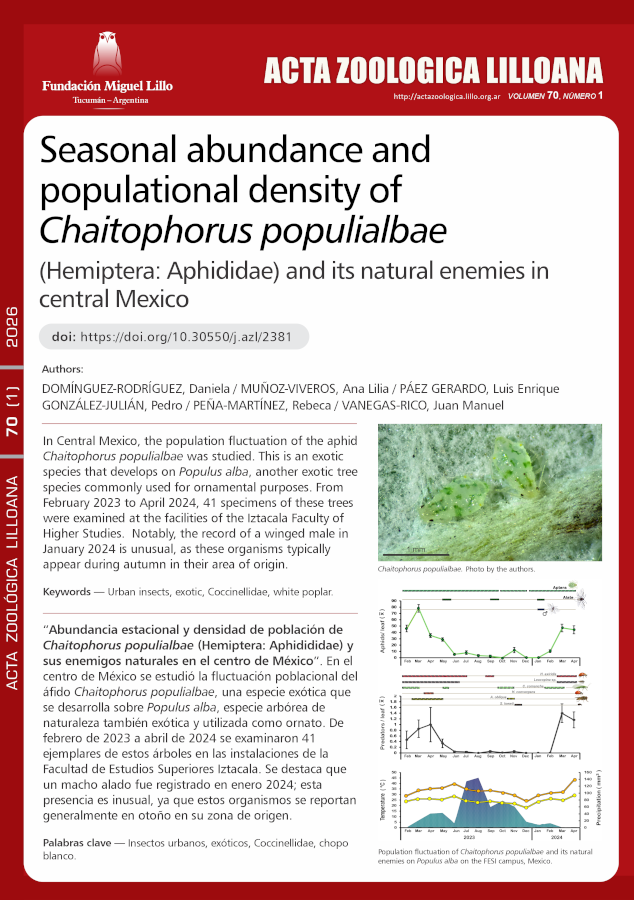
In Central Mexico, the population fluctuation of the aphid Chaitophorus populialbae was studied. This is an exotic species that develops on Populus alba, a tree species that is also exotic and used for ornamental. From February 2023 to April 2024, 41 specimens of these trees were examined at the facilities of the Iztacala Faculty of Higher Studies. The incidence and severity of the aphid were recorded, generating an infestation scale, and its natural enemies were collected and counted. An incidence of 93% was obtained, with low populations (18 ± 1 individuals/leaf, ranging from 18 to< 300 individuals). Six predators were collected from the same leaves, in descending order: Harmonia axyridis, Hippodamia convergens, Allograpta obliqua, Chrysoperla comanche, Leucopina sp and Scymnus loewii. In addition, mutualism with Linepithema humile ants was recorded. Starting in February 2023, the population of parthenogenetic apterous forms increased until reaching its highest value in the first half of March 2023, when some winged parthenogenetic forms were present, with records also in September 2023 and April 2024. It is noteworthy that the present record of a winged male in March 2024 is unusual, as these organisms appear in autumn in their area of origin.
Downloads
Referências
Ahmed T., Waqar, M., Moazzam, J., & Iqbal, J. (2016). Population dynamics of aphids (Hemiptera: Aphididae) on wheat varieties (Triticum aestivum L.) as affected by abiotic conditions in Bahawalpur, Pakistan. Pakistan Journal of Zoology, 48, 1039-1044.
Alaserhat, I., & Canbay, A. (2017). Aphididae species, their parasitoids, predators, and parasitism rates on pepper (Capsicum Annuum L.). Entomological News, 127(1), 36-50. DOI:10.3157/021.127.0106
Ali, H.B., & Kamal, R.S. (2018). Faunistic review of the genus Chaitophorus Koch, 1854 (Aphididae, Chaitophorinae, Chaitophorini) with new record species for Iraq aphid fauna. Bulletin of Iraq Natural History Museum, 15(2), 145-151. DOI:10.26842/binhm.7.2018.15.2.0145 DOI: https://doi.org/10.26842/binhm.7.2018.15.2.0145
Altschul, S.F., Gish, W., Miller, W., Myers, E.W., & Lipman, D.J. (1990). Basic local alignment search tool. Journal of Molecular Biology, 215, 403–410. DOI:10.1016/S0022-2836(05)80360-2 DOI: https://doi.org/10.1016/S0022-2836(05)80360-2
Apak, F.K. & Ak?it, T. (2016). Natural enemies and population dynamics of the Blackmargined Aphid (Monellia caryella (Fitch) Aphididae, Hemiptera) on pecan trees in Ayd?n, Turkey. Journal of the Entomological Research Society, 18(3), 49-60. https://www.entomol.org/journal/index.php/JERS/article/view/1018
Aphidnet 2024., (31 de Marzo) https://aphid.aphidnet.org/index.php
Baker, E.A. & Broad, G.R. (2009). Five aphid parasitoids (Hymenoptera: Braconidae: Aphidiinae) new to Britain. British Journal of Entomology and Natural History, 26(4), 255–263.
Banks, N. (1948). Chrysopidae (Nothochrysidae) collected in Mexico by Dr. A. Dampf (Neuroptera). Psyche, 55, 151-177. DOI:10.1155/1948/36576 DOI: https://doi.org/10.1155/1948/36576
Bonnemaison, L. (1951). Contribution a l'étude des facteurs provoquant l'apparition des formes ailées et sexuée chez les Aphidinae, Annales des Epiphytes, Université de Paris. 380 pp.
Bannerman, J.A., McCornack, B.P., Ragsdale, D.W., Koper, N., & Costamagna, A.C. (2018). Predators and alate immigration influence the season-long dynamics of soybean aphid (Hemiptera: Aphididae). Biological Control, 117: 87-98. DOI:10.1016/j.biocontrol.2017.10.011 DOI: https://doi.org/10.1016/j.biocontrol.2017.10.011
Benavides-Meza, H.M., & García-Ponce, N. (2023). Características del arbolado del Panteón Civil Dolores y valoración de sus servicios ambientales. Madera y Bosques, 29(2): e2922533. DOI:10.21829/myb.2023.2922533 DOI: https://doi.org/10.21829/myb.2023.2922533
Bhagat, R.C. (1982). New aphid parasitoids (Hymenoptera: Aphidiidae) from Kashmir, India. Oriental Insects, 16(1), 113–117. DOI:10.1080/00305316.1982.10434333 DOI: https://doi.org/10.1080/00305316.1982.10434333
Brown, P.M.J., Thomas, C.E. & Lombaert, E. (2011). La propagación global de Harmonia axyridis (Coleoptera: Coccinellidae): distribución, dispersión y rutas de invasión. BioControl, 56, 623–641. DOI:10.1007/s10526-011-9379-1 DOI: https://doi.org/10.1007/s10526-011-9379-1
Cabrera, J.G., Contreras-Bermúdez, Y., Sarmiento-Cordero, M.A., González, J.A.S., Monjaras-Barrera, J. I., & Gaimari, S.D. (2024). First report of Leucopina bivittata (Malloch, 1940) (Diptera: Chamaemyiidae) feeding on the vine mealybug, Planococcus ficus (Signoret, 1875) (Hemiptera: Pseudococcidae), and its first report from Baja California Norte, Mexico. The Pan-Pacific Entomologist, 100(3), 171-174. DOI:10.3956/2024-100.3.171 DOI: https://doi.org/10.3956/2024-100.3.171
Carrera, A., & Cermeli M. (2003). Inventario y fluctuación de áfidos alados en Caripe, Venezuela. Manejo Integrado de Plagas y Agroecología (Costa Rica), 69:58-61.
Catto, M. A., Mugerwa, H., Myers, B.K., Pandey, S., Dutta, B., & Srinivasan, R. (2022). A review on transcriptional responses of interactions between insect vectors and plant viruses. Cells, 11(4), 693. https://doi.org/10.3390/cells11040693 DOI: https://doi.org/10.3390/cells11040693
Cervantes-Mayagoitia, J.F., Lomeli-Flores, J.R., Peña-Martínez, R., Terrón-Sierra, R.A., & Rodríguez-Navarro, S. (2004). Bioecología de ácaros y áfidos de importancia agrícola en México. Serie Académicos 52. Universidad Autónoma Metropolitana. México.
Coeur d'acier A., Cruaud, A., Artige, E., Genson, G., Clamens, A.-L., Pierre, E., Hudaverdian, S., Simon, J.-C., Jousselin, E., & Rasplus, J.-Y., (2014). DNA barcoding and the Associated PhylAphidB@se Website for the identification of European Aphids (Insecta: Hemiptera: Aphididae). Plos One, 9(6), e97620. DOI:10.1371/journal.pone.0097620. DOI: https://doi.org/10.1371/journal.pone.0097620
De la Sota, C., Ruffato-Ferreira, V.J., Ruiz-García, L., & Alvarez, S. (2019). Urban green infrastructure as a strategy of climate change mitigation. A case study in northern Spain. Urban Forestry & Urban Greening, 40, 145-151. DOI:10.1016/j.ufug.2018.09.004 DOI: https://doi.org/10.1016/j.ufug.2018.09.004
Degen, A.A., Gersani, M., Avivi Y., Weisbrot, N. (1986). La prise de miellat chez la fourmi tisserande Polyrhachis simplex (Hymenoptera: Formicidae) soignant l'Aphide Chaitophorous populialbae (Homoptera: Aphididae). Insectes Sociales, 33, 211-215. DOI:10.1007/BF02224599 DOI: https://doi.org/10.1007/BF02224599
Dransfield, R D., & Brightwell, R. (2025). Chaitophorus populialbae: Poplar leaf aphid. https://influentialpoints.com/Gallery/Chaitophorus_populialbae_Poplar_leaf_Aphid.htm Accessed 6 May 2025
El Fakhouri, K., Sabraoui, A., Kehel Z. & El Bouhssini, M. (2021). Population dynamics and yield loss assessment for pea aphid, Acyrthosiphon pisum (Harris) (Homoptera: Aphididae), on lentil in Morocco. Insects, 12(12), 1080. DOI:10.3390/insects12121080 DOI: https://doi.org/10.3390/insects12121080
Espinosa-García, M.G. (2010). Diagnostico fitosanitario del arbolado de la FES-Iztacala, Tlalnepantla, Estado de México. (Tesis de Licenciatura). Universidad Nacional Autónoma de México, México. https://repositorio.unam.mx/contenidos/440341
Favret, C., Aphid Taxon Community, eds. 2025. Blackman & Eastop’s Aphids on the World’s Plants, version 1.0. Accessed at https://aphidsonworldsplants.info on [march 05 2025]
Flessa, F., Babel, W., Kehl, A., Rambold, G., & Kohl, M. (2022). Effect of sap-feeding insects, plant characteristics, and weather parameters on sooty moulds in the temperate zone. Journal of Plant Pathology, 104(4), 1291-1301. DOI:10.1007/s42161-022-01177-0 DOI: https://doi.org/10.1007/s42161-022-01177-0
Folmer, O., Black, M., Hoeh, W., Lutz, R., & Vrijenhoek, R. (1994). DNA primers for amplification of mitochondrial cytochrome c oxidase subunit I from diverse metazoan invertebrates. Molecular Marine Biology and Biotechnology, 3, 294–299. https://pubmed.ncbi.nlm.nih.gov/7881515/
Fortoul-Diaz, J.V., Huerta-de la Peña ,A., Lomeli-Flores, J.R., Hernández-Salgado, J.H., & Pérez-Magaña, A. (2020). Fluctuación Poblacional de Melanaphis sacchari (Zehntner) e identificación de sus depredadores en Sorgo con manejo tradicional en Puebla, México. Southwestern Entomologist, 45(2), 553-562. DOI:10.3958/059.045.0223 DOI: https://doi.org/10.3958/059.045.0223
Fussi, B., Bonello, J., Calleja, E., & Heinze, B. (2012). Combining the use of molecular techniques and archival documentary evidence to trace the origin of Populus alba in a Central Mediterranean archipelago. European Journal of Forest Research, 131, 347-354. DOI:10.1007/s10342-011-0506-4 DOI: https://doi.org/10.1007/s10342-011-0506-4
FESI. 2022. Acerca de la Fes Iztacala: Ubicación y vías de acceso. https://www.iztacala.unam.mx/fesi_localizacion.php
Garber, M.D., Benmarhnia, T., Mason, J., Morales?Zamora, E., & Rojas Rueda, D. (2025). Parking and Public Health. Current Environmental Health Reports, 12, 2. DOI:10.1007/s40572-024-00465-4 DOI: https://doi.org/10.1007/s40572-024-00465-4
GBIF.org (13 May 2025). Populus alba L., GBIF Occurrence Download. DOI:10.15468/dl.dpxg68
GBIF.org (29 May 2025). Chaitophorus populialbae (Boyer de Fonscolombe, 1841), GBIF Occurrence Download. DOI:10.15468/dl.3eyhfm
Glacet, L., Noël, G., Ben, I., Iannello, L., Boullis, A., & Francis, F. (2024). Aphid honeydew in intraguild interactions: enhancing predator mobility, foraging, and dynamics between Adalia bipunctata and Episyrphus balteatus. Arthropod-Plant Interactions, 18(4), 703-712. DOI:10.1007/s11829-024-10061-w DOI: https://doi.org/10.1007/s11829-024-10061-w
Griu, T., & Lunguleasa, A. (2016). The use of the white poplar (Populus alba L.) biomass as fuel. Journal of Forestry Research, 27, 719-725. DOI:10.1007/s11676-015-0178-x DOI: https://doi.org/10.1007/s11676-015-0178-x
Gutiérrez-Gómez, E.N., Carapia-Ruiz, V.E., Castillo-Gutiérrez, A., & Sánchez-Flores, O.A. (2018). Enemigos naturales del pulgón amarillo del sorgo (Hemiptera: Morelos. Melanaphis sacchari (Zehntner) Aphididae) en Xalostoc, Ayala, Entomología mexicana, 5, 131-135.
Holman, J. (2009). Host Plant Catalog of Aphids Palearctic Region Springer. Host plant Genera Families and Major Taxa, The Plants and their Aphids. Springer Dordrecht. DOI:10.1007/978-1-4020-8286-3 DOI: https://doi.org/10.1007/978-1-4020-8286-3
Instituto Nacional de Estadística y Geografía (2023). Cuéntame INEGI. Available at: https://cuentame.inegi.org.mx/ayuda/inegi.aspx?tema=A.
Alaserhat, ?., & Canbay. A. 2017. Aphididae Species, Their Parasitoids, Predators, and Parasitism Rates on Pepper (Capsicum Annuum L.), Entomological News, 127(1), 36-50. DOI:/10.3157/021.127.0106 DOI: https://doi.org/10.3157/021.127.0106
Isebrands, J.G., & Karnosky, D.F. (2001). Environmental benefits of poplar culture. pp. 205-218. In: Dickmann D.I., Isebrands J.G., Eckenwalder J.E., & Richardson J. (eds), Poplar culture in North America. NRC Research Press, Ottawa, Ontario, Canada. DOI:10.1139/9780660181455
James, C.K.N.G., & Perry, K.L. (2004). Transmission of plant viruses by aphid vectors. Molecular Plant Pathology, 5(5):505-511 DOI:10.1111/j.1364-3703.2004.00240.x DOI: https://doi.org/10.1111/j.1364-3703.2004.00240.x
Jan, H., Akhtar, M.N., Akhtar, Z.R., Naveed, W.A., Latif, M., & Shah, S.Z.A. (2017). Effect of biotic and abiotic factors on the population dynamics of wheat aphids. Journal of Entomology and Zoology Studies, 5(6), 2349-2353. https://www.entomoljournal.com/archives/?year=2017&vol=5&issue=6&ArticleId=2880
Jaouannet, M., Rodriguez, P.A., Thorpe, P., Lenoir, C.J., MacLeod, R., Escudero-Martinez, C., & Bos, J.I. (2014). Plant immunity in plant–aphid interactions. Frontiers in plant science, 5, 663. DOI:10.3389/fpls.2014.00663 DOI: https://doi.org/10.3389/fpls.2014.00663
Joshi, S., & Ballal, C.R. (2013). Syrphid predators for biological control of aphids. Journal of Biological Control, 27(3), 151-170. DOI:10.18311/jbc/2013/3285
Jubouri, A., & Abd-Abdullah, R. (2023). Seasonal abundance and population density of Chaitophorus populialbae on euphratica poplar trees in Iraq. AIP Conference Proceedings, 2414(1). DOI:10.1063/5.0114871 DOI: https://doi.org/10.1063/5.0114871
Juhász, A.L., & Szénási, Á. (2024). Do Cultivar, Watering and plant distance impact aphids and their natural enemies in chili (Capsicum chinense Jacq.) Horticulturae, 10(7), 697. DOI:10.55362/IJE/2024/4249 DOI: https://doi.org/10.3390/horticulturae10070697
Kollert, W. & Lebedys, A. (2018). La populicultura en Europa y España. In Proceedings of the II Simposio del chopo, Valladolid, Spain (pp. 17-19). https://simposiodelchopo.es/sites/default/files/ponencias/docs/kollert.pdf
Lara, L.A., Godínez-Cortés, S., Torres, R.I., Padron-Torres, E., Reyes, J., González-González, F.A., & Hernández, H. (2022). Coccinélidos (Coleoptera: Coccinellidae) asociados a cítricos del centro-sur de Tamaulipas, México. Acta Zoológica Mexicana, 38: 1-10. DOI:10.21829/azm.2022.3812454 DOI: https://doi.org/10.21829/azm.2022.3812454
Li, Z.H., Zheng, F.Q., Yie, B.H., Qi, D.Z., & Li, A.M. (1993). Predation of Leis axyridis on Chaitophorus populialbae. Acta Entomologica Sinica, 36(4), 438-443. DOI:10.16380/J.KCXB.1993.04.008
Lomeli-Flores, J.R., Peña-Martínez, R., Camacho, A.D. (2001). Identificación de áfidos (Homoptera: Aphididae) y sus enemigos naturales en trigo y cebada, en Montecillo, Estado de México. Vedalia, 8:17-26.
López-Arroyo, J.I., Cortez-Mondaca, E., Arredondo-Bernal, H.C., Ramírez-Delgado, M., Loera-Gallardo, J., & Mellín-Rosas, M.A. (2007). Uso de artrópodos depredadores para el control biológico de plagas en México, pp. 90- 105. In: Rodríguez-del Bosque L.A. & Arredondo-Bernal H.C. (eds.). Teoría y aplicación del control biológico. Sociedad Mexicana de Control Biológico, México.
Lumbierres, B., Pons, X., & Stary, P. (2005). Parasitoids and predators of aphids associated with public green areas of Lleida (NE Iberian Peninsula). Advances in Horticultural Science, 19(2), 69-75. DOI:42882383
Magaña-López, I., Guillén-Sánchez, D., Hernández-Pérez, R., Trejo-Loyo, A. G., Alia-Tejacal, I., López-Martínez, V., Juárez-López, P., & Andrade-Rodríguez, M. (2020). Diversidad y Fluctuación Poblacional de Áfidos en Papaya, Morelos, México. Southwestern Entomologist, 45(3), 793-802. DOI:10.3958/059.045.0319 DOI: https://doi.org/10.3958/059.045.0319
Martínez, G.L., & Chacalo, H.A. 1994. Los Árboles de la Ciudad de México. Universidad Autónoma Metropolitana. México. 351pp. DOI:10.48044/jauf.1994.040 DOI: https://doi.org/10.48044/jauf.1994.040
Martínez, L. (2008). Árboles y Áreas Verdes Urbanas de la Ciudad de México y Zona Metropolitana. Fundación Xochitla, A.C. México. 549 pp. http://www.conabio.gob.mx/institucion/proyectos/resultados/FichapubGP005.pdf
Martínez-Juárez, G., Rodríguez-Trejo, D.A., Granados-Sánchez, D., Mohedano-Caballero, L. Villanueva-Morales, A. (2022). Descripción del arbolado de alineación de la Ciudad de Puebla por grado de marginación y vialidad. Revista Mexicana de Ciencias Forestales, 13(70), 13i70.830. DOI:10.29298/rmcf.v13i70.830. DOI: https://doi.org/10.29298/rmcf.v13i70.830
Mendel, Z., Protasov, A., Vanegas-Rico, J.M., Lomeli-Flores, J.R., Suma, P., & Rodríguez-Leyva, E. (2020). Classical and fortuitous biological control of the prickly pear cochineal, Dactylopius opuntiae, in Israel. Biological Control, 142, 104157. DOI:10.1016/j.biocontrol.2019.104157 DOI: https://doi.org/10.1016/j.biocontrol.2019.104157
Mileti?, Z., Jonjev, M., Jari?, S., Kosti?, O., Sekuli?, D., Mitrovi?, M., & Pavlovi?, P. (2024). Green solution to riparian pollution: Populus alba L. potential for phytoremediation and bioindication of PTEs along the Sava river. Heliyon, 10(7), e28183. DOI:10.1016/j.heliyon.2024.e28183 DOI: https://doi.org/10.1016/j.heliyon.2024.e28183
Mondor, E.B., & Addicott, J.F. (2007). Do exaptations facilitate mutualistic associations between invasive and native species. Biological Invasions, 9, 623-628. DOI:10.1007/s10530-006-9062-0 DOI: https://doi.org/10.1007/s10530-006-9062-0
Müller, C. B., Williams, I. S., & Hardie, J. (2001). The role of nutrition, crowding and interspecific interactions in the development of winged aphids. Ecological Entomology, 26(3), 330-340. DOI:10.1046/j.1365-2311.2001.00321.x DOI: https://doi.org/10.1046/j.1365-2311.2001.00321.x
Muluneh, M.G., & Worku, B.B. (2022). Contributions of urban green spaces for climate change mitigation and biodiversity conservation in Dessie city, Northeastern Ethiopia. Urban Climate, 46, 101294. DOI:10.1016/j.uclim.2022.101294 DOI: https://doi.org/10.1016/j.uclim.2022.101294
Muñoz Gutiérrez, L., Pérez Miranda, R., Reséndiz-Martínez, J.F., & Reyes-Robles, R. (2022). Caracterización de árboles de riesgo en el Parque Nacional Viveros de Coyoacán, Ciudad de México. Revista Mexicana de Ciencias Forestales, 13(72), 201-222. DOI:10.29298/rmcf.v13i72.1227 DOI: https://doi.org/10.29298/rmcf.v13i72.1227
Muñoz-Viveros, A.L., Peña-Martínez, R., Terrón-Sierra, R.A., González-Julián, P. & Guzmán-Díaz, L. (2011). Registro de dos especies de áfidos en México: Chaitophorus populialbae (B. de F., 1841) y Macrosiphoniella artemisiae (B. de F., 1841) (Hemiptera: Aphididae), Entomología mexicana, 10, 679-701.
Muñoz-Viveros, A.L., Arce-Lara, D., Peña-Martínez, R., Ríos-Pérez, A.D., Obeso-Fernández del Valle, A., & Vanegas-Rico, J.M. (2025). Pseudoregma panicola (Hemiptera: Aphididae), a new report on Arundo donax and its potential as an urban pest in Mexico. Revista Mexicana de Biodiversidad, 96, e965494. DOI:10.22201/ib.20078706e.2025.96.5494 DOI: https://doi.org/10.22201/ib.20078706e.2025.96.5494
NASA POWER (2024). Available at: https://power.larc.nasa.gov/data-access-viewer/
Nevo, E., & Coll, M. (2001). Effect of Nitrogen Fertilization on Aphis gossypii (Homoptera: Aphididae): Variation in size, color, and reproduction. Journal of Economic Entomology, 94(1), 27-32. DOI:10.1603/0022-0493-94.1.27 DOI: https://doi.org/10.1603/0022-0493-94.1.27
Nielsen, A.B., Van Den Bosch, M., Maruthaveeran, S., & van den Bosch, C.K. (2014). Species richness in urban parks and its drivers: A review of empirical evidence. Urban Ecosystems, 17: 305-327. DOI:10.1007/s11252-013-0316-1 DOI: https://doi.org/10.1007/s11252-013-0316-1
Nováková, E., Hypša, V., Klein, J., Foottit, R.G., von Dohlen, C.D., & Moran, N.A. (2013). Reconstructing the phylogeny of aphids (Hemiptera: Aphididae) using DNA of the obligate symbiont Buchnera aphidicola. Molecular Phylogenetics and Evolution, 68(1), 42–54. DOI:10.1016/j.ympev.2013.03.016 DOI: https://doi.org/10.1016/j.ympev.2013.03.016
Nutsford D., Pearson A.L., & Kingham S. (2013). An ecological study investigating the association between access to urban green space and mental health. Public health, 127(11), 1005-1011. DOI:10.1016/j.puhe.2013.08.016 DOI: https://doi.org/10.1016/j.puhe.2013.08.016
Ordoñez, M.F., Jacobo, J.L., Quintana, E., Parra, R.A., Guerrero, V.M., & Ríos. C. (2017). Natural enemies associated with woolly aphid in apple orchards with different pest management. Revista Mexicana de Ciencias Agrícolas, 8(4), 799-809. DOI:10.29312/remexca.v8i4.8 DOI: https://doi.org/10.29312/remexca.v8i4.8
Ortego, J., Astorga, O., & Sevilla, M. (1999). Reciente introducción a la Argentina de Chaitophorus leucomelas (Hemiptera: Aphididae-Salicaceae) que afecta a los álamos. Multequina, 8, 131-134.
Palomares-Pérez, M., Bravo-Núñez, M., Sotelo-Leyva, C., López-Guillén, G., Aguilar-& Marcelino, L. (2022). Evaluación de un complejo de entomófagos para el control de Melanaphis sacchari1 bajo condiciones de invernadero. Southwestern Entomologist, 47(2), 465-470. DOI:10.3958/059.047.0222 DOI: https://doi.org/10.3958/059.047.0222
Pastierovi?, F., Kalyniukova, A., Hradecký, J., Dvo?ák, O., Vítámvás, J., Mogilicherla, K. & Tomášková, I. (2024). Biochemical Responses in Populus tremula: Defending against sucking and leaf-chewing insect herbivores. Plants, 13(9), 1243. DOI:10.3390/plants13091243 DOI: https://doi.org/10.3390/plants13091243
Pauleit, S., Jones, N., Garcia-Martin, G., Garcia-Valdecantos, J.L., Rivière, L.M., Vidal-Beaudet, L., Bodson, M., & Randrup, T.B. (2002). Tree establishment practice in towns and cities–Results from a European survey. Urban Forestry & Urban Greening, 1(2), 83-96. DOI:10.1078/1618-8667-00009 DOI: https://doi.org/10.1078/1618-8667-00009
Pecina-Quintero, V., Marín-Jarillo, A., Bujanos-Muñiz, R., Cortez-Mondaca, E., Yañez-López, R., & Jiménez-Becerril, M.F. (2021). Comportamiento poblacional de Melanaphis sacchari (Zehntner)1 y entomófagos en El Bajío, México. Southwestern Entomologist, 46(3), 751-758. DOI:10.3958/059.046.0316 DOI: https://doi.org/10.3958/059.046.0316
Peña-Martínez, R. (1985). Ecological notes on aphids of the high plateau of Mexico with a check-list of species collected in 1980. In Proceedings of the International Aphidological Symposium. Jablonna. Polska Akademia Nauk, Warsaw, pp 425–430.
Peña-Martínez, P; Muñoz-Viveros, A. L., Cibrián-Llanderal, V. D. y Cibrián Tovar, D. (2017). Superfamilia Aphidoidea, 162-169 pp. In: Cibrián, D. (ed.), Fundamentos de Entomología Forestal. Universidad Autónoma Chapingo, México.
Petrova, V., Jankevica, L., Stalažs, A. (2024). Seasonal dynamics of the exotic cherry plum aphid Brachycaudus divaricatae (Hemiptera, Sternorrhyncha: Aphididae) on Prunus Cerasifera in Latvia, with notes on local predators. Proceedings of the Latvian Academy of Sciences, 78(3), 220-227. DOI:10.2478/prolas-2024-0030 DOI: https://doi.org/10.2478/prolas-2024-0030
Pintera, A. (1987). Taxonomic revision of the species of genus Chaitophorus Koch in Palaearctics (Homoptera: Aphidoidea). Deutsche Entomologische Zeitschrift, 34(4-5), 219-340. DOI:10.1002/mmnd.1987034040 DOI: https://doi.org/10.1002/mmnd.4800340402
Poljakovi?-Pajnik, L., Nikoli?, N., Kova?evi?, B., Vasi?, V., Dreki?, M., Orlovi?, S., & Kesi?, L. (2024). Aphid colonisation’s impact on photosynthetic and CHN traits in three ornamental shrubs. Insects, 15(9):694. DOI:10.3390/insects15090694 DOI: https://doi.org/10.3390/insects15090694
Raina, S., Shankar, U. & Sharma, D. 2022. Population dynamics of aphids (Chaetosiphon fragaefolii Cockerell) on strawberries. The Pharma Innovation Journal, 11 (7): 1109-1112.
Rakhshani, E, Starý, P, & Tomanovi?, Z. (2012). Species of Adialytus Förster, 1862 (Hymenoptera, Braconidae, Aphidiinae) in Iran: taxonomic notes and tritrophic associations. Zookeys, 221, 81-95. DOI:10.3897/zookeys.221.3541 DOI: https://doi.org/10.3897/zookeys.221.3541
Raspi, A. (1996). Thaumatomyia elongatula (Becker) (Chloropidae) and Leucopis annulipes Zetterstedt (Chamaemyiidae): Two diptera preying on Phloeomyzus passerinii (Signoret) (Homoptera: Phloeomyzidae) in Italy. Proceedings of the Entomological Society of Washington, 98(3): 509–516. https://www.biodiversitylibrary.org/part/66661
Raum, S., Collins, C.M., Urquhart, J., Potter, C., Pauleit, S., & Egerer, M. (2023). Tree insect pests and pathogens: a global systematic review of their impacts in urban areas. Urban Ecosystems, 26(2), 587-604. DOI:10.1007/s11252-022-01317-5 DOI: https://doi.org/10.1007/s11252-022-01317-5
Reséndiz-Martínez, J.F., Guzmán-Díaz, L. Muñoz-Viveros, A.L. Olvera-Coronel, L.P. Pacheco-Hernández, M. de L., & Arriola-Padilla V.J. (2019). Insectos y ácaros fitófagos del arbolado en el Parque Recreativo y Cultural Tezozómoc, Azcapotzalco, Ciudad de México. Revista Mexicana de Ciencias Forestales, 10(56),149-173. DOI:10.29298/rmcf.v10i56.454 DOI: https://doi.org/10.29298/rmcf.v10i56.454
Reséndiz-Martínez, J.F., Castañeda-García, C.N., Muñoz-Viveros, A.L., Gutiérrez-Rojas, M., & Ruiz-Juárez, D. (2020). Insectos Plaga en el Arbolado de un Parque de la Ciudad de México. Southwestern Entomologist, 45(3), 781-792. DOI:10.3958/059.045.0318 DOI: https://doi.org/10.3958/059.045.0318
Reséndiz-Martínez, J.F., Gutiérrez-Rojas, M., Preciado-Rangel, P., Muñoz-Viveros, A L. & Ruiz-Juárez, D. (2024). Predominancia de especies forestales y asociación de hongos fitopatógenos en árboles de la Ciudad de México. Biotecnia, 26, 256-265. DOI:10.18633/biotecnia.v26.2156 DOI: https://doi.org/10.18633/biotecnia.v26.2156
Risco, L. G., González, L. V., Suárez, Y. M. & Fernández, C. G. (2015). Fluctuación poblacional y preferencia de Toxoptera citricida, T. aurantii y Aphis spiraecola en seis cultivares de papaya introducidos en Cuba. Centro Agrícola, 42(1), 5-10.
Roiron, P., Ali, A.A., Guendon, J.L., Carcaillet, C., & Terral, J.F. (2004). Evidence of the native nature of Populus alba L. in the western Mediterranean basin. Comptes Rendus Biologies, 327 (2), 125-132. DOI:10.1016/j.crvi.2003.12.006 DOI: https://doi.org/10.1016/j.crvi.2003.12.006
?ahbaz, A., & Uysal, M. (2006). The predators and parasitoids of the aphid species (Homoptera: Aphididae) on poplars in Konya province of Turkey. Selcuk Journal of Agriculture and Food Sciences, 20(38), 119-125. https://dergipark.org.tr/en/download/article-file/3066698
Satar, S., Raspi, A., Özdemir, I., Tusun, A., Karacao?lu, M., & Benelli, G. (2015). Seasonal habits of predation and prey range in aphidophagous silver flies (Diptera Chamaemyiidae), an overlooked family of biological control agents. Bulletin of Insectology, 68(2), 173-180.
Shen, W., Fu, Y., Wang, L., Yao, Y., Zhang, Y., Li, M., Liu, H., Su, X. & Zhao, J. (2023). Transcriptomic analysis revealed that low-density aphid infestation temporarily changes photosynthesis and disease resistance but persistently promotes insect resistance in poplar leaves. Forests, 14(9), 1866. https://doi.org/10.3390/f14091866 DOI: https://doi.org/10.3390/f14091866
Stary, P. (1983). New species and records of aphid parasitoids from Mexico (Hymenoptera, Aphidiidae) Acta Entomológica Bohemoslovaca, 80(1), 35-48.
Stekolshchikov, A.V., & Buga, S.V. (2018). The aphid fauna (Hemiptera, Sternorrhyncha, Aphidomorpha) of Murmansk province (Russia), with description of Aphis khrulevi sp. nov. and Dysaphis karyakini sp. nov. and males of Chaitophorus nigricantis Pintera, 1987. Zootaxa, 4527(4), 451-493. DOI:10.11646/zootaxa.4527.4.1 DOI: https://doi.org/10.11646/zootaxa.4527.4.1
Suay-Cano, V. A., Tinaut A., & Selfa J. (2002). Las hormigas (Hymenoptera, Formicidae) asociadas a pulgones (Hemiptera, Aphididae) en la provincia de Valencia. Graellsia, 58(1), 21-37. DOI:10.3989/graellsia.2002.v58.i1.264 DOI: https://doi.org/10.3989/graellsia.2002.v58.i1.264
Tamura, K., Stecher, G., & Kumar, S. (2021). MEGA11: Molecular Evolutionary Genetics Analysis V.11. Molecular Biology and Evolution, 38: 3022–3027. DOI:10. 1093/molbev/msab120 DOI: https://doi.org/10.1093/molbev/msab120
Tomanovi?, Ž., Petrovic, A., Kavallieratos, N.G., Starý, P., Tos?vski, I., & Bogdanovi?, A.M. (2009). Areopraon chaitophori n. sp. (Hymenoptera: Braconidae: Aphidiinae) associated with Chaitophorus leucomelas Koch on poplars, with a key for European Areopraon Mackauer species. Annales de La Société Entomologique de France (N.S.), 45(2), 187–192. DOI:10.1080/00379271.2009.10697601. DOI: https://doi.org/10.1080/00379271.2009.10697601
Vashist, M., Singh, S.K., & Kumar, T.V. (2025). Enhancing resilience for sustainable cities: a review of threats to urban trees. Biodiversity and Conservation, 34, 1-28. DOI:10.1007/s10531-025-03025-w DOI: https://doi.org/10.1007/s10531-025-03025-w
Vasquez, A.V., & Wood, E.M. (2022). Urban parks are a refuge for birds in park-poor areas Frontiers in Ecology and Evolution, 10, 1-16. DOI:10.3389/fevo.2022.958572 DOI: https://doi.org/10.3389/fevo.2022.958572
Wang, T, Zhang, Y, Sun, Y G, Wang, J.; Han, J., Guo, X., Zhang, F., & Qu, A. (2011a). Study on the selective effect of Harmonia axyridis (Pallas) var. spectabilis to Chaitophorus populeti and C. populialbae [J]. Journal of Anhui Agricultural Sciences,39(28), 17286–17287. (In Chinese).
Wang, T., Zhang, Y., & Wang, J.X. (2011b). Study on the selection effect of Harmonia axyridis ab. conspicua to Chaitophorus populeti and C. populialbae [J]. Journal of Liaoning Forestry Science & Technology, 5, 8–11. (In Chinese).
Weisser, W.W., Braendle, C., & Minoretti, N. (1999). Predator-induced morphological shift in the pea aphid. Proceedings of the Royal Society of London. Series B: Biological Sciences, 266(1424), 1175-1181 DOI:10.1098/rspb.1999.0760 DOI: https://doi.org/10.1098/rspb.1999.0760
Zhang Xf., Chen M., Zhang By, Zhang Yq L., Hou Yj, Su Xh 2009. Survival and development of immature Harmonia axyridis (Pallas) feeding on Chaitophorus populeti (Panzer) propagated on transgenic Populus alba × P. glandulosa. Forestry Studies in China 11: 164–167. DOI:10.1007/s11632-009-0033-2 DOI: https://doi.org/10.1007/s11632-009-0033-2
Zhang, R., Huang, X., Jiang, L., & Qiao, G. (2011). Phylogeny and species differentiation of Mollitrichosiphum spp. (Aphididae, Greenideinae) based on mitochondrial COI and Cyt b genes. Current Zoology, 57, 806–815. DOI:10.1093/czoolo/57.6.806 DOI: https://doi.org/10.1093/czoolo/57.6.806
Downloads
Publicado
Como Citar
Edição
Seção
Licença
Copyright (c) 2026 Acta Zoológica Lilloana

Este trabalho está licenciado sob uma licença Creative Commons Attribution-NonCommercial-NoDerivatives 4.0 International License.