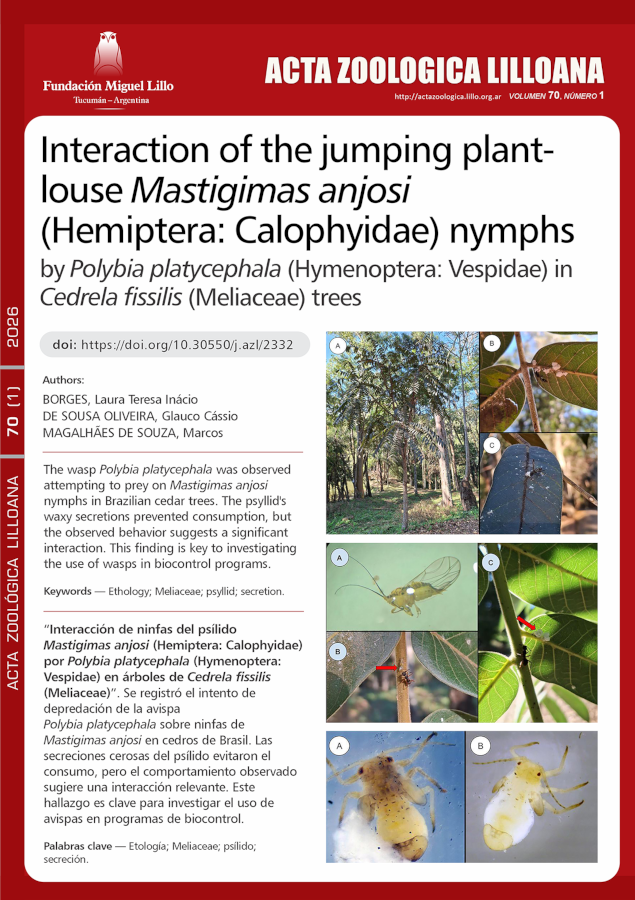
Interaction of the jumping plant-louse Mastigimas anjosi (Hemiptera: Calophyidae) nymphs by Polybia platycephala (Hymenoptera: Vespidae) in Cedrela fissilis (Meliaceae) trees
Autores
-
Laura Tereza Inácio Borges
Instituto Federal de Educação, Ciência e Tecnologia, do Sul de Minas Gerais, Praça Tiradentes, nº 416, 37576-000, Inconfidentes, Minas Gerais, Brasil.
 https://orcid.org/0009-0009-9594-1041
-
Glauco Cássio de Sousa Oliveira
Programa de Pós-Graduação em Botânica Aplicada, Universidade Federal de Lavras, Lavras, MG, Brasil.
https://orcid.org/0000-0001-9811-8485
-
Marcos Magalhães de Souza
Instituto Federal de Educação, Ciência e Tecnologia, do Sul de Minas Gerais, Praça Tiradentes, nº 416, 37576-000, Inconfidentes, Minas Gerais, Brasil
https://orcid.org/0000-0003-0415-1714
DOI:
 https://doi.org/10.30550/j.azl/2332
Palavras-chave:
Meliaceae, Polybia, psyllid, secretionResumo
Mastigimas anjosi (Hemiptera: Calophyidae) is a psyllid that attacks commercially important trees such as Cedrela fissilis, whose control is carried out mainly through the use of insecticides. Among the symptoms of M. anjosi infestation, the white flocculent waxy secretions produced by the nymphs on plant tissues act as a physical protective barrier against predators. Thus, this note aims to report an attempted predation of M. anjosi nymphs by the social wasp Polybia platycephala (Hymenoptera: Vespidae) on a C. fissilis tree in southeastern Brazil. Observations were conducted in May and June 2025, in southern Minas Gerais State, within the Atlantic Forest biome. Although individuals of P. platycephala were not successful in overcoming the protective barrier of M. anjosi, the behavior observed indicates a potential predatory interaction or consumption of honeydew. Therefore, this interaction should be further investigated, particularly regarding the potential use of social wasps in the biocontrol of M. anjosi.
Downloads
Referências
Araújo, L. C. S., Vital, O. S., Júnior, L. E. C. C., Crispim, F. G. A., Jacques, G. C., & Souza, M. M. (2024). Honeydew excretada por Idioscopus sp. (Hemiptera: Cicadellidae) como fonte de alimento para vespas sociais (Vespidae: Polistinae). Revista de Biologia e Ciências da Terra, 24(2), 64–70.
Barbosa, B. C., Paschoalini, M. F., & Prezoto, F. (2014). Temporal activity patterns and foraging behavior by social wasps (Hymenoptera, Polistinae) on fruits of Mangifera indica L. (Anacardiaceae). Sociobiology, 61(2), 239–242. https://doi.org/10.13102/sociobiology.v61i2.239-242 DOI: https://doi.org/10.13102/sociobiology.v61i2.239-242
Bichara-Filho, C. C., Santos, G. M. D. M., Resende, J. J., Cruz, J. D., Gobbi, N., & Machado, V. L. L. (2009). Foraging behavior of the swarm-founding wasp, Polybia (Trichothorax) sericea. Sociobiology, 53(1), 61–69.
Brock, R. E., Cini, A. & Sumner, S. (2021). Ecosystem services provided by aculeate wasps. Biological Reviews, 96(4), 1645-1675. doi: https://doi.org/10.1111/brv.12719 DOI: https://doi.org/10.1111/brv.12719
Burckhardt, D., Queiroz, D. L., Queiroz, E. C., Andrade, D. P., Zanol, K., Rezende, M. Q., & Kotrba, M. (2011). The jumping plant-louse Mastigimas anjosi. Spixiana, 34(1), 109–120. Available online: https://api.semanticscholar.org/CorpusID:85984519
Burckhardt, D., Queiroz, D. L., & Drohojowska, J. (2013). Revision of the neotropical jumping plant-louse genus Mastigimas. Zootaxa, 3745(1), 1–18. https://doi.org/10.11646/zootaxa.3745.1.1 DOI: https://doi.org/10.11646/zootaxa.3745.1.1
Costa, V. A., Queiroz, D. L. de, & Anjos, N. (2015). Psyllaephagus trioziphagus (Hymenoptera: Encyrtidae), parasitoide de Mastigimas anjosi (Hemiptera: Calophyidae). Pesquisa Florestal Brasileira, 35(83), 339–342. https://doi.org/10.4336/2015.pfb.35.83.852 DOI: https://doi.org/10.4336/2015.pfb.35.83.852
Custódio, R. H., Oliveira, G. C. S., Vilela, D. S., & Souza, M. M. (2024). Use of cicada carcass caught in spider web. Revista de Biologia Neotropical, 21(2), 77–81. Available online: https://revistas.ufg.br/RBN/article/view/78380 (Accessed on 2025, November 16).
Del-Claro, K. (2010). Introdução à ecologia comportamental. Rio de Janeiro: Technical Books. (1ª ed.). Technical Books.
Fernandes, G. W., Fagundes, M., Greco, M. K. B., Barbeitos, M. S., & Santos, J. C. (2005). Ants and their effects on an insect herbivore community associated with the inflorescences of Byrsonima crassifolia (Linnaeus) HBK (Malpighiaceae). Revista Brasileira de Entomologia, 49(2), 264-269. https://doi.org/10.1590/S0085-56262005000200011 DOI: https://doi.org/10.1590/S0085-56262005000200011
Ferreira-Filho, P. J., Prado, M. C., Ghiotto, T. C., Giuliani, G. K., Dias, L. P., Silva, M. M., Guerreiro, J. C., & Zanuncio, J. C. (2017). The native psyllid Mastigimas anjosi (Hemiptera: Calophyidae): first record and abundance on pink cedar, Cedrela fissilis (Meliaceae), trees in São Paulo, Brazil. Florida Entomologist, 100(4), 817–819. https://doi.org/10.1653/024.100.0410 DOI: https://doi.org/10.1653/024.100.0410
Gobbi, N., & Machado, V. L. L. (1985). Material capturado e utilizado na alimentação de Polybia (Myrapetra) paulista Ihering, 1896 (Hymenoptera, Vespidae). Anais da Sociedade Entomológica do Brasil, 14(2), 189–195. DOI: https://doi.org/10.37486/0301-8059.v14i2.383
Hermes, M. G., & Köhler, A. (2006). The flower-visiting social wasps (Hymenoptera, Vespidae, Polistinae) in two areas of Rio Grande do Sul State, southern Brazil. Revista Brasileira de Entomologia, 50(2), 268–274. https://doi.org/10.1590/S0085-56262006000200008 DOI: https://doi.org/10.1590/S0085-56262006000200008
Hernández, J., Sarmiento, C. E., & Fernández, C. (2009). Foraging activity of Polybia occidentalis venezuelana (Hymenoptera, Vespidae). Revista Colombiana de Entomología, 35(2), 230–234. https://doi.org/10.25100/socolen.v35i2.9224 DOI: https://doi.org/10.25100/socolen.v35i2.9224
Kasper, M. L., Reeson, A. F., Cooper, S. J., Perry, K. D., & Austin, A. D. (2004). Assessment of prey overlap between a native (Polistes humilis) and an introduced (Vespula germanica) social wasp using morphology and phylogenetic analyses of 16S rDNA. Molecular ecology, 13(7), 2037–2048. https://doi.org/10.1111/j.1365-294X.2004.02193.x DOI: https://doi.org/10.1111/j.1365-294X.2004.02193.x
López, Y., Hernández, J., & Caraballo, P. (2013). Actividad de forrajeo de la avispa social Polybia emaciata (Hymenoptera: Vespidae: Polistinae). Revista Colombiana de Entomología, 39(2), 250–255. http://dx.doi.org/10.25100/socolen.v39i2.8245 DOI: https://doi.org/10.25100/socolen.v39i2.8245
Machado, V. L. L., Gobbi, N., & Alves Jr., V. V. (1988). Material capturado e utilizado na alimentação de Polybia (Trichothorax) sericea (Olivier, 1791) (Hymenoptera, Vespidae). Revista Brasileira de Zoologia, 5(2), 261–266. https://doi.org/10.1590/S0101-81751988000200010 DOI: https://doi.org/10.1590/S0101-81751988000200010
Matos, M. F., Abreu, D. Á. V., Lemes, P. G., Zanuncio, A. J. V., & Zanuncio, J. C. (2019). Atopozelus opsimus (Hemiptera: Reduviidae) preying on Mastigimas anjosi (Hemiptera: Calophyidae), a pest of tropical cedar, Cedrela fissilis (Meliaceae). Florida Entomologist, 102(2), 447–450. https://doi.org/10.1653/024.102.0227 DOI: https://doi.org/10.1653/024.102.0227
Medeiros, H. R. Grandinete, Y. C., Manning, P., Harper, K. A., Cutler, G. C., Tyedmers, P., Righi, C.A. & Ribeiro, M. C. (2019). Forest cover enhances natural enemy diversity and biological control services in Brazilian sun coffee plantations. Agronomy for Sustainable Development, 39(50): 2–9. https://doi.org/10.1007/s13593-019-0600-4 DOI: https://doi.org/10.1007/s13593-019-0600-4
Oliveira, G. C. S., Custódio, R. H., Vilela, D. S., & Souza, M. M. (2024). Records of insects in the diet of social wasps of the genus Polybia Lepeletier, 1836 (Vespidae: Polistinae) in southeastern Brazil.. Revista Acta Ambiental Catarinense, 21(1), 1–7. https://doi.org/10.24021/raac.v21i1.7948 DOI: https://doi.org/10.24021/raac.v21i1.7948
Oliveira, G. C. S. (2025). Record of Cinnamomum verum (Lauraceae) as a host for treehoppers (Hemiptera, Auchenorrhyncha: Aetalionidae and Membracidae). Entomological Communications, 7, ec07021. https://doi.org/10.37486/2675-1305.ec07021 DOI: https://doi.org/10.37486/2675-1305.ec07021
Oliveira, G. C. S., Crispim, F. G. A., Vilela, D. S., & Souza, M. M. (2025). Honeydew of Aethalion reticulatum (Linnaeus, 1767) (Hemiptera: Aethalionidae) as a food resource for social wasps (Vespidae: Polistinae) in an urban area within the Atlantic Forest–Cerrado ecotone. Boletim do Museu Paraense Emílio Goeldi. Ciências Naturais, 20(2), e2025-0971. https://doi.org/10.46357/bcnaturais.v20i2.971 DOI: https://doi.org/10.46357/bcnaturais.v20i2.971
Prezoto, F., Lima, M. A., & Machado, V. L. L. (2005). Survey of preys captured and used by Polybia platycephala (Richards) (Hymenoptera: Vespidae, Epiponini). Neotropical Entomology, 34(5), 849–851. https://doi.org/10.1590/S1519566X2005000500019 DOI: https://doi.org/10.1590/S1519-566X2005000500019
Prezoto, F., Maciel, T. T., Detoni, M., Mayorquin, A. Z., & Barbosa, B. C. (2019). Pest control potential of social wasps in small farms and urban gardens. Insects,10 (7), 192. https://doi.org/10.3390/insects10070192 DOI: https://doi.org/10.3390/insects10070192
Queiroz, D., Burckhardt, D., & Anjos, N. D. (2013). Psilídeos no Brasil: 8 – Mastigimas anjosi. Embrapa Florestas – Comunicado Técnico (INFOTECA-E). Available online: http://www.infoteca.cnptia.embrapa.br/infoteca/handle/doc/957826. Accessed on 2025, November 16.
Renne, D. G. S., Costa, M. J., Jacques, G. C., & Souza, M. M. (2024). Avaliação dos danos aos frutos de Psidium guajava (Linnaeus, 1753), Myrtaceae var. Kumagai, por vespas sociais (Vespidae: Polistinae) ForScience, 12(2), e01277. https://doi.org/10.29069/forscience.2024v12n2.e1277 DOI: https://doi.org/10.29069/forscience.2024v12n2.e1277
Richards, O. W. (1978). The Social Wasps of the Americas excluding the Vespinae. London: British Museum of Natural History.
Souza, G. K., Pikart, T. G., Jacques, G. C., Castro, A. A., Souza, M. M., Serrão, J. E., & Zanuncio, J. C. (2013). Social wasps on Eugenia uniflora Linnaeus (Myrtaceae) plants in the urban area of Viçosa, Minas Gerais State, Brazil. Sociobiology, 60(2), 204–209. https://doi.org/10.13102/sociobiology.v60i2.204-209 DOI: https://doi.org/10.13102/sociobiology.v60i2.204-209
Downloads
Publicado
Como Citar
Edição
Seção
Licença
Copyright (c) 2026 Acta Zoológica Lilloana

Este trabalho está licenciado sob uma licença Creative Commons Attribution-NonCommercial-NoDerivatives 4.0 International License.