Nuevos datos sobre el cuidado maternal y la dispersión juvenil de Pterinopelma roseum (Araneae: Theraphosidae)
Autores/as
- Jorge Barneche Centro de Estudios Parasitológicos y Vectores, Consejo Nacional de Investigaciones Científicas y Técnicas, Universidad Nacional de La Plata, (CEPAVE-CONICETUNLP)
- Emmanuel Veron Instituto Superior de Formación Docente y Técnica Nº 24 Bernardo Houssay
-
Leonela Schwerdt
Centro de Recursos Naturales Renovables de la Zona Semiárida, Consejo Nacional de Investi- gaciones Científicas y Técnicas, (CERZOS-CONICET, UNS)
 https://orcid.org/0000-0002-2512-0725
DOI:
 https://doi.org/10.30550/j.azl/2462
Palabras clave:
tarántula, ooteca, dispersión, setas urticantesResumen
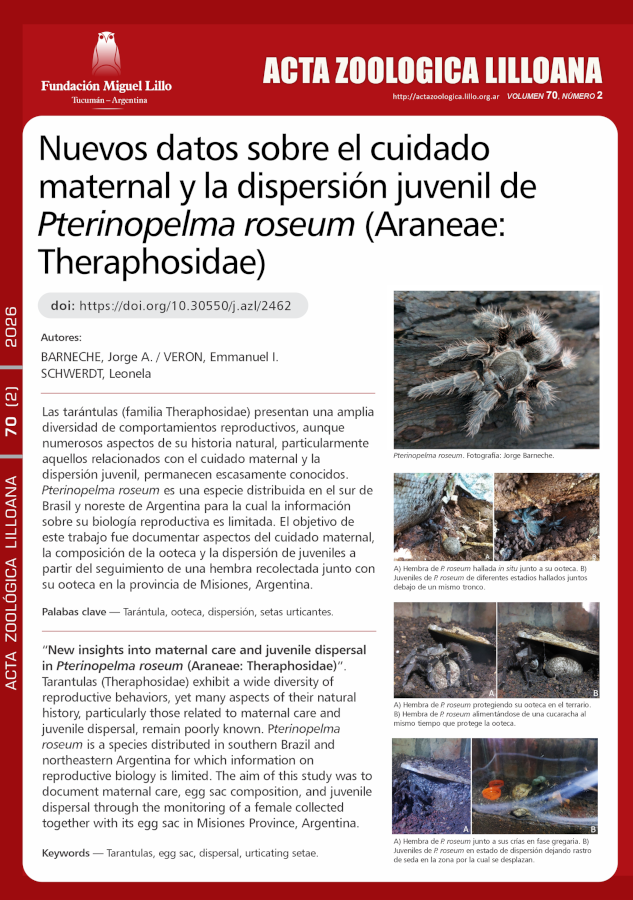
Las tarántulas (Theraphosidae) presentan una amplia diversidad de comportamientos reproductivos, aunque numerosos aspectos de su historia natural, particularmente aquellos relacionados con el cuidado maternal y la dispersión juvenil, permanecen escasamente conocidos. Pterinopelma roseum es una especie distribuida en el sur de Brasil y noreste de Argentina para la cual la información sobre su biología reproductiva es limitada. El objetivo de este trabajo fue documentar aspectos del cuidado maternal, la composición de la ooteca y la dispersión de juveniles a partir del seguimiento de una hembra recolectada junto con su ooteca en la provincia de Misiones, Argentina. La hembra fue mantenida en condiciones controladas de laboratorio y observada diariamente hasta la dispersión de las crías. Durante el período de gestación protegió activamente la ooteca, permaneciendo la mayor parte del tiempo en contacto con ella y mostrando conductas defensivas frente a perturbaciones, aunque continuó alimentándose regularmente. La ooteca presentó abundante cobertura de pelos urticantes y su análisis reveló la presencia de setas tipo I y III. Luego de la eclosión los juveniles permanecieron agrupados dentro del refugio durante 13 días, sin registrarse eventos de canibalismo. Posteriormente iniciaron una dispersión terrestre caracterizada por desplazamientos en hilera y deposición de hilos de seda sobre el sustrato. Se contabilizaron 382 juveniles emergidos. Estos resultados amplían el conocimiento sobre la biología reproductiva de P. roseum y aportan información novedosa sobre la historia natural de las tarántulas neotropicales.
Descargas
Citas
Bertani, R. (2001). Revision, cladistic analysis, and zoogeography of Vitalius, Nhandu, and Proshapalopus; with notes on other theraphosine genera (Araneae, Theraphosidae). Arquivos deZoologia, 36, 265-356.
Bertani, R., Guadanucci, J. P. (2013). Morphology, evolution and usage of urticating setae by tarantulas (Araneae: Theraphosidae). Zoologia 30(4), 403-418.
Brazil, V., Vellard, J. (1926). Contribuicao ao estudo do veneno das aranhas. II. Memórias do Instituto Butantan, 3, 243-295.
Bücherl, W. (1952). Instintos maternais nas aranhas brasileiras. Dusenia, 3, 57-74.
Buzatto, B. A., Haeusler, L., Tamang, N. (2021). Trapped indoors? Long-distance dispersal in mygalomorph spiders and its effect on species ranges. Journal of Comparative Physiology A, 207(2), 279-292.
Costa, F. G., Pérez-Miles, F. (2002). Reproductive biology of uruguayan theraphosids (Araneae, Mygalomorphae). The Journal of Arachnology, 30(3), 571-587.
Decae, A. E. (1987). Dispersal: ballooning and other mechanisms. In Ecophysiology of spiders (pp. 348-356). Berlin, Heidelberg: Springer Berlin Heidelberg.
Dor, A., Hénaut, Y. (2012). Silk use and spiderling behavior in the tarantula Brachypelma vagans (Araneae: Theraphosidae). Acta Zoologica Mexicana, 28(1), 1–12.
Ferretti, N., Copperi, S., Schwerdt, L., Pompozzi, G. (2015). First record of Vitalius roseus (Mello-Leitão, 1923) (Araneae: Theraphosidae: Theraphosinae) in Argentina: Distribution map, natural history, and sexual behaviour. Arachnology, 16(7), 241-243.
Ferretti, N (2020) Communication and Reproductive Biology of Tarantulas. In: Fernando P-M (ed) New World tarantulas: Taxonomy, Biogeography and Evolutionary Biology of Theraphosidae. Springer.
Galleti-Lima, A., Hamilton, C. A., Borges, L. M., Guadanucci, J. P. (2023). Phylogenomics of Lasiodoriforms: reclassification of the South American genus Vitalius Lucas, Silva and Bertani and allied genera (Araneae: Theraphosidae). Frontiers in Ecology and Evolution, 11.
Gonzaga, C., Matos, F., Caiaffa, M., Medeiros, M., Sallum, S., Teixeira, R., De Oliveira, F., Martins, M., Costa, A. (2024). Egg-sac artificial incubation and spiderling neonatal care of Vitalius sorocabae tarantula in Sorocaba Zoo. British Tarantula Society Journal, 29(1).
Kaderka, R., Bulantová, J., Heneberg, P., ?ezá?, M. (2019). Urticating setae of tarantulas (Araneae: Theraphosidae): morphology, revision of typology and terminology and implications for taxonomy. Plos One, 14(11): e0224384.
Keyserling, E. (1891). Die Spinnen Amerikas: Brasilianische Spinnen. 3 (Vol. 3). Bauer & Raspe.
Lucas, S., Silva Jr, P. D., y Bertani, R. (1993). Vitalius a new genus of the subfamily Theraphosinae Thorell, 1870 from Brazil (Araneae, Theraphosidae). Spixiana, 16(3), 241-245.
de Mello Leitão, C. F. (1923). Theraphosoideas do Brasil. Diario Official.
Montenegro Vargas, R., Montenegro Heidke, M., Aguilera, M. A. (2022). Primeros registros de dispersión terrestre en juveniles de Grammostola rosea (Walckenaer, 1837) (Araneae: Theraphosidae) en Chile. Revista Chilena de Entomologia, 48(1), 99-106.
Ortíz-Villatoro, D. E., González-Barboza, M., Hilario, M., Russi, E., Perafán, C. A., Pérez-Miles, F. (2020). Urticating setae in uruguayan Theraphosidae spiders: active or passive defense? Boletín de la Sociedad Zoológica del Uruguay, 29(2), 66-72.
Pérez-Miles, F., Postiglioni, R., Montes-de-Oca, L., Baruffaldi, L., y Costa, F. G. (2007). Mating system in the tarantula spider Eupalaestrus weijenberghi (Thorell, 1894): evidences of monandry and polygyny. Zoology, 110(4), 253-260.
Pocock, R. I. (1903). On some genera and species of South-American Aviculariidæ. Journal of Natural History, 11(61), 81-115.
Postiglioni, R., Pérez-Miles, F., Costa, F. G. (2005). Las hembras de Eupalaestrus weijenberghi (Araneae, Theraphosidae) producen camadas cada dos años: consecuencias para un complicado rompecabezas reproductivo. Minas: Actas Primer Congreso Latinoamericano de Aracnología, 141.
Punzo, F., Henderson, L. (1999) Aspects of the natural history and behavioural ecology of the tarantula spider Aphonopelma hentzi (Girard, 1854) (Orthognatha, Theraphosidae). Bulletin of the British Arachnological Society, 11,121-128.
Reichling, S. B. (2000). Group dispersal in juvenile Brachypelma vagans (Araneae, Theraphosidae). Journal of Arachnology, 28(2), 248-250.
Russi, E., Pérez-Miles, F. (2023). The tarantula Grammostola anthracina uses type IV urticating setae in passive defence: evidence from its presence on the ootheca. Arachnology, 19(4), 702-707.
Shillington, C., McEwen, B. (2006). Activity of juvenile tarantulas in and around the maternal burrow. Journal of Arachnology, 34(1), 261-265.
Simpson, M. R. (1995). Convariation of spider egg and clutch size: the influence of foraging and parental care. Ecology, 76, 795-800.
Stradling, D. J. (1994). Distribution and behavioral ecology of an arboreal “tarantula” spider in Trinidad. Biotropica 26, 84-97.
World Spider Catalog. (2026). World Spider Catalog. Version 27. Natural History Museum Bern, online at http://wsc.nmbe.ch, accessed on {date of access}. doi: 10.24436/2
Descargas
Publicado
Cómo citar
Número
Sección
Licencia
Derechos de autor 2026 Acta Zoológica Lilloana

Esta obra está bajo una licencia internacional Creative Commons Atribución-NoComercial-SinDerivadas 4.0.