New insights into maternal care and juvenile dispersal in Pterinopelma roseum (Araneae: Theraphosidae)
Authors
- Jorge Barneche Centro de Estudios Parasitológicos y Vectores, Consejo Nacional de Investigaciones Científicas y Técnicas, Universidad Nacional de La Plata, (CEPAVE-CONICETUNLP)
- Emmanuel Veron Instituto Superior de Formación Docente y Técnica Nº 24 Bernardo Houssay
-
Leonela Schwerdt
Centro de Recursos Naturales Renovables de la Zona Semiárida, Consejo Nacional de Investi- gaciones Científicas y Técnicas, (CERZOS-CONICET, UNS)
 https://orcid.org/0000-0002-2512-0725
DOI:
 https://doi.org/10.30550/j.azl/2462
Keywords:
Tarantulas, egg sac, dispersal, urticating setaeAbstract
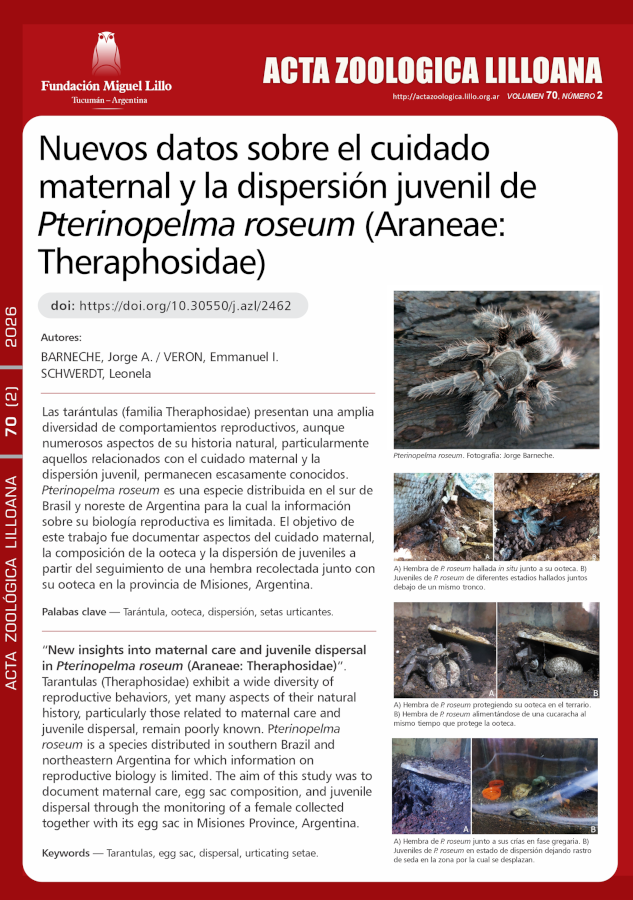
Tarantulas (Theraphosidae) exhibit a wide diversity of reproductive behaviors, yet many aspects of their natural history, particularly those related to maternal care and juvenile dispersal, remain poorly known. Pterinopelma roseum is a species distributed in southern Brazil and northeastern Argentina for which information on reproductive biology is limited. The aim of this study was to document maternal care, egg sac composition, and juvenile dispersal through the monitoring of a female collected together with its egg sac in Misiones Province, Argentina. The female was maintained under controlled laboratory conditions and observed daily until juvenile dispersal. During the incubation period, the female actively protected the egg sac, remaining in contact with it most of the time and displaying defensive behaviors when disturbed, while continuing to feed regularly. The egg sac was densely covered with urticating setae, and its analysis revealed the presence of type I and type III setae. After hatching, the juveniles remained aggregated within the refuge for 13 days, and no cannibalistic events were recorded. Subsequently, they initiated terrestrial dispersal characterized by movement in single-file formations and the deposition of silk threads on the substrate. A total of 382 juveniles emerged from the egg sac. These findings expand current knowledge of the reproductive biology of P. roseum and provide novel information for understanding the natural history of Neotropical tarantulas.
Downloads
References
Bertani, R. (2001). Revision, cladistic analysis, and zoogeography of Vitalius, Nhandu, and Proshapalopus; with notes on other theraphosine genera (Araneae, Theraphosidae). Arquivos deZoologia, 36, 265-356.
Bertani, R., Guadanucci, J. P. (2013). Morphology, evolution and usage of urticating setae by tarantulas (Araneae: Theraphosidae). Zoologia 30(4), 403-418.
Brazil, V., Vellard, J. (1926). Contribuicao ao estudo do veneno das aranhas. II. Memórias do Instituto Butantan, 3, 243-295.
Bücherl, W. (1952). Instintos maternais nas aranhas brasileiras. Dusenia, 3, 57-74.
Buzatto, B. A., Haeusler, L., Tamang, N. (2021). Trapped indoors? Long-distance dispersal in mygalomorph spiders and its effect on species ranges. Journal of Comparative Physiology A, 207(2), 279-292.
Costa, F. G., Pérez-Miles, F. (2002). Reproductive biology of uruguayan theraphosids (Araneae, Mygalomorphae). The Journal of Arachnology, 30(3), 571-587.
Decae, A. E. (1987). Dispersal: ballooning and other mechanisms. In Ecophysiology of spiders (pp. 348-356). Berlin, Heidelberg: Springer Berlin Heidelberg.
Dor, A., Hénaut, Y. (2012). Silk use and spiderling behavior in the tarantula Brachypelma vagans (Araneae: Theraphosidae). Acta Zoologica Mexicana, 28(1), 1–12.
Ferretti, N., Copperi, S., Schwerdt, L., Pompozzi, G. (2015). First record of Vitalius roseus (Mello-Leitão, 1923) (Araneae: Theraphosidae: Theraphosinae) in Argentina: Distribution map, natural history, and sexual behaviour. Arachnology, 16(7), 241-243.
Ferretti, N (2020) Communication and Reproductive Biology of Tarantulas. In: Fernando P-M (ed) New World tarantulas: Taxonomy, Biogeography and Evolutionary Biology of Theraphosidae. Springer.
Galleti-Lima, A., Hamilton, C. A., Borges, L. M., Guadanucci, J. P. (2023). Phylogenomics of Lasiodoriforms: reclassification of the South American genus Vitalius Lucas, Silva and Bertani and allied genera (Araneae: Theraphosidae). Frontiers in Ecology and Evolution, 11.
Gonzaga, C., Matos, F., Caiaffa, M., Medeiros, M., Sallum, S., Teixeira, R., De Oliveira, F., Martins, M., Costa, A. (2024). Egg-sac artificial incubation and spiderling neonatal care of Vitalius sorocabae tarantula in Sorocaba Zoo. British Tarantula Society Journal, 29(1).
Kaderka, R., Bulantová, J., Heneberg, P., ?ezá?, M. (2019). Urticating setae of tarantulas (Araneae: Theraphosidae): morphology, revision of typology and terminology and implications for taxonomy. Plos One, 14(11): e0224384.
Keyserling, E. (1891). Die Spinnen Amerikas: Brasilianische Spinnen. 3 (Vol. 3). Bauer & Raspe.
Lucas, S., Silva Jr, P. D., y Bertani, R. (1993). Vitalius a new genus of the subfamily Theraphosinae Thorell, 1870 from Brazil (Araneae, Theraphosidae). Spixiana, 16(3), 241-245.
de Mello Leitão, C. F. (1923). Theraphosoideas do Brasil. Diario Official.
Montenegro Vargas, R., Montenegro Heidke, M., Aguilera, M. A. (2022). Primeros registros de dispersión terrestre en juveniles de Grammostola rosea (Walckenaer, 1837) (Araneae: Theraphosidae) en Chile. Revista Chilena de Entomologia, 48(1), 99-106.
Ortíz-Villatoro, D. E., González-Barboza, M., Hilario, M., Russi, E., Perafán, C. A., Pérez-Miles, F. (2020). Urticating setae in uruguayan Theraphosidae spiders: active or passive defense? Boletín de la Sociedad Zoológica del Uruguay, 29(2), 66-72.
Pérez-Miles, F., Postiglioni, R., Montes-de-Oca, L., Baruffaldi, L., y Costa, F. G. (2007). Mating system in the tarantula spider Eupalaestrus weijenberghi (Thorell, 1894): evidences of monandry and polygyny. Zoology, 110(4), 253-260.
Pocock, R. I. (1903). On some genera and species of South-American Aviculariidæ. Journal of Natural History, 11(61), 81-115.
Postiglioni, R., Pérez-Miles, F., Costa, F. G. (2005). Las hembras de Eupalaestrus weijenberghi (Araneae, Theraphosidae) producen camadas cada dos años: consecuencias para un complicado rompecabezas reproductivo. Minas: Actas Primer Congreso Latinoamericano de Aracnología, 141.
Punzo, F., Henderson, L. (1999) Aspects of the natural history and behavioural ecology of the tarantula spider Aphonopelma hentzi (Girard, 1854) (Orthognatha, Theraphosidae). Bulletin of the British Arachnological Society, 11,121-128.
Reichling, S. B. (2000). Group dispersal in juvenile Brachypelma vagans (Araneae, Theraphosidae). Journal of Arachnology, 28(2), 248-250.
Russi, E., Pérez-Miles, F. (2023). The tarantula Grammostola anthracina uses type IV urticating setae in passive defence: evidence from its presence on the ootheca. Arachnology, 19(4), 702-707.
Shillington, C., McEwen, B. (2006). Activity of juvenile tarantulas in and around the maternal burrow. Journal of Arachnology, 34(1), 261-265.
Simpson, M. R. (1995). Convariation of spider egg and clutch size: the influence of foraging and parental care. Ecology, 76, 795-800.
Stradling, D. J. (1994). Distribution and behavioral ecology of an arboreal “tarantula” spider in Trinidad. Biotropica 26, 84-97.
World Spider Catalog. (2026). World Spider Catalog. Version 27. Natural History Museum Bern, online at http://wsc.nmbe.ch, accessed on {date of access}. doi: 10.24436/2
Downloads
Published
How to Cite
Issue
Section
License
Copyright (c) 2026 Acta Zoológica Lilloana

This work is licensed under a Creative Commons Attribution-NonCommercial-NoDerivatives 4.0 International License.