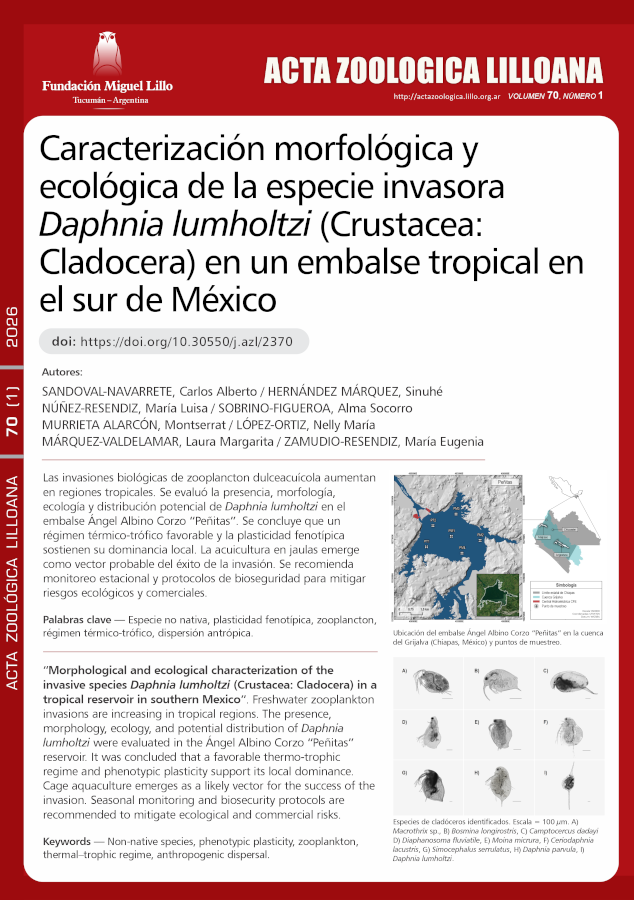
Caracterización morfológica y ecológica de la especie invasora Daphnia lumholtzi (Crustacea: Cladocera) en un embalse tropical en el sur de México
Autores/as
-
Carlos Alberto Sandoval Navarrete
Maestría en Biología Universidad Autónoma Metropolitana, Iztapalapa, 09310, México.
 https://orcid.org/0009-0002-7863-7725
-
Sinuhé Hernández Márquez
Laboratorio de Fitoplancton Marino y Salobre, Doctorado en Ciencias Biológicas y de la Salud
https://orcid.org/0000-0002-3110-4502
-
María Luisa Núñez-Resendiz
Laboratorio de Macroalgas Marinas y Salobres, Área de Ficología Comparada, Departamento de Hidrobiología, Universidad Autónoma Metropolitana, Iztapalapa, 09310, México.
https://orcid.org/0000-0001-6587-2609
-
Alma Socorro Sobrino Figueroa
Laboratorio Alejandro Villalobos, Departamento de Hidrobiología, Universidad Autónoma Metropolitana, Iztapalapa, 09310, México.
https://orcid.org/0000-0001-9488-828X
-
Montserrat Murrieta Alarcón
Laboratorio de Fitoplancton Marino y Salobre, Área de Ficología Comparada, Departamento de Hidrobiología, Universidad Autónoma Metropolitana, Iztapalapa, 09310, México.
https://orcid.org/0009-0006-1737-4342
-
Nelly María López Ortiz
Laboratorio de Secuenciación Genómica, LaNaBio, Instituto de Biología, Universidad Nacional Autónoma de México, 04510, México.
https://orcid.org/0009-0007-5204-5461
-
Laura Margarita Márquez Valdelamar
Laboratorio de Secuenciación Genómica, LaNaBio, Instituto de Biología, Universidad Nacional Autónoma de México, 04510, México.
https://orcid.org/0000-0001-9680-7754
-
María Eugenia Zamudio Resendiz
Laboratorio de Fitoplancton Marino y Salobre, Área de Ficología Comparada, Departamento de Hidrobiología, Universidad Autónoma Metropolitana, Iztapalapa, 09310, México.
https://orcid.org/0000-0001-8306-6766
DOI:
 https://doi.org/10.30550/j.azl/2370
Palabras clave:
Especie no nativa, plasticidad fenotípica, zooplancton, régimen térmico-trófico, dispersión antrópicaResumen
Las invasiones biológicas de zooplancton dulceacuícola aumentan en regiones tropicales. Se evaluó la presencia, morfología, ecología y distribución potencial de Daphnia lumholtzi en el embalse Ángel Albino Corzo “Peñitas”. Se muestrearon seis sitios en temporadas de secas (2022–2024), registrando temperatura, conductividad, oxígeno disuelto, pH, transparencia y clorofila-a; el zooplancton se recolectó con red de 100 µm. Se realizó morfometría (210 organismos por temporada), cartografía fisicoquímica y análisis ecológicos (Kruskal–Wallis, Olmstead-Tukey, Spearman). La distribución potencial se modeló con MaxEnt.
Los parámetros fisicoquímicos no difirieron entre años. La comunidad de cladóceros incluyó nueve especies; D. lumholtzi fue dominante y codominó con Ceriodaphnia lacustris y Diaphanosoma fluviatile. Su abundancia se asoció positivamente con temperatura (r = 0.69; p = 0.011) y clorofila-a (r = 0.55; p = 0.007), mientras C. lacustris mostró relación inversa con la temperatura (r = ?0.48; p = 0.021) y con D. lumholtzi (r = ?0.92; p = 0.001). Los ejemplares presentaron espinas cefálica y caudal desarrolladas, postabdomen bilobulado y tres procesos postabdominales. MaxEnt mostró desempeño excelente (AUC ? 0.99) e identificó la temperatura superficial (~84 %) y la clorofila-a (~8 %) como predictores principales, con probabilidades > 0.7 en zonas lénticas y tramos interpresas.
Se concluye que un régimen térmico-trófico favorable y la plasticidad fenotípica sostienen su dominancia local. La acuicultura en jaulas emerge como vector probable. Se recomienda monitoreo estacional y protocolos de bioseguridad para mitigar riesgos sobre el zooplancton nativo y la ictiofauna de interés comercial o bajo protección especial.
Descargas
Citas
Abrantes, N., Antunes, S. C., Pereira, M. J., y Gonçalves, F. (2005). Seasonal succession of cladocerans and phytoplankton, and their interactions in a shallow eutrophic lake (Lake Vela, Portugal). Acta Oecologica, 29, 54–64. https://doi.org/10.1016/j.actao.2005.07.006 DOI: https://doi.org/10.1016/j.actao.2005.07.006
Aguirre-Muñoz, A., y Mendoza-Alfaro, R. (2009). Especies exóticas invasoras: impactos sobre las poblaciones de flora y fauna, los procesos ecológicos y la economía. En R. Dirzo, R. González y I. March (Eds.), Capital natural de México: Estado de conservación y tendencias de cambio (Vol. II, pp. 277–318). CONABIO.
Allison, S., Acharya, S. K., y Jack, J. (2009). Overcrowding, food and phosphorus limitation effects on ephippia production and population dynamics in the invasive species Daphnia lumholtzi. Hydrobiologia, 618(1), 47–56. https://doi.org/10.1007/s10750-008-9546-2 DOI: https://doi.org/10.1007/s10750-008-9546-2
Anzueto-Calvo, M. de J., Velázquez-Velázquez, E., y Gómez-González, A. E. (2016). Peces de la Reserva de la Biosfera Selva El Ocote y presa Nezahualcóyotl (Malpaso), Chiapas, México. Revista Mexicana de Biodiversidad, 87(3), 972–979. https://doi.org/10.1016/j.rmb.2016.07.002 DOI: https://doi.org/10.1016/j.rmb.2016.07.002
Araújo M.B. y Guisan A. (2006). Five (or so) challenges for species distribution modeling. Journal of Biogeography 33(10): 1677-1688. DOI:10.1111/j.1365-2699.2006.01584.x DOI: https://doi.org/10.1111/j.1365-2699.2006.01584.x
ArcGis Pro (2024). Predicción de solo presencia (MaxEnt) (Estadística espacial). Esri. https://n9.cl/gqdsw
Benzie, J. A. H. (1988). The systematics of Australian Daphnia (Cladocera: Daphniidae): Species descriptions and keys. Hydrobiologia, 166(1), 95–161. https://doi.org/10.1007/BF00028632 DOI: https://doi.org/10.1007/BF00028632
Benzie, J. A. H. (2005). The genus Daphnia (including Daphniopsis) (Anomopoda: Daphniidae). Ghent y Backhuys Publishers.
Bledzki, L. (2023). Key to the identification and ecology of Daphnia (Crustacea: Cladocera) of North America (north of Mexico). Mount Holyoke College.
Brooks, J. (1959). Cladocera. In: Edmonson, W. (Ed.), Fresh Water Biology. John Wiley y Sons.
Bueno-Soria, J., y Santiago-Fragoso, S. (2002). Presa Nezahualcóyotl (Malpaso). En G. de la Lanza-Espino y J. García-Calderón (Comps.), Lagos y presas de México (pp. xxx–xxx). AGT Editor.
Diel, P., Kiene, M., Martin-Creuzburg, D., y Laforsch, C. (2020). Knowing the enemy: Inducible defences in freshwater zooplankton. Diversity, 12(4), 147. https://doi.org/10.3390/d12040147 DOI: https://doi.org/10.3390/d12040147
Dzialowski, A. R., O’Brien, J. W., y Swaffar, S. M. (2000). Range expansion and potential dispersal mechanisms of the exotic cladoceran Daphnia lumholtzi. Journal of Plankton Research, 22(12), 2205–2223. https://doi.org/10.1093/plankt/22.12.2205 DOI: https://doi.org/10.1093/plankt/22.12.2205
Elías-Gutiérrez, M., E. Suárez-Morales, M.A. Gutiérrez-Aguirre., M. Silva-Briano, J. G. Granados-Ramírez y T. Garfias-Espejo. (2008a). Cladocera y Copepoda de las aguas continentales de México, guía ilustrada. UNAM, CONABIO, ECOSUR, CONACyT, SEMARNAT.
Elías-Gutiérrez, M., Silva-Briano, M., y Gutiérrez-Aguirre, M. A. (2008b). DNA barcodes for Cladocera and Copepoda from Mexico and Guatemala, highlights and new discoveries. Zootaxa, 1839, 1–42. https://doi.org/10.11646/zootaxa.1839.1.1 DOI: https://doi.org/10.11646/zootaxa.1839.1.1
El-Magd, I. H. y Ali, E. M. (2010). Estimating and Mapping Chlorophyll a Concentration as a Function of Environmental Changes of Manzala Lagoon, Egypt Using. Egyptian Journal of Aquatic Research, 36(2), 305-316. https://n9.cl/0kdc8
Engel, K., Tollrian, R., y Gabriel, W. (2014). Morphological defences of invasive Daphnia lumholtzi protect against vertebrate and invertebrate predators. Journal of Plankton Research, 36(5), 1140–1145. https://doi.org/10.1093/plankt/fbu023 DOI: https://doi.org/10.1093/plankt/fbu023
Engel, K., Tollrian, R., y Straile, D. (2012). Competitive ability, thermal tolerance and invasion success in exotic Daphnia lumholtzi. Journal of Plankton Research, 34(1), 92–97. https://doi.org/10.1093/plankt/fbr083 DOI: https://doi.org/10.1093/plankt/fbr083
Engel, K., y Tollrian, R. (2009). Inducible defences as key adaptations for the successful invasion of Daphnia lumholtziin North America? Proceedings of the Royal Society B: Biological Sciences, 276(1663), 1865–1873. https://doi.org/10.1098/rspb.2008.1861 DOI: https://doi.org/10.1098/rspb.2008.1861
Frisch, D., Havel, J. E., y Weider, L. J. (2013). The invasion history of the exotic freshwater zooplankter Daphnia lumholtzi (Cladocera, Crustacea) in North America: A genetic analysis. Biological Invasions, 15(4), 817–828. https://doi.org/10.1007/s10530-012-0329-3 DOI: https://doi.org/10.1007/s10530-012-0329-3
Gophen, M. (1976). Temperature dependence of food intake, ammonia excretion and respiration in Ceriodaphnia reticulata (Jurine) (Lake Kinneret, Israel). Freshwater Biology, 6(5), 451–455. https://doi.org/10.1111/j.1365-2427.1976.tb01634.x DOI: https://doi.org/10.1111/j.1365-2427.1976.tb01634.x
Graeve, A., Janßen, M., Villalba-De La Peña, M., Tollrian, R., y Weiss, L. C. (2021). Higher, faster, better: Maternal effects shorten time lags and increase morphological defenses in Daphnia lumholtzi offspring generations. Frontiers in Ecology and Evolution, 9, 637421. https://doi.org/10.3389/fevo.2021.637421 DOI: https://doi.org/10.3389/fevo.2021.637421
Hagey, L. R., Møller, P. R., Hofmann, A. F., y Krasowski, M. D. (2010). Diversity of bile salts in fish and amphibians: Evolution of a complex biochemical pathway. Physiological and Biochemical Zoology, 83(2), 308–321. https://doi.org/10.1086/649966 DOI: https://doi.org/10.1086/649966
Hahn, M., y von Elert, E. (2022). One kairomone and multiple effects in Daphnia species—5?-cyprinol sulfate induces morphological defenses in the invasive species Daphnia lumholtzi. Frontiers in Ecology and Evolution, 10, 804521. https://doi.org/10.3389/fevo.2022.804521 DOI: https://doi.org/10.3389/fevo.2022.804521
Havel, J. E., Colbourne, J. K., y Hebert, P. D. N. (2000). Reconstructing the history of intercontinental dispersal in Daphnia lumholtzi by use of genetic markers. Limnology and Oceanography, 45(6), 1414–1419. https://doi.org/10.4319/lo.2000.45.6.1414 DOI: https://doi.org/10.4319/lo.2000.45.6.1414
Havel, J. E., y Hebert, P. D. N. (1993). Daphnia lumholtzi (Cladocera: Daphniidae): A new exotic zooplankter in North American inland lakes. Journal of Plankton Research, 15(7), 813–826. https://doi.org/10.1093/plankt/15.7.813
Havel, J. E., y Lampert, W. (2006). Habitat partitioning of native and exotic Daphnia in gradients of temperature and food: mesocosm experiments. Freshwater Biology, 51(3), 487–498. https://doi.org/10.1111/j.1365-2427.2006.01511.x DOI: https://doi.org/10.1111/j.1365-2427.2006.01511.x
Horstmann, M., Tollrian, R., y Weiss, L. C. (2021). Thwarting predators? A three-dimensional perspective of morphological alterations in the freshwater crustacean Daphnia. PLOS ONE, 16(7), e0254263. https://doi.org/10.1371/journal.pone.0254263 DOI: https://doi.org/10.1371/journal.pone.0254263
Ibarra-Montoya, J. L., Rangel-Peraza, G., González-Farias, F. A., De Anda, J., Zamudio-Reséndiz, M. E., Martínez-Meyer, E., y Macias-Cuellar, H. (2010). Modelo de nicho ecológico para predecir la distribución potencial de fitoplancton en la Presa Hidroeléctrica Aguamilpa, Nayarit. México. Ambiente y Água - An Interdisciplinary Journal of Applied Science, 5(3), 60-75. DOI:10.4136/ambi-agua.154 DOI: https://doi.org/10.4136/ambi-agua.154
Kolar, C. S., Van Goetham, D., y Havel, J. E. (1997). Potential effect of invasion by an exotic zooplankter, Daphnia lumholtzi. Journal of Freshwater Ecology, 12(4), 521–530. https://doi.org/10.1080/02705060.1997.9663566 DOI: https://doi.org/10.1080/02705060.1997.9663566
Kotov, A. y Taylor, D. (2014). Daphnia lumholtzi Sars, 1885 (Cladocera: Daphniidae) invades Argentina. Journal of limnology, 73(2), 167-172. DOI:10.4081/jlimnol.2014.920 DOI: https://doi.org/10.4081/jlimnol.2014.920
Lennon, J. T., Smith, V. H., y Williams, K. (2001). Influence of temperature on exotic Daphnia lumholtzi and implications for invasion success. Journal of Plankton Research, 23(4), 425–433. https://doi.org/10.1093/plankt/23.4.425 DOI: https://doi.org/10.1093/plankt/23.4.425
Lorenzen, C. J. (1967). Determination of chlorophyll and pheo-pigments: Spectrophotometric equations. Limnology and Oceanography, 12(2), 343–346. https://doi.org/10.4319/lo.1967.12.2.0343 DOI: https://doi.org/10.4319/lo.1967.12.2.0343
Mantovano, T., Bailly, D., Ferreira, J. H. D., Oliveira da Conceição, E., Cassemiro, F. A. S., Campos, R., Lansac-Tôha, F. A. (2020). A global analysis of the susceptibility of river basins to invasion of a freshwater zooplankton (Daphnia lumholtzi). Freshwater Biology, 66(4), 683–698. https://doi.org/10.1111/fwb.13670 DOI: https://doi.org/10.1111/fwb.13670
Merow, C., Smith, M. J., y Silander, J. A. (2013). A practical guide to MaxEnt for modeling species’ distributions: What it does, and why inputs and settings matter. Ecography, 36, 1058–1069. https://doi.org/10.1111/j.1600-0587.2013.07872.x DOI: https://doi.org/10.1111/j.1600-0587.2013.07872.x
NCSS, LLC. (2020). NCSS 2020 Statistical Software. Kaysville, Utah, USA. https://www.ncss.com/
Nunes, A. H., Miracle, M. R., Dias, J. D., Fabrin, T. M. C., Braghin, L. S. M., y Bonecker, C. C. (2018). First genetic characterization of non-native Daphnia lumholtzi Sars, 1885 in Brazil confirms North American origin. International Review of Hydrobiology, 103(3–4), 48–53. https://doi.org/10.1002/iroh.201701914 DOI: https://doi.org/10.1002/iroh.201701914
Olmos-Tomasini, E. (2002). Presa La Angostura (Belisario Domínguez). En G. de la Lanza-Espino y J. García-Calderón (Comps.), Lagos y presas de México (pp. xxx–xxx). AGT Editor.
Pattinson, K. R., Havel, J. E., y Rhodes, R. G. (2003). Invasibility of a reservoir to exotic Daphnia lumholtzi: Experimental assessment of diet selection and life-history responses to cyanobacteria. Freshwater Biology, 48(2), 233–246. https://doi.org/10.1046/j.1365-2427.2003.00987.x DOI: https://doi.org/10.1046/j.1365-2427.2003.00987.x
Perdomo-Vanegas, A. (2015). Predicción de parámetros físicos químicos de calidad del agua mediante el uso de sensores remotos: caso de estudio embalse del Neusa. [Tesis de posgrado, Fundación Universidad de Bogotá Jorge Tadeo Lozano]. https://n9.cl/gik30
Peterson, B., Nicolas, F., Koupal, K., y Hoback, W. (2005). Daphnia lumholtzi, an exotic zooplankton, invading a Nebraska reservoir. The Prairie Naturalist, 37, 11–19. https://n9.cl/u9yv8
Phillips, S. J., Anderson, R. P., y Schapire, R. E. (2006). Maximum entropy modeling of species geographic distributions. Ecological Modelling, 190(3–4), 231–259. https://doi.org/10.1016/j.ecolmodel.2005.03.026 DOI: https://doi.org/10.1016/j.ecolmodel.2005.03.026
Platas-Rosado, D. E., Hernández-Arzaba, J. C., y González-Reynoso, L. (2017). Importancia económico y social del sector acuícola en México. Agroproductividad, 10(2), 19–24. https://n9.cl/huj0t
Ponce-Palafox, J., Hernández-Ocampo, D., Díaz-Alvares, J., y Esparza-Leal, H. (2006). Aplicación de modelos multivariados en el estudio de las presas. In: Arredondo-Figueroa, J. L., G. Díaz-Zavaleta y J. T. Ponce-Palafox (Comps.) Limnología de Presas Mexicanas. AGT Editor, Universidad Autónoma Metropolitana.
Posit Team. (2024). RStudio: Integrated Development Environment for R (Version 2024.12.1-563). Posit Software, PBC. https://posit.co/
Pyšek, P., y Richardson, D. M. (2010). Invasive species, environmental change and management, and health. Annual Review of Environment and Resources, 35, 25–55. https://doi.org/10.1146/annurev-environ-033009-095548 DOI: https://doi.org/10.1146/annurev-environ-033009-095548
QGIS Development Team. (2024). QGIS Geographic Information System (Version 3.40). QGIS Association. https://www.qgis.org/
Romero-Beltrán, E., Rendón-Martínez, R., Gaspar-Dillanes, M. T., Osuna-Bernal, A., Romero-Correa, A., Mauricio-Payán, A., Medina-Osuna, P. M., Valdés-Ledón, P., Mora-Cervantes, I., y Bect-Valdéz, J. A. (2020). Capacidad de carga ecológica y física para el desarrollo de proyectos acuícolas en la Presa Ángel Albino Corzo “Peñitas”, Chiapas. Secretaría de Agricultura y Desarrollo Social / INAPESCA. https://n9.cl/2x3gu
Sars, G. O. (1885). Australian Cladocera, raised from dried mud. Forhandlinger i Videnskabs–Selskabei Chris-tiania, 8, 1–46.
Schnake, K. (2002). Cyclomorphosis of Daphnia lumholtzi in response to spatial heterogeneity in Lake Taylorville [Master’s thesis, Eastern Illinois University]. https://thekeep.eiu.edu/theses/1391
Silva-Briano, M. G., Arroyo-Bustos, R., Beltrán-Álvarez, A., Adabache-Ortiz, R., y Galván de la Rosa, R. (2010). Daphnia Ctenodaphnia lumholtzi G. O. Sars, 1885 (Crustacea: Cladocera); un cladócero exótico en México. Hidrobiológica, 20(3), 275–280. https://n9.cl/79vpi
Simões, N. R., Robertson, B. A., Lansac-Tôha, F. A., Takahashi, E. M., Bonecker, C. C., Velho, L. F. M., y Joko, C. Y. (2009). Exotic species of zooplankton in the upper Paraná river floodplain, Daphnia lumholtzi Sars, 1885 (Crustacea: Branchiopoda). Brazilian Journal of Biology, 69(2), 551–558. https://doi.org/10.1590/S1519-69842009000300010 DOI: https://doi.org/10.1590/S1519-69842009000300010
Sommer, U. (1989). Plankton ecology: Succession in plankton communities. Springer-Verlag. https://doi.org/10.1007/978-3-642-74890-5 DOI: https://doi.org/10.1007/978-3-642-74890-5
Sousa, F. D. R., Siqueira, T., y Matsumura-Tundisi, T. (2017). Predicting the invasive potential of Daphnia lumholtzi in the Neotropics: Are generalists threatened and relicts protected by their life-history traits? Journal of Limnology, 76(2), 272–280. https://doi.org/10.4081/jlimnol.2016.1571 DOI: https://doi.org/10.4081/jlimnol.2016.1571
Swaffar, S. M., y O’Brien, W. J. (1996). Spines of Daphnia lumholtzi create feeding difficulties for juvenile bluegill sunfish (Lepomis macrochirus). Journal of Plankton Research, 18(6), 1055–1061. https://doi.org/10.1093/plankt/18.6.1055 DOI: https://doi.org/10.1093/plankt/18.6.1055
Swar, D. B., y Fernando, C. H. (1979). Seasonality and fecundity of Daphnia lumholtzi (Sars) (Cladocera: Daphnidae) in Lake Phewa, Nepal. Hydrobiologia, 64, 261–268. https://doi.org/10.1007/BF00020527 DOI: https://doi.org/10.1007/BF00020527
Velázquez-Velázquez, E., Gómez-González, A. E., Anzueto-Calvo, M., y Villatoro-Álvarez, J. (2014). Peces del Parque Nacional Cañón del Sumidero, Chiapas, México. Ediciones De Laurel.
Yurista, P. M. (2004). Temperature-dependent morphology of Daphnia lumholtzi and implications for invasion success. Hydrobiologia, 526(1), 231–236. https://doi.org/10.1023/B:HYDR.0000041600.22987.38
Zanata, L. H., Gaeta-Espindola, E. L., Rocha O y Pereira R. H. G. (2003). First record of Daphnia lumholtzi (Sars, 1885), exotic cladoceran, in São Paulo State (Brazil). Brazilian Journal of Biology, 63(4), 717-720. DOI.org/10.1590/S151969842003000400019 DOI: https://doi.org/10.1590/S1519-69842003000400019
Zeneib, A. (2008). Daphnia lumholtzi (Sars, 1885) (Cladocera - Daphniidae): A newly recorded species in Syria. Tishreen University Journal for Research and Scientific Studies - Biological Sciences Series, 30(3), 80–82.
Descargas
Publicado
Cómo citar
Número
Sección
Licencia
Derechos de autor 2026 Acta Zoológica Lilloana

Esta obra está bajo una licencia internacional Creative Commons Atribución-NoComercial-SinDerivadas 4.0.