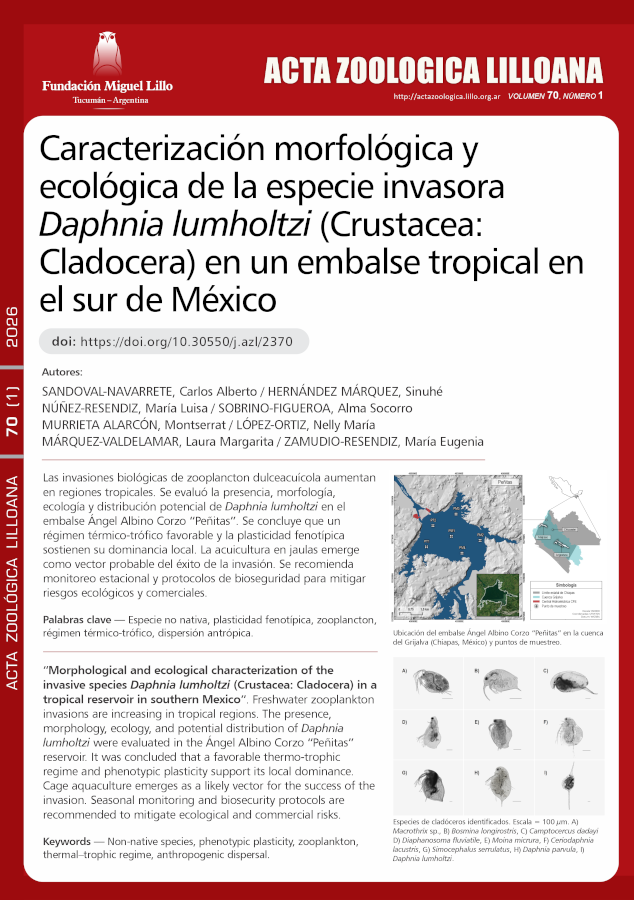
Morphological and ecological characterization of the invasive species Daphnia lumholtzi (Crustacea: Cladocera) in a tropical reservoir in southern Mexico
Authors
-
Carlos Alberto Sandoval Navarrete
Maestría en Biología Universidad Autónoma Metropolitana, Iztapalapa, 09310, México.
 https://orcid.org/0009-0002-7863-7725
-
Sinuhé Hernández Márquez
Laboratorio de Fitoplancton Marino y Salobre, Doctorado en Ciencias Biológicas y de la Salud
https://orcid.org/0000-0002-3110-4502
-
María Luisa Núñez-Resendiz
Laboratorio de Macroalgas Marinas y Salobres, Área de Ficología Comparada, Departamento de Hidrobiología, Universidad Autónoma Metropolitana, Iztapalapa, 09310, México.
https://orcid.org/0000-0001-6587-2609
-
Alma Socorro Sobrino Figueroa
Laboratorio Alejandro Villalobos, Departamento de Hidrobiología, Universidad Autónoma Metropolitana, Iztapalapa, 09310, México.
https://orcid.org/0000-0001-9488-828X
-
Montserrat Murrieta Alarcón
Laboratorio de Fitoplancton Marino y Salobre, Área de Ficología Comparada, Departamento de Hidrobiología, Universidad Autónoma Metropolitana, Iztapalapa, 09310, México.
https://orcid.org/0009-0006-1737-4342
-
Nelly María López Ortiz
Laboratorio de Secuenciación Genómica, LaNaBio, Instituto de Biología, Universidad Nacional Autónoma de México, 04510, México.
https://orcid.org/0009-0007-5204-5461
-
Laura Margarita Márquez Valdelamar
Laboratorio de Secuenciación Genómica, LaNaBio, Instituto de Biología, Universidad Nacional Autónoma de México, 04510, México.
https://orcid.org/0000-0001-9680-7754
-
María Eugenia Zamudio Resendiz
Laboratorio de Fitoplancton Marino y Salobre, Área de Ficología Comparada, Departamento de Hidrobiología, Universidad Autónoma Metropolitana, Iztapalapa, 09310, México.
https://orcid.org/0000-0001-8306-6766
DOI:
 https://doi.org/10.30550/j.azl/2370
Keywords:
Non-native species, phenotypic plasticity, zooplankton, thermal–trophic regime, anthropogenic dispersalAbstract
Biological invasions of freshwater zooplankton are increasing in tropical regions. The presence, morphology, ecology, and potential distribution of Daphnia lumholtzi were evaluated in the Ángel Albino Corzo “Peñitas” reservoir. Six sites were sampled during dry seasons (2022–2024), recording temperature, conductivity, dissolved oxygen, pH, transparency, and chlorophyll-a; zooplankton was collected with a 100 µm net. Morphometrics (210 organisms per season), physicochemical mapping, and ecological analyses (Kruskal–Wallis, Olmstead-Tukey, Spearman) were conducted. Potential distribution was modeled using MaxEnt.
Physicochemical parameters did not differ among years. The cladoceran community comprised nine species; D. lumholtzi was dominant and codominant with Ceriodaphnia lacustris and Diaphanosoma fluviatile. Its abundance was positively associated with temperature (r = 0.69; p = 0.011) and chlorophyll-a (r = 0.55; p = 0.007), whereas C. lacustris showed negative relationships with temperature (r = ?0.48; p = 0.021) and with D. lumholtzi (r = ?0.92; p = 0.001). Specimens exhibited well-developed cephalic and caudal spines, a bilobed postabdomen, and three postabdominal processes. MaxEnt showed excellent performance (AUC ? 0.99), identifying surface temperature (~84%) and chlorophyll-a (~8%) as main predictors, with probabilities > 0.7 in lentic zones and inter-dam sections.
A favorable thermal–trophic regime and phenotypic plasticity likely sustain its local dominance. Cage aquaculture emerges as a probable introduction vector. Seasonal monitoring and biosecurity protocols are recommended to mitigate risks to native zooplankton and commercially important or protected fish fauna.
Downloads
References
Abrantes, N., Antunes, S. C., Pereira, M. J., y Gonçalves, F. (2005). Seasonal succession of cladocerans and phytoplankton, and their interactions in a shallow eutrophic lake (Lake Vela, Portugal). Acta Oecologica, 29, 54–64. https://doi.org/10.1016/j.actao.2005.07.006 DOI: https://doi.org/10.1016/j.actao.2005.07.006
Aguirre-Muñoz, A., y Mendoza-Alfaro, R. (2009). Especies exóticas invasoras: impactos sobre las poblaciones de flora y fauna, los procesos ecológicos y la economía. En R. Dirzo, R. González y I. March (Eds.), Capital natural de México: Estado de conservación y tendencias de cambio (Vol. II, pp. 277–318). CONABIO.
Allison, S., Acharya, S. K., y Jack, J. (2009). Overcrowding, food and phosphorus limitation effects on ephippia production and population dynamics in the invasive species Daphnia lumholtzi. Hydrobiologia, 618(1), 47–56. https://doi.org/10.1007/s10750-008-9546-2 DOI: https://doi.org/10.1007/s10750-008-9546-2
Anzueto-Calvo, M. de J., Velázquez-Velázquez, E., y Gómez-González, A. E. (2016). Peces de la Reserva de la Biosfera Selva El Ocote y presa Nezahualcóyotl (Malpaso), Chiapas, México. Revista Mexicana de Biodiversidad, 87(3), 972–979. https://doi.org/10.1016/j.rmb.2016.07.002 DOI: https://doi.org/10.1016/j.rmb.2016.07.002
Araújo M.B. y Guisan A. (2006). Five (or so) challenges for species distribution modeling. Journal of Biogeography 33(10): 1677-1688. DOI:10.1111/j.1365-2699.2006.01584.x DOI: https://doi.org/10.1111/j.1365-2699.2006.01584.x
ArcGis Pro (2024). Predicción de solo presencia (MaxEnt) (Estadística espacial). Esri. https://n9.cl/gqdsw
Benzie, J. A. H. (1988). The systematics of Australian Daphnia (Cladocera: Daphniidae): Species descriptions and keys. Hydrobiologia, 166(1), 95–161. https://doi.org/10.1007/BF00028632 DOI: https://doi.org/10.1007/BF00028632
Benzie, J. A. H. (2005). The genus Daphnia (including Daphniopsis) (Anomopoda: Daphniidae). Ghent y Backhuys Publishers.
Bledzki, L. (2023). Key to the identification and ecology of Daphnia (Crustacea: Cladocera) of North America (north of Mexico). Mount Holyoke College.
Brooks, J. (1959). Cladocera. In: Edmonson, W. (Ed.), Fresh Water Biology. John Wiley y Sons.
Bueno-Soria, J., y Santiago-Fragoso, S. (2002). Presa Nezahualcóyotl (Malpaso). En G. de la Lanza-Espino y J. García-Calderón (Comps.), Lagos y presas de México (pp. xxx–xxx). AGT Editor.
Diel, P., Kiene, M., Martin-Creuzburg, D., y Laforsch, C. (2020). Knowing the enemy: Inducible defences in freshwater zooplankton. Diversity, 12(4), 147. https://doi.org/10.3390/d12040147 DOI: https://doi.org/10.3390/d12040147
Dzialowski, A. R., O’Brien, J. W., y Swaffar, S. M. (2000). Range expansion and potential dispersal mechanisms of the exotic cladoceran Daphnia lumholtzi. Journal of Plankton Research, 22(12), 2205–2223. https://doi.org/10.1093/plankt/22.12.2205 DOI: https://doi.org/10.1093/plankt/22.12.2205
Elías-Gutiérrez, M., E. Suárez-Morales, M.A. Gutiérrez-Aguirre., M. Silva-Briano, J. G. Granados-Ramírez y T. Garfias-Espejo. (2008a). Cladocera y Copepoda de las aguas continentales de México, guía ilustrada. UNAM, CONABIO, ECOSUR, CONACyT, SEMARNAT.
Elías-Gutiérrez, M., Silva-Briano, M., y Gutiérrez-Aguirre, M. A. (2008b). DNA barcodes for Cladocera and Copepoda from Mexico and Guatemala, highlights and new discoveries. Zootaxa, 1839, 1–42. https://doi.org/10.11646/zootaxa.1839.1.1 DOI: https://doi.org/10.11646/zootaxa.1839.1.1
El-Magd, I. H. y Ali, E. M. (2010). Estimating and Mapping Chlorophyll a Concentration as a Function of Environmental Changes of Manzala Lagoon, Egypt Using. Egyptian Journal of Aquatic Research, 36(2), 305-316. https://n9.cl/0kdc8
Engel, K., Tollrian, R., y Gabriel, W. (2014). Morphological defences of invasive Daphnia lumholtzi protect against vertebrate and invertebrate predators. Journal of Plankton Research, 36(5), 1140–1145. https://doi.org/10.1093/plankt/fbu023 DOI: https://doi.org/10.1093/plankt/fbu023
Engel, K., Tollrian, R., y Straile, D. (2012). Competitive ability, thermal tolerance and invasion success in exotic Daphnia lumholtzi. Journal of Plankton Research, 34(1), 92–97. https://doi.org/10.1093/plankt/fbr083 DOI: https://doi.org/10.1093/plankt/fbr083
Engel, K., y Tollrian, R. (2009). Inducible defences as key adaptations for the successful invasion of Daphnia lumholtziin North America? Proceedings of the Royal Society B: Biological Sciences, 276(1663), 1865–1873. https://doi.org/10.1098/rspb.2008.1861 DOI: https://doi.org/10.1098/rspb.2008.1861
Frisch, D., Havel, J. E., y Weider, L. J. (2013). The invasion history of the exotic freshwater zooplankter Daphnia lumholtzi (Cladocera, Crustacea) in North America: A genetic analysis. Biological Invasions, 15(4), 817–828. https://doi.org/10.1007/s10530-012-0329-3 DOI: https://doi.org/10.1007/s10530-012-0329-3
Gophen, M. (1976). Temperature dependence of food intake, ammonia excretion and respiration in Ceriodaphnia reticulata (Jurine) (Lake Kinneret, Israel). Freshwater Biology, 6(5), 451–455. https://doi.org/10.1111/j.1365-2427.1976.tb01634.x DOI: https://doi.org/10.1111/j.1365-2427.1976.tb01634.x
Graeve, A., Janßen, M., Villalba-De La Peña, M., Tollrian, R., y Weiss, L. C. (2021). Higher, faster, better: Maternal effects shorten time lags and increase morphological defenses in Daphnia lumholtzi offspring generations. Frontiers in Ecology and Evolution, 9, 637421. https://doi.org/10.3389/fevo.2021.637421 DOI: https://doi.org/10.3389/fevo.2021.637421
Hagey, L. R., Møller, P. R., Hofmann, A. F., y Krasowski, M. D. (2010). Diversity of bile salts in fish and amphibians: Evolution of a complex biochemical pathway. Physiological and Biochemical Zoology, 83(2), 308–321. https://doi.org/10.1086/649966 DOI: https://doi.org/10.1086/649966
Hahn, M., y von Elert, E. (2022). One kairomone and multiple effects in Daphnia species—5?-cyprinol sulfate induces morphological defenses in the invasive species Daphnia lumholtzi. Frontiers in Ecology and Evolution, 10, 804521. https://doi.org/10.3389/fevo.2022.804521 DOI: https://doi.org/10.3389/fevo.2022.804521
Havel, J. E., Colbourne, J. K., y Hebert, P. D. N. (2000). Reconstructing the history of intercontinental dispersal in Daphnia lumholtzi by use of genetic markers. Limnology and Oceanography, 45(6), 1414–1419. https://doi.org/10.4319/lo.2000.45.6.1414 DOI: https://doi.org/10.4319/lo.2000.45.6.1414
Havel, J. E., y Hebert, P. D. N. (1993). Daphnia lumholtzi (Cladocera: Daphniidae): A new exotic zooplankter in North American inland lakes. Journal of Plankton Research, 15(7), 813–826. https://doi.org/10.1093/plankt/15.7.813
Havel, J. E., y Lampert, W. (2006). Habitat partitioning of native and exotic Daphnia in gradients of temperature and food: mesocosm experiments. Freshwater Biology, 51(3), 487–498. https://doi.org/10.1111/j.1365-2427.2006.01511.x DOI: https://doi.org/10.1111/j.1365-2427.2006.01511.x
Horstmann, M., Tollrian, R., y Weiss, L. C. (2021). Thwarting predators? A three-dimensional perspective of morphological alterations in the freshwater crustacean Daphnia. PLOS ONE, 16(7), e0254263. https://doi.org/10.1371/journal.pone.0254263 DOI: https://doi.org/10.1371/journal.pone.0254263
Ibarra-Montoya, J. L., Rangel-Peraza, G., González-Farias, F. A., De Anda, J., Zamudio-Reséndiz, M. E., Martínez-Meyer, E., y Macias-Cuellar, H. (2010). Modelo de nicho ecológico para predecir la distribución potencial de fitoplancton en la Presa Hidroeléctrica Aguamilpa, Nayarit. México. Ambiente y Água - An Interdisciplinary Journal of Applied Science, 5(3), 60-75. DOI:10.4136/ambi-agua.154 DOI: https://doi.org/10.4136/ambi-agua.154
Kolar, C. S., Van Goetham, D., y Havel, J. E. (1997). Potential effect of invasion by an exotic zooplankter, Daphnia lumholtzi. Journal of Freshwater Ecology, 12(4), 521–530. https://doi.org/10.1080/02705060.1997.9663566 DOI: https://doi.org/10.1080/02705060.1997.9663566
Kotov, A. y Taylor, D. (2014). Daphnia lumholtzi Sars, 1885 (Cladocera: Daphniidae) invades Argentina. Journal of limnology, 73(2), 167-172. DOI:10.4081/jlimnol.2014.920 DOI: https://doi.org/10.4081/jlimnol.2014.920
Lennon, J. T., Smith, V. H., y Williams, K. (2001). Influence of temperature on exotic Daphnia lumholtzi and implications for invasion success. Journal of Plankton Research, 23(4), 425–433. https://doi.org/10.1093/plankt/23.4.425 DOI: https://doi.org/10.1093/plankt/23.4.425
Lorenzen, C. J. (1967). Determination of chlorophyll and pheo-pigments: Spectrophotometric equations. Limnology and Oceanography, 12(2), 343–346. https://doi.org/10.4319/lo.1967.12.2.0343 DOI: https://doi.org/10.4319/lo.1967.12.2.0343
Mantovano, T., Bailly, D., Ferreira, J. H. D., Oliveira da Conceição, E., Cassemiro, F. A. S., Campos, R., Lansac-Tôha, F. A. (2020). A global analysis of the susceptibility of river basins to invasion of a freshwater zooplankton (Daphnia lumholtzi). Freshwater Biology, 66(4), 683–698. https://doi.org/10.1111/fwb.13670 DOI: https://doi.org/10.1111/fwb.13670
Merow, C., Smith, M. J., y Silander, J. A. (2013). A practical guide to MaxEnt for modeling species’ distributions: What it does, and why inputs and settings matter. Ecography, 36, 1058–1069. https://doi.org/10.1111/j.1600-0587.2013.07872.x DOI: https://doi.org/10.1111/j.1600-0587.2013.07872.x
NCSS, LLC. (2020). NCSS 2020 Statistical Software. Kaysville, Utah, USA. https://www.ncss.com/
Nunes, A. H., Miracle, M. R., Dias, J. D., Fabrin, T. M. C., Braghin, L. S. M., y Bonecker, C. C. (2018). First genetic characterization of non-native Daphnia lumholtzi Sars, 1885 in Brazil confirms North American origin. International Review of Hydrobiology, 103(3–4), 48–53. https://doi.org/10.1002/iroh.201701914 DOI: https://doi.org/10.1002/iroh.201701914
Olmos-Tomasini, E. (2002). Presa La Angostura (Belisario Domínguez). En G. de la Lanza-Espino y J. García-Calderón (Comps.), Lagos y presas de México (pp. xxx–xxx). AGT Editor.
Pattinson, K. R., Havel, J. E., y Rhodes, R. G. (2003). Invasibility of a reservoir to exotic Daphnia lumholtzi: Experimental assessment of diet selection and life-history responses to cyanobacteria. Freshwater Biology, 48(2), 233–246. https://doi.org/10.1046/j.1365-2427.2003.00987.x DOI: https://doi.org/10.1046/j.1365-2427.2003.00987.x
Perdomo-Vanegas, A. (2015). Predicción de parámetros físicos químicos de calidad del agua mediante el uso de sensores remotos: caso de estudio embalse del Neusa. [Tesis de posgrado, Fundación Universidad de Bogotá Jorge Tadeo Lozano]. https://n9.cl/gik30
Peterson, B., Nicolas, F., Koupal, K., y Hoback, W. (2005). Daphnia lumholtzi, an exotic zooplankton, invading a Nebraska reservoir. The Prairie Naturalist, 37, 11–19. https://n9.cl/u9yv8
Phillips, S. J., Anderson, R. P., y Schapire, R. E. (2006). Maximum entropy modeling of species geographic distributions. Ecological Modelling, 190(3–4), 231–259. https://doi.org/10.1016/j.ecolmodel.2005.03.026 DOI: https://doi.org/10.1016/j.ecolmodel.2005.03.026
Platas-Rosado, D. E., Hernández-Arzaba, J. C., y González-Reynoso, L. (2017). Importancia económico y social del sector acuícola en México. Agroproductividad, 10(2), 19–24. https://n9.cl/huj0t
Ponce-Palafox, J., Hernández-Ocampo, D., Díaz-Alvares, J., y Esparza-Leal, H. (2006). Aplicación de modelos multivariados en el estudio de las presas. In: Arredondo-Figueroa, J. L., G. Díaz-Zavaleta y J. T. Ponce-Palafox (Comps.) Limnología de Presas Mexicanas. AGT Editor, Universidad Autónoma Metropolitana.
Posit Team. (2024). RStudio: Integrated Development Environment for R (Version 2024.12.1-563). Posit Software, PBC. https://posit.co/
Pyšek, P., y Richardson, D. M. (2010). Invasive species, environmental change and management, and health. Annual Review of Environment and Resources, 35, 25–55. https://doi.org/10.1146/annurev-environ-033009-095548 DOI: https://doi.org/10.1146/annurev-environ-033009-095548
QGIS Development Team. (2024). QGIS Geographic Information System (Version 3.40). QGIS Association. https://www.qgis.org/
Romero-Beltrán, E., Rendón-Martínez, R., Gaspar-Dillanes, M. T., Osuna-Bernal, A., Romero-Correa, A., Mauricio-Payán, A., Medina-Osuna, P. M., Valdés-Ledón, P., Mora-Cervantes, I., y Bect-Valdéz, J. A. (2020). Capacidad de carga ecológica y física para el desarrollo de proyectos acuícolas en la Presa Ángel Albino Corzo “Peñitas”, Chiapas. Secretaría de Agricultura y Desarrollo Social / INAPESCA. https://n9.cl/2x3gu
Sars, G. O. (1885). Australian Cladocera, raised from dried mud. Forhandlinger i Videnskabs–Selskabei Chris-tiania, 8, 1–46.
Schnake, K. (2002). Cyclomorphosis of Daphnia lumholtzi in response to spatial heterogeneity in Lake Taylorville [Master’s thesis, Eastern Illinois University]. https://thekeep.eiu.edu/theses/1391
Silva-Briano, M. G., Arroyo-Bustos, R., Beltrán-Álvarez, A., Adabache-Ortiz, R., y Galván de la Rosa, R. (2010). Daphnia Ctenodaphnia lumholtzi G. O. Sars, 1885 (Crustacea: Cladocera); un cladócero exótico en México. Hidrobiológica, 20(3), 275–280. https://n9.cl/79vpi
Simões, N. R., Robertson, B. A., Lansac-Tôha, F. A., Takahashi, E. M., Bonecker, C. C., Velho, L. F. M., y Joko, C. Y. (2009). Exotic species of zooplankton in the upper Paraná river floodplain, Daphnia lumholtzi Sars, 1885 (Crustacea: Branchiopoda). Brazilian Journal of Biology, 69(2), 551–558. https://doi.org/10.1590/S1519-69842009000300010 DOI: https://doi.org/10.1590/S1519-69842009000300010
Sommer, U. (1989). Plankton ecology: Succession in plankton communities. Springer-Verlag. https://doi.org/10.1007/978-3-642-74890-5 DOI: https://doi.org/10.1007/978-3-642-74890-5
Sousa, F. D. R., Siqueira, T., y Matsumura-Tundisi, T. (2017). Predicting the invasive potential of Daphnia lumholtzi in the Neotropics: Are generalists threatened and relicts protected by their life-history traits? Journal of Limnology, 76(2), 272–280. https://doi.org/10.4081/jlimnol.2016.1571 DOI: https://doi.org/10.4081/jlimnol.2016.1571
Swaffar, S. M., y O’Brien, W. J. (1996). Spines of Daphnia lumholtzi create feeding difficulties for juvenile bluegill sunfish (Lepomis macrochirus). Journal of Plankton Research, 18(6), 1055–1061. https://doi.org/10.1093/plankt/18.6.1055 DOI: https://doi.org/10.1093/plankt/18.6.1055
Swar, D. B., y Fernando, C. H. (1979). Seasonality and fecundity of Daphnia lumholtzi (Sars) (Cladocera: Daphnidae) in Lake Phewa, Nepal. Hydrobiologia, 64, 261–268. https://doi.org/10.1007/BF00020527 DOI: https://doi.org/10.1007/BF00020527
Velázquez-Velázquez, E., Gómez-González, A. E., Anzueto-Calvo, M., y Villatoro-Álvarez, J. (2014). Peces del Parque Nacional Cañón del Sumidero, Chiapas, México. Ediciones De Laurel.
Yurista, P. M. (2004). Temperature-dependent morphology of Daphnia lumholtzi and implications for invasion success. Hydrobiologia, 526(1), 231–236. https://doi.org/10.1023/B:HYDR.0000041600.22987.38
Zanata, L. H., Gaeta-Espindola, E. L., Rocha O y Pereira R. H. G. (2003). First record of Daphnia lumholtzi (Sars, 1885), exotic cladoceran, in São Paulo State (Brazil). Brazilian Journal of Biology, 63(4), 717-720. DOI.org/10.1590/S151969842003000400019 DOI: https://doi.org/10.1590/S1519-69842003000400019
Zeneib, A. (2008). Daphnia lumholtzi (Sars, 1885) (Cladocera - Daphniidae): A newly recorded species in Syria. Tishreen University Journal for Research and Scientific Studies - Biological Sciences Series, 30(3), 80–82.
Downloads
Published
How to Cite
Issue
Section
License
Copyright (c) 2026 Acta Zoológica Lilloana

This work is licensed under a Creative Commons Attribution-NonCommercial-NoDerivatives 4.0 International License.