Preliminary analysis of the effect of white chuño production on the aquatic macroinvertebrate community in rivers of the Central Andes of Peru
Authors
-
Manuel Alejandro Silva Poma
Departamento de Cursos Básicos, Universidad Científica del Sur, Lima, Perú
 https://orcid.org/0000-0003-4809-5806
-
Jorge Luis Peralta Argomeda
Laboratorio de Ecología de Invertebrados Acuáticos Continentales, Facultad de Ciencias Biológicas, Universidad Nacional Mayor de San Marcos, Lima, Perú.
https://orcid.org/0000-0001-9416-8194
-
Henry Tinoco Vega
Fundación Zoológica de Denver, Denver, Colorado
https://orcid.org/0009-0006-6250-8389
-
Luis Castillo Roque
Fundación Zoológica de Denver, Denver, Colorado
https://orcid.org/0000-0002-5529-9623
DOI:
 https://doi.org/10.30550/j.azl/2355
Keywords:
Pollution, monitoring, high Andean rivers, aquatic invertebratesAbstract
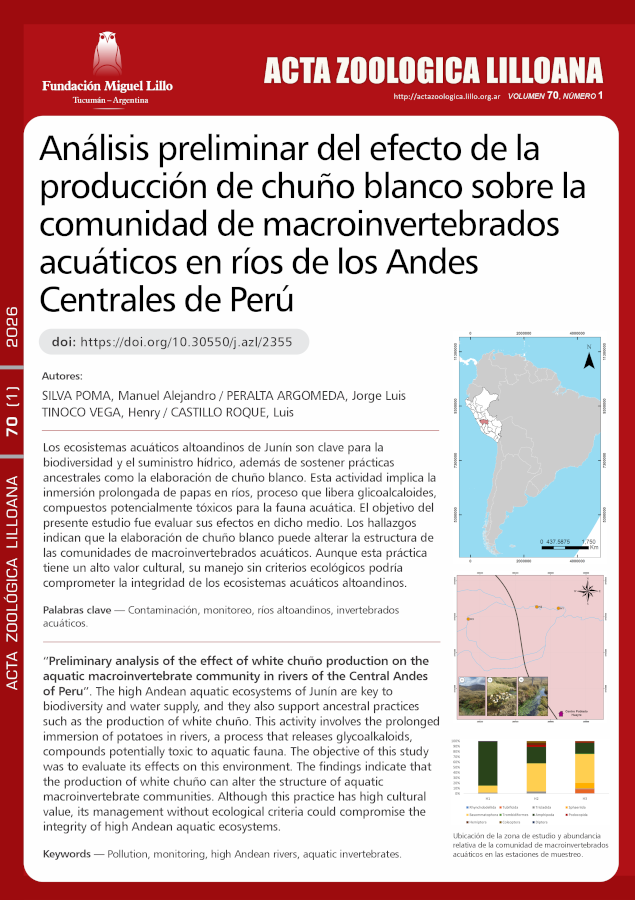
The high Andean aquatic ecosystems of Junín are key to biodiversity and water supply, as well as supporting ancestral practices such as the production of white chuño (freeze-dried potatoes). This activity involves the prolonged immersion of potatoes in rivers, a process that releases glycoalkaloids, compounds potentially toxic to aquatic fauna. The objective of this study was to evaluate the effect of white chuño production on the aquatic macroinvertebrate community in the Huayricucho River, in the central Andes of Peru.Three sampling stations were established: upstream of the chuño ponds, in the immersion zone, and downstream. Physicochemical and hydrological parameters, as well as the community structure of the macroinvertebrates, were analyzed. A total of 2228 individuals distributed among 13 genera were recorded. Abundance and Pielou evenness showed significant differences between stations, with a marked reduction in the immersion zone of chuño, while richness did not show significant differences. The ordination analysis (nMDS) and the ANOSIM test revealed significant changes in community composition, characterized by the predominance of more tolerant taxa at the impacted station.These findings indicate that the production of white chuño (freeze-dried potatoes) can alter the structure of aquatic macroinvertebrate communities. Although this practice has high cultural value, its management without ecological criteria could compromise the integrity of high-Andean aquatic ecosystems. Therefore, it is recommended to integrate conservation strategies that harmonize ancestral knowledge with environmental sustainability.
Downloads
References
Blankemeyer, J. T., Atherton R., Friedman, M. (1995). Effect of potato glycoalkaloids ?-chaconine and ?-solanine on sodium active transport in frog skin. Journal of Agricultural and Food Chemistry, 43(3), 636–639. https://doi.org/10.1021/jf00051a015 DOI: https://doi.org/10.1021/jf00051a015
Castillo, L., Elías, R., Tinoco, H., Rodríguez, J.E. & Matamoros, Y. (Eds.). (2022). Taller para realizar un Análisis de Viabilidad de la Población y del hábitat (PHVA) y establecer una Estrategia de Conservación de la rana gigante de Junín y Pasco. 03-05 de junio, 2022. Junín y Pasco, Perú. IUCN SSC Grupo de Especialistas en Planificación para la Conservación (CPSG Mesoamérica).
Castillo, L. & Watson, A.S. (2022). Are protected areas working for endangered frogs in the Peruvian Andes? Biodiversity and Conservation 31:1847?1866. https://doi.org/10.6084/m9.figshare.19294451.v1 DOI: https://doi.org/10.1007/s10531-022-02406-9
Cervantes, R., Sánchez, J. M., Alegre, J., Rendón, E., Baiker, J. R., Locatelli, B., Bonnesoeur, V. (2022). CONTRIBUCIÓN DE LOS ECOSISTEMAS ALTOANDINOS EN LA PROVISIÓN DEL SERVICIO ECOSISTÉMICO DE REGULACIÓN HÍDRICA. Ecología Aplicada, 20(2), 137-146. https://doi.org/10.21704/rea.v20i2.1804 DOI: https://doi.org/10.21704/rea.v20i2.1804
Clarke, K. R., Gorley, R. N., Somerfield, P. J., Warwick, R. M., (2014). Change in marine communities: an approach to statistical analysis and interpretation, 3rd edition. PRIMER-E: Plymouth, UK. 172 pp
Fonseca C, Huarachi E, Chura W, Cotrado G. 2008. Guía de las buenas prácticas del procesamiento para la producción artesanal de la Tunta. Alianza institucional para el desarrollo competitivo de la tunta, Puno. International Potato Center. ISBN 978-92-9060-339-9. https://hdl.handle.net/10568/176258
INRENA. (2008). Plan Maestro 2008-2012: Reserva Nacional de Junín. 1–222.
Kurek, J. (2019). Introductory Chapter: Alkaloids - Their Importance in Nature and for Human Life. Alkaloids - Their Importance in Nature and Human Life. https://doi.org/10.5772/INTECHOPEN.85400 DOI: https://doi.org/10.5772/intechopen.85400
HAMMER, O., HARPER, DAT., RYAN, P.D. (2001). PAST. Paleontological statistics software package for education and data analysis. Paleontologia Electronica, 4(1):1-9.
Melton, M.A., Biwer, M.E., Panjarjian, R. (2020). Differentiating Chuño blanco and Chuño negro in archaeological samples based on starch metrics and morphological attributes. Journal of Archaeological Science: Reports, 34, 102650. https://doi.org/10.1016/j.jasrep.2020.102650 DOI: https://doi.org/10.1016/j.jasrep.2020.102650
Pascual, M., Barral, M.P., Poca, M., Pessacg, N., García-Silva, L., Albariño, R., Romero, M.E., Jobbágy, E.G. (2021). Ecosistemas acuáticos continentales y sus servicios: Enfoques y escenarios de aplicación en el mundo real. Ecología Austral, 32(1-bis), 195–212. https://doi.org/10.25260/EA.22.32.1.1.1290 DOI: https://doi.org/10.25260/EA.22.32.1.1.1290
Peñarrieta, J.M., Salluca, T., Tejeda, L., Alvarado, J.A., Bergenstahl, B. (2011). Changes in phenolic antioxidants during chuño production (traditional Andean freeze and sun-dried potato). Journal of Food Composition and Analysis, 24, 580-587. https://doi.org/10.1016/j.jfca.2010.10.006 DOI: https://doi.org/10.1016/j.jfca.2010.10.006
Rayburn, J.R., Friedman, M., Bantle, J.A. (1995). Synergistic interaction of glycoalkaloids alpha-chaconine and alpha-solanine on developmental toxicity in Xenopus embryos. Food and Chemical Toxicology, 33(12), 1013–1019. https://doi.org/10.1016/0278-6915(95)00081-X DOI: https://doi.org/10.1016/0278-6915(95)00081-X
[SERNANP] Servicio Nacional de Áreas Naturales Protegidas por el Estado. (2020). Reserva Nacional de Junín. Un espejo en medio de los Andes. Primera Edición. Perú.
Schrenk, D., Bignami, M., Bodin, L., Chipman, J.K., Mazo, J., Hogstrand, C., Hoogenboom, L., Leblanc, J., Nebbia, C.S., Nielsen, E., Ntzani, E., Petersen, A., Sand, S., Schwerdtle, T., Vleminckx, C., Wallace, H., Brimer, L., Cottrill, B., Dusemund, B., … Grasl-Kraupp, B. (2020). Risk assessment of glycoalkaloids in feed and food, in particular in potatoes and potato-derived products. EFSA Journal, 18(8), 6222. https://doi.org/10.2903/J.EFSA.2020.6222 DOI: https://doi.org/10.2903/j.efsa.2020.6222
Shepard, R. N. (1962). The analysis of proximities: Multidimensional scaling with an unknown distance function. I. Psychometrika, 27(2), 125–140. https://doi.org/10.1007/BF02289630 DOI: https://doi.org/10.1007/BF02289630
Silva, M., Castillo, L., Elias, R., Peralta-Argomeda, J. & Huamantinco-Araujo, A. (2021). WATER QUALITY OF THE HABITAT OF TWO ENDANGERED HIGH-ANDEAN FROGS USING AQUATIC MACROINVERTEBRATES AS BIOINDICATORS. International Journal of Conservation Science, 12(3), 1061-1076.
Ventrella, E., Adamski, Z., Chudzi?ska, E., Mi?dowicz-Kobielska, M., Marciniak, P., Büyükgüzel, E., Büyükgüzel, K., Erdem, M., Falabella, P., Scrano, L., Bufo, S.A. (2016). Solanum tuberosum and Lycopersicon esculentum Leaf Extracts and Single Metabolites Affect Development and Reproduction of Drosophila melanogaster. PloS one, 11(5), e0155958. https://doi.org/10.1371/journal.pone.0155958 DOI: https://doi.org/10.1371/journal.pone.0155958
Wang, S., Panter, K.E., Gaffield, W., Evans, R.C., Bunch, T.D. (2005). Effects of steroidal glycoalkaloids from potatoes (Solanum tuberosum) on in vitro bovine embryo development. Animal reproduction science, 85(3-4), 243–250. https://doi.org/10.1016/j.anireprosci.2004.06.00 DOI: https://doi.org/10.1016/j.anireprosci.2004.06.002
Watson, A., Fitzgerald, A., Damián-Baldeón, O., Chamorro, A., & Castillo, L. (2016). Ranas Altoandinas en la Región de Junín: Estado Actual y Plan Estratégico de conservación de Telmatobius macrostomus (Peters, 1873) y Telmatobius brachydactylus https://doi.org/10.13140/RG.2.2.16588.31365
Winkiel, M.J., Chowa?ski, S., Walkowiak-Nowicka, K., Go??biowski, M., S?oci?ska, M. (2024). A tomato a day keeps the beetle away–the impact of Solanaceae glycoalkaloids on energy management in the mealworm Tenebrio molitor. Environmental Science and Pollution Research, 31(48), 58581-58598. https://doi.org/10.1007/s11356-024-35099-4 DOI: https://doi.org/10.1007/s11356-024-35099-4
Downloads
Published
How to Cite
Issue
Section
License
Copyright (c) 2026 Acta Zoológica Lilloana

This work is licensed under a Creative Commons Attribution-NonCommercial-NoDerivatives 4.0 International License.