Use of food resources by an assemblage of parrots in the Foothill Forest of the Argentine Yungas
DOI:
 https://doi.org/10.30550/j.azl/2318
Keywords:
Diet, niche breadth, psittaciformes, YungasAbstract
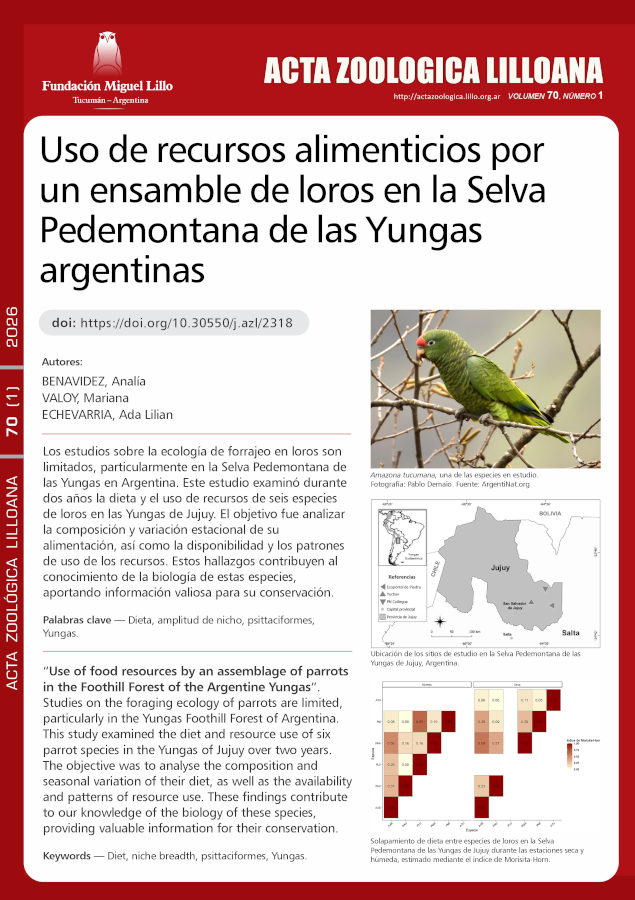
This study examined the diet and resource use of six parrot species in the Yungas of Jujuy over two years. The objective was to analyse the composition and seasonal variation of their diet, as well as the availability and patterns of resource use. The consumption of seeds, fruits, and flowers from 23 plant species belonging to 10 families was recorded, with seeds being the main item in their diet. Significant differences in food availability were found between seasons, which were reflected in seasonal variation in diet composition. Low values were observed in niche breadth and overlap between parrot species. A positive relationship was found between resource availability and the number of feeding events. The species showed a tendency to concentrate their foraging on a few plant species, responding to resource variation by changing the main items in their diet or through local movements. These findings contribute to our knowledge of the biology of these species, providing valuable information for their conservation.
Downloads
References
Anderson, M. J. (2001). Permutation tests for univariate or multivariate analysis of variance and regression. Canadian journal of fisheries and aquatic sciences, 58, 626-639. DOI: https://doi.org/10.1139/f01-004
Banda, K., A. Delgado-Salinas, D. Dexter, R. Linares-Palomino, A. Oliveira-Filho et al. (2016). Plant diversity patterns in neotropical dry forests and their conservation implications. Science, 353,1383-1387. DOI: https://doi.org/10.1126/science.aaf5080
Bolker, B.M., Brooks, M.E., Clark, C.J., Geange, S.W., Poulsen, J.R., Stevens, M.H.H., White, J.S.S. (2009). Generalized linear mixed models: a practical guide for ecology and evolution. Trends in ecology & evolution, 24, 127-135. DOI: https://doi.org/10.1016/j.tree.2008.10.008
Benavídez, A., Palacio, F.X., Rivera, L.O., Echevarria, A.L., Politi, N. (2018). Diet of Neotropical parrots is independent of phylogeny but correlates with body size and geographical range. The Ibis, 16, 742-754. DOI: https://doi.org/10.1111/ibi.12630
Benavídez, A., Tallei, E., Lilian, E.A., Rivera, L. (2021). Feeding ecology of the Green-cheeked Parakeet, Pyrrhura molinae (Psittaciformes, Psittacidae), in a subtropical forest of Argentina. Neotropical Biology and Conservation, 16, 205-219. DOI: https://doi.org/10.3897/neotropical.16.e62109
Blanco, G., Hilardo, F., Tella, J.L. (2018). Ecological functions of parrots: An integrative perspective from plant life cycle to ecosystem functioning. Emu-Austral Ornithology, 118, 36-49. DOI: https://doi.org/10.1080/01584197.2017.1387031
Blendinger, P.G., Álvarez, M.E. (2009). Aves de la Selva Pedemontana de las Yungas australes.Selva Pedemontana de las Yungas. En Historia Natural, Ecología y Manejo de un Ecosistema en Peligro (233-272). Ediciones del Subtrópico, Tucumán, Argentina.
Brightsmith, D.J., Boyd, J., Hobson, E., Randel, C. (2021). Satellite telemetry reveals complex migratory movement patterns of two large macaw species in the western Amazon basin. Avian Conservation and Ecology 16: 14. DOI: https://doi.org/10.5751/ACE-01822-160114
Brown, A.D., Grau, H.R., Malizia, L.R., Grau, A. (2001). Argentina. EnBosques nublados del Neotrópico (623-659). InBio, Santo Domingo de Heredia, Costa Rica.
Brown, A.D., Blendinger, P., Lomáscolo, T., Bes, P.G. (2009). Selva pedemontana de las Yungas. En Historia natural, ecología y manejo de un ecosistema en peligro (213-273). San Miguel de Tucumán, Argentina. Ediciones del Subtrópico.
Bjork, R.D. (2004). Delineating pattern y process in tropical lowlys: Mealy Parrot migration dynamics as a guide for regional conservation planning. PhD Thesis. Oregon State University, Corvallis, Oregon, USA.
Colwell, R.K., Futuyma, D.J. (1971). On the measurement of niche breadth and overlap. Ecology, 52, 567-576. DOI: https://doi.org/10.2307/1934144
de la Parra?Martinez, S.M., Muñoz?Lacy, L.G., Salinas?Melgoza, A., Renton, K. (2019). Optimal diet strategy of a large-bodied psittacine: food resource abundance and nutritional content enable facultative dietary specialization by the Military Macaw. Avian Research, 10, 38-47. DOI: https://doi.org/10.1186/s40657-019-0177-2
Díaz, S., Kitzberger, T. (2006). High Nothofagus flower consumption and pollen emptying in the southern South American Austral Parakeet (Enicognathus ferrugineus). Austral Ecology, 31, 759-766. DOI: https://doi.org/10.1111/j.1442-9993.2006.01637.x
Díaz S, Kitzberger, T., Peris, S. (2012). Food resources and reproductive output of Austral Parakeet (Enicognathus ferrugineus) in forests of northern Patagonia. Emu, 112, 234-243. DOI: https://doi.org/10.1071/MU12005
Fournier, L.A. (1974). Un método cuantitativo para la medición de características fenológicas en árboles. Turrialba, 24, 422-423.
Galetti, M. (1993). Diet of the Scaly-headed Parrot (Pionus maximiliani) in a semideciduous forest in southeastern Brazil. Biotropica, 25, 419-425. DOI: https://doi.org/10.2307/2388865
Gilardi, J.D., Toft, C.A. (2012). Parrots eat nutritious foods despite toxins.PLoS ONE, 7, e38293. DOI: https://doi.org/10.1371/journal.pone.0038293
Gomez, M.D., Rivera, L.O., Politi, N., Ruggera, R.A. (2016). Avifauna de los bosques ribereños de las selvas pedemontanas del noroeste argentino. Ornitología Neotropical, 27, 47-57.
Grau, H.R. (2005). Dinámica de bosques en el gradiente altitudinal de las Yungas argentinas. En Ecología y manejo de los Bosques Argentinos (181-188). UNLP, Buenos Aires, Argentina.
IUCN. 2025. The IUCN Red List of threatened species. [fecha de consulta: Agosto 2025] https://www.iucnredlist.org/
Jordano, P. (2014). Fruits and frugivory. En Seeds: the ecology of regeneration in plant communities (18-61). CABI, Wallingford. DOI: https://doi.org/10.1079/9781780641836.0018
Krebs, C.J. (1998). Niche measures and resource preferences. Ecological Methodology, 455-495.
Lee, A.T., Brightsmith, D.J., Vargas, M.P., Leon, K.Q., Mejia, A.J., Marsden, S.J. (2014). Diet and geophagy across a western Amazonian parrot assemblage. Biotropica, 46, 322-330. DOI: https://doi.org/10.1111/btp.12099
Matuzak, G.D., Bezy, M.B., Brightsmith, D.J. (2008). Foraging ecology of parrots in a modified landscape: Seasonal trends and introduced species. The Wilson Journal of Ornithology, 120, 353-365. DOI: https://doi.org/10.1676/07-038.1
Mogni, V.Y., Oakley, L.J., Maturo, H.M., Galetti, L.A., Prado, D.E. (2015). Biogeografía y Florística de los Bosques Secos Estacionales Neotropicales (BSEN). OKARA: Geografia em debate, 9, 275-296.
Morisita, M. (1959). Measuring interspecific association and similarity between communities. Memoirs of the Faculty of Science of Kyushu University, Series E. Biology (Basel) 3: 6580.
Myers, N., Mittermeier, R.A., Mittermeier, C.G., Da Fonseca, G.A., Kent, J. (2000). Biodiversity hotspots for conservation priorities. Nature, 403, 853-858. DOI: https://doi.org/10.1038/35002501
Olah, G., Butchart, S.H., Symes, A., Guzmán, I.M., Cunningham, R., Brightsmith, D.J., Heinsohn, R. (2016). Ecological and socio-economic factors affecting extinction risk in parrots. Biodiversity and Conservation, 25, 205-223. DOI: https://doi.org/10.1007/s10531-015-1036-z
Politi, N., Rivera, L.O. (2005). Abundance and distribution of parrots along the elevational gradient of Calilegua National Park, Argentina. Ornitología Neotropical, 16, 4.
Politi, N., Rivera, L., Balducci, E., Malizia, L.R, Blundo, C. et al. (2021). Yungas. En Uso sostenible del bosque: Aportes desde la Silvicultura Argentina (373-432). Ciudad Autónoma de Buenos Aires, Argentina.
R Development Core Team. (2023). R: A language and environment for statistical computing. R foundation for statistical computing. Vienna, Austria.
Ragusa-Netto J. 2004. Flowers, fruits and the abundance of the Yellow-crowned parakeet (Brotogeris chiriri) at a gallery forest in the South Pantanal (Brazil). Brazilian Journal of Biology, 64, 867-877. DOI: https://doi.org/10.1590/S1519-69842004000500017
Ragusa-Netto, J., Fecchio, A. (2006). Plant food resources and the diet of a parrot community in a gallery forest of the southern Pantanal (Brazil). Brazilian Journal of Biology, 66, 1021-1032. DOI: https://doi.org/10.1590/S1519-69842006000600008
Ragusa-Netto, J. (2007). Nectar, fleshy fruits y the abundance of parrots at a gallery forest in the southern Pantanal (Brasil). Studies on Neotropical Fauna y Environment, 42, 93-99. DOI: https://doi.org/10.1080/01650520600979643
Ragusa?Netto, J. (2008). Yellow?chevroned Parakeet (Brotogeris chiriri) abundance and canopy foraging at a dry forest in western Brazil. Studies on Neotropical Fauna and Environment, 43, 99-105. DOI: https://doi.org/10.1080/01650520701510859
Ragusa-Netto, J. (2023). Feeding ecology of a parrot assemblage in the Brazilian Cerrado. Ornitologia Neotropical, 33, 109-119. DOI: https://doi.org/10.58843/ornneo.vi.755
Renton, K. (2001). Lilac-crowned Parrot diet and food resource availability: resource tracking by a parrot seed predator. The Condor, 103, 62-69. DOI: https://doi.org/10.1093/condor/103.1.62
Renton, K. (2006). Diet of adult and nestling Scarlet Macaws in Southwest Belize, Central America. Biotropica, 38, 280-283. DOI: https://doi.org/10.1111/j.1744-7429.2006.00123.x
Renton K., Salinas-Melgoza, A., Labra-Hernández, M.A, de la Parra-Martínez, S.M. (2015). Resource requirements of parrots: nest site selectivity and dietary plasticity of Psittaciformes. Journal of Ornithology, 156, 73-90. DOI: https://doi.org/10.1007/s10336-015-1255-9
Rivera, L. (2011). Ecología, biología reproductiva y conservación del Loro Alisero Amazona tucumana en Argentina. Tesis doctoral, Universidad Nacional de Córdoba, Córdoba. DOI: https://doi.org/10.56178/eh.v27i1.673
Rivera, L., Politi, N., Bucher, E. H. (2020). Feeding ecology and key food resources for the endemic and threatened Tucuman Amazon Amazona tucumana in Argentina. Acta Ornithologica, 54, 225-234. DOI: https://doi.org/10.3161/00016454AO2019.54.2.008
Sanchez-Azofeifa, A., Powers, J.S., Fernandes, G.W., Quesada, M. (2013). Tropical Dry Forests in the Americas: Ecology, Conservation, and Management; CRC Press: Boca Raton, FL, USA. DOI: https://doi.org/10.1201/b15417
Schaaf, A.A., Benavidez, A., Rivera, L.O., Politi, N. (2016). Primer registro de nidificación y cambios en la abundancia del Loro Hablador (Amazona aestiva) en una zona de Selva Pedemontana del noroeste argentino. El hornero, 31, 113-116. DOI: https://doi.org/10.56178/eh.v31i2.559
Silva, P.A. (2018). Massive consumption of unripe slash pine (Pinus elliottii) seeds by Blue-and-yellow Macaws (Ara ararauna). Ornitología Neotropical, 29, 301-308. DOI: https://doi.org/10.58843/ornneo.v29i1.363
Soares, C.S., Barnett, A.A., Scudeller, V.V., Borges, S.H. (2023). Searching for food in a concrete jungle: feeding ecology of a Psittacine assemblage (Aves, Psittacidae) in a major Amazonian city. Anais da Academia Brasileira de Ciências, 95, e20220606. DOI: https://doi.org/10.1590/0001-3765202320220606
Zuloaga, F.O., Morrone, O. y M. J. Belgrano, M.J. (2016). Catálogo de las Plantas Vasculares del Cono Sur (Argentina, Sur de Brasil, Chile, Paraguay y Uruguay). Instituto de Botánica Darwinion. [fecha de consulta: Marzo 2025]. https://www2.darwin.edu.ar/ Proyectos/FloraArgentina/Generos.asp
Zuur, A.F., Ieno, E.N., Walker, N.J., Saveliev, A.A., Smith, G. M. (2009). Mixed effects models and extensions in ecology with R. New York: springer. DOI: https://doi.org/10.1007/978-0-387-87458-6
Downloads
Published
How to Cite
Issue
Section
License
Copyright (c) 2026 Acta Zoológica Lilloana

This work is licensed under a Creative Commons Attribution-NonCommercial-NoDerivatives 4.0 International License.