Registro de infestación de Eutrombicula alfreddugesi (Prostigmata: Trombiculidae) en Phrynosoma orbiculare en la Sierra de Santa Catarina, Ciudad de México
Autores/as
-
Carlos Mauricio Galindo Miranda
Laboratorio de Conservación de Fauna Silvestre, Departamento de Biología, Universidad Autónoma Metropolitana-Iztapalapa
 https://orcid.org/0009-0009-1074-0866
-
Galo Ludwig Márquez-Villalba
Laboratorio de Conservación de Fauna Silvestre, Departamento de Biología, Universidad Autónoma Metropolitana-Iztapalapa
https://orcid.org/0000-0003-1438-1273
-
Jesus Campos-Serrano
Laboratorio de Conservación de Fauna Silvestre, Departamento de Biología, Universidad Autónoma Metropolitana-Iztapalapa
https://orcid.org/0009-0001-0287-9771
-
Salvador Gaona-Ramírez
Laboratorio de Conservación de Fauna Silvestre, Departamento de Biología, Universidad Autónoma Metropolitana-Iztapalapa
https://orcid.org/0000-0002-8926-5050
-
María Del Carmen Herrera-Fuentes
Laboratorio de Biología y Ecología de Artrópodos, Departamento de Biología, Universidad Autónoma Metropolitana-Iztapalapa
https://orcid.org/0009-0001-7540-2309
- Beatriz Adriana Silva-Torres Laboratorio de Conservación de Fauna Silvestre, Departamento de Biología, Universidad Autónoma Metropolitana-Iztapalapa
DOI:
 https://doi.org/10.30550/j.azl/2284
Palabras clave:
Eutrombicula alfreddugesi, Phrynosoma orbiculare, Ectoparasito, Sierra de Santa Catarina, IztapalapaResumen
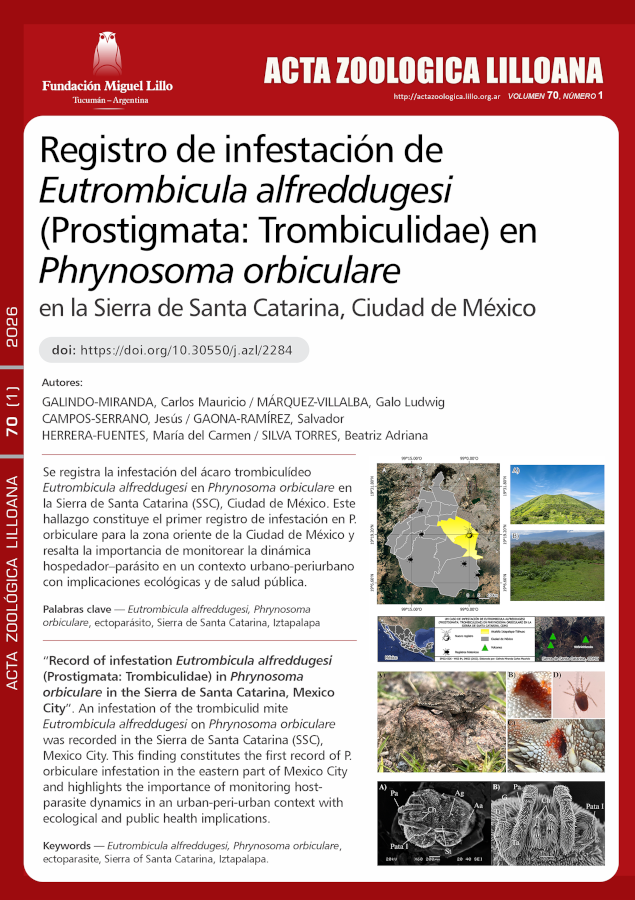
Se registra la infestación del ácaro trombiculídeo Eutrombicula alfreddugesi en Phrynosoma orbiculare en la Sierra de Santa Catarina (SSC), Ciudad de México. Durante la temporada de lluvias se capturaron cuatro ejemplares (dos machos y dos hembras, adultos y juveniles), todos parasitados por larvas de E. alfreddugesi. En total se recolectaron 106 larvas, principalmente en cuello, párpados y oídos. Los parámetros parasitológicos estimados mostraron una prevalencia del 100 % , una intensidad media de 26.5 larvas por hospedador y una abundancia media del mismo valor, debido a la ausencia de ejemplares libres de ectoparásitos. Los machos presentaron mayores cargas parasitarias que las hembras, lo que coincide con patrones reportados en otros reptiles. Este hallazgo constituye el primer registro de infestación en P. orbiculare para la zona oriente de la Ciudad de México y resalta la importancia de monitorear la dinámica hospedador–parásito en un contexto urbano-periurbano con implicaciones ecológicas y de salud pública.
Descargas
Citas
Arnold, E. (1986). Mite pockets of lizards, a possible means of reducing damage by ectoparasites. Biological Journal of Linnean Society, 29, 1–21. DOI: https://doi.org/10.1111/j.1095-8312.1986.tb01767.x
Bada-del Moral, M., Arenas, R., Bada-Pérez, M. P., González-Ramírez, M., & Vergara-Takahashi, L. (2015). Trombidiasis (“tlazahuate”) en Veracruz, México. Dermatología Revista Mexicana, 59(4), 233-237.
Bush, A. O., Lafferty, K. D., Lotz, J. M., & Shostak, A. W. (1997). Parasitology Meets Ecology on Its Own Terms: Margolis et al. Revisited. The Journal of Parasitology, 83(4), 575–583. https://doi.org/10.2307/3284227 DOI: https://doi.org/10.2307/3284227
Chaccour, C. J. (2005). Trombiculiasis: reporte de dos casos y revisión de la literatura. Dermatología Venezolana, 43(2), 18–21.
Ewing, H.E. (1938). A key to the genera of chiggers with descriptionsof new genera and species. The Journal of the Washington Academy of Sciences. 28:288–295.
Ewing, H. E. (1944). The Trombiculid Mites (Chigger Mites) and Their Relation to Disease. The Journal of Parasitology, 30(6), 339–365. https://doi.org/10.2307/3272686 DOI: https://doi.org/10.2307/3272686
Fuller HS. 1952. The mite larvae of the family Trombiculidae in the Oudemans collection: taxonomy and medical importance). Zoologische Verhandelingen. 18:1–261.
Gaceta Oficial del Distrito Federal. (2005, agosto 19). Acuerdo por el que se aprueba el programa de manejo del área natural protegida con carácter de zona de conservación ecológica “Sierra de Santa Catarina”. Gaceta Oficial del Distrito Federal.
Gadsden, H. E. (1988). Comparación altitudinal de ectoparásitos de lagartijas del complejo Sceloporus grammicus (Reptilia, Iguanidae) en la Sierra de Tepoztlán, Morelos, México. Acta Zoológica Mexicana (nueva serie), (30), 21–31. https://doi.org/10.21829/azm.1988.25301651 DOI: https://doi.org/10.21829/azm.1988.25301651
García-De la Peña, C. (2011). Eutrombicula alfreddugesi (Acari: Trombiculidae): New host records from four species of lizards in the Sierra de Jimulco, Coahuila, Mexico. The Southwestern Naturalist, 56(1), 131–133. https://doi.org/10.1894/JC-41.1 DOI: https://doi.org/10.1894/JC-41.1
García-De la Peña, C., A. Contreras-Balderas, G. Castañeda-G. & D. Lazcano. 2004. Infestación y distribución corporal de la nigua Eutrombiculida alfredduguesi (Acari: Trombiculidae) en el lacertilio de las rocas Sceloporus couchi (Sauria: Phrynosomatidae). Acta Zoológica Mexicana (nueva serie) 20:159-165 DOI: https://doi.org/10.21829/azm.2004.2022335
García-De la Peña, C., Gadsden, H., & Salas-Westphal, A.?I. (2010). Carga ectoparasitaria en la lagartija espinosa de Yarrow (Sceloporus jarrovii) en el Cañón de las Piedras Encimadas, Durango, México.?Interciencia, 35(10), 772–776.
García-Nolasco, D. P., Mora Collado, N., Serna Lagunes, R., Pérez León, R., Nuñez Pastrana, R., Romero Salas, D., & Tapia Maruri, D. (2024). ÁCAROS (ACARIFORMES: PROSTIGMATA) PARÁSITOS DE Sceloporus variabilis (REPTILIA: PHRYNOSOMATIDAE) EN LA ZONA DE LAS ALTAS MONTAÑAS, VERACRUZ, MÉXICO. Revista Latinoamericana De Herpetología, 7(4), e994 (144 – 155). https://doi.org/10.22201/fc.25942158e.2024.4.994 DOI: https://doi.org/10.22201/fc.25942158e.2024.4.994
García-Vázquez, U. O., y Méndez de la Cruz, F. (2016). Reptiles. En Comisión Nacional para el Conocimiento y Uso de la Biodiversidad & Secretaría del Medio Ambiente del Distrito Federal (Eds.), La biodiversidad en la Ciudad de México (pp. 390–397). CONABIO/SEDEMA.
González-Mondragón, É. A., y Arenas-Guzmán, R. (2021). Trombidiasis (trombiculiasis): revisión de una enfermedad común pero poco diagnosticada. Dermatología Cosmética, Médica y Quirúrgica, 19(4), 353–358.
Hoffmann, A. (1990). Los trombicúlidos de México (Acarida: Trombiculidae). Parte taxonómica (1.ª ed.). Universidad Nacional Autónoma de México, Instituto de Biología.
Hoffmann, A. (1990). Los trombicúlidos de México (Acarida: Trombiculidae). Publicaciones Especiales del Instituto de Biología, Universidad Nacional Autónoma de México, 2, 1–275.
Jenkins, D. W., 1947. A laboratory method of rearing chiggers affecting man (Acarina: DOI: https://doi.org/10.1093/aesa/40.1.56
Lareschi, M. (2017). Artrópodos ectoparásitos. En F. B. Drago (Ed.), Macroparásitos: Diversidad y biología (pp. 167–185). Editorial de la Universidad Nacional de La Plata. https://sedici.unlp.edu.ar/handle/10915/73986
Márquez-Villalba, G. L., B. E. Morales-Ríos, y M. Martínez-Coronel. (2024). EL RETO NATURALISTA: la UAM-I en el área natural protegida Sierra de Santa Catarina, CDMX. Cemanahuac, Nueva época 71:22-24.
Márquez-Villalba, G. L., et al. (2023). Actualización de la lista de mamíferos silvestres de la Sierra de Santa Catarina, Ciudad de México. Revista Mexicana de Mastozoología (Nueva Época) 13:12-23. DOI: https://doi.org/10.22201/ie.20074484e.2023.13.1.381
Márquez-Villalba, G. L., y Martínez-Coronel, M. (2025). El Tapayaxin: un emblemático reptil silvestre del oriente de la Ciudad de México. Herpetología Mexicana, 10, 1-8. https://doi.org/10.69905/ak8cx661 DOI: https://doi.org/10.69905/ak8cx661
May Uicab, D.?A. (2024). Ectoparasitismo por larvas del ácaro Eutrombicula alfreddugesi en cuatro especies de Anolis de la Península de Yucatán, México (Tesis de Maestría, El Colegio de la Frontera Sur, Unidad Chetumal). Repositorio institucional.
Mullen, G. R., and O'Connor, B. M. (2009). Mites (Acari). En G. R. Mullen & L. A. Durden (Eds.), Medical and Veterinary Entomology (2ª ed., pp. 433–492).
Olvera-Arrieta, J., Smith, G.?R., Woolrich-Piña, G.?A., Lemos-Espinal, J.?A., & Gadsden, H. (2022). Infestación de ácaros de dos especies de Xenosaurus (Squamata: Xenosauridae) de ambientes contrastantes. Naturalista de América del Norte Occidental, 82(2), 417–420. https://doi.org/10.3398/064.082.0215 DOI: https://doi.org/10.3398/064.082.0215
Oudemans, A.C. (1910) Acarologische aanteekeningen XXXIII. Entomol Ber 3:83–90 DOI: https://doi.org/10.5962/bhl.part.1133
Paredes-León, R., García-Prieto, L., Guzmán-Cornejo, C., León-Règagnon, V., & Pérez, T. M. (2008). Metazoan parasites of Mexican amphibians and reptiles. Zootaxa, 1904(1), 1–166. https://doi.org/10.11646/zootaxa.1904.1.1 DOI: https://doi.org/10.11646/zootaxa.1904.1.1
Paredes-León, R., García-Prieto, L., Guzmán-Cornejo, C., León-Règagnon, V., & Pérez, T. M. (2008). Metazoan parasites of Mexican amphibians and reptiles. Zootaxa, 1904(1), 1–166. https://doi.org/10.11646/zootaxa.1904.1.1 DOI: https://doi.org/10.11646/zootaxa.1904.1.1
Philip Samuel, P., Govindarajan, R., Krishnamoorthi, R., & Venkatesh, A. (2021). A rapid protocol for clearing, staining, and mounting of Arthropoda: Trombiculidae, Pediculidae and Pulicidae. North-Western Journal of Zoology, 17(1), 1–5. https://doi.org/10.24349/nwjz.e201104
Rózsa, L., J. Reiczigel & G. Majoros. 2000. Quantifying parasites in samples of hosts. Journal of Parasitology 86:228-232. DOI: https://doi.org/10.1645/0022-3395(2000)086[0228:QPISOH]2.0.CO;2
Trombiculidae). Ann. Ent. Soc. Amer. 40 (1): 56-68.
Wall, R. L., & Shearer, D. (2001). Veterinary ectoparasites: Biology, pathology and control (2nd ed.). Blackwell Science. DOI: https://doi.org/10.1002/9780470690505
Descargas
Publicado
Cómo citar
Número
Sección
Licencia
Derechos de autor 2026 Acta Zoológica Lilloana

Esta obra está bajo una licencia internacional Creative Commons Atribución-NoComercial-SinDerivadas 4.0.