New predatory interaction of Trichonephila clavipes (Araneae: Nephilidae) on Fidicinini (Hemiptera: Cicadidae) in a forest fragment of the Neotropical region
Autores
-
Hugo Yuri Elias Gomes de Assis
Superintendência de Administração do Meio Ambiente, Avenida Monsenhor Walfredo Leal 560, Tambiá 58020-540, João Pessoa, Paraíba, Brazil
 https://orcid.org/0000-0002-0610-8640
-
Silvio Felipe Barbosa Lima
Unidade Acadêmica de Ciências Exatas e da Natureza, Centro de Formação de Professores, Universidade Federal de Campina Grande, Rua Sergio Moreira de Figueiredo, Casas Populares 58900-000, Cajazeiras, Paraíba, Brazil
https://orcid.org/0000-0001-7892-5773
DOI:
 https://doi.org/10.30550/j.azl/2499
Palavras-chave:
Arachnida, Cicadoidea, Cicadinae, predator-prey interactions, zoophagous arthropodsResumo
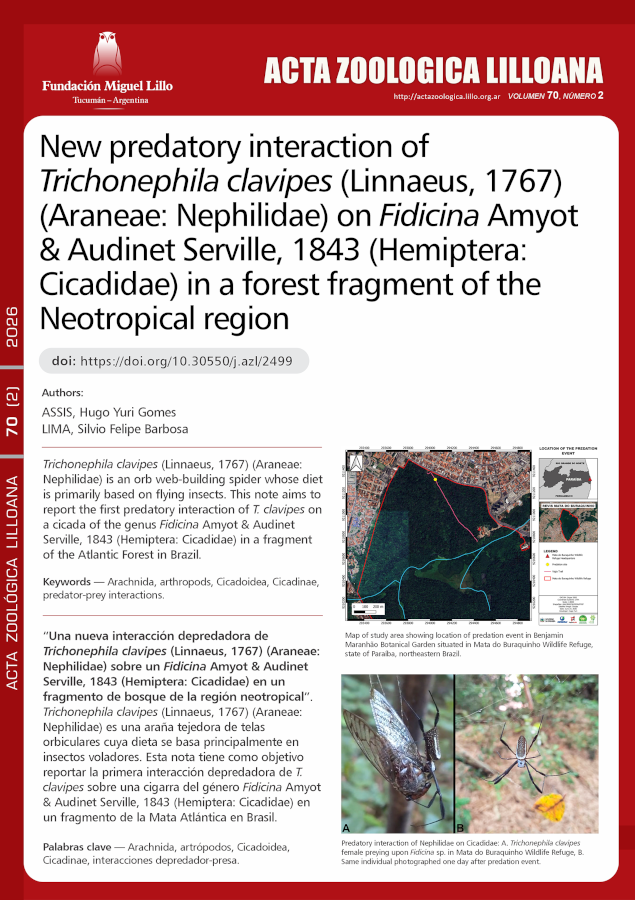
Trichonephila clavipes (Araneae: Nephilidae) is an orb web-building spider whose diet is primarily based on flying insects. This note aims to report the first predatory interaction of T. clavipes on a cicada of the genus Fidicina (Hemiptera: Cicadidae) in a fragment of the Atlantic Forest in Brazil. The predation event was observed (ad libitum) in the Benjamin Maranhão Botanical Garden situated in the Mata do Buraquinho Wildlife Refuge, northeastern Brazil. A specimen of Fidicina sp. was found freshly dead and trapped in the web of T. clavipes. The nephilid was observed moving slowly between the ventral and dorsal regions of the Fidicina sp. without weaving a web around the cicadid. Then, T. clavipes was observed perched on the left side of the Fidicina sp., with its pedipalps and chelicerae manipulating the thorax of the cicada. The spider had its second and third pairs of legs on the cicada, while the first and fourth pairs of legs were supported on the web. The spider always remained close to the cicada, without making any atypical movements even during the approach for observation and photographic recording or when the wind gently swayed the web. T. clavipes has a vital ecological role in controlling the population of flying insects. However, there are numerous aspects of the predatory interaction of T. clavipes that need further study, such as the insect richness that the species feeds on, as welll as the feeding behavior of the nephilid.
Downloads
Referências
Aoki, C., Lopes, F. S., Souza, F. L. (2010). Insecta, Hemiptera, Cicadidae, Quesada gigas (Olivier, 1790), Fidicina mannifera (Fabricius, 1803), Dorisiana viridis (Olivier, 1790) and Dorisiana drewseni (Stål, 1854): first records for the state of Mato Grosso do Sul, Brazil. Check List, 6, 162–163. https://doi.org/10.15560/6.1.192
Azevedo, A. K. M., Barbosa, M. R. V. (2026). Superárvores da Mata Atlântica na Paraíba: levantamento das maiores árvores presentes na Mata do Buraquinho e no Campus I da UFPB. pp 102–112. In: Vasconcellos, A., Ernesto, M. V., Alves, R. R. N., Pereira-Filho, G. A., Vieira, W. L. S. (Eds). Mata do buraquinho: história, ambiente, biodiversidade e conservação. Científica Digital. Barueri, Brazil. 374 p.
Barreto, M. R., Porfiro, J. M. (2015). Espécies de Carineta (Hemiptera: Cicadidae) no Estado de Mato Grosso, Brasil. EntomoBrasilis, 8(3), 246–248. https://doi.org/10.12741/ebrasilis.v8i3.523
Barton, P.S., Evans, M.J., Foster, C.N., Cunningham, S. A., Manning, A.D. (2017). Environmental and spatial drivers of spider diversity at contrasting microhabitats. Austral Ecology, 42, 700–710. https://doi.org/10.1111/aec.12488
Cardoso, P., Pekár, S., Birkhofer, K., Chuang, A., Fukushima, C.S., Hebets, E.A., Henaut, Y., Hesselberg, T., Malumbres-Olarte, J., Michálek, O., Michalko, R., Scott, C., Wolff, J., Mammola, S. (2025). Ecosystem services provided by spiders. Biological Reviews, 100, 2217–2236. https://doi.org/10.1111/brv.70044
Carvalho, L. S., Silva, I. S. S., Brescovit, A. D. (2026). Diversidade de Aracnídeos da Mata do Buraquinho, João Pessoa, Paraíba. pp 113–131. In: Vasconcellos, A., Ernesto, M. V., Alves, R. R. N., Pereira-Filho, G. A., Vieira, W. L. S. (2026). Mata do buraquinho: história, ambiente, biodiversidade e conservação. Científica Digital. Barueri, Brazil. 374 p.
Cazorla, D., Alarcón, M. (2025). Presencia de la araña de seda dorada Trichonephila clavipes (Linnaeus 1767) (Araneae: Araneidae: Nephilinae) en la sierra de San Luis (Estado Falcón) y Mérida (Estado Mérida), Venezuela. Revista Nicaragüense de Entomología, 373, 1–26. https://doi.org/10.5281/zenodo.14927736
Chakravarthy, A. K., Kammar, V., Shashank, P. R. (2016). Arthropods: Evolution and Ecology. pp 1–16. In: Chakravarthy, A., Sridhara, S. (Eds). Economic and Ecological Significance of Arthropods in Diversified Ecosystems. Springer. Singapore. 422 p. https://doi.org/10.1007/978-981-10-1524-3_1
Cubas-Rodriguez, A. M., Brescovit, A. D. (2024). Distribution of Trichonephila clavipes (Linnaeus, 1767) (Araneae: Araneidae) in Honduras. Revista Chilena de Entomología, 50(2), 193–199. https://doi.org/10.35249/rche.50.2.24.08
Custódio, R. H., Oliveira, G. C. S., Vilela, D. S., Souza, M. M. (2024). Use of cicada carcass caught in spider web as a food resource for the social wasp Agelaia pallipes (Olivier, 1791). Revista de Biologia Neotropical, 21(2), 77–81.
Feitosa, M. L. B., Lo-Man-Hung, N., Araujo Lira, A. F. (2025). Ecological dynamics of Trichonephila clavipes and its inquilines in an urban green area from submontane Neotropical rainforest. Biologia, 80, 2007–2013. https://doi.org/10.1007/s11756-025-01940-5
Gadelha Neto, P. C., Costa, P. R. A. M., Queiroz, R. T., Barbosa, M. R. V. (2026). Levantamento Florístico do Refúgio de Vida Silvestre Mata do Buraquinho. pp 63–90. In: Vasconcellos, A., Ernesto, M. V., Alves, R. R. N., Pereira-Filho, G. A., Vieira, W. L. S. (Eds). Mata do buraquinho: história, ambiente, biodiversidade e conservação. Científica Digital. Barueri, Brazil. 374 p.
Hébert, C. (2023). Forest Arthropod Diversity. pp 45–90. In: Allison, J. D., Paine, T.D., Slippers, B., Wingfield, M.J. (Eds). Forest Entomology and Pathology. Springer Cham. Switzerland. 810 p. https://doi.org/10.1007/978-3-031-11553-0_3
Kubota, M. M., MacCagnan, D. H. B., Pereira, N. A., Martinelli, N. M. (2011). Infestação de Quesada gigas (Olivier, 1790) (Hemiptera: Cicadidae) em plantas de cafeeiro. Biológico, 73(2), 307–310.
Lewthwaite, J. M. M., Baiotto, T. M., Brown, B. V., Cheung Y. Y., Baker A. J., Lehnen, C., McGlynn, T. P., Shirey, V., Gonzalez, L., Hartop, E., Kerr, P. H., Wood, E., Guzman, L. M. (2024). Drivers of arthropod biodiversity in an urban ecosystem. Scientific Reports, 14, 390. https://doi.org/10.1038/s41598-023-50675-3
Menezes, D. W. L., Souza, B. I. (2026). História Ambiental da Mata do Buraquinho: devastação e preservação de uma Floresta Urbana (1585-2014). pp 17–62. In: Vasconcellos, A., Ernesto, M. V., Alves, R. R. N., Pereira-Filho, G. A., Vieira, W. L. S. (Eds.). Mata do buraquinho: história, ambiente, biodiversidade e conservação. Científica Digital. Barueri, Brazil. 374 p.
Neto, E. M. C. (2008). As cigarras (Hemiptera: Cicadidae) na visão dos moradores do povoado de Pedra Branca, Bahia, Brasil. Boletín Sociedad Entomológica Aragonesa, 43, 453–457. https://doi.org/10.5281/zenodo.8420306
Nunes, V. L., Ruschel, T. P., Maccagnan, D. B. H., Simões, P. C., Acosta, R. C. (2023). Cigarras do Brasil. Guia Fotográfico. Ebook. 46 p. https://doi.org/10.5281/zenodo.7712483
Paraíba. (2025). Refúgio de Vida Silvestre da Mata do Buraquinho: Plano de Manejo. SUDEMA. João Pessoa, Brazil. 176 p.
Pereira Filho, G. A., Vieira, W. L. S., Alves, R. R. N., França, F. G. R. (2017). Serpentes da Paraíba: Diversidade e Conservação. João Pessoa, Brazil. 316 p.
Pereira, B. A., Ilha, C., Rosa, M. G., Brescovit, A. D., Pompeo, P. N., Oliveira Filho, L. C. I., Baretta, D., Rezende, R. S., Baretta, C. R. D. M. (2025). Intensification of land use in Neotropical environments determines loss of taxonomic and functional diversity of spiders. Agriculture, Ecosystems & Environment, 381, 109447. https://doi.org/10.1016/j.agee.2024.109447
Porto, L. M. V. (2025). First report of Trichonephila clavipes (Linnaeus, 1767) (Araneae: Araneidae) predation on an amphibian (Anura) in southern Brazil. Oecologia Australis, 29(2), 176–181. http://doi.org/10.4257/oeco.2025.2902.07
Ribeiro, R., Arantes Pereira, M. F., Martinelli, N. M., Bottura Maccagnan, D. H. (2006). Dispersão de Fidicinoides sp. (Hemiptera: Cicadidae) em cafeeiro. Científica, 34(2), 263–268. http://doi.org/10.15361/1984-5529.2006v34n2p263.
Robison, M. H., Mirick, H. (1971). The predatory behavior of the Golden-Web Spider Nephila clavipes (Araneae: Araneidae). Psyche, 78(3), 123–139.
Rodrigues, E. N. L., Rodrigues, P. E. S., Mendonça Jr., M. S. (2016). Spider species composition in the tree-shrub strata of riparian forests and its microhabitats in southern Brazil. Zoologia, 33(3), e20150102. https://doi.org/10.1590/S1984-4689zool-20150102
Rosenberg, Y., Bar-On, Y. M., Fromm, A., Ostikar, M., Shoshany, A., Giz, O., Milo, R. (2023). The global biomass and number of terrestrial arthropods. Science Advances, 9, eabq4049. https://doi.org/10.1126/sciadv.abq4049
Sanborn, A. (2008). Cicadas (Hemiptera: Cicadoidea). pp 874–877. In: Capinera, J.L. (Ed.). Encyclopedia of Entomology. Springer. Dordrecht, Netherlands. 2580 p. https://doi.org/10.1007/978-1-4020-6359-6_666
Sanborn, A. F., Zamar, M. I., Linares, M. A., Ortiz, F., Burgos, F., Farfán, C.M., D’Occio, M. (2024). Actualización de la diversidad de cigarras (Hemiptera: Cicadidae) de la provincia de Jujuy (República Argentina). Acta Zoológica Lilloana, 68(2), 515–523.
https://doi.org/10.30550/j.azl/2006
Santos, R. S., Martinelli, N. M. (2009). Descrição de Novas Espécies de Fidicinoides Boulard & Martinelli (Hemiptera: Cicadidae) do Brasil. Neotropical Entomology, 38(5), 638–642.
Seymour, M., Roslin, T., deWaard, J. R., Perez, K. H. J., Souza, M. L. D., Ratnasingham, S.,..., Hebert, P. D. N. (2024). Global arthropod beta-diversity is spatially and temporally structured by latitude. Communications Biology, 7, 552. https://doi.org/10.1038/s42003-024-06199-1
Sharma, L. (2023). Sampling Methodology to Study Terrestrial Arthropods Biodiversity. International Journal of Innovative Science and Research Technology, 8(10), 100–105. https://doi.org/10.5281/zenodo.10002711
Shirai, L. T., Mota, L. L., Sarno, L. P., Madureira, A. F., Bonifácio, L. S., Oliveira, E. M. (2024). Scientific Note: Predation of Morpho helenor (Cramer, 1776) by Trichonephila clavipes (Linnaeus, 1767) (Nephilidae, Arachnida). Tropical Lepidoptera Research, 34(1), 60–62.
Silva, I. H., Oliveira, G. C. S., Souza, M. M. (2023) Social wasps captured by the spider Trichonephila clavipes (L.) in anthropogenic environments associated with Atlantic Forest fragments in southern Minas Gerais, Brazil. Acta Brasiliensis, 7(3), 99–101. https://doi.org/10.22571/2526-4338668
Simões, P. C., Sanborn, A., Quartau, J.A. (2013). New species of Cicadatra from Greece. Entomological Science, 16, 83–90. https://doi.org/10.1111/j.1479-8298.2012.00540.x
Vasconcellos, A., Ernesto, M. V., Alves, R. R. N., Pereira-Filho, G. A., Vieira, W. L. S. (2026). Mata do buraquinho: história, ambiente, biodiversidade e conservação. Científica Digital. Barueri, Brazil. 374 p.
Weems Jr., H. V., Edwards Jr., G. B. (2024). Golden Silk Spider, Trichonephila clavipes (Linnaeus) (Arachnida: Araneae: Tetragnathidae). Askifas. Gainesville, USA. Available at: https://ask.ifas.ufl.edu/publication/IN467 (accessed on 26/07/2026).
Downloads
Publicado
Como Citar
Edição
Seção
Licença
Copyright (c) 2026 Acta Zoológica Lilloana

Este trabalho está licenciado sob uma licença Creative Commons Attribution-NonCommercial-NoDerivatives 4.0 International License.