Otimização do Monitoramento de Moscas-das-Frutas Tefritídeas Baseado em Atrativos: Perspectivas sobre Desempenho de Armadilhas, Tendências Sazonais e Composição de Espécies em Bangladesh
Autores
-
Nayma Akter
Department of Zoology, Jahangirnagar University, Savar, Dhaka-1342, Bangladesh
 https://orcid.org/0009-0009-5506-2675
-
Sumita Rani Das
Department of Zoology, Jahangirnagar University, Savar, Dhaka-1342, Bangladesh
https://orcid.org/0009-0005-6889-3196
-
Md. Towhidur Rahman
Department of Zoology, Jahangirnagar University, Savar, Dhaka-1342, Bangladesh
https://orcid.org/0009-0007-4296-5213
-
M. Aftab Hossain
Insect Biotechnology Division, Institute of Food and Radiation Biology, Bangladesh Atomic Energy Commission, Dhaka-1349, Bangladesh
https://orcid.org/0009-0009-7502-502X
-
Abu Faiz Md. Aslam
Department of Zoology, Jahangirnagar University, Savar, Dhaka-1342, Bangladesh
https://orcid.org/0000-0001-5248-3946
DOI:
 https://doi.org/10.30550/j.azl/2291
Palavras-chave:
Metil eugenol, Cue-lure, Eficácia do atrativo, Monitoramento de moscas-das-frutasResumo
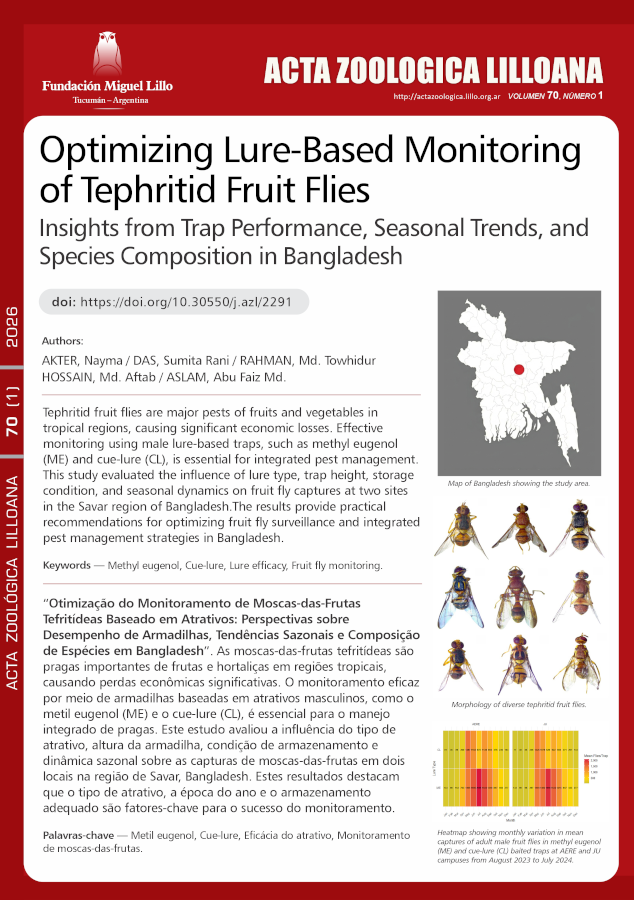
As moscas-das-frutas tefritídeas são pragas importantes de frutas e hortaliças em regiões tropicais, causando perdas econômicas significativas. O monitoramento eficaz por meio de armadilhas baseadas em atrativos masculinos, como o metil eugenol (ME) e o cue-lure (CL), é essencial para o manejo integrado de pragas. Este estudo avaliou a influência do tipo de atrativo, altura da armadilha, condição de armazenamento e dinâmica sazonal sobre as capturas de moscas-das-frutas em dois locais (AERE e Universidade de Jahangirnagar) na região de Savar, Bangladesh. Armadilhas ME e CL foram instaladas em três alturas (2, 3 e 5 pés) durante um período de um ano (agosto de 2023-julho de 2024). Um total de 36.107 machos foi registrado, representando nove espécies dos gêneros Bactrocera, Dacus e Zeugodacus. As armadilhas com ME capturaram significativamente mais machos do que as com CL (p < 0,05), confirmando forte seletividade do atrativo — B. dorsalis e B. zonata predominaram nas capturas com ME, enquanto Z. cucurbitae e Z. tau foram mais frequentes nas com CL. A altura da armadilha não influenciou significativamente as capturas, indicando que a instalação a cerca de 1-1,5 m é adequada para o monitoramento. A abundância das moscas atingiu o pico no verão (junho-julho) e diminuiu no inverno (dezembro-fevereiro), refletindo a influência climática na atividade populacional. O armazenamento a 4°C prolongou significativamente a eficácia dos atrativos. Estes resultados destacam que o tipo de atrativo, a época do ano e o armazenamento adequado são fatores-chave para o sucesso do monitoramento.
Downloads
Referências
Ahmad, A., Saraswat, D., & El Gamal, A. (2023). A survey on using deep learning techniques for plant disease diagnosis and recommendations for development of appropriate tools. Smart Agricultural Technology, 3, 100083. https://doi.org/10.1016/j.atech.2022.100083 DOI: https://doi.org/10.1016/j.atech.2022.100083
Bausin, C. A., Sampiano, K. F. S., Bayang, S. S., Aceres, L. V., & Sibongga, L. M. A. (2024). Effects of trap height on the capture of Bactrocera spp. (Diptera: Tephritidae) in mango orchard of Tagum City, Davao del Norte, Philippines. Current Applied Science and Technology, e0257143. DOI: https://doi.org/10.55003/cast.2024.257143
Chambers, D. L. (1977). Quality control in mass rearing. Annual Review of Entomology, 22(1), 289–308. DOI: https://doi.org/10.1146/annurev.en.22.010177.001445
Clarke, A. R., Li, Z. H., Qin, Y. J., Zhao, Z. H., Liu, L. J., & Schutze, M. K. (2019). Bactrocera dorsalis (Hendel) (Diptera: Tephritidae) is not invasive through Asia: It’s been there all along. Journal of Applied Entomology, 143(8), 797–801. DOI: https://doi.org/10.1111/jen.12649
Dhillon, M. K., Singh, R., Naresh, J. S., & Sharma, H. C. (2005). The melon fruit fly, Bactrocera cucurbitae: A review of its biology and management. Journal of Insect Science, 5(1), 40. https://doi.org/10.1093/jis/5.1.40 DOI: https://doi.org/10.1093/jis/5.1.40
Doorenweerd, C., Leblanc, L., Norrbom, A. L., San Jose, M., & Rubinoff, D. (2018). A global checklist of the 932 fruit fly species in the tribe Dacini (Diptera, Tephritidae). ZooKeys, 730, 19–56. https://doi.org/10.3897/zookeys.730.21786 DOI: https://doi.org/10.3897/zookeys.730.21786
Drew, R. A., & Romig, M. C. (2013). Tropical fruit flies (Tephritidae: Dacinae) of South-East Asia: Indomalaya to North-West Australasia. CABI. DOI: https://doi.org/10.1079/9781780640358.0000
Hiramoto, M. K., Arita-Tsutsumi, L., & Jang, E. B. (2006). Test of effectiveness of newly formulated plastic matrix with methyl eugenol for monitoring Bactrocera dorsalis (Hendel) populations. Proceedings of the Hawaiian Entomological Society, 38, 103–110.
Holbrook, F. R., & Fujimoto, S. M. (1969). Mediterranean fruit flies and melon flies trapped at various heights with synthetic lure. Journal of Economic Entomology, 62(4), 962–963. DOI: https://doi.org/10.1093/jee/62.4.962
Hossain, M. A., Leblanc, L., Momen, M., Bari, M. A., & Khan, S. A. (2019). Seasonal abundance of economically important fruit flies (Diptera: Tephritidae: Dacinae) in Bangladesh, in relation to abiotic factors and host plants. Proceedings of the Hawaiian Entomological Society, 52, 25–37.
Hossain, M. A., Norrbom, A. L., Leblanc, L., Hossain, M. F., & Seheli, K. (2024). New country records and annotated checklist of non-Dacini Tephritidae (Diptera) in Bangladesh. Insecta Mundi, 1077, 1–13.
Krosch, M. N., Schutze, M. K., Armstrong, K. F., Graham, G. C., Yeates, D. K., & Clarke, A. R. (2012). A molecular phylogeny for the tribe Dacini (Diptera: Tephritidae): Systematic and biogeographic implications. Molecular Phylogenetics and Evolution, 64(3), 513–523. https://doi.org/10.1016/j.ympev.2012.05.006 DOI: https://doi.org/10.1016/j.ympev.2012.05.006
Leblanc, L., Hossain, M. A., Doorenweerd, C., Khan, S. A., Momen, M., San Jose, M., & Rubinoff, D. (2019). Six years of fruit fly surveys in Bangladesh: A new species, 33 new country records and discovery of the highly invasive Bactrocera carambolae (Diptera: Tephritidae). ZooKeys, 876, 87–109. https://doi.org/10.3897/zookeys.876.38096 DOI: https://doi.org/10.3897/zookeys.876.38096
Leblanc, L., Hossain, M. A., Momen, M., & Seheli, K. (2021). New country records, annotated checklist and key to the dacine fruit flies (Diptera: Tephritidae: Dacinae: Dacini) of Bangladesh. Insecta Mundi, 0880, 1–56.
Madhura, H. S., & Viraktamath, C. A. (2001). Selection of fruit flies (Diptera: Tephritidae) traps at different heights. In Proceedings of the 2nd National Symposium on Integrated Pest Management in Horticultural Crops (pp. 29–30). Bangalore, India.
Naqvi, M. H. (2005). Management and quality assurance of fruits and vegetables for export: Needs for product-to-market approach. In Use of irradiation for quarantine treatment of fresh fruits and vegetables (pp. 14–24). Dhaka, Bangladesh.
Oksanen, J., Simpson, G. L., Blanchet, F. G., Kindt, R., Legendre, P., Minchin, P. R., … Wagner, H. (2022). vegan: Community ecology package (Version 2.6-4) [R package]. https://CRAN.R-project.org/package=vegan
R Core Team. (2025). R: A language and environment for statistical computing (Version 4.5.0) [Computer software]. R Foundation for Statistical Computing.
Reddy, P. V. R., Mani, M., & Rashmi, M. A. (2022). Pests and their management in mango. In Trends in horticultural entomology (pp. 519–550). DOI: https://doi.org/10.1007/978-981-19-0343-4_16
Shelly, T. E., Fezza, T. J., & Martin, R. M. (2024). Field longevity of methyl eugenol and cue-lure plugs and associated insecticidal strips: Captures of Bactrocera dorsalis and Zeugodacus cucurbitae (Diptera: Tephritidae) in Hawaii. Environmental Entomology, 53(5), 782–788. DOI: https://doi.org/10.1093/ee/nvae064
Siddiqui, Q., Ahmed, N., Shah Rashdi, S. M. M., & Niazi, S. (2003). Effect of time of the day and trap height on the catches of Bactrocera zonata through male annihilation technique. Asian Journal of Plant Sciences, 2(2), 228–232. DOI: https://doi.org/10.3923/ajps.2003.228.232
Sivinski, J., & Calkins, C. O. (1986). Pheromones and parapheromones in the control of tephritids. Florida Entomologist, 69(1), 157–168. DOI: https://doi.org/10.2307/3494757
Tan, K. H. (1984). Description of a new attractant trap and effect of placement height on catches of two Dacus species (Diptera: Tephritidae). Journal of Plant Protection in the Tropics, 1, 117–120.
Tan, K. H., & Nishida, R. (2012). Methyl eugenol: Its occurrence, distribution, and role in nature, especially in relation to insect behavior and pollination. Journal of Insect Science, 12(1), 56. DOI: https://doi.org/10.1673/031.012.5601
Vargas, R. I., Burns, R. E., Mau, R. F., Stark, J. D., Cook, P., & Piñero, J. C. (2009). Captures in methyl eugenol and cue-lure detection traps with and without insecticides and with a solid lure–insecticide dispenser. Journal of Economic Entomology, 102(2), 552–557. DOI: https://doi.org/10.1603/029.102.0212
Vargas, R. I., Shelly, T. E., Leblanc, L., & Pinero, J. C. (2010). Recent advances in methyl eugenol and cue-lure technologies for fruit fly detection, monitoring, and control in Hawaii. Vitamins & Hormones, 83, 575–595. DOI: https://doi.org/10.1016/S0083-6729(10)83023-7
Downloads
Publicado
Como Citar
Edição
Seção
Licença
Copyright (c) 2026 Acta Zoológica Lilloana

Este trabalho está licenciado sob uma licença Creative Commons Attribution-NonCommercial-NoDerivatives 4.0 International License.