Gynandry and intersexuality in spiders: half a century onwards
Gynandry and intersexuality in spiders
Autores
-
Danniella Sherwood
Department of Biology, Faculty of Mathematics and Natural Sciences, University of Prishtina, Mother Teresa Street p.n., 10000 Prishtinë, Republic of Kosovo.
 https://orcid.org/0000-0001-8170-9529
-
Galina N. Azarkina
Laboratory of Systematics of Invertebrate Animals, Institute of Systematics and Ecology of Animals, Siberian Branch of the Russian Academy of Sciences, Frunze Street 11, Novosibirsk 630091, Russia
https://orcid.org/0000-0002-9328-3913
DOI:
 https://doi.org/10.30550/j.azl/2287
Palavras-chave:
anomaly, Araneae, gynandromorph, sex, teratologyResumo
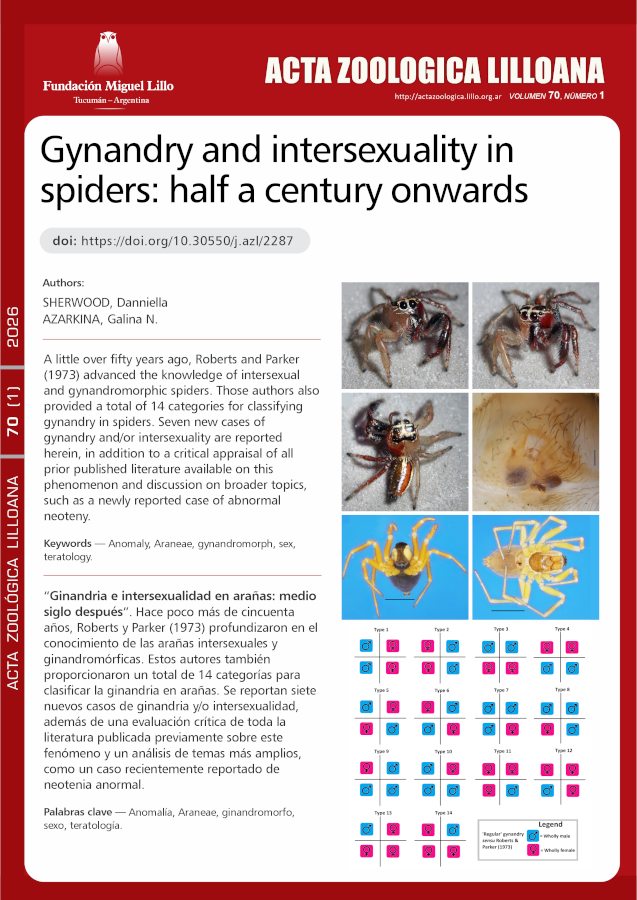
A little over fifty years ago, Roberts & Parker (1973) advanced the knowledge of intersexual and gynandromorphic spiders. Those authors also provided a total of 14 categories for classifying gynandry in spiders. Eight new cases of gynandry and/or intersexuality are reported herein, in addition to a critical appraisal of all prior published literature available on this phenomenon and discussion on broader topics, such as a newly reported case of abnormal neoteny.
Downloads
Referências
Allard, C., Robertson, M. W. (2003). Nematode and dipteran endoparasites of the wolf spider Pardosa milvina (Araneae, Lycosidae). Journal of Arachnology, 31, 139–141. DOI: https://doi.org/10.1636/0161-8202(2003)031[0139:NADEOT]2.0.CO;2
Alvarenga, A. da S. de, Magalhaes, I. L. F., Fonseca, R. N. de, Pérez-González, A. (2020). Rectifying the identities of the males of two Micrathena species (Araneae: Araneidae), with report of the first case of intersexuality in the genus. Zootaxa, 4808(1), 151–164. DOI: https://doi.org/10.11646/zootaxa.4808.1.9
Anderson, J. F. (1961). A gynandromorphic crab spider. Bulletin of the Brooklyn Entomological Society, 56, 100–102.
Armas, L. F. de. (1990). Dos casos de anomalía sexual en escorpiones cubanos (Scorpiones: Buthidae). Ciencias Biológicas, 21–22, 173–175.
Assmuth, W. (1983). Ein Fall von Gynandromorphismus bei Oedothorax apicatus (Blackwall) (Arachnida, Araneae). Hessische Faunistische Briefe, 3, 9–14.
Baba, Y. G., Suguro, T., Naya, N., Yamauchi, T. (2016). A gynandromorph of the funnel-web spider Allagelena opulenta (Araneae: Agelenidae). Acta Arachnologica, 65(1), 11–13. DOI: https://doi.org/10.2476/asjaa.65.11
Baert, L. (1975). Four gynandromorph and intersexual Linyphiid spiders for Belgium. Biologisch Jaarboek Dodonaea, 43, 58–62.
Baert, L. (1976). Nieuwe intersexuele spin voor België: Gonatium rubellum (Blackw.). Bulletin et Annales de la Société royale belge d’Entomologie, 112, 203–207.
Balogh, I. J. (1936). Über eine neue gynandromorphe Spinne, Philaeus chrysops (Poda). Folia zoologica et hydrobiologica, 9(1), 67–68.
Brændegaard, J. (1925). A case of lateral hermaphroditism in a spider, Lycosa pullata Cl. . Entomologiske Meddelelser, 16, 13.
Bednarz, S., Czajka, M. (1975). A case of gynandromorphism in Oedothorax agrestis (Blackwall, 1853) (Micryphantidae). Zoologica Poloniae, 24(3/4), 385–391.
Bertkau, P. (1888). Zwitter von Gastropacha Quercus vor und berichtete uber die Untersuchung von dessen Geschlechtsorganen. Verhandlungen des naturhistorischen Vereines der preussischen Rheinlande, 45, 68.
Bertkau, P. (1889a). Untersuchungen der Geschlechtsorgane eines Arthropodenzwitters. Verhandlungen des naturhistorischen Vereines der preussischen Rheinlande, 48, 49–50.
Bertkau, P. (1889b). Beschreibung eines Zwitters von Gastropacha Quercus nebst allgemeinen Bemerkungen und einem Verzeichnis der beschriebenen Arthropodenzwitter. Archiv für Naturgeschichte, 55(1), 7–116.
Bertkau, P. (1891). Beschreibung eines Arthropodenzwitters. Archiv für Naturgeschichte, 57, 229–238.
Blackwall, J. (1867). Description of several species of East Indian spiders apparently new or little known to arachnologists. Annals and Magazine of Natural History, 19(3), 387–394. DOI: https://doi.org/10.1080/00222936708562695
Blaszak, C. (1968). Badania nad interseksami u kosarzy (Opiliones). Polskie Pismo Entomologiczne, 38(1), 9–27.
Breitling, R., Lemke, M., Bauer, T., Hohner, M., Grabolle, A., Blick, T. (2015). Phantom spiders: notes on dubious spider species from Europe. Arachnologische Mitteilungen, 50, 65–80. DOI: https://doi.org/10.5431/aramit5010
Bonnet, P. (1934). La Gynandromorphisme chez les Araignées. Bulletin Biologique de la France et de la Belgique, 68(2), 167–187.
Budrien?, A., Budrys, E., Orlovskyt?, S. (2021). A bilateral gynandromorph of Discoelius dufourii (Hymenoptera, Vespidae, Zethinae): morphology and mating behaviour. Journal of Hymenoptera Research, 81, 23–41. DOI: https://doi.org/10.3897/jhr.81.61550
Cavignato, T. C., Duarte, M. (2009). A bilateral gynandromorph of Periga falcata (Walker 1855) (Lepidoptera: Saturniidae: Hemileucinae). Proceedings of the Entomological Society of Washington, 111(1), 276–279. DOI: https://doi.org/10.4289/0013-8797-111.1.276
Chemini, C. (1984). Andromorphy in a female of Nemastoma dentigerum Canestrini (Opiliones) from northern Italy. Newsletter of the British Arachnological Society, 40, 56.
Cokendolpher, J. C., Enríquez, T. (2004). A new species and records of Pseudocellus (Arachnida: Ricinulei: Ricinoididae) from caves in Yucatán, Mexico and Belize. Texas Memorial Museum, Speleological Monographs, 6, 95–99.
Cooper, A. E. (1975). Further examples of gynandry and intersexuality in spiders. Newsletter of the British Arachnological Society, 15(6), 5–6.
Deichmann, E. (1920). Note sur un cas de Hermaphroditisme lateral chez une Araignée. Entomologiske Meddelelser, 13, 181–182.
Delle Cave, L. (1979). On a remarkable Galeodes barbarus (Lucas) from Ethiopia (Arachnida, Solifugae). Bulletin of the British Arachnological Society, 4(9), 396–397.
Denis, J. (1947). Une curieuse anomalie sexuelle chez une araignée. Bulletin de la Société Entomologique de France, 52(3), 41–43. DOI: https://doi.org/10.3406/bsef.1947.15944
Denis, J. (1949). Un nouveau cas d'anomalie sexuelle chez une araignée. Bulletin mensuel de la Société linnéenne de Lyon, 18(6), 126–127. DOI: https://doi.org/10.3406/linly.1949.8562
Downie, I. (2006). Parasitic hairworms and spiders. Newsletter of the British Arachnological Society, 105, 8.
Emerton, J. H. (1907). A female spider with one male palpus. Psyche, 14, 40. DOI: https://doi.org/10.1155/1907/98763
Exline, H. (1938). Gynandromorph spiders. Journal of Morphology, 63(3), 441–475. DOI: https://doi.org/10.1002/jmor.1050630303
Falconer, W. (1910). Abnormality in spiders. The Naturalist, 199–203, 229–232.
Falconer, W. (1917). Abnormal spiders. The Naturalist, 232–233.
Francke, O. F. (1978). Systematic revision of diplocentrid scorpions (Diplocentridae) from Circum Caribbean Lands. Special Publications of The Museum of Texas Tech University, 14, 1–92. DOI: https://doi.org/10.5962/bhl.title.156481
Fusco, G., & Minelli, A. (2023). Descriptive versus causal morphology: gynandromorphism and intersexuality. Theory in Biosciences, 142, 1–11. DOI: https://doi.org/10.1007/s12064-023-00385-1
Gack, C., & von Helversen, O. (1976). Zum Verhalten einer gynandromorphen Wolfspinne (Arachnida: Araneae: Lycosidae). Entomologica Germanica, 3, 109–118. DOI: https://doi.org/10.1127/entom.germ/3/1976/109
Galiano, M. E. (1985). Un caso de ginandria combinado con intersexualidad en Phiale gratiosa Cl. L. Koch, 1846, (Araneae, Salticidae). Revista de la Sociedad Entomológica Argentina, 44(3/4), 399–402.
Gertsch, W. J. (1934). Some American spiders of the family Hahniidae. American Museum Novitates, (712), 1–32.
Gnelista, V. A. (2005). About abnormalities in the development of genitalia in Linyphiidae spiders. Vestnik zoologii, 39(5), 75–77. [In Russian]
Hackman, W. (1952). A gynandromorph of the spider Troxochrus scabriculus Westr. Memoranda Societatis pro Fauna et Flora Fennica, 27, 67–69.
Hadjissaranos, C. (1951). Sur une case d'araignée gynandromorphe. Akadamia Antheon Praktica, 24, 296–303.
Harvey, M. S. (1982). A parasitic nematode (Mermithidae) from the pseudoscorpion “Sternophorus” hirsti Chamberlin (Sternophoridae). Journal of Arachnology, 10(2), 192.
Harvey, P. R., Nellist, D. R., & Telfer, M. G. (2002). Provisional atlas of British spiders (Arachnida, Araneae), Volumes 1 & 2. Biological Records Centre.
Heimer, S. (1978). Über bemerkenswerte Spinnenfunde im Kreis Eisenach (Arachnida, Araneae). Beiträge zur Spinnenfauna der DDR, III. Faunistische Abhandlungen, Staatliches Museum für Tierkunde, Dresden, 7, 19–22.
Holm, Å. (1941). Über Gynandromorphismus und Intersexualität bei den Spinnen. Zoologiska Bidrag från Uppsala, 20, 397–415.
Huber, B. A., Sinclair, B. J., & Schmitt, M. (2007). The evolution of asymmetric genitalia in spiders and insects. Biological Reviews of the Cambridge Philosophical Society, 82(4), 647–698. DOI: https://doi.org/10.1111/j.1469-185X.2007.00029.x
Huber, B. A. (2022). Revisions of Holocnemus and Crossopriza: the spotted-leg clade of Smeringopinae (Araneae, Pholcidae). European Journal of Taxonomy, 795, 1–241. DOI: https://doi.org/10.5852/ejt.2022.795.1663
Hull, J. E. (1911). New and rare British spiders. Transactions of the Natural History Society of Northumberland (N.S.), 4(1), 42–58.
Hull, J. E. (1918). Gynandry in Arachnida. Journal of Genetics, 7(8), 171–181.
Iida, H., & Hasegawa, H. (2003). First record of a mermithid nematode emerging from the wolf spider Pardosa pseudoannulata (Araneae: Lycosidae). Acta Arachnologica, 52(2), 77–78. DOI: https://doi.org/10.2476/asjaa.52.77
Jackson, A. R. (1907a). A contribution to the spider fauna of the county of Glamorgan. Report & Transactions of the Cardiff Naturalists' Society, 39, 63–77.
Jackson, A. R. (1907b). The spiders of the Tyne valley. Transactions of the Natural History Society of Northumberland, Durham, and Newcastle-upon-Tyne (N.S.), 1(3), 337–405.
Jackson, A. R. (1909). On some rare arachnids obtained during 1908. Transactions of the Natural History Society of Northumberland, Durham, and Newcastle-upon-Tyne (N.S.), 3(2), 418–439, plates 10.
Jackson, A. R. (1924). On new and rare British Spiders. Proceedings of the Dorset Natural History and Antiquarian Field Club, 45, 101–120.
Janssen, M. (1987). Een geval van gynandromorfie bij spinnen: Peponocranium ludicrum (O.P.-Cambridge) (Arachnida, Araneae, Erigonidae). Natuurhistorisch Maandblad, 76(6/7), 118–119.
Kaston, B.J. (1961). Spider Gynandromorphs and Intersexes. Journal of the New York Entomological Society, 69, 177–190.
Knulle, W. (1954). Gynandromorphie bei Erigone vagans spinosa Cambr. (Micryphantidae: Araneae). Zoologischer Anzeiger, 152, 219–227.
Kolosváry, G. (1935). Die Spinnenbiosphäre des ungarländischen Pannonbeckens, III. Acta Literaria Scientia Universalis Hungarica, 5 (Acta biol., 3), 134–144.
Kostro-Ambroziak, A., Jab?o?ska, U., ?wis?ocka, M., Wi?niewski, K., Kupryjanowicz, J. (2024). New mermithid nematode-spider associations, along with a molecular phylogeny of mermithids hosted in spiders. European Zoological Journal, 91(1), 590–600. DOI: https://doi.org/10.1080/24750263.2024.2348708
Krumpalova, Z. (1999). A case of gynandromorph spider (Araneae, Liocranidae) in Slovakia. Revue Arachnologique, 13(4), 61–67.
Kulczy?ski, W. (1885). Potworek Obojnakowy Pajaka Erigone fusca Blackw. Rozprawy i Sprawozdania z Posiedze? Wydzia?u Matematyczno-Przyrodniczego Akamemii Umiej?tno?ci, 14, 169–180.
Kumada, K. (1989). A gynandromorph of the theridiid spider, Episinus nubilus Yaginuma, from Japan. In Y. Nishikawa & H. Ono (Eds.), Arachnological Papers Presented to Takeo Yaginuma on the Occasion of his Retirement (pp. 39–41). Osaka: Arachnologists' Group Osaka.
Kunsete, C., Thanoosing, C., Sivayyapram, V., Traiyasut, P. & Warrit, N. (2025). New insights into Damarchus: a new species and gynandromorph description from Thailand (Araneae: Bemmeridae). Zootaxa 5696(3): 409–424. DOI: https://doi.org/10.11646/zootaxa.5696.3.6
Laborda, A., Pérez-Miles, F. (2017). The first case of gynandry in Mygalomorphae: Pterinochilus murinus, morphology and comments on sexual behavior. Journal of Arachnology, 45, 235–237. DOI: https://doi.org/10.1636/JoA-S-049.1
Leech, R.E. (1966). The spiders (Araneida) of Hazen Camp 81°49'N, 71°18'W. Quaestiones entomologicae, 2(2), 153–208.
Machado, A. de B. (1951). Ochyroceratidae (Araneae) de l'Angola. Publicações Culturais da Companhia de Diamantes de Angola, 8, 1–88.
Mackie, D.W. (1969). A gynandromorph lycosid Spider. Bulletin of the British Arachnological Society, 1(3), 40–41.
Maekawa, T., Ikeda, H. (1992). Sexual behaviour of a gynandromorphic spider of Carrhotus xanthogramma (Araneae: Salticidae). Acta Arachnologica, 41, 103–108. DOI: https://doi.org/10.2476/asjaa.41.103
Martens, A., Wildermuth, H. (2021). Gynandromorphism and intersexuality in Odonata: a review. Odonatologica, 50(1–2), 65–80.
Martin, D. (2013). Aberrante Epigynenbildungen bei der Wolfspinne Pardosa palustris (Araneae, Lycosidae). Arachnologische Mitteilungen, 46, 1–5. DOI: https://doi.org/10.5431/aramit4601
Marusik, Y.M., Koponen, S. (2001). Spiders of the family Zodariidae from Mongolia (Arachnida: Araneae). Reichenbachia, 34, 39–48.
Matthiesen, F.A. (1968). On the male reproductive organs in some Brazilian scorpions. Revista Brasileira de Pesquisas Médicas e Biológicas, 1(5–6), 273–274.
Mattoni, C.I. (2005). Tergal and sexual anomalies in bothriurid scorpions (Scorpiones, Bothriuridae). Journal of Arachnology, 33, 622–628. DOI: https://doi.org/10.1636/04-125.1
Maury, E.A. (1983). Singular anomalía sexual en un ejemplar de Brachistosternus pentheri Mello-Leitão 1931 (Scorpiones, Bothriuridae). Revista de la Sociedad Entomológica Argentina, 42(1–4), 155–156.
Mcheidze, T.S. (1967). A case of gynandromorphism of Agelena labyrinthica (CL.) (Agelenidae). Zoologicheskii Zhurnal, 46(2), 294–296. (in Russian).
Meyer, M. (2014). New record of a parasitoid worm (Mermithidae, Nematoda) in a spider of the genus Trochosa (Lycosidae). Arachnologische Mitteilungen, 48, 13–15. DOI: https://doi.org/10.5431/aramit4803
Millidge, A.F. (1991). Further linyphiid spiders (Araneae) from South America. Bulletin of the American Museum of Natural History, 205, 1–199.
Nishikawa, Y. (1971). A gynandromorph spider, Oxytata striatipes L. Koch from Japan. Acta Arachnologica, 23(2), 26–28. DOI: https://doi.org/10.2476/asjaa.23.26
Noordam, A. (2021). European Acroceridae – new host records, modified epigynes and the British isolation. Newsletter of the British Arachnological Society, 150, 10–14.
Müller, H.G. (1984). Gynandromorphismus und Intersexualität bei Spinnen und Insekten, mit einer Beschreibung von Genitalanomalien bei Micrargus herbigradus und Erigone (atra?) (Arachnida: Araneida: Linyphiidae). Entomologische Zeitschrift, 94(14), 199–208.
Okumura, K. (2019). Unexpected pitfalls in spider identification. Kishidaia, 115, 95–96. DOI: https://doi.org/10.31714/KOSMOS.2019.05
Okumura, K. (2020). Examples of deformed specimens of coelotine spiders. Kishidaia, 117, 1–3.
Palmgren, P. (1979). On the frequency of gynandromorphic spiders. Annales Zoologici Fennici, 16, 183–185.
Parker, J.R., Roberts, M.J. (1974). Internal and external parasites of the spider Pardosa hortensis (Thorell) (Araneae: Lycosidae). Bulletin of the British Arachnological Society, 3(3), 82–84.
Penney, D., Bennett, S.P. (2006). First unequivocal mermithid-linyphid (Araneae) parasite-host association. Journal of Arachnology, 34, 273–278. DOI: https://doi.org/10.1636/S04-92.1
Pewtress, J. (2021). A gynandromorph Gonatium rubens. Newsletter of the British Arachnological Society, 150, 14–15.
Pickard-Cambridge, O. (1903). On new and rare British Arachnida. Proceedings of the Dorset Natural History and Antiquarian Field Club, 23(1902), 16–40, pl. 1.
Pickard-Cambridge, O. (1913). On new and rare British arachnids noted and observed in 1912. Proceedings of the Dorset Natural History and Antiquarian Field Club, 34, 107–136.
Poinar, G. O. Jr. (1985). Mermithid (Nematoda) parasites of spiders and harvestmen. Journal of Arachnology, 13, 121–128.
Poinar, G. O. Jr., ?ur?i?, B. P. M. (1992). Parasitism of pseudoscorpions (Arachnida) by Mermithidae (Nematoda). Journal of Arachnology, 20, 64–66.
Poinar, G. O. Jr., Thomas, G. M. (1985). Laboratory infection of spiders and harvestmen (Arachnida: Araneae and Opiliones) with Neoplectana and Heterorhabditis nematodes (Rhabitoidea). Journal of Arachnology, 13, 297–302.
Ponomarev, A. V., Kovblyuk, M. M. (2009). Gynandromorph specimen of spider Agroeca brunnea (Blackwall, 1833) (Aranei: Liocranidae) in Rostov region (Russia). Vestnik Yuzhnogo Nauchnogo Tsentra RAN, 5(4), 91–93.
Rabaud, E., Millot, J. (1933). Anomalies sexuelles chez les Araignées. Archives de Zoologie Expérimentale et Générale, 75, 267–281.
Reddell, J. R., Cokendolpher, J. C. (1995). Catalogue, bibliography, and generic revision of the order Schizomida (Arachnida). Texas Memorial Museum, Speleological Monographs, 4, 1–170.
Rivera-Quiroz, F. A., Schilthuizen, M., Petcharad, B., Miller, J. A. (2020). Imperfect and askew: A review of asymmetric genitalia in araneomorph spiders (Araneae: Araneomorphae). PLOS ONE, 15(6), e0220354. DOI: https://doi.org/10.1371/journal.pone.0220354
Roberts, M. J., Parker, J. R. (1973). Gynandry and intersexuality in spiders. Bulletin of the British Arachnological Society, 2(9), 177–183.
Roberts, M. J. (1976). Centromerus parkeri Cooke; an intersex of Centromerus prudens (O.P.-Cambridge). Bulletin of the British Arachnological Society, 3(7), 191–193.
Šestáková, A., ?ernecká, ?., Naumova, M., Purgat, P., Szita, É., Gajdoš, P. (2022). A review of two very rare ground spiders from sandy habitats, new for Slovakia (Araneae: Gnaphosidae). Arachnologische Mitteilungen, 64, 14–24. DOI: https://doi.org/10.30963/aramit6402
Sherwood, D. (2020). On gynandromorphism evident in the exuviae of a theraphosid spider Theraphosa blondi (Latreille, 1804) (Araneae: Theraphosidae). Arachnology, 18(5), 473–476. DOI: https://doi.org/10.13156/arac.2020.18.5.473
Sherwood, D., Gonçalves, R. A., Peñaherrera-R., P., Jiménez, M.-L., Chamé-Vázquez, D., Sudhin, P. P., Sen, S., Azarkina, G. N., Caleb, J. T. D., Brescovit, A. D. & Lucas, S. M. (2025d). Palpal teratology in adult male spiders (Arachnida: Araneae): new cases and synopsis of the historical literature. Invertebrate Zoology, 22(3), 505–518. DOI: https://doi.org/10.15298/invertzool.22.3.10
Simó, M., Lamborda, A., Falero, N. (2006). A case of gynandry in Oxyopes salticus Hentz, 1845 (Oxyopidae). Revista Ibérica de Aracnología, 14, 179–181.
de Souza Ribas, N., Lopez, J. F. M., Lima, E. (2021). Description of a bilateral gynandromorph in Spodoptera frugiperda (Smith, 1797) (Lepidoptera: Noctuidae) from Brazil. Revista Brasileira de Entomologia, 65(2), e20200116. DOI: https://doi.org/10.1590/1806-9665-rbent-2020-0116
Spassky, S. A. (1914). Der Hermaphroditismus bei den Spinnen. Izvestia Donskogo Politeknitcheskogo Instituta, 3(2), 98–99 + tab. III.
Strand, E. (1900). Zur Kenntnis der Arachniden Norwegens. Det Kongelige Norske Videnskabers Selskabs Skrifter, 2, 1–46.
Stratton, G. E. (1995). A gynandromorphic Schizocosa (Araneae, Lycosidae). Journal of Arachnology, 23(2), 130–133.
Suzuki, S. (1980). An intersex of the harvestman Gagrellula ferruginea (Loman). Acta Arachnologica, 29(1), 43–46. DOI: https://doi.org/10.2476/asjaa.29.43
Suzuki, Y., Kuramitsu, K., Yokoi, T. (2019). Morphology and sex-specific behavior of a gynandromorphic Myrmarachne formicaria (Araneae: Salticidae) spider. Die Naturwissenschaften, 106(7–8), 34. DOI: https://doi.org/10.1007/s00114-019-1625-x
Tanaka, H. (1971). A gynandromorph of the spider Zilla sachalinensis (Saito) from Japan. Acta Arachnologica, 23(2), 23–25. DOI: https://doi.org/10.2476/asjaa.23.23
Teruel, R. (2017). Una especie nueva de Ravilops Víquez & Armas, 2005 de República Dominicana, Antillas Mayores (Thelyphonida: Thelyphonidae). Revista Ibérica de Aracnología, 30, 15–20.
Thaler, K. (2004). Ein Gynander des Fadenkankers Nemastoma triste (C. L. Koch) (Opiliones, Nemastomatidae). Entomologische Nachrichten und Berichte, 48, 64–65.
Tsurusaki, N. (1983). Intersexuality and gynandromorphism in gagrellid harvestmen (Palpatores, Opiliones, Arachnida). Acta Arachnologica, 31(1), 7–16. DOI: https://doi.org/10.2476/asjaa.31.7
Vanuytven, H. (1995). Een geval van gynandromorfie en intersexualiteit bij Oedothorax fuscus (Araneae, Linyphiidae). Nieuwsbrief van de Belgische Arachnologische Vereniging, 10(2), 27–28.
Waaler, P. F. (1970). Spiders (Aranea) from Syd-Varanger, north Norway, with a note on a gynandromorph Cornicularia. Rhizocrinus, 1(5), 1–9.
Wiebes, J. T. (1959). A gynandromorphous specimen of Trochosa terricola Thorell (Araneae, Lycosidae). Proceedings of the Koninklijke Nederlandse Akademie van Wetenschappen, 62(C), 84–89.
Wright, J. (1995). A gynandromorph Baryphyma trifrons (O.P.-Cambridge) from the Isle of Man. Newsletter of the British Arachnological Society, 72, 13.
Wunderlich, J. (1973). Zur Spinnenfauna Deutschlands, XV. Weitere seltene und bisher unbekannte Arten sowie Anmerkungen zur Taxonomie und Synonymie (Arachnida: Araneae). Senckenbergiana Biologica, 54, 405–428.
Wunderlich, J. (1994). Funf Gynandromorphe Baldachin-Spinnen aus Europa (Araneae: Linyphiidae). Beiträge zur Araneologie, 4, 471–477.
Wunderlich, J. (2008). Differing views of the taxonomy of spiders (Araneae), and on spiders' intraspecific variability. Beiträge zur Araneologie, 5, 756–781.
Yaginuma, T. (1966). Three anomalous spiders from Japan. Acta Arachnologica, 20(1), 21–23. DOI: https://doi.org/10.2476/asjaa.20.21
Yaginuma, T., Arita, T. (1966). A gynandromorph of a crab spider, Xysticus insulicola Boes et Str. from Japan. Acta Arachnologica, 20(1), 18–20. DOI: https://doi.org/10.2476/asjaa.20.18
Downloads
Publicado
Como Citar
Edição
Seção
Licença
Copyright (c) 2026 Acta Zoológica Lilloana

Este trabalho está licenciado sob uma licença Creative Commons Attribution-NonCommercial-NoDerivatives 4.0 International License.