Distribución potencial de Kinosternon cora (Testudines: Kinosternidae) e implicaciones para su conservación
Autores
-
Jesús Alberto Loc-Barragán
Ciencia Conservación y Desarrollo de las Comunidades (CICODEC) A.C., Tepic 63066, Nayarit, México.
 https://orcid.org/0000-0001-6851-054X
-
Héctor Alexis Castro-Bastidas
Centro de Estudios "Justo Sierra" (CEJUS), Badiraguato 80600, Sinaloa, México
https://orcid.org/0000-0002-6448-5639
DOI:
 https://doi.org/10.30550/j.azl/2254
Palavras-chave:
Especie endémica, MaxEnt, Nayarit, Sinaloa, Tortugas de agua dulceResumo
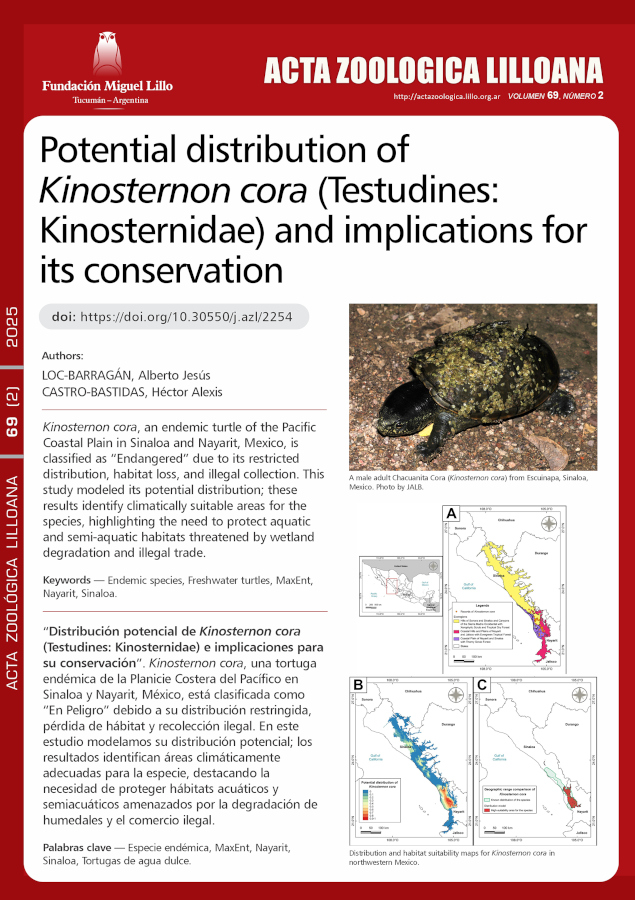
Kinosternon cora, una tortuga endémica de la Planicie Costera del Pa-
cífico en Sinaloa y Nayarit, México, está clasificada como “En Peligro”
debido a su distribución restringida, pérdida de hábitat y recolección
ilegal. En este estudio modelamos su distribución potencial usando
MaxEnt y 48 registros de presencia verificados, analizando variables
bioclimáticas (temperatura media anual, rango diurno de temperatura,
temperatura del trimestre más cálido, precipitación de los trimestres
más seco y frío). El modelo LQPTH/?3 mostró alto rendimiento (AUC =
0.970, pROC = 1.51, p = 0.001), prediciendo 3,548.27 km² de hábitat
adecuado con un 85.9% de superposición con la distribución conocida.
La temperatura media anual (29.5–30.0°C) y la baja precipitación en la
temporada seca (<100 mm) fueron los predictores más influyentes,
contribuyendo 41.64% y 22.2% al modelo, respectivamente, con rangos
óptimos de temperatura diurna (10.0–16.0°C) y temperaturas del trimes-
tre más cálido (28.5–30.0°C), reflejando la dependencia de humedales
térmicamente estables. La precipitación en el trimestre más frío no tuvo
efecto significativo. Estos resultados identifican áreas climáticamente
adecuadas para K. cora, destacando la necesidad de proteger hábitats
acuáticos y semiacuáticos amenazados por la degradación de humeda-
les y el comercio ilegal. Las áreas predichas sin registros sugieren zonas
para muestreos dirigidos para refinar el conocimiento de la distribución.
Este estudio apoya los esfuerzos de conservación al identificar áreas
prioritarias para la protección del hábitat y recomendar la integración
de variables no bioclimáticas, como la cobertura vegetal, para refinar
modelos de distribución futuros.
Downloads
Referências
Abdelaal, M., Fois, M., Fenu, G., Bacchetta, G. (2019). Using MaxEnt modeling to predict the potential distribution of the endemic plant Rosa arabica Crép. in Egypt. Ecological Informatics, 50, 68-75. https://doi.org/10.1016/j.ecoinf.2019.01.003 DOI: https://doi.org/10.1016/j.ecoinf.2019.01.003
Araujo M. B., Guisan, A. (2006). Five (or so) challenges for species distribution modeling. Journal of Biogeography, 33(10), 1677-1688. https://doi.org/10.1111/j.1365-2699.2006.01584.x DOI: https://doi.org/10.1111/j.1365-2699.2006.01584.x
Assis, C. L., Valadão, R. M., de Mendonça, S. H. S. T., Peçanha, E. L. S., Costa, H. C., Novaes, C. M., de Barros, T. F., Rodrigues, L. S., Gasparini, J. L., Feio, R. N. (2024). Extensive sampling and citizen science expand the distribution of the threatened freshwater turtle Ranacephala hogei (Mertens, 1967). Anais da Academia Brasileira de Ciências, 96(Suppl. 1), e20240484. https://doi.org/10.1590/0001-3765202420240484 DOI: https://doi.org/10.1590/0001-3765202420240484
Bakx, T. R. M., Koma, Z., Seijmonsbergen, A. C., Kissling, W. D. (2019). Use and categorization of light detection and ranging vegetation metrics in avian diversity and species distribution research. Diversity and Distributions, 25, 1045-1059. https://doi.org/10.1111/ddi.12915 DOI: https://doi.org/10.1111/ddi.12915
Barve, N., Barve, V., Jiménez-Valverde, A., Lira-Noriega, A., Maher, S. P., Townsend Peterson, A., Soberón, J., Villalobos, F. (2011). The crucial role of the accessible area in ecological niche modeling and species distribution modeling. Ecological Modelling, 222(11), 1810–1819. https://doi.org/10.1016/j.ecolmodel.2011.02.011 DOI: https://doi.org/10.1016/j.ecolmodel.2011.02.011
Berriozabal-Islas, C., Ramírez-Bautista, A., Torres-Ángeles, F., Mota-Rodrigues, J. F., Macip-Ríos, R., Octavio-Aguilar, P. (2020). Climate change effects on turtles of the genus Kinosternon (Testudines: Kinosternidae): an assessment of habitat suitability and climate niche conservatism. Hydrobiologia, 847(19), 4091-4110. https://doi.org/10.1007/s10750-020-04402-y DOI: https://doi.org/10.1007/s10750-020-04402-y
Brooks, R. J., Brown, G. P., Galbraith, D. A. (1991). Effects of a sudden increase in natural mortality of adults on a population of the common snapping turtle (Chelydra serpentina). Canadian Journal of Zoology, 69(5), 1314-1320. https://doi.org/10.1139/z91-185 DOI: https://doi.org/10.1139/z91-185
Brun, P., Zimmermann, N. E., Hari, C., Pellisier, L., Karger, D. N. (2022). Global climate-related predictors at kilometre resolution for the past and future. Earth System Science Data, 14, 5573-5603. https://doi.org/10.5194/essd-14-5573-2022 DOI: https://doi.org/10.5194/essd-14-5573-2022
Camacho-Valdez, V., Ruiz-Luna, A., Ghermandi, A., Nunes, P. A. L. D. (2013). Valuation of ecosystem services provided by coastal wetlands in northwest Mexico. Ocean & Coastal Management, 78, 1-11. https://doi.org/10.1016/j.ocecoaman.2013.02.017 DOI: https://doi.org/10.1016/j.ocecoaman.2013.02.017
Castro-Bastidas, H. A. (2024). Taxonomic and geospatial review of the herpetofauna of Sinaloa, Mexico. Bulletin of the Chicago Herpetological Society, 59(8), 111-118.
Chaves-Quirós, A. C., Serrano, G., Marin, G., Arguedas, E., Jimenez, A., Spotila, J. R. (1996). Biology and conservation of leatherback turtles, Dermochelys coriacea, at Playa Langosta, Costa Rica. Chelonian Conservation and Biology, 2, 184-189.
CONABIO [Comisión Nacional para el Conocimiento y Uso de la Biodiversidad]. (2020). Ecorregiones terrestres de México. http://www.biodiversidad.gob.mx/region/ecorregiones (Consulted in March 25)
CONABIO. (2021). La biodiversidad en Nayarit: Estudio de estado. D.F., México: CONABIO. https://www.biodiversidad.gob.mx/publicaciones/librosDoc/EE_Nayarit_2021.pdf
Cupul-Magaña, F. G., Flores-Guerrero, U. S., Escobedo-Galván, A. H. (2020). Distribución potencial de la tortuga mesoamericana Trachemys ornata en México. Intropica, 15(1), 66-70. https://revistas.unimagdalena.edu.co/index.php/intropica/article/view/3446 DOI: https://doi.org/10.21676/23897864.3446
Dormann, C. F., Elith, J., Bacher, S., Buchmann, C., Carl, G., Carré, G., García Marquéz, J. R., Gruber, B., Lafourcade, B., Leitão, P. J., Münkemüller, T., McClean, C., Osborne, P. E., Reineking, B., Schröder, B., Skidmore, A. K., Zurell, D., Lautenbach, S. (2013). Collinearity: A review of methods to deal with it and a simulation study evaluating their performance. Ecography, 36(1), 27-46. https://doi.org/10.1111/j.1600-0587.2012.07348.x DOI: https://doi.org/10.1111/j.1600-0587.2012.07348.x
Elith, J., Graham, C. H., Anderson, R. P., Dudík, M., Ferrier, S., Guisan, A., Hijmans, R. J., Huettmann, F., Leathwick, J. R., Lehmann, A., Li, J., Lohmann, L. G., Loiselle, B. A., Manion, G., Moritz, C., Nakamura, M., Nakazawa, Y., McC. Overton, J., Peterson, A. T., ... Zimmermann, N. E. (2006). Novel methods improve prediction of species’ distributions from occurrence data. Ecography, 29, 129-151. https://doi.org/10.1111/j.2006.0906-7590.04596.x DOI: https://doi.org/10.1111/j.2006.0906-7590.04596.x
González-Bernal, M. A., Rojas-Aguilar, E. I., Rosales-Martínez, C. S., Loc-Barragán, J. A. (2025). Notes on the herpetofauna of Sinaloa, Mexico 1: New geographical record for the Cora Mud Turtle (Kinosternon cora) in Sinaloa, Mexico. Bulletin of the Chicago Herpetological Society, 60(5), 67-68.
González-García, S. A., Bojórquez-Serrano, J. I., Nájera-González, O., García-Paredes, J. D., Madueño-Molina, A., Flores-Vilchez, F. (2009). Regionalización ecológica de la llanura costera norte de Nayarit, México. Investigaciones Geográficas, 69, 21-32.
Harvey, C. A., Villanueva, C., Villacís, J., Chacón, M., Muñoz, D., López, M., Ibrahim, M., Gómez, R., Taylor, R., Martinez, J., Navas, A., Saenz, J., Sánchez, D., Medina, A., Vilchez, S., Hernández, B., Perez, A., Ruiz, F., López, F., ... Sinclair, F. L. (2005). Contribution of live fences to the ecological integrity of agricultural landscapes. Agriculture, Ecosystems & Environment, 111(1-4), 200-230. https://doi.org/10.1016/j.agee.2005.06.011 DOI: https://doi.org/10.1016/j.agee.2005.06.011
Hortal, J., Bello, F., Diniz-Filho, J. A. F., Lewinsohn, T. M., Lobo, J. M., Ladle, R. J. (2015). Seven shortfalls that beset large-scale knowledge of biodiversity. Annual Review of Ecology, Evolution, and Systematics, 46, 523-554. https://doi.org/10.1146/annurev-ecolsys-112414-054400 DOI: https://doi.org/10.1146/annurev-ecolsys-112414-054400
Legler, J. M., Vogt, R. C. (2013). The Turtles of Mexico: Land and Freshwater Forms. Berkeley, California: University of California Press. https://doi.org/10.1525/9780520956896 DOI: https://doi.org/10.1525/9780520956896
Lemos-Espinal, J. A., Smith, G. R. (2020). A checklist of the amphibians and reptiles of Sinaloa, Mexico with a conservation status summary and comparisons with neighboring states. ZooKeys, 931, 85-114. https://doi.org/10.3897/zookeys.931.50922 DOI: https://doi.org/10.3897/zookeys.931.50922
Lobo, J. M., Jiménez-Valverde, A., Real, R. (2008). AUC: a misleading measure of the performance of predictive distribution models. Global Ecology and Biogeography, 17(2), 145-151. https://doi.org/10.1111/j.1466-8238.2007.00358.x DOI: https://doi.org/10.1111/j.1466-8238.2007.00358.x
Loc-Barragán, J. A., Iverson, J. B. (2024). Kinosternon cora (Cora Mud Turtle). Distribution and morphometrics. Herpetological Review, 55(2), 249-250.
Loc-Barragán, J. A., Reyes-Velasco, J., Woolrich-Piña, G. A., Grünwald, C. I., Venegas-De Anaya, M., Rangel-Mendoza, J. A., López-Luna, M. A. (2020). A new species of mud turtle of genus Kinosternon (Testudines: Kinosternidae) from the Pacific coastal plain of northwestern Mexico. Zootaxa, 4885(4), 509-529. https://doi.org/10.11646/zootaxa.4885.4.3 DOI: https://doi.org/10.11646/zootaxa.4885.4.3
Loc-Barragán, J. A., Woolrich-Piña, G. A., López-Luna, M. A., Iverson, J. B. (In press). Kinosternon cora. The IUCN Red List of Threatened Species. http://iucnredlist.org
Magurran, A. E. (2004). Measuring Biological Diversity. Oxford: Blackwell Publishing.
Marn, N., Jusup, M., Legovi?, T., Kooijman, S. A. L. M., Klanjš?ek, T. (2017). Environmental effects on growth, reproduction, and life-history traits of loggerhead turtles. Ecological Modelling, 360, 163-178. https://doi.org/10.1016/j.ecolmodel.2017.07.001 DOI: https://doi.org/10.1016/j.ecolmodel.2017.07.001
Miorando, P. S., Rebêlo, G. H., Pignati, M. T., Brito-Pezzuti, J. C. (2013). Effects of community-based management on Amazon River turtles: a case study of Podocnemis sextuberculata in the lower Amazon floodplain, Pará, Brazil. Chelonian Conservation and Biology, 12, 143-150. https://doi.org/10.2744/CCB-1011.1 DOI: https://doi.org/10.2744/CCB-1011.1
Molina-Serrano, K. M., Aguirre-Toledo, H. D., Meza-Inostroza, P. M., Castro-Bastidas, H. A., Bucio-Pacheco, M., Iverson, J. B. (2025). Southern range extension of Kinosternon sonoriense Le Conte 1854 (Testudines: Kinosternidae). Zootaxa, 5604(1), 87-93. https://doi.org/10.11646/zootaxa.5604.1.10 DOI: https://doi.org/10.11646/zootaxa.5604.1.10
Naimi, B., Araújo, M. (2016). sdm: A reproducible and extensible R platform for species distribution modelling. Ecography, 39, 368-375. https://doi.org/10.1111/ecog.01881 DOI: https://doi.org/10.1111/ecog.01881
Nájera-González, A., Carrillo-González, F. M., Nájera-González, O., Chávez-Dagostino, R. M. (2020). Caracterización climática y variabilidad de temperatura superficial de la llanura costera de Nayarit y su teleconexión con ENSO y PDO. Acta Universitaria, 30, 1-21. https://doi.org/10.15174/au.2020.2651 DOI: https://doi.org/10.15174/au.2020.2651
Nájera-González, A., Carrillo-González, F. M., Morales-Hernández, J. C., Nájera-González, O. (2021). Cambio de cobertura y uso de suelo en llanura costera asociados a procesos antropogénicos: caso San Blas, Nayarit. Madera y Bosques, 27(1). https://doi.org/10.21829/myb.2021.2712104 DOI: https://doi.org/10.21829/myb.2021.2712104
Pearson, R. G., Raxworthy, C. J., Nakamura, M., Townsend Peterson, A. (2006). Predicting species distributions from small numbers of occurrence records: a test case using cryptic geckos in Madagascar. Journal of Biogeography, 34(1), 102-117. https://doi.org/10.1111/j.1365-2699.2006.01594.x DOI: https://doi.org/10.1111/j.1365-2699.2006.01594.x
Peterson, A. T., Pape?, M., Soberón, J. (2008). Rethinking receiver operating characteristic analysis applications in ecological niche modelling. Ecological Modelling, 213(1), 63-72. https://doi.org/10.1016/j.ecolmodel.2007.11.008 DOI: https://doi.org/10.1016/j.ecolmodel.2007.11.008
Peterson, A. T., Soberón, J., Pearson, R. G., Anderson, R. P., Martínez-Meyer, E., Nakamura, M., Araújo, M. B. (2011). Ecological Niches and Geographic Distributions. Princeton, New Jersey: Princeton University Press. DOI: https://doi.org/10.23943/princeton/9780691136868.003.0003
Peterson, A. T., Soberón, J. (2012). Species distribution modeling and ecological niche modeling: getting the concepts right. Natureza and Conservação, 10, 102-107. https://doi.org/10.4322/natcon.2012.019 DOI: https://doi.org/10.4322/natcon.2012.019
Phillips, S. J., Dudík, M. (2008). Modeling of species distributions with Maxent: new extensions and a comprehensive evaluation. Ecography, 31, 161-175. https://doi.org/10.1111/j.0906-7590.2008.5203.x DOI: https://doi.org/10.1111/j.0906-7590.2008.5203.x
Phillips, S. J., Dudík, M., Schapire, R. E. (2017). MaxEnt software for modeling species niches and distributions (Version 3.4.1). American Museum of Natural History. http://biodiversityinformatics.amnh.org/open_source/maxent/
PROFEPA [Procuraduría Federal de Protección al Ambiente]. (2025). Boletín de prensa. https://www.gob.mx/profepa/prensa/profepa-asegura-120-tortugas-y-16-ranas-vivas-en-el-aicm-pretendian-enviarlas-a-japon?state=published (Consulted in June 2025)
QGIS Development Team. (2025). QGIS 3.42.1. Geographic Information System. Bern, Suiza: Open Source Geospatial Foundation Project. http://qgis.osgeo.org
R Core Team. (2016). R: A Language and Environment for Statistical Computing. Vienna, Austria: R Foundation for Statistical Computing. http://www.R-project.org/
Ramírez-Bautista, A., Torres-Hernández, L. A., Cruz-Elizalde, R., Berriozabal-Islas, C., Hernández-Salinas, U., Wilson, L. D., Johnson, J. D., Porras, L. W., Balderas-Valdivia, C. J., González-Hernández, A. J. X., Mata-Silva, V. (2023). An updated list of the Mexican herpetofauna: with a summary of historical and contemporary studies. ZooKeys, 1166, 287-306. https://doi.org/10.3897/zookeys.1166.82796 DOI: https://doi.org/10.3897/zookeys.1166.86986
Real, R., Barbosa, A. M., Vargas, J. M. (2006). Obtaining environmental favourability functions from logistic regression. Environmental and Ecological Statistics, 13, 237-245. https://doi.org/10.1007/s10651-005-0003-3 DOI: https://doi.org/10.1007/s10651-005-0003-3
Šari?, K. K., Lauš, B., Buri?, I., Koren, Š. A., Koren, T. (2023). The current distribution and status of the Hermann’s tortoise, Testudo hermanni boettgeri (Reptilia, Testudines, Testudinidae) in Croatia. Herpetozoa, 36, 159-175. https://doi.org/10.3897/herpetozoa.36.e101672 DOI: https://doi.org/10.3897/herpetozoa.36.e103510
Saunders, S. P., Cuthbert, F. J., Zipkin, E. F. (2018). Evaluating population viability and efficacy of conservation management using integrated population models. Journal of Applied Ecology, 55(3), 1380-1392. https://doi.org/10.1111/1365-2664.13080 DOI: https://doi.org/10.1111/1365-2664.13080
Serrano, J. M., Berlanga-Robles, C. A., Ruiz-Luna, A. (2014). High amphibian diversity related to unexpected values in a biogeographic transitional area in north-western Mexico. Contributions to Zoology, 83, 151-166. https://doi.org/10.1163/18759866-08302005 DOI: https://doi.org/10.1163/18759866-08302005
Soberón, J. M. (2010). Niche and area of distribution modeling: a population ecology perspective. Ecography, 33, 159-167. https://doi.org/10.1111%2Fj.1600-0587.2009.06074.x DOI: https://doi.org/10.1111/j.1600-0587.2009.06074.x
Stanford, C. B., Iverson, J. B., Rhodin, A. G. J., van Dijk, P. P., Mittermeier, R. A., Kuchling, G., Berry, K. H., Bertolero, A., Bjorndal, K. A., Blanck, T. E. G., Buhlmann, K. A., Burke, R. L., Congdon, J. D., Diagne, T., Edwards, T., Eisemberg, C. C., Ennen, J. R., Forero-Medina, G., Frankel, M., ... Gibbons, J. W. (2020). Turtles and tortoises are in trouble. Current Biology, 30(12), R721-R735. https://doi.org/10.1016/j.cub.2020.04.088 DOI: https://doi.org/10.1016/j.cub.2020.04.088
Tingley, R., Herman, T. B. (2009). Land-cover data improve bioclimatic models for anurans and turtles at a regional scale. Journal of Biogeography, 36(9), 1656-1672. http://www.jstor.org/stable/40305934 DOI: https://doi.org/10.1111/j.1365-2699.2009.02117.x
Turtle Taxonomy Working Group [TTWG] (Rhodin, A. G. J., Iverson, J. B., Bour, R., Fritz, U., Georges, A., Shaffer, H. B., van Dijk, P. P.). (2021). Turtles of the world: Annotated checklist and atlas of taxonomy, synonymy, distribution, and conservation status (9th Ed.). In: Rhodin, A. G. J., Iverson, J. B., van Dijk, P. P., Stanford, C. B., Goode, E. V., Buhlmann, K. A., Mittermeier, R. A. (Eds.). Conservation Biology of Freshwater Turtles and Tortoises: A Compilation Project of the IUCN/SSC Tortoise and Freshwater Turtle Specialist Group. Chelonian Research Monographs, 8, 1-472. https://doi.org/10.3854/crm.8.checklist.atlas.v9.2021 DOI: https://doi.org/10.3854/crm.8.checklist.atlas.v9.2021
TTWG (Rhodin, A. G. J., Iverson, J. B., Fritz, U., Gallego-García, N., Georges, A., Shaffer, H. B. van Dijk, P. P.) (2025). Turtles of the world: Annotated checklist and atlas of taxonomy, synonymy, distribution, and conservation status (10th Ed.). In: Rhodin, A. G. J., Iverson, J. B., van Dijk, P. P., Stanford, C. B., Goode, E. V., Buhlmann, K. A. Mittermeier, R. A. (Eds.). Conservation Biology of Freshwater Turtles and Tortoises: A Compilation Project of the IUCN/SSC Tortoise and Freshwater Turtle Specialist Group. Chelonian Research Monographs, 10, 1-575. https://doi.org/10.3854/crm.10.checklist.atlas.v10.2025 DOI: https://doi.org/10.3854/crm.10.checklist.atlas.v10.2025
Uetz, P., Freed, P., Aguilar, R., Reyes, F., Hošek, J. (2025). Reptile database. http://www.reptile-database.org (Consulted in March 25)
Downloads
Publicado
Como Citar
Edição
Seção
Licença
Copyright (c) 2025 Acta Zoológica Lilloana

Este trabalho está licenciado sob uma licença Creative Commons Attribution-NonCommercial-NoDerivatives 4.0 International License.