Distribución de los patrones de color de la araña orbicular espinosa Gasteracantha cancriformis (Linnaeus, 1758) (Arachnida: Araneidae) en Honduras
Autores/as
-
Alex Mauricio Cubas-Rodríguez
Museo de Entomología, Escuela de Biología, Facultad de Ciencias, Universidad Nacional Autónoma de Honduras, Departamento Francisco Morazán, Tegucigalpa, Honduras
 https://orcid.org/0000-0001-6426-1101
-
Darko D. Cotoras
Pontificia Universidad Católica de Chile, Santiago de Chile, Chile
https://orcid.org/0000-0003-1739-5830
-
Andre F. A. Lira
Laboratório de Estudos Herpetológicos e Paleoherpetológicos, Universidad Federal Rural de Pernambuco, Pernambuco, Brazil
https://orcid.org/0000-0002-8443-4126
-
Antonio D. Brescovit
Laboratório de Coleções Zoológicas, Instituto Butantan, São Paulo, Brazil
https://orcid.org/0000-0002-1511-5324
DOI:
 https://doi.org/10.30550/j.azl/2415
Palabras clave:
Centroamérica, policromatismo, araña de seis espinas, déficit wallaceanoResumen
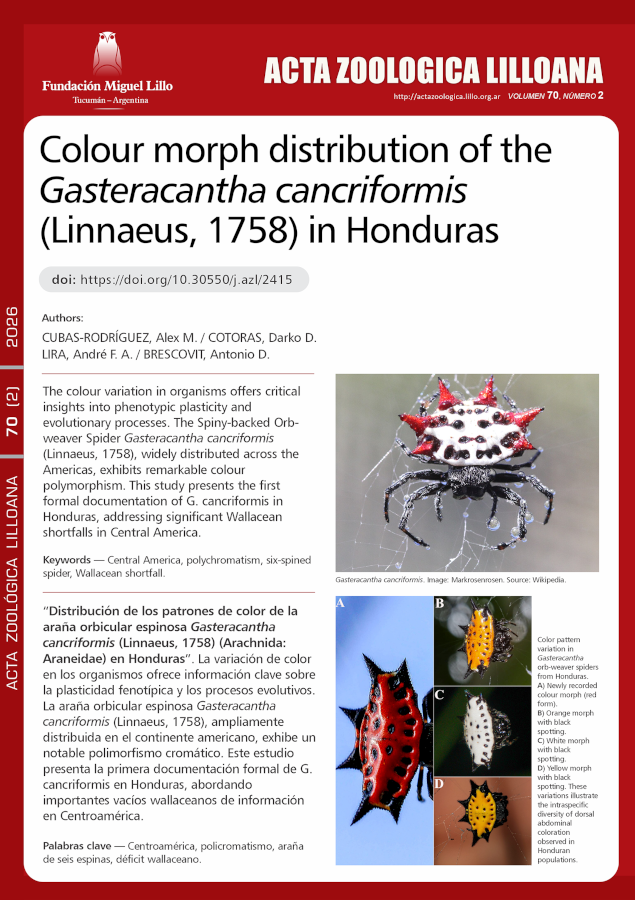
La variación de color en los organismos ofrece información clave sobre la plasticidad fenotípica y los procesos evolutivos. La araña orbicular espinosa Gasteracantha cancriformis (Linnaeus, 1758), ampliamente distribuida en el continente americano, exhibe un notable polimorfismo cromático. Este estudio presenta la primera documentación formal de G. cancriformis en Honduras, abordando importantes vacíos wallaceanos de información en Centroamérica. Mediante el uso de datos de ciencia ciudadana provenientes de iNaturalist y modelación de nicho ecológico, se cartografió su distribución y se identificaron cuatro morfos de color, incluyendo una nueva variante roja. Además, se observó una mayor idoneidad del hábitat en regiones de bosques lluviosos de Honduras. Nuestros resultados concuerdan con tres morfos previamente documentados para Centroamérica; sin embargo, el hallazgo de un morfo rojo
único resalta procesos de diversificación regional. Este trabajo subraya el valor de las plataformas de ciencia ciudadana para la investigación en biodiversidad y enfatiza la necesidad de ampliar los estudios aracnológicos en Centroamérica con el fin de de dilucidar los factores evolutivos que impulsan la diversidad fenotípica.
Descargas
Citas
Anderson, A. G., & Dodson, G. N. (2015). Color change ability and its effect on prey capture success in female Misumenoides formosipes crab spiders: Color change and foraging in a crab spider. Ecological Entomology, 40, 106–113. https://doi.org/10.1111/een.12167
Bezerra-Gusmão, M. A., Viana-Junior, A. B., Da Costa, B. G., Mello, A. P., Silva, P. G., & Arab, A. (2022). Cerambycid beetle communities in Caatinga dry forests are structured by seasonal species turnover. Neotropical Entomology, 51, 368–375. https://doi.org/10.1007/s13744-022-00951-0
Caro, T., Cluff, E., & Morgan, V. M. (2019). Color polymorphism and protective coloration in coconut crabs. Ethology Ecology & Evolution, 31, 514–525. https://doi.org/10.1080/03949370.2019.1626488
Chamberland, L., Salgado-Roa, F. C., Basco, A., Crastz-Flores, A., Binford, G. J., & Agnarsson, I. (2020). Phylogeography of the widespread Caribbean spiny orb weaver Gasteracantha cancriformis. PeerJ, 8, e8976. https://doi.org/10.7717/peerj.8976
Cotoras, D. D., Brewer, M. S., Croucher, P. J. P., Oxford, G. S., Lindberg, D. R., & Gillespie, R. G. (2017). Convergent evolution in the color polymorphism of Selkirkiella spiders (Theridiidae) from the South American temperate rainforest. Biological Journal of the Linnean Society, 120, 649–663. https://doi.org/10.1111/bij.12908
Croucher, P. J., Oxford, G. S., Lam, A., Mody, N., & Gillespie, R. G. (2012). Colonization history and population genetics of the color-polymorphic Hawaiian happy-face spider Theridion grallator (Araneae, Theridiidae). Evolution, 66, 2815–2833. https://doi.org/10.1111/j.1558-5646.2012.01653.x
Cubas-Rodríguez, A. M., & Brescovit, A. D. (2024a). Distribution of Trichonephila clavipes (Linnaeus, 1767) (Araneae: Araneidae) in Honduras. Revista Chilena de Entomología, 50, 193–199. http://dx.doi.org/10.35249/rche.50.2.24.08
Cubas-Rodríguez, A. M., & Brescovit, A. D. (2024b). Six-eyed spiders, the first record of Sicarius rugosus (F. O. Pickard-Cambridge, 1899) (Araneae: Haplogynae: Sicariidae) for Honduras, with comments on its natural history. Arachnology, 19, 1029–1033. https://doi.org/10.13156/arac.2024.19.7.1029
De Armas, L. F., & Cubas-Rodríguez, A. M. (2023). Presencia de Centruroides limbatus (Scorpiones: Buthidae) en Honduras. Revista Nicaragüense de Entomología, 298, 3–16.
Galeotti, P., Rubolini, D., Dunn, P. O., & Fasola, M. (2003). Color polymorphism in birds: causes and functions. Journal of Evolutionary Biology, 16, 635–646. https://doi.org/10.1046/j.1420-9101.2003.00569.x
Gawryszewski, F. M., & Motta, P. C. (2011). Coloration of the orb-web spider Gasteracantha cancriformis does not increase its foraging success. Ethology Ecology & Evolution, 24, 23–38. https://doi.org/10.1080/03949370.2011.582044
Hazzi, N. A., & Hormiga, G. (2021). Morphological and molecular evidence support the taxonomic separation of the medically important Neotropical spiders Phoneutria depilata (Strand, 1909) and P. boliviensis (F. O. Pickard-Cambridge, 1897) (Araneae: Ctenidae). ZooKeys, 1022, 13–50. https://doi.org/10.3897/zookeys.1022.60571
Hernández-Ortiz, V., Dzul-Cauich, J. F., Madora, M., & Coates, R. (2022). Local climate conditions shape the seasonal patterns of the diptera community in a tropical rainforest of the Americas. Neotropical Entomology, 51, 499–513. https://doi.org/10.1007/s13744-022-00965-8
Levi, H. W. (1996). The American orb weavers Hypognatha, Encyosaccus, Xylethrus, Gasteracantha, and Enacrosoma (Araneae: Araneidae). Bulletin of the Museum of Comparative Zoology, 155, 89–157.
McKinnon, J. S., & Pierotti, M. E. R. (2010). Color polymorphism and correlated characters: genetic mechanisms and evolution. Molecular Ecology, 19, 5101–5125. https://doi.org/10.1111/j.1365-294X.2010.04846.x
Nosil, P., Villoutreix, R., Carvalho, C. F., Farkas, T. E., Soria-Carrasco, V., Feder, J. L., Crespi, B. J., & Gompert, Z. (2018). Natural selection and the predictability of evolution in Timema stick insects. Science, 359, 765–770. https://doi.org/10.1126/science.aap9125
Oxford, G. S. (2005). Genetic drift within a protected polymorphism: enigmatic variation in color-morph frequencies in the candy-stripe spider, Enoplognatha ovata. Evolution, 59, 2170–2184. https://doi.org/10.1554/05-046.1
Salgado-Roa, F. C., Chamberland, L., Pardo-Díaz, C., Cisneros-Heredia, D. F., Lasso, E., & Salazar, C. (2022). Dissecting a geographical colorful tapestry: Phylogeography of the color polymorphic spider Gasteracantha cancriformis. Journal of Zoological Systematics and Evolutionary Research, 1, 8112945. https://doi.org/10.1155/2022/8112945
Salgado-Roa, F. C., Stuart-Fox, D., White, T. E., & Medina, I. (2024). Color polymorphism is prevalent on islands but shows no association with range size in web-building spiders. Journal of Evolutionary Biology, 37, 1355–1375. https://doi.org/10.1093/jeb/voae118
Silva, I. S., Lucena, E. F., Moura, F. M. S., & Vasconcellos, A. (2021). Termite flights seasonally promote nutrient pulses in the Caatinga dry forest in northeastern Brazil. Applied Soil Ecology, 166, 104066. https://doi.org/10.1016/j.apsoil.2021.104066
Stuart-Fox, D., Aulsebrook, A., Rankin, K. J., Dong, C. M., & McLean, C. A. (2021). Convergence and divergence in lizard color polymorphisms. Biological Reviews, 96, 289–309. https://doi.org/10.1111/brv.12656
Svensson, E. I., & Abbott, J. (2005). Evolutionary dynamics and population biology of a polymorphic insect. Journal of Evolutionary Biology, 18, 1503–1514. https://doi.org/10.1111/j.1420-9101.2005.00946.x
Van der Geer, A. A. E. (2019). Effect of isolation on coat color polymorphism of Polynesian rats in Island Southeast Asia and the Pacific. PeerJ, 7, e6894. https://doi.org/10.7717/peerj.6894
Descargas
Publicado
Cómo citar
Número
Sección
Licencia
Derechos de autor 2026 Acta Zoológica Lilloana

Esta obra está bajo una licencia internacional Creative Commons Atribución-NoComercial-SinDerivadas 4.0.