New records for two different species of the leaf-cutting ant genus Atta (Hymenoptera: Formicidae) in Córdoba, Argentina: Atta saltensis and Atta vollenweideri.
Authors
-
Mariana Pereyra
Laboratorio de Ecología Evolutiva y Biología Floral, Instituto Multidisciplinario de Biología Vegetal, Universidad Nacional de Córdoba – Consejo Nacional de Investigaciones Científicas y Técnicas
 https://orcid.org/0000-0003-2831-3060
-
Corina Anahí Barrera
Fundación para el Estudio de Especies Invasivas (FuEDEI)
https://orcid.org/0000-0001-5554-541X
DOI:
 https://doi.org/10.30550/j.azl/2455
Keywords:
central Argentina, fungus-growing ants, dominant herbivorous, ecosystem engineersAbstract
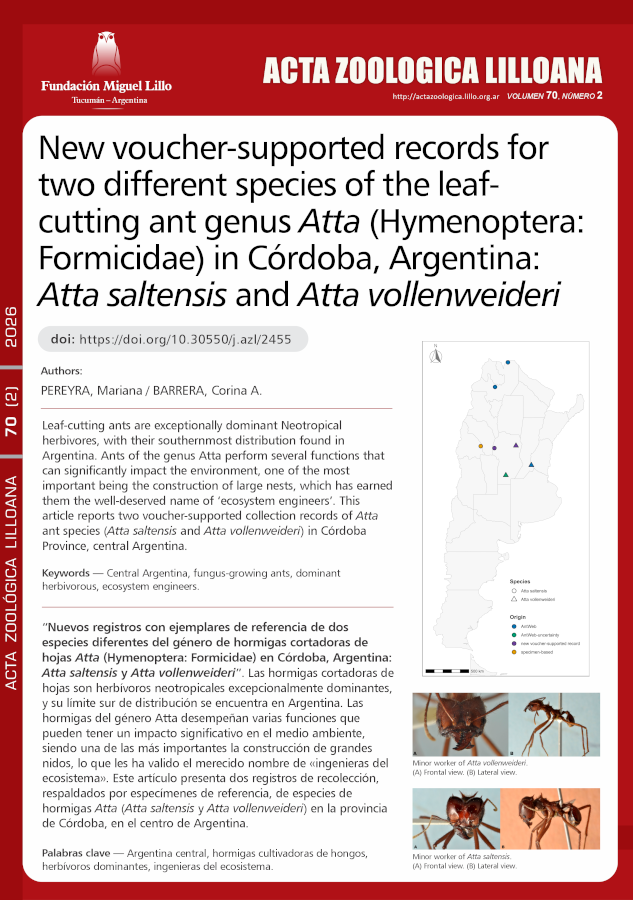
Leaf-cutting ants are exceptionally dominant Neotropical herbivores, with their southernmost distribution found in Argentina. Ants of the genus Atta perform several functions that can significantly impact the environment, one of the most important being the construction of large nests, which has earned them the well-deserved name of ‘ecosystem engineers’. However, the profound impacts these ants have
on ecosystems, such as the removal of large amounts of biomass, can be devastating in some human-modified environments. Understanding the distribution of these key ant species is fundamentally important. Although leafutting ants have been extensively studied, the distribution of some Atta species remains incompletely documented in Argentina, particularly because several historical records lack precise locality data or verifiable voucher information. This article reports two voucher-supported collection records of Atta ant species (Atta saltensis and Atta vollenweideri) in Córdoba Province, central Argentina.
Downloads
References
Barrera, C. A., Buffa, L. M., Valladares, G. (2015). Do leaf-cutting ants benefit from forest fragmentation? Insights from community and species-specific responses in a fragmented dry forest. Insect Conservation and Diversity, 8(5), 456-463. https://doi.org/10.1111/icad.12125
Barrera, C. A., Sosa-Calvo, J., Schultz, T. R., Rabeling, C., Bacci Jr, M. (2022). Phylogenomic reconstruction reveals new insights into the evolution and biogeography of Atta leaf-cutting ants (Hymenoptera: Formicidae). Systematic Entomology, 47(1), 13-35. https://doi.org/10.1111/syen.12513
Blanton, C. M., Ewel, J. J. (1985). Leaf-cutting ant herbivory in successional and agricultural tropical ecosystems. Ecology, 66(3), 861-869. https://doi.org/10.2307/1940548
Bolton, B. (2025) An Online Catalog of the Ants of the World [WWWdocument]. https://antcat.org/ [accessed on 10 October 2025].
Borgmeier, T. (1950) Estudos sôbre Atta (Hym. Formicidae). Memórias do Instituto Oswaldo Cruz. Rio de Janeiro 48, 239-263.
Borgmeier, T. (1959) Revision der Gattung Atta Fabricius (Hym., Formicidae). Studia Entomologica, 2, 321–390.
Cabido, M., Zeballos, S. R., Zak, M., Carranza, M. L., Giorgis, M. A., Cantero, J. J., Acosta, A. T. (2018). Native woody vegetation in central Argentina: Classification of Chaco and Espinal forests. Applied Vegetation Science, 21(2), 298-311. https://doi.org/10.1111/avsc.12369
Cabrera, A. L. (1976) Regiones fitogeográficas argentinas. In: Kugler WF (Ed.) Enciclopedia Argentina de Agricultura y Jardinería. Acme, Buenos Aires, 85 pp
Chen, I.-C., Hill, J. K., Ohlemüller, R., Roy, D. B., Thomas, C. D. (2011). Rapid range shifts of species associated with high levels of climate warming. Science, 333(6045), 1024–1026. https://doi.org/10.1126/science.1206432
Cuezzo, F. (1998). Formicidae. In J. J. Morrone & S. Coscarón (Eds.), Biodiversidad de artrópodos argentinos: Una perspectiva biotaxonómica (pp. 452–462). Ediciones Sur.
Farji-Brener, A. G., Ruggiero, A. (1994). Leaf-cutting ants (Atta and Acromyrmex) inhabiting Argentina: patterns in species richness and geographical range sizes. Journal of Biogeography, 391-399.
Fernández, F., Castro-Huertas, V., Serna, F. (2015). Hormigas cortadoras de hojas de Colombia: Acromyrmex & Atta (Hymenoptera: Formicidae). Fauna de Colombia, Monografía No. 5. Instituto de Ciencias Naturales, Universidad Nacional de Colombia.
Folgarait, P. J. (1998). Ant biodiversity and its relationship to ecosystem functioning: a review. Biodiversity & Conservation, 7, 1221-1244. https://doi.org/10.1023/A:1008891901953
Forel, A. (1893). Note sur les Attini. Annales de la Société Entomologique de Belgique, 37, 586-607.
Forel, A. (1913) Fourmis d’Argentine, du Brésil, du Guatémala & de Cuba reçues de M. M. Bruch, Prof. v. Ihering, Mlle Baez, M. Peper et M. Rovereto. Bulletin de la Société Vaudoise des Sciences Naturelles, 49, 203-250.
Forti, L. C., Rando, J. S., da Silva Camargo, R., Moreira, A. A., Castellani, M. A., Leite, S. A., Andrade Sousa, K. K., Caldato, N. (2020). Occurrence of leaf-cutting and grass-cutting ants of the Genus Atta (Hymenoptera: Formicidae) in geographic regions of Brazil. Sociobiology, 67(4), 514-525.
Fowler, H.G., Pagani, M.I., Da Silva, O.A., Forti, L.C., Da Silva, V.P., De Vasconcelos, H.L. (1989). A pest is a pest is a pest? The dilemma of neotropical leaf-cutting ants: keystone taxa of natural ecosystems. Environmental Management, 13, 671–675. DOI: https://doi.org/10.1007/BF01868306
Gonçalves, C. R. (1942). Contribuição para o conhecimento do gênero Atta Fabr., das formigas saúvas. Boletim da Sociedade Brasileira de Agronomia, 5, 333-358.
Gonçalves, C. R. (1971). As saúvas de Mato Grosso, Brasil (Hymenoptera, Formicidae). Arquivos do Museu Nacional, 54, 249–253.
Guénard, B., Weiser, M. D., Gómez, K., Narula, N., Economo, E. P. (2017). The Global Ant Biodiversity Informatics (GABI) database: Synthesizing data on the geographic distribution of ant species (Hymenoptera: Formicidae). Myrmecological News, 24, 83–89. https://doi.org/10.25849/myrmecol.news_024:083
Hölldobler, B., Wilson, E. O. (1990). The ants. Harvard University Press.
Janicki, J., Narula, N., Ziegler, M., Guénard, B., Economo, E. P. (2016). Visualizing and interacting with large-volume biodiversity data using client-server web-mapping applications: The design and implementation of antmaps.org. Ecological Informatics, 32, 185–193. https://doi.org/10.1016/j.ecoinf.2016.02.006
Jonkman, J. C. M. (1980). The external and internal structure and growth of nests of the leaf-cutting ant Atta vollenweideri Forel, 1893 (Hym.: Formicidae). Zeitschrift für Angewandte Entomologie, 89, 217–246. https://doi.org/10.1111/j.1439-0418.1980.tb03461.x
Karlin, M.S., Karlin, U.O., Coirini, R.O., Reati, R.G., Zapata, R.M. (2013) El Chaco Árido. Editorial Brujas, Córdoba.
Kempf, W.W. (1972). Catálogo abreviado das formigas da região Neotropical. Studia Entomologica, 15, 3-344.
Kusnezov, N. (1978). Hormigas Argentinas. Clave para su identificación. Miscelanea-Fundacion Miguel Lillo (Argentina), 61.
Masiulionis, V. E., Samuels, R. I. (2025). Investigating the biology of leaf-cutting ants to support the development of alternative methods for the control and management of these agricultural pests. Agriculture, 15(6), 642. https://doi.org/10.3390/agriculture15060642
Mehdiabadi, N. J., Schultz, T. R. (2010). Natural history and phylogeny of the fungus-farming ants (Hymenoptera: Formicidae: Myrmicinae: Attini). Myrmecological News, 13, 37-55.
Morello, J., Protomastro, J., Sancho, L., Blanco, C. (1985). Estudio Macroecológico de los Llanos de La Rioja. Serie del Cincuentenario de la Administración de Parques Nacionales, Buenos Aires.
Mueller, U.G., Ishak, H.D., Bruschi, S.M., Smith, C.C., Herman, J.J., Solomon, S.E., Mikheyev, A.S., Rabeling, C., Scott, J.J., Cooper, M., Rodrigues, A., Ortiz, A., Brandão, C.R.F., Lattke, J.E., Pagnocca, F.C., Rehner, S.A., Schultz, T.R., Vasconcelos, H.R., Adams, R.M.M., Bollazzi, M., Clark, R. M., Himler, A. G., LaPolla, J. S., Leal, I. R., Johnson, R. A., Roces, F., Sosa-Calvo, J., Wirth, R., Bacci Jr, M. (2017). Biogeography of mutualistic fungi cultivated by leafcutter ants. Molecular Ecology, 26, 6921–6937. DOI: https://doi.org/10.1111/mec.14431
Murúa, A. F., Cuezzo, F., Acosta, J. C. (1999). La fauna de hormigas del Gran Bajo Oriental del departamento Valle Fértil (San Juan, Argentina). Revista de la Sociedad Entomológica Argentina, 58(3–4), 135–138.
Nascimento, G., Câmara, T., Arnan, X. (2022). Critical thermal limits in ants and their implications under climate change. Biological Reviews, 97(4) ,1287-1305. https://doi.org/10.1111/brv.12843
Peirone-Cappri, L., Cingolani, A. M., Alvarez Pringles, A. P., Sánchez-Restrepo, A. F. (2025). Leaf-cutting ants’ distribution in an elevation gradient in central Argentina. Studies on Neotropical Fauna and Environment, 60(1), 58-67. https://doi.org/10.1080/01650521.2024.2381976
Rivas Martínez, S., Navarro, G., Penas, A., Costa, M. (2011). Biogeographic Map of South America. A preliminary survey. International Journal of Geobotany Research, 1, 21–40. https://doi.org/10.5616/ijgr110002
Sabattini, J., Bollazzi, M. (2023). Herbivory by Atta vollenweideri: Reviewing the significance of grass-cutting ants as a pest of livestock. Frontiers in Insect Science, 3, 1101445. https://doi.org/10.3389/finsc.2023.1101445
Salvador, S. A. (2013). Hormigas Isaú (Atta vollenweideri) en la alimentación de algunas aves de Villa María, Córdoba, Argentina. Nuestras Aves, 58, 63-64.
Sánchez-Restrepo, A. F. (2020). Historia evolutiva y distribución geográfica de las hormigas cortadoras de hojas (géneros Acromyrmex spp. y Atta spp.) en el cono sur de Sudamérica (Doctoral dissertation, Universidad de Buenos Aires).
Schultz, T. R., Brady, S. G. (2008). Major evolutionary transitions in ant agriculture. Proceedings of the National Academy of Sciences, 105(14), 5435-5440. https://doi.org/10.1073/pnas.0711024105
Schultz, T. R., Sosa-Calvo, J., Kweskin, M. P., Lloyd, M. W., Dentinger, B., Kooij, P. W., Vellinga, E. C., Rehner, S. A., Rodrigues, A., Montoya, Q. V., Fernández-Marín, H., Ješovnik, A., Niskanen, T., Liimatainen, K., Leal-Dutra, C. A., Solomon, S. E., Gerardo, N. M., Currie, C. R., Bacci Jr, M., Vasconcelos, H. L., Rabelling, C., Faircloth, V.C., Doyle, V. P. (2024). The coevolution of fungus-ant agriculture. Science, 386(6717), 105-110. https://doi.org/10.1126/science.adn7179
Swanson, A. C., Schwendenmann, L., Allen, M. F., Aronson, E. L., Artavia-León, A., Dierick, D., Fernandez-Bou, A.S., Harmon, T.C., Murillo-Cruz, C., Oberbauer, S.F., Pinto-Tomás, A.A., Runde, P.W., Zelikova, T. J. (2019). Welcome to the Atta world: A framework for understanding the effects of leaf-cutter ants on ecosystem functions. Functional Ecology, 33(8), 1386-1399. https://doi.org/10.1111/1365-2435.13319
Vasconcelos, H. L., Vieira-Neto, E. H. M., Mundim, F. M., Bruna, E. M. (2006). Roads alter the colonization dynamics of a keystone herbivore in Neotropical savannas. Biotropica, 38, 661–666.
Vieira-Neto, E. H., Vasconcelos, H. L., Bruna, E. M. (2016). Roads increase population growth rates of a native leaf-cutter ant in Neotropical savannahs. Journal of Applied Ecology, 53(4), 983-992.
Ward, P. S., Brady, S. G., Fisher, B. L., Schultz, T. R. (2015). The evolution of myrmicine ants: phylogeny and biogeography of a hyperdiverse ant clade (hymenoptera: Formicidae). Systematic Entomology, 40(1), 61-81. https://doi.org/10.1111/syen.12090
Wirth R., Beyschlag, W., Ryel, R., Herz, H., Hölldobler, B. (2003). The Herbivory of Leaf-cutting Ants. A Case Study on Atta colombica in the Tropical Rainforest of Panama. Springer, Berlin, Germany.
Zeballos, S. R., Acosta, A. T., Agüero, W. D., Ahumada, R. J., Almirón, M. G., Argibay, D. S., Arroyo, D.N., Blanco, L.J., Biurrun, F.N., Cantero, J.J., Márquez, J., Quiroga, A., Quiroga, R.E, Cabido, M.R. (2023). Vegetation types of the Arid Chaco in Central-Western Argentina. Vegetation Classification and Survey, 4, 167-188. https://doi.org/10.3897/VCS.100532
Downloads
Published
How to Cite
Issue
Section
License
Copyright (c) 2026 Acta Zoológica Lilloana

This work is licensed under a Creative Commons Attribution-NonCommercial-NoDerivatives 4.0 International License.