The Pereyra Iraola Biosphere Reserve (Buenos Aires, Argentina) as a model for the cross-sectional and longitudinal study of the infestation of the tropical rat mite, Ornithonyssus bacoti (Mesostigmata, Macronyssidae), a parasite of wild rodents (Cricetidae)
Authors
-
Evelin Quishpe Males
Centro de Estudios Parasitológicos y de Vectores (CEPAVE) (CONICET-UNLP)
 https://orcid.org/0009-0005-0670-3326
-
Iván Paolocá
Laboratorio de Etnobotánica y Botánica Aplicada (LEBA), Facultad de Ciencias Naturales y Museo (FCNyM), Universidad Nacional de La Plata (UNLP)
https://orcid.org/0000-0002-1503-5914
-
Mariel Costa
Centro de Estudios Parasitológicos y de Vectores (CEPAVE) (CONICET-UNLP)
https://orcid.org/0009-0004-2004-4569
-
Marcela Lareschi
Centro de Estudios Parasitológicos y de Vectores (CEPAVE) (CONICET-UNLP)
https://orcid.org/0000-0002-5300-9100
DOI:
 https://doi.org/10.30550/j.azl/2448
Keywords:
Acari, Ectoparasite, MaB, Pereyra Park, Punta LaraAbstract
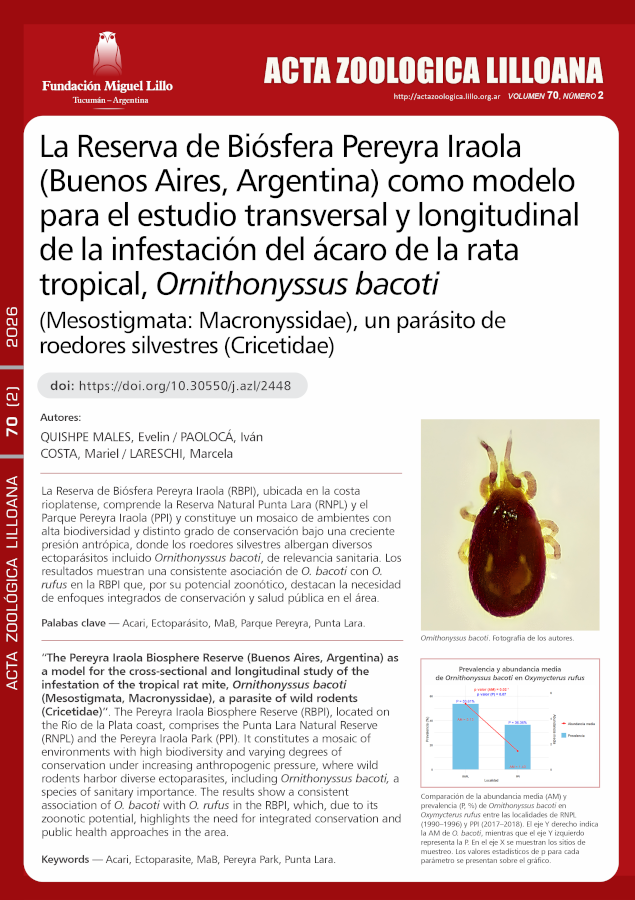
The Pereyra Iraola Biosphere Reserve (RBPI), located on the Río de la Plata coast, comprises the Punta Lara Natural Reserve (RNPL) and the Pereyra Iraola Park (PPI). It constitutes a mosaic of environments with high biodiversity and varying degrees of conservation under increasing anthropogenic pressure, where wild rodents harbor diverse ectoparasites, including Ornithonyssus bacoti, a species of sanitary importance. The objective of this study is to analyze the variation in the prevalence (P) and mean abundance (AM) of O. bacoti using data from surveys conducted in RNPL (1990-1996) and PPI (2017-2018). Differences were assessed using Fisher's exact test for P and Bootstrap-t for AM, considering species with n?10 parasites per site. Of the 352 rodents examined, 107 (S=7) were parasitized by 917 O. bacoti. In the RNPL, the AM of O. bacoti in O. rufus was significantly higher than in the PPI (AM=5.13 vs. AM=1.43; p=0.02), while the P did not differ between locations (P=53.6% vs. P=36.4%; p>0.05). In the RNPL, no significant differences in AM or P were observed between O. rufus (AM=5.13; P=53.6%) and Scapteromys aquaticus (AM=4.85; P=48.6%). The remaining rodent species showed AM?0.15 and P?7.4%, and/or insufficient sample sizes. The results show a consistent association of O. bacoti with O. rufus in the RBPI, which, due to its zoonotic potential, highlights the need for integrated conservation and public health approaches in the area.
Downloads
References
Alsoubani, M., Varela-Stokes, A., Vazquez, G., Huang, S., Heger, N. y Doron, S. (2023). An unusual outbreak of dermatitis due to rodent mite infestation in an acute-care hospital. Infection Control & Hospital Epidemiology, 44, 1–3. https://doi.org/10.1017/ice.2023.96
Bonneuil, C. y Fressoz, J. B. (2016). The Shock of the Anthropocene. The Earh, History and Us. Verso.
Bush, A., Lafferty, K., Lotz, J. y Shostak, A. (1997). Parasitology meets ecology on its own terms: Margolis et al. revisited. The Journal of Parasitology, 83, 575–583. https://doi.org/10.2307/3284227
Colombo, M., García, R. y Depino, E. A. (2023). Biodiversidad bajo amenaza. La Reserva de Punta Lara en la mira. https://unlp.edu.ar/investiga/bajolalupa
Dascanio, L. M., Barrera, M. y Frangi, J. (1994). Biomass structure and dry matter dynamics of subtropical alluvial and exotic Ligustrum forest at the Río de la Plata, Argentina. Vegetatio, 115, 61–76.
Del Río, J. P., Maidana, J. A., Molteni, A., Pérez, M., Pochettino, M. L., Souilla, L. y Turco, E. (2007). El rol de las “quintas” familiares del Parque Pereyra Iraola (Buenos Aires, Argentina) en el mantenimiento de la agrobiodiversidad. Kurtziana, 33, 217–226.
Domínguez, A. (2008). El contexto cultural en la implementación de proyectos de desarrollo rural: El caso del Parque Pereyra Iraola. Mundo Agrario, 9, 1–16.
Harvey, D. (2004). El nuevo imperialismo. Madrid: Akal.
Lareschi, M. (1996). Estudio preliminar de la comunidad de roedores (Rodentia: Muridae) y sus ectoparásitos (Acari, Phthiraptera y Siphonaptera) en Punta Lara (Buenos Aires). Revista de la Sociedad Entomológica Argentina, 55, 113–120.
Liljesthröm, G. y Lareschi, M. (2002). Estudio preliminar de la comunidad ectoparasitaria de roedores sigmodontinos en el partido de Berisso, provincia de Buenos Aires. En O. D. Salomón (Ed.), Actualizaciones en artropodología sanitaria Argentina (pp. 257–260). Red Argentina de Estudio de Artrópodos Vectores de Enfermedades Humanas.
Massoia, E. (1961). Nota sobre Cricétidos de la Selva Marginal de Punta Lara. Publicaciones del Museo Municipal de Ciencias Naturales y Tradicional de Mar del Plata, 1, 115–134.
Melis, M. E., Espinoza-Carniglia, M. V., Paolocá, I., Savchenko, E., Costa, M. D., Balcazar, D., Galliari, C. A., Nava, S. y Lareschi, M. (2025). Communities of ectoparasites associated with cricetid rodents in Pereyra Iraola Biosphere Reserve, Argentina, with an analysis of Rickettsia infection. Revista de la Sociedad Entomológica Argentina, 84(1). https://doi.org/10.25085/rsea.840106
Morosi, J. A., Amarilla, B., Contin, M., Vitalone, C., Conti, A. L., Delgado, A., Vásquez, V., Coletti, R., Stornini, A. y Molinari, G. (1992). Parque Provincial Pereyra Iraola: Una introducción a la conservación y refuncionalización de su patrimonio. LINTA, CIC.
Mullen, G. R. y O’Connor, B. M. (2019). Mites (Acari). In Mullen, G. R. y Durden L. A. (Eds.), Medical and Veterinary Entomology (3rd ed., pp. 533–602). Academic Press.
Paolocá, I. (2025). Diálogos y conflictos acerca de lo ambiental entre visiones locales de distintos actores del área rioplatense: Aportes para la superación de divergencias y la promoción del trabajo intersectorial [Tesis Doctoral, FCNyM, UNLP] https://doi.org/10.35537/10915/176762
Reiczigel, J., Marozzi, M., Fábián, I. Rózsa, L. (2019). Biostatistics for parasitologists – A primer to quantitative parasitology. Trends in Parasitology, 35(4), 277–281. https://doi.org/10.1016/j.pt.2019.01.003
Ringuelet, R. (1962). Rasgos faunísticos de las reservas naturales de la provincia de Buenos Aires. Physis, 23, 83–92.
Vitalone, C. y Delgado, A. (1994). Parque Pereyra Iraola: Del territorio inalterado al territorio degradado. Anales LINTA, 1, 21–36. https://digital.cic.gba.gob.ar/items/42d3b634-0506-475c-ac8e-7cba7af8f147
Downloads
Published
How to Cite
Issue
Section
License
Copyright (c) 2026 Acta Zoológica Lilloana

This work is licensed under a Creative Commons Attribution-NonCommercial-NoDerivatives 4.0 International License.