Dietary observations of the Caribbean night monkey Aotus griseimembra (Primates: Aotidae) and the Santander squirrel Leptosciurus santanderensis (Rodentia: Sciuridae) in a tropical rainforest fragment in northern Colombia
Authors
-
David Marín-C
Grupo de Mamíferos y Colección Teriológica Universidad de Antioquia, Colombia, 050010
 https://orcid.org/0000-0001-7254-6238
-
Angie T. Sánchez-S.
Universidad CES, Medellín, Antioquia, Colombia, 050021
https://orcid.org/0000-0002-9482-5542
DOI:
 https://doi.org/10.30550/j.azl/2428
Keywords:
Frugivory, dispersal, mammals, Aotus, Leptosciurus, SantanderAbstract
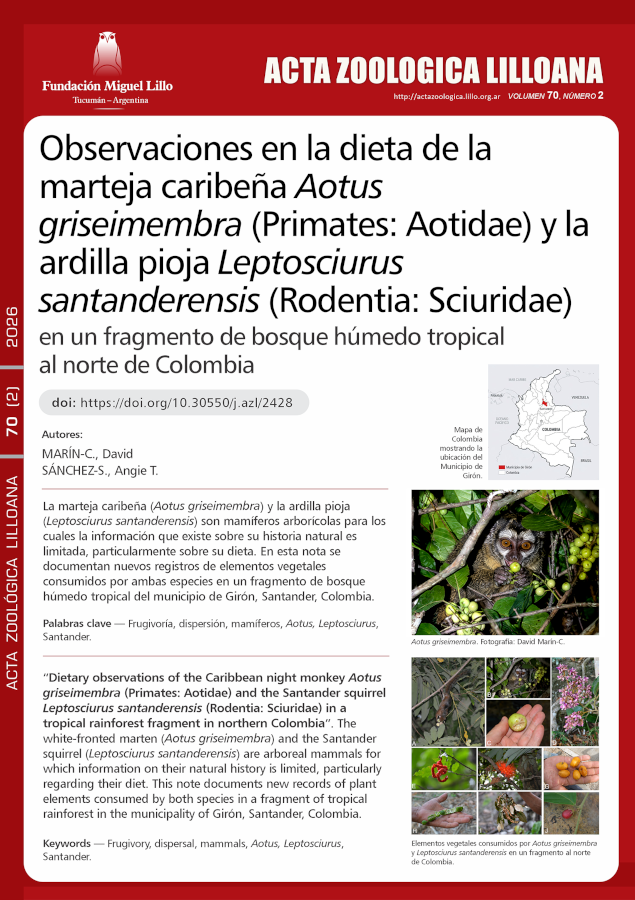
The white-fronted marten (Aotus griseimembra) and the Santander squirrel (Leptosciurus santanderensis) are arboreal mammals for which information on their natural history is limited, particularly regarding their diet. This note documents new records of plant elements consumed by
both species in a fragment of tropical rainforest in the municipality of Girón, Santander, Colombia. Observations were made during freeranging surveys conducted between 2014 and 2015, in which feeding sites and foraging behavior were recorded. During the study, 18 individuals of A. griseimembra and 32 individuals of L. santanderensis
were recorded, and a total of 12 plant elements consumed by these species were identified. The white-fronted marten fed on nine plant species, primarily fruits of Cecropia peltata and Ficus sp., as well as flowers of Dipteryx sp. The squirrel, for its part, fed on six species, including fruits of Mabea occidentalis and flowers of Brownea sp. Shared consumption of Casearia sp., Cupania latifolia, and Ficus sp.
was also recorded between the two mammals. These records expand our knowledge of the diet of A. griseimembra and constitute the first reports of dietary items for L. santanderensis. They also highlight the
possible role of both species as consumers of fruits and flowers, and their potential contribution to seed dispersal and vegetation restoration in fragmented tropical landscapes.
Downloads
References
Andresen, E., Arroyo-Rodríguez, V., Ramos-Robles, M. (2018). Primate Seed Dispersal: Old and New Challenges. International Journal of Primatology, 39(3), 443-465. https://doi.org/10.1007/s10764-018-0024-z
Aquino, R., Encarnacion, F. (1994). Field Work and Conservation. En R. J. Baer, F, E. Weller, I. Kakoma (Eds.), Aotus: The Owl Monkey (pp. 59-95).
Bobadilla, S., Enitez, V., Uichón, M. (2016). Asiatic Callosciurus squirrels as seed dispersers of exotic plants in the Pampas. Oxford University Press, 62(3), 215-219. https://doi.org/10.1093/cz/zow009
Camargo, G., Calderón, M. J., Cárdenas, J., Maclennan, J. S., Fernández, J. J., Laguado, Y. A., Tavera, D. F. S., Cáceres, P., Rodríguez, D. R., Villamizar, D., Cano, J. S. C., Ríos, J. A., Burgos, C., Rendón, J. J. P., Ríos, I., Avila-Pinto, Y. N., Payares, M., Peña, P., Peña, N., Aparicio, Y. (2021). Monitoreo de especies endémicas y amenazadas del área de influencia de las vías sustitutivas Central Hidroeléctrica Sogamoso (Versión 1.2). ISAGEN S.A. E.S.P. https://doi.org/10.15472/MXVF3C
Castaño, J. H., Cardona, D., Botero, J. E. (2010). Ecología del mono nocturno andino (Aotus lemurinus) en fragmentos de bosque subandinos de Colombia. Primatología en Colombia: Avances al Principio del milenio, 69-90.
CITES. (2025). Apéndices I, II y III. Convención sobre el Comercio Internacional de Especies Amenazadas de Fauna y Flora Silvestres (CITES). 41, 48.
Cuatrecasas-Arumí, J. (2017). Aspectos de la vegetación natural de Colombia. Parte I. Revista de la Academia Colombiana de Ciencias Exactas, Físicas y Naturales, 41, 100. https://doi.org/10.18257/raccefyn.570
de Abreu-Jr, E. F., Pavan, S. E., Tsuchiya, M. T. N., Wilson, D. E., Percequillo, A. R., Maldonado, J. E. (2020). Museomics of tree squirrels: A dense taxon sampling of mitogenomes reveals hidden diversity, phenotypic convergence, and the need of a taxonomic overhaul. BMC Evolutionary Biology, 20(1), 77. https://doi.org/10.1186/s12862-020-01639-y
De Vivo, M., Carmignotto, A. (2015). Family Sciuridae. En J. L. Patton, U. F. J. Pardiñas, G. D’Elía (Eds.), Mammals of South America, Volume 2: Rodents (pp. 30-31). University of Chicago Press. https://doi.org/10.7208/chicago/9780226169606.001.0001
Defler, T. R. (2010). Historia natural de los primates colombianos. Universidad Nacional de Colombia, Bogotá, Facultad de Ciencias, Departamento de Biología.
Estrada-Villegas, S., Stevenson, P. R., López, O., DeWalt, S. J., Comita, L. S., Dent, D. H. (2023). Animal seed dispersal recovery during passive restoration in a forested landscape. Philosophical Transactions of the Royal Society B: Biological Sciences, 378 (1867). https://doi.org/10.1098/rstb.2021.0076
Evans, T. D., Duckworth, J. W., Timmins, R. J. (2000). Field observations of larger mammals in Laos, 1994-1995. Mammalia, 64, 55-100. 20210076. https://doi.org/10.1515/mamm.2000.64.1.55
Fernandez-Duque, E., Di Fiore, A., Carrillo-Bilbao, G. (2008). Behavior, ecology, and demography of Aotus vociferans in Yasuní National Park, Ecuador. International Journal of Primatology, 29(2), 421-431. https://doi.org/10.1007/s10764-008-9244-y
Fernandez-Duque E, Juárez, C. P., Di Fiore, A. (2008). Adult male replacement and subsequent infant care by male and siblings in socially monogamous owl monkeys (Aotus azarai). Primates, 49(1), 81-84. https://doi.org/10.1007/s10329-007-0056-z
Fleming, T. H., Kress, W. J. (2013). The Ornaments of Life: Coevolution and Conservation in the Tropics. University of Chicago Press. https://doi.org/10.7208/chicago/9780226023328.001.0001
Galetti, M., Paschoal, M., Pedroni, F. (1992). Predation on palm nuts (Syagrus romanzoffiana) by squirrels (Sciurus ingrami) in south-east Brazil. Journal of Tropical Ecology, 8(1), 121-123. https://doi.org/10.1017/S0266467400006210
García-Franco, J. G., Rico-Gray, V. (1991). Biología reproductiva de Tillandsia deppeana Steudel (Bromeliaceae) en Veracruz, México. Brenesia, 35, 61-79. https://hdl.handle.net/20.500.14330/PER01000173889
Glanz, W. E. (1984). Food and Habitat Use by Two Sympatric Sciurus Species in Central Panama. Journal of Mammalogy, 65(2), 342-347. https://doi.org/10.2307/1381179
Hale, S. L., Greer, V. L., Koprowski, J. L., Ramos-Lara, N. (2018). Microsciurus santanderensis (Rodentia: Sciuridae). Mammalian Species, 50(970), 166-169. https://doi.org/10.1093/mspecies/sey017
Hernández-Camacho, J., Cooper, R. (1976). The nonhuman Primates of Colombia. En Thorington, R. W., Heeltne, P. G. (Eds.), Neotropical Primates: Field Studies and Conservation (pp. 35-69). National Academies Press. https://doi.org/10.17226/18666
Holdridge, L. R. (1967). Life zone ecology. En Tropical Science Center. Tropical Science Center.
Howe, H. F., Smallwood, J. (1982). Ecology of Seed Dispersal. Annual Review of Ecology and Systematics, 13(1), 201-228.
Koprowski, J. L., Goldstein, E. A., Bennet, K. R., Pereira-Mendes, C. (2016). Family Sciuridae. En Wilson, D. E., Lacher, T. E., Mittermeier, R. A. (Eds.), Handbook of the mammals of the world. Vol 6—Lagomorphs and Rodents (1.a ed., Vol. 6, pp. 648-838). Lynx.
Koprowski, J. L., Corse, M. (2001). Food habits of the chiricagua fox squirrel (Sciurus nayaritensis chiricahuae). The Southwestern Naturalist, 46(1), 62-65.
Koprowski, J., Roth, L. (2019). Microsciurus santanderensis: Koprowski, J. Roth, L.: The IUCN Red List of Threatened Species 2019: e.T13412A22255091 [Dataset]. https://doi.org/10.2305/IUCN.UK.2019-1.RLTS.T13412A22255091.en
Link, A., Mittermeier, R. A., Urbani, B. (2021). Aotus griseimembra. The IUCN Red List of Threatened Species 2021. https://dx.doi.org/10.2305/IUCN.UK.2021-1.RLTS.T1807A190452803
Link, A., Stevenson, P. R. (2004). Fruit dispersal syndromes in animal disseminated plants at Tinigua National Park, Colombia. Revista Chilena de Historia Natural, 77(2), 319-334. https://doi.org/10.4067/S0716-078X2004000200010
Marín-Gómez, O. H. (2008). Consumo de néctar por Aotus lemurinus y su rol como posible polinizador de las flores de Inga edulis (Fabales: Mimosoideae). Neotropical Primates, 15(1), 30-32. https://doi.org/10.1896/044.015.0108
Rocha, E. C., Brito, D., Silva, P. M. E., Silva, J., Bernardo, P. V. D. S., Juen, L. (2018). Effects of habitat fragmentation on the persistence of medium and large mammal species in the Brazilian Savanna of Goiás State. Biota Neotropica, 18(3). https://doi.org/10.1590/1676-0611-bn-2017-0483
Schmid, R., Forget, P. M., Lambert, J. E., Hulme, P. E., Wall, S. B. V. (2005). Seed Fate: Predation, Dispersal, and Seedling Establishment. Taxon, 54(3), 844. https://doi.org/10.2307/25065456
Solari, S., Muñoz-Saba, Y., Rodríguez-Mahecha, J. V, Defler, T. R., Ramírez-Chaves, H. E., Trujillo, F. (2013). Riqueza, endemismo y conservación de los mamíferos de Colombia. Mastozoología Neotropical, 20(2), 301-365.
Steele, M. A., Yi, X. (2020). Squirrel-Seed Interactions: The Evolutionary Strategies and Impact of Squirrels as Both Seed Predators and Seed Dispersers. Frontiers in Ecology and Evolution, 8, 259. https://doi.org/10.3389/fevo.2020.00259
Tinoco-Sotomayor, A. N., García-Restrepo, S. (2023). Registros y notas ecológicas de Aotus griseimembra Elliot, 1912 en los Montes de María, Colombia. Neotropical Primates, 29(1), 88-91. https://doi.org/10.62015/np.2023.v29.778
Wehncke, E. V, Hubbell, S. P., Foster, R. B., Dalling, J. W. (2003). Seed dispersal patterns produced by white-faced monkeys: Implications for the dispersal limitation of neotropical tree species. Journal of Ecology, 91, 677-685.
Downloads
Published
How to Cite
Issue
Section
License
Copyright (c) 2026 Acta Zoológica Lilloana

This work is licensed under a Creative Commons Attribution-NonCommercial-NoDerivatives 4.0 International License.