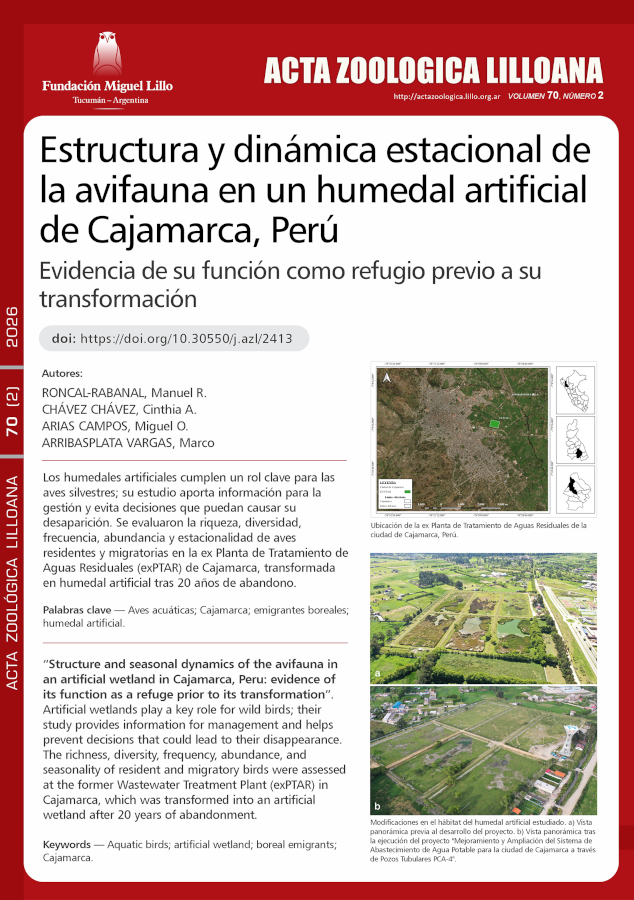
Structure and seasonal dynamics of the avifauna in an artificial wetland in Cajamarca, Peru: evidence of its function as a refuge prior to its transformation
Authors
-
Manuel Roberto Roncal Rabanal
Gabinete de Recursos Naturales, Escuela Académico Profesional de Ingeniería Ambiental, Uni- versidad Nacional de Cajamarca, Filial Celendín. Shuitute s/n, Chacapampa, Celendín, Cajamarca, Perú.
 https://orcid.org/0000-0002-7870-9824
-
Cinthia Chávez Chávez
Gabinete de Recursos Naturales, Escuela Académico Profesional de Ingeniería Ambiental, Universidad Nacional de Cajamarca, Filial Celendín. Shuitute s/n, Chacapampa, Celendín, Cajamarca, Perú.
https://orcid.org/0000-0002-4948-3328
-
Miguel Arias Campos
Gabinete de Recursos Naturales, Escuela Académico Profesional de Ingeniería Ambiental, Universidad Nacional de Cajamarca, Filial Celendín. Shuitute s/n, Chacapampa, Celendín, Cajamarca, Perú.
https://orcid.org/0000-0001-9724-8149
-
Marco Arribasplata Vargas
Empresa Prestadora de Servicios de Saneamiento de Cajamarca S.A (SEDACAJ), Cruz de Piedra N°150, Cajamarca, Perú.
https://orcid.org/0000-0001-6315-3109
DOI:
 https://doi.org/10.30550/j.azl/2413
Keywords:
acuatic birds, artificial wetland, boreal emigrants, CajamarcaAbstract
Artificial wetlands play a key role for wild birds; their study provides information for management and helps prevent decisions that could lead to their disappearance. The richness, diversity, frequency, abundance, and seasonality of resident and migratory birds were assessed at the former Wastewater Treatment Plant (exPTAR) in Cajamarca, which was transformed into an artificial wetland after 20 years of abandonment. Direct counts were conducted over 40 weeks (November 2020–October 2021) through observation and auditory recording between 7:00 and 9:00 a.m., supplemented with data from the 2018–2020 period. A total of 92 species were recorded; 73 species (27 families) were identified during the 2020–2021 period, including 30 aquatic species, nine boreal migrants, one endemic to Peru and Ecuador, and 12 species listed in Appendix II of CITES, all of which are of Least Concern. The Margalef index (4.02–6.80) indicated high diversity. The most frequent species were S. cyanoptera, A. georgica, Z. auriculata, P. sanguinolentus, G. galeata, F. ardesiaca, P. rubinus, T. musculus, and Z. capensis, while P. ridgwayi was the most abundant. Boreal migratory birds showed seasonality from September to April; the others were resident. Species outside their traditional range were recorded, such as A. bahamensis and P. unicinctus, in addition to new records for the area (S. sylvicola, B. exilis, and P. martinica) and one record outside the Amazonian range (B. versicolurus). The implementation of the PCA-4 project (2022–2024) modified the wetland, affecting the avifauna and their habitats.Downloads
References
Becerra Serial, R. M., & Grigera, D. (2005). Dinámica estacional del ensamble de aves de un bosque norpatagónico de lenga (Nothofagus pumilio) y su relación con la disponibilidad de sustratos de alimentación. Hornero, 20(2), 131–139. https://doi.org/10.56178/eh.v20i2.803
Begazo, A. (2023). Perú aves. CORBIDI. https://www.peruaves.org
Brightsmith, D., Burgio, K. R., Hiller, B. J., Block, K. E., Pyle, P., & Patten, M. A. (2020). White-winged parakeet (Brotogeris versicolurus) (Version 1.0). En P. G. Rodewald (Ed.), Birds of the World. Cornell Lab of Ornithology. https://doi.org/10.2173/bow.whwpar.01
Cheng, C., & Ma, Z. (2023). Conservation interventions are required to improve bird breeding performance in artificial wetlands. Biological Conservation, 278, 109872. https://doi.org/10.1016/j.biocon.2022.109872
Clarkson, B. R., Ausseil, A. G. E., & Gerbeaux, P. (2013). Wetland ecosystem services. En J. R. Dymond (Ed.), Ecosystem services in New Zealand: Conditions and trends. Manaaki Whenua Press. https://doi.org/10.7931/DL1V30
Ministerio del Ambiente. (2021). Decreto Supremo N.° 006-2021-MINAM: Disposiciones generales para la gestión multisectorial y descentralizada de los humedales. Diario Oficial El Peruano.
eBird. (2021). eBird: An online database of bird distribution and abundance. Cornell Lab of Ornithology. https://www.ebird.org
Eitniear, J. C., del Hoyo, J., Collar, N., & Kirwan, G. M. (2020). Comb duck (Sarkidiornis sylvicola) (Version 1.0). En S. M. Billerman, B. K. Keeney, P. G. Rodewald, & T. S. Schulenberg (Eds.), Birds of the World. Cornell Lab of Ornithology. https://doi.org/10.2173/bow.comduc3.01
Giosa, E., Mammides, C., & Zotos, S. (2018). The importance of artificial wetlands for birds: A case study from Cyprus. PLoS ONE, 13(5), e0197286. https://doi.org/10.1371/journal.pone.0197286
Gray, M. J., Hagy, H. M., Nyman, J. A., & Stafford, J. D. (2013). Management of wetlands for wildlife. En J. T. Anderson & C. A. Davis (Eds.), Wetland techniques. Springer.
Gucel, S., Kadis, C., Ozden, O., Charalambidou, I., Linstead, C., Fuller, W., Kounnamas, C., & Ozturk, M. (2012). Assessment of biodiversity differences between natural and artificial wetlands in Cyprus. Pakistan Journal of Botany, 44, 213–224.
Hale, R., Swearer, S. E., Sievers, M., & Coleman, R. (2019). Balancing biodiversity outcomes and pollution management in urban stormwater treatment wetlands. Journal of Environmental Management, 233, 302–307. https://doi.org/10.1016/j.jenvman.2018.12.049
International Union for Conservation of Nature. (2023). The IUCN Red List of Threatened Species (Version 2023-1). https://www.iucnredlist.org
Juri, M. D., & Chani, J. M. (2009). Variación estacional en la composición de las comunidades de aves en un gradiente urbano. Ecología Austral, 19(3), 175–184. https://ojs.ecologiaaustral.com.ar/index.php/Ecologia_Austral/article/view/1330
Li, D., Chen, S., Lloyd, H., Zhu, S., Shan, K., & Zhang, Z. (2013). The importance of artificial habitats to migratory waterbirds within a natural/artificial wetland mosaic, Yellow River Delta, China. Bird Conservation International, 23(2), 184–198. https://doi.org/10.1017/S0959270913000099
Ministerio del Ambiente. (2015). Guía de inventario de la fauna silvestre.
Ministerio del Ambiente. (2018). Listado de especies de fauna silvestre CITES-Perú.
Mitsch, W. J., Bernal, B., & Hernandez, M. E. (2015). Ecosystem services of wetlands. International Journal of Biodiversity Science, Ecosystem Services & Management, 11(1), 1–4. https://doi.org/10.1080/21513732.2015.1006250
Mora-Donjuán, C. A., Burbano-Vargas, O. N., Méndez-Osorio, C., & Castro-Rojas, D. F. (2017). Evaluación de la biodiversidad y caracterización estructural de un bosque de encino (Quercus L.) en la Sierra Madre del Sur, México. Revista Forestal Mesoamericana Kurú, 14(35), 68. https://doi.org/10.18845/rfmk.v14i35.3154
Moore, T. L., & Hunt, W. F. (2012). Ecosystem service provision by stormwater wetlands and ponds: A means for evaluation. Water Research, 46(20), 6811–6823. https://doi.org/10.1016/j.watres.2011.11.026
Moreno, C. E. (2001). Métodos para medir la biodiversidad. Manuales y Tesis SEA.
Murillo?Pacheco, J., López?Iborra, G. M., Escobar, F., Bonilla?Rojas, W. F., & Verdú, J. R. (2018). The value of small, natural and man?made wetlands for bird diversity in the east Colombian Piedmont. Aquatic Conservation: Marine and Freshwater Ecosystems, 28(1), 87–97. https://doi.org/10.1002/aqc.2835
Ocampo-Peñuela, N. (2010). El fenómeno de la migración en aves: Una mirada desde la Orinoquia. Orinoquia, 14(2), 188–200.
Planqué, B., Vellinga, W. P., Pieterse, S., Jongsma, J., & De By, R. (2022). Xeno-canto: Sharing bird sounds from around the world. https://www.xeno-canto.org
Plenge, M. (2026). Lista de las aves del Perú. Unión de Ornitólogos del Perú. https://sites.google.com/site/boletinunop/checklist
Rajpar, M. N., & Zakaria, M. (2013). Assessing an artificial wetland in Putrajaya, Malaysia, as an alternate habitat for waterbirds. Waterbirds, 36(4), 482–493. https://doi.org/10.1675/063.036.0405
Rajpar, M. N., Ahmad, S., Zakaria, M., Ahmad, A., Guo, X., Nabi, G., & Wanghe, K. (2022). Artificial wetlands as alternative habitat for a wide range of waterbird species. Ecological Indicators, 138, 108855. https://doi.org/10.1016/j.ecolind.2022.108855
Roncal-Rabanal, M. R., Arias Campos, M., Chávez Chávez, C., & Soto Camacho, C. (2020). Avifauna del área urbana de la ciudad de Cajamarca. Caxamarca, 19, 63–76.
Schulenberg, T. S., Stotz, D. F., Lane, D. F., O’Neill, J. P., & Parker III, T. A. (2010). Birds of Peru. Princeton University Press.
Schulenberg, T. S., & Sedgwick, C. W. (2021). Spot-throated hummingbird (Thaumasius taczanowskii) (Version 1.1). En T. S. Schulenberg (Ed.), Birds of the World. Cornell Lab of Ornithology. https://doi.org/10.2173/bow.spthum2.01.1
Söderquist, P., Dessborn, L., Djerf, H., Elmberg, J., Gunnarsson, G., & Holopainen, S. (2021). Effects of released farmed mallards on species richness of breeding waterbirds and amphibians in natural, restored and constructed wetlands. Wildlife Biology, 2021(3), wlb-00846. https://doi.org/10.2981/wlb.00846
Toledo Castillo, S., Aponte, H., & Gil Villacres, F. (2023). La conservación de los humedales peruanos: Un análisis de su legislación, sanciones y consecuencias. Revista Kawsaypacha, 11, 1–18. https://doi.org/10.18800/kawsaypacha.202301.a004
Tinoco, B. A. (2009). Seasonality of the bird community in the Tumbesian dry forest in southwest Ecuador. Ornitología Neotropical, 20(2), 157–170.
Villegas Espinoza, K. J., & Zamora Pablo, R. M. (2019). Estudio de la avifauna en la ex planta de tratamiento de aguas residuales para la conservación de la biodiversidad en Cajamarca [Tesis de pregrado, Universidad Privada del Norte]. https://hdl.handle.net/11537/21541
Worrall, P., Peberdy, K. J., & Millett, M. C. (1997). Constructed wetlands and nature conservation. Water Science and Technology, 35(5), 205–213. https://doi.org/10.2166/wst.1997.0199
Zhang, C., Wen, L., Wang, Y., Liu, C., Zhou, L., & Lei, G. (2020). Can constructed wetlands be wildlife refuges? A review of their potential biodiversity conservation value. Sustainability, 12(4), 1442. https://doi.org/10.3390/su12041442
Downloads
Published
How to Cite
Issue
Section
License
Copyright (c) 2026 Acta Zoológica Lilloana

This work is licensed under a Creative Commons Attribution-NonCommercial-NoDerivatives 4.0 International License.