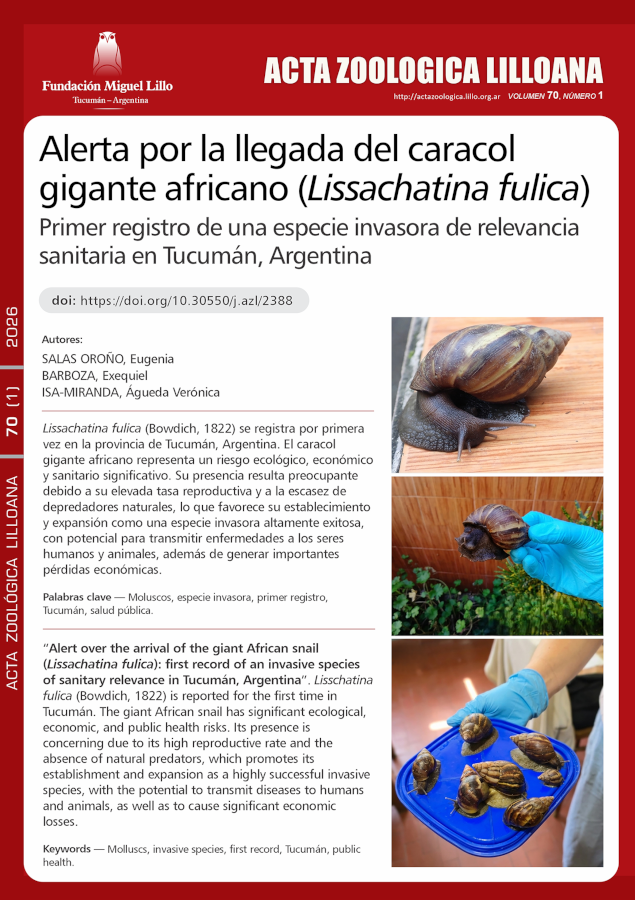
Alert over the arrival of the giant African snail (Lissachatina fulica): first record of an invasive species of sanitary relevance in Tucumán, Argentina
Authors
-
Eugenia Salas Oroño
Instituto de Invertebrados, Fundación Miguel Lillo
 https://orcid.org/0000-0003-2058-8609
-
Exequiel Barboza
Museo de Ciencias Naturales, Fundación Miguel Lillo
https://orcid.org/0009-0007-2371-5403
-
Águeda Verónica Isa-Miranda
nstituto de Invertebrados, Fundación Miguel Lillo; CONICET
https://orcid.org/0000-0002-3300-7490
DOI:
 https://doi.org/10.30550/j.azl/2388
Keywords:
Molluscs, invasive species, first record, Tucumán, public healthAbstract
Lisschatina fulica (Bowdich, 1822) is reported for the first time in Tucumán. Until now, this invasive species had only been recorded in Argentina from Misiones and Corrientes. The giant African snail has significant ecological, economic, and public health risks. Live specimens were found in the garden of a residential building in the Ciudadela neighborhood, in the capital city. A plausible hypothesis is that the species was accidentally introduced through gardening activities. Its presence is concerning due to its high reproductive rate and the absence of natural predators, which promotes its establishment and expansion as a highly successful invasive species, with the potential to transmit diseases to humans and animals, as well as to cause significant economic losses.
Downloads
References
Bowdich, T. E. (1822). Elements of conchology, including the fossil genera and the animals. Part I. Univalves. Paris, 79 pp., 19 pls. DOI: https://doi.org/10.5962/bhl.title.12480
Cuezzo, M. G. (2004). Gigante africano: Una plaga potencial para nuestro país. Vida Silvestre, 89, 52–55.
Fontanilla, I. K. C. (2010). Achatina (Lissachatina) fulica Bowdich: Its molecular phylogeny, genetic variation in global populations, and its possible role in the spread of the rat lungworm Angiostrongylus cantonensis (Chen). University of Nottingham.
Gutiérrez Gregoric, D. E., Núñez, V., Vogler, R., & Rum, A. (2011). Invasion of the Argentinean Paranense rainforest by the giant African snail Achatina fulica. American Malacological Bulletin, 29, 135–137. https://doi.org/10.4003/006.029.0205 DOI: https://doi.org/10.4003/006.029.0205
Gutiérrez Gregoric, D. E., & Beltramino, A. A. (2021). El caracol gigante africano a 10 años de su detección en la Argentina. Boletín de la Asociación Argentina de Malacología, 11(1), 16–23.
Gutiérrez Gregoric, D. E., Núñez, V., Vogler, R. E., & Rum, A. (2012). Un gigante africano invade la Argentina. Ciencia Hoy, 22(129), 39–43.
Lowe, S., Browne, M., Boudjelas, S., & De Poorter, M. (2004). 100 of the world’s worst invasive alien species: A selection from the global invasive species database. Genéve: ISSG/SSC/IUCN, 12 pp.
Reinante, E., Teibler, G. P., Álvarez, J. D., & Vizcaychipi, K. A. (2022). Estudio epidemiológico y parasitológico de caracoles gigantes africanos (Lissachatina fulica) en Misiones, Argentina. Revista Veterinaria, 33(1), 3–10. DOI: https://doi.org/10.30972/vet.3315870
Salas Oroño, E. (2018). Caracol de boca rosada (Megalobulimus oblongus). Universo Tucumano, 3. Fundación Miguel Lillo.
Virgillito, M., Orellana, J. D., Giménez, J. E., Veller, M., & Méndez, P. H. (2015). Situación actual del caracol gigante africano (Achatina fulica) en la Argentina. SNS, (8), abril–junio. Servicio Nacional de Sanidad y Calidad Agroalimentaria (SENASA).
https://www.boletinoficial.gob.ar/detalleAviso/primera/237478/20201119
Downloads
Published
How to Cite
Issue
Section
License
Copyright (c) 2026 Acta Zoológica Lilloana

This work is licensed under a Creative Commons Attribution-NonCommercial-NoDerivatives 4.0 International License.