New haplotypes found in specimens of Puma concolor (Carnivora: Felidae) from Argentina
Authors
-
Ailén Dumont
Escuela de Medicina Veterinaria, Facultad de Ciencias de la Vida, Universidad Andrés Bello, República 440, Santiago, 8370251, Chile
 https://orcid.org/0000-0002-4986-696X
-
Pablo Siroski
Laboratorio de Ecología Molecular Aplicada (LEMA-ICIVET-CONICET), FCV, UNL
https://orcid.org/0000-0002-4011-8260
-
Antonio Sciabarrasi
Cátedra de Zoología, Diversidad y Ambiente, Facultad de Ciencias Veterinarias, Universidad Nacional del Litoral
https://orcid.org/0000-0002-0601-3166
-
Gisela Poletta
Cátedra de Toxicología, Farmacología y Bioquímica Legal, Facultad de Bioquímica y Ciencias Biológicas, Universidad Nacional del Litoral-CONICET
https://orcid.org/0000-0003-2375-8319
-
Patricia Amavet
Laboratorio de Genética, Facultad de Humanidades y Ciencias, Universidad Nacional del Litoral-CONICET
https://orcid.org/0000-0001-8143-7498
DOI:
 https://doi.org/10.30550/j.azl/2373
Keywords:
mammals, population of origin, ND5 gene, puma-human conflicts, conservation geneticsAbstract
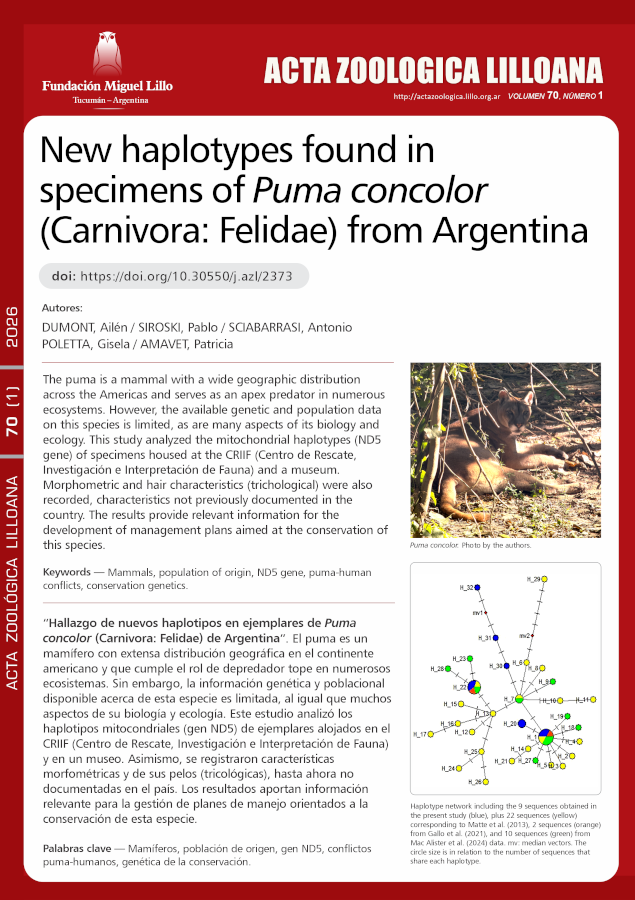
The puma is a mammal with a wide geographic distribution across the Americas, serving as an apex predator in different ecosystems. However, the available genetic and population information about this species is limited, as are many aspects of its biology and ecology. Habitat reduction and fragmentation have intensified conflicts between pumas and humans, leading to a decline in their populations in Argentina, primarily due to retaliatory hunting for livestock attacks. In Santa Fe province, numerous pumas are confiscated during wildlife checks or due to conflict situations and transferred to the Centro de Rescate e Interpretación de Fauna La Esmeralda (CRIIF) in Santa Fe city. After their recovery, some individuals are reintroduced into the wild without considering their genetic information. This study analyzed the mitochondrial haplotypes (ND5 gene) of puma specimens housed at the CRIIF and in a museum to infer their possible population of origin based on haplotypes previously described for the species in Argentina. Morphometric and trichological characteristics, previously undocumented in the country, were also recorded. Four previously unreported haplotypes and five that coincided with previous records were identified. Morphometric measurements were characterized by sex and age, and trichological data were obtained, providing relevant information for the development of management plans to conserve this species.
Downloads
References
Amavet, P. S., Vilardi, J. C., Rosso, E., Saidman, B. (2009). Genetic and morphometric variability in Caiman latirostris (broad-snouted caiman), Reptilia, Alligatoridae. Journal of Experimental Zoology Part A: Ecological Genetics and Physiology, 311(4), 258–269. DOI: https://doi.org/10.1002/jez.523
Baca Ibarra, I. I., Sánchez-Cordero, V. , Stoner, K. E. (2010). Morfología del pelo en mamíferos terrestres. 60 Años de La Colección Nacional de Mamíferos del Instituto de Biología, UNAM. Aportaciones al Conocimiento y Conservación de los Mamíferos Mexicanos, 89–102.
Bandelt, H. J., Forster, P., Röhl, A. (1999). Median-joining networks for inferring intraspecific phylogenies. Molecular Biology and Evolution, 16, 37–48. DOI: https://doi.org/10.1093/oxfordjournals.molbev.a026036
Beck, T., Beecham, J., Beier, P., Hofstra, T., Hornocker, M., Lindzey, F., Logan, K., Pierce, B., Quigley, H., Ross, I., Shaw, H., Sparrowe, R., Torres, S. (2007). Cougar Management Guidelines (1 ed.). Wild futures.
Chehébar, C., Martín, S. (1989). Guía para el reconocimiento microscópico de los pelos de los mamíferos de la Patagonia. Doñana, Acta Vertebrata, 16, 247–291.
Culver, M., Johnson, W. E., Pecon-Slattery, J., O’Brien, S. J. (2000). Genomic ancestry of the American puma (Puma concolor). Journal of Heredity, 91(3), 186–197. DOI: https://doi.org/10.1093/jhered/91.3.186
Dávila Flores, K. J.,Matos Suclupe, A.R. (2018). Tricología para la identificación de Especies de Mamíferos Silvestres y Razas Domésticas en los Distritos de la Región Lambayeque, 2018. Tesis de grado, Departamento Académico de Biología, Facultad de Ciencias Biológicas, Universidad Nacional Pedro Ruiz Gallo, Perú. https://1library.co/document/q7wgg1dz-tricologia-identificacion-especies-mamiferos-silvestres-domesticas-distritos-lambayeque.html
De Angelo, C., Llanos, R., M., G. M., Varela, D., Valenzuela, A. E. J., Pía, M. V., Monteverde, M., Reppucci, J. I., Lucherini, M., D’Agostino, R., J., B. M., Quiroga, V. A. (2019). Puma concolor. SAyDS–SAREM (Eds.) Categorización 2019 de los Mamíferos de Argentina Según Su Riesgo de Extinción. Lista Roja de los Mamíferos de Argentina. DOI: https://doi.org/10.31687/SaremLR.19.150
Ferreira, M. A., Allemann, N., Dias, L. G. G. G., dos Santos Honsho, C. (2014). Relação entre a biometria ultrassonográfica ocular e os parâmetros morfométricos do crânio, idade, peso e gênero em gatos domésticos. Pesquisa Veterinaria Brasileira, 34(2), 192–198. DOI: https://doi.org/10.1590/S0100-736X2014000200016
Gallo, O., Castillo, D.F., Godinho, R., Mac Allister, M.E., Fernández, G.P., Failla, M., Casanave, E.B. (2021). Molecular data reveal a structured puma (Puma concolor) population in northern Patagonia, Argentina. Mammalian Biology, 101, 653-663. DOI: https://doi.org/10.1007/s42991-021-00160-z
Gonçalves, F., Bovendorp, R.S., Beca, G., Bello, C., Costa-Pereira, R., Muylaert, R.L., Rodarte, R.R., Villar, N., Souza, R., Graipel, M.E., Cherem, J.J., Faria, D., Baumgarten, J., Alvarez, M.R., Vieira, E.M., Cáceres, N., Pardini, R., Leite, Y.L.R., Costa, L.P., Mello, M.A.R., Fischer, E., Passos, F.C., Varzinczak, L.H., Prevedello, J.A., Cruz-Neto, A.P., Carvalho, F., Percequillo, A.R., Paviolo, A., Nava, A., Duarte, J.M.B., de la Sancha, N.U., Bernard, E., Morato, R.G., Ribeiro, J.F., Becker, R.G., Paise, G., Tomasi, P.S., Vélez-Garcia, F., Melo, G.L., Sponchiado, J., Cerezer, F., Barros, M.A.S., de Souza, A.Q.S., Dos Santos, C.C., Giné, G.A.F., Kerches-Rogeri, P., Weber, M.M., Ambar, G., Cabrera-Martinez, L.V., Eriksson, A., Silveira, M., Santos, C.F., Alves, L., Barbier, E., Rezende, G.C., Garbino, G.S.T., Rios, É.O., Silva, A., Nascimento, A.T.A., de Carvalho, R.S., Feijó, A., Arrabal, J., Agostini, I., Lamattina, D., Costa, S., Vanderhoeven, E, de Melo, F.R., de Oliveira Laroque, P., Jerusalinsky, L., Valença-Montenegro, M.M., Martins, A.B., Ludwig, G., de Azevedo, R.B., Anzóategui, A., da Silva, M.X., Figuerêdo Duarte Moraes, M., Vogliotti, A., Gatti, A., Püttker, T., Barros, C.S., Martins, T.K., Keuroghlian, A., Eaton, D.P., Neves, C.L., Nardi, M.S., Braga, C., Gonçalves, P.R., Srbek-Araujo, A.C., Mendes, P., de Oliveira, J.A., Soares, F.A.M., Rocha, P.A., Crawshaw, P. Jr, Ribeiro, M.C., Galetti, M. (2018) Atlantic mammal traits: a data set of morphological traits of mammals in the Atlantic Forest of South America. Ecology, 99 (2):498. https://doi.org/10.1002/ecy.2106. PMID: 29399824 DOI: https://doi.org/10.1002/ecy.2106
Guerisoli, M., Luengos Vidal, E., Franchini, M., Caruso, N., Casanave, E.B. , Lucherini, M. (2017). Characterization of puma–livestock conflicts in rangelands of central Argentina. Royal Society Open Science 4:170852. DOI: https://doi.org/10.1098/rsos.170852
Katoh, K., Rozewicki,J., Yamada,K.D. (2019). MAFFT online service: multiple sequence alignment, interactive sequence choice and visualization. Briefings in Bioinformatics, 20 (4), 1160–1166. https://doi.org/10.1093/bib/bbx108 DOI: https://doi.org/10.1093/bib/bbx108
Kumar, S., Stecher, G., Li, M., Knyaz, C., Tamura, T. (2018). MEGA X: Molecular Evolutionary Genetics Analysis across Computing Platforms. Molecular Biology and Evolution, 35(6), 1547–1549. DOI: https://doi.org/10.1093/molbev/msy096
Librado, P., Rozas, J. (2009). DnaSP v5: a software for comprehensive analysis of DNA polymorphism data. Bioinformatics, 25, 1451–1452. https://doi.org/10.1093/bioinformatics/btp187 DOI: https://doi.org/10.1093/bioinformatics/btp187
Llanos, R., Andrade, A., Travaini, A. (2020).Puma and livestock in central Patagonia (Argentina): from ranchers’ perceptions to predator management. Human Dimensions of Wildlife, 25, 1, 1-16. DOI: https://doi.org/10.1080/10871209.2019.1668987
López Romero, A. P. (2008). Determinación de variables morfométricas corporales en cien felinos en tres clínicas del norte de Bogotá. Tesis de grado, Facultad de Medicina Veterinaria, Universidad de La Salle, Colombia. https://ciencia.lasalle.edu.co/items/f0d273b8-27a1-46c4-a9b1-1ceb9c7d1ce8
Mac Allister, M.E. (2019). Caracterización genética del puma (Puma concolor Linnaeus, 1771) en la patagonia, a través de marcadores moleculares mitocondriales (ND5 y región control). Tesis de grado, Escuela de Ciencias Agrarias, Naturales y Ambientales, Universidad Nacional del Noroeste de la Provincia de Buenos Aires, Argentina. https://repositorio.unnoba.edu.ar:8080/xmlui/handle/23601/436
Mac Allister, M.E., Figueroa, C.E., Mazzei, R., Tintorelli, R.G., Acosta, D.B., Gallo, O., Castillo, D., Pinardi, E., Zelada Perrone, V.D., Rodríguez, A., Zanón Martínez, J.I., Merino, M.L., Túnez, J.I., Travaini, A., Fernández, G.P. (2024) Genetic diversity and diversification patterns of puma (Puma concolor) populations in the southern end of the species distribution. Frontiers in Ecology and Evolution, 12, 1436320. https://doi.org/10.3389/fevo.2024.1436320 DOI: https://doi.org/10.3389/fevo.2024.1436320
Matte, E. M., Castilho, C. S., Miotto, R. A., Sana, D. A., Johnson, W. E., O’Brien, S. J., de Freitas, T. R. O., Eizirik, E. (2013). Molecular evidence for a recent demographic expansion in the puma (Puma concolor) (Mammalia, Felidae). Genetics and Molecular Biology, 36(4), 586–597. DOI: https://doi.org/10.1590/S1415-47572013000400018
Ojeda, G. N., Amavet, P. S., Rueda, E. C., Siroski, P. A., (2012). DNA extraction from skins of wild (Hydrochoerus hydrochaeris and Pecari tajacu) and domestic (Sus scrofa domestica) species using a novel protocol. Genetics and Molecular Research, 11(1), 672-78. DOI: https://doi.org/10.4238/2012.March.19.1
Palacios, R.(2007). Manual para la identificación de carnívoros andinos. Guía de campo. Alianza Gato Andino, Córdoba, Argentina.
Palma Pecho, A. E. (2019). Caracterización de los pelos de las presas potenciales del puma (Puma concolor) en el sector Sauce Grande del coto de caza El Angolo, Piura, Perú. Tesis de Grado, Facultad de Ciencias Forestales, Universidad Nacional Agraria La Molina.
Paviolo, A., Cruz, P., Iezzi, M.E., Martínez Pardo, J., Varela, D., De Angelo, C., Benito, S., Vanderhoeven, E., Palacio, E., Quiroga, V., Arrabal, J.P., Costa, S., Di Bitetti, M.S. (2018). Barriers, corridors, or suitable habitat? Effect of monoculture tree plantations on the habitat use and prey availability for jaguars and pumas in the Atlantic Forest. Forest Ecology and Management, 430, 576-586. https://doi.org/10.1016/j.foreco.2018.08.029 DOI: https://doi.org/10.1016/j.foreco.2018.08.029
Pech-Canché, J. M., Sosa–Escalante, J. E., Koyoc Cruz, M. E. (2009). Guía para la identificacion de pelos de guardia de mamíferos no voladores del Estado de Yucatán, México. Revista Mexicana de Mastozoología, 13(1), 7–33. DOI: https://doi.org/10.22201/ie.20074484e.2009.13.1.33
Pereira J. A., Aprile, G. (2012). Felinos de Sudamérica. Londaiz Laborde Ediciones, Buenos Aires, Argentina.
Quiroga, V. A., Noss, A. J., Paviolo, A., Boaglio, G. I., Di Bitetti, M. S. (2016). Puma density, habitat use and conflict with humans in the Argentine Chaco. Journal for Nature Conservation, 31, 9–15. DOI: https://doi.org/10.1016/j.jnc.2016.02.004
R Core Team (2020). R: A language and environment for statistical computing. R Foundation for Statistical Computing, Vienna, Austria. https://www.R-project.org/
Ripple, W.J., Estes, J.A., Beschta, R.L., Wilmers, C.C., Ritchie, E.G., Hebblewhite, M., Berger, J., Elmhagen, B., Letnic, M., Nelson, M.P., Schmitz, O.J., Smith, D.W., Wallach, A.D., Wirsing, A.J. (2014). Status and ecological effects of the world’s largest carnivores. Science, 343 (6167), 1241484. https://doi.org/10.1126/science.1241484. PMID: 24408439. DOI: https://doi.org/10.1126/science.1241484
Tintorelli, R.G. (2017). Caracterización genética del puma (Puma concolor Linnaeus 1771) en la estepa patagónica de la provincia de Neuquén, a través de marcadores moleculares mitocondriales. Tesis de grado, Escuela de Ciencias Agrarias, Naturales y Ambientales, Universidad Nacional del Noroeste de la Provincia de Buenos Aires, Argentina. https://repositorio.unnoba.edu.ar/xmlui/handle/23601/373
Trigo, T. C., Freitas, T. R. O., Kunzler, G., Cardoso, L., Silva, J. C. R., Johnson, W. E., O’Brien, S. J., Bonatto, S. L. , Eizirik, E. (2008). Inter-species hybridization among Neotropical cats of the genus Leopardus, and evidence for an introgressive hybrid zone between L. geoffroyi and L. tigrinus in southern Brazil. Molecular Ecology, 17,4317–4333. DOI: https://doi.org/10.1111/j.1365-294X.2008.03919.x
Downloads
Published
How to Cite
Issue
Section
License
Copyright (c) 2026 Acta Zoológica Lilloana

This work is licensed under a Creative Commons Attribution-NonCommercial-NoDerivatives 4.0 International License.