Distinct evolutionary lineages of Hoplisoma carlae (Siluriformes: Callichthyidae) due to dispersal barriers
Authors
-
Mariano A. Fernández
Laboratorio de Sistemática y Biología Evolutiva, Facultad de Ciencias Naturales y Museo, Universidad Nacional de La Plata
 https://orcid.org/0009-0001-3951-0265
-
Yanina F. Briñoccoli
Instituto de Limnología “Dr. Raúl A. Ringuelet” (ILPLA). CONICET-CCT La Plata – UNLP
https://orcid.org/0000-0002-4461-291X
-
Sergio Bogan
División Ictiología, Museo Argentino de Ciencias Naturales “Bernardino Rivadavia”
https://orcid.org/0000-0002-4414-1804
-
Manuel Eirin
Instituto de Limnología “Dr. Raúl A. Ringuelet” (ILPLA)
https://orcid.org/0009-0002-9439-257X
-
Dra.
Instituto de Limnología “Dr. Raúl A. Ringuelet” (ILPLA)
https://orcid.org/0000-0003-3497-4359
DOI:
 https://doi.org/10.30550/j.azl/2339
Keywords:
Genetic divergence, Iguazú Waterfalls, isolation, population structure, Sierra de la Victoria, Urugua-í StreamAbstract
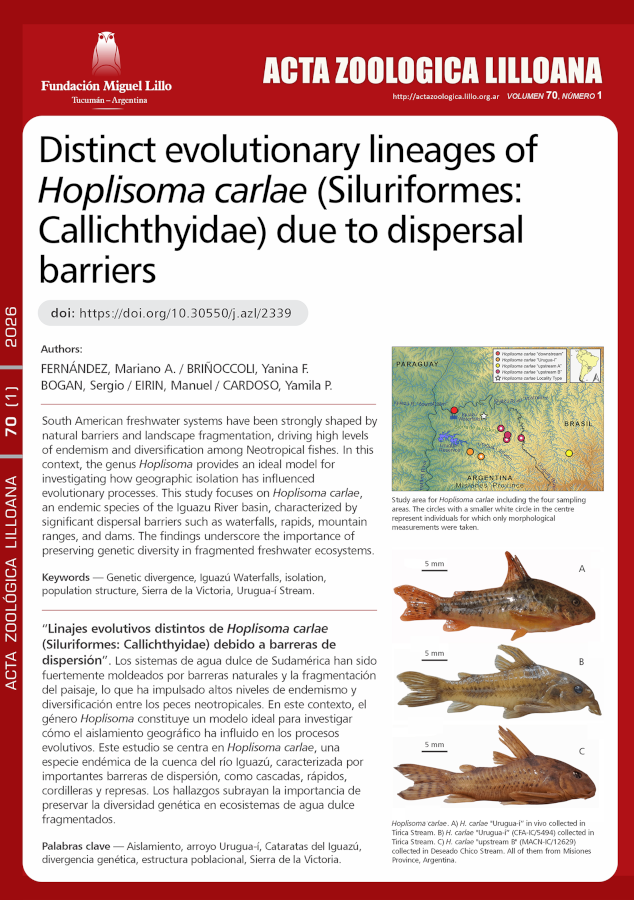
The freshwater systems of South America have been strongly shaped by natural barriers and landscape fragmentation, driving high levels of endemism and diversification among Neotropical fishes. In this context, the subfamily Corydoradinae, particularly the genus Hoplisoma, offers an ideal model to investigate how geographic isolation has influenced evolutionary processes. This study focuses on Hoplisoma carlae, a species endemic to the Iguazú River basin, a region characterized by major dispersal barriers such as waterfalls, rapids, mountain ranges, and dams. We conducted an integrated analysis combining mitochondrial DNA (COI) sequences and morphological data from populations of H. carlae from Argentina and Brazil. Phylogenetic and population structure analyses revealed three well-differentiated groups corresponding to (1) the Urugua-í stream, (2) the upstream Iguazú River (“upstream A”), and (3) downstream sections of the Iguazú (including specimens from near the type locality of H. carlae) (“upstream B”). These groups are likely undergoing recent divergence driven by geographic isolation. The divergence time of H. carlae coincides with the formation of the Iguazu Falls. Our results suggest that natural barriers, including mountain ranges like the Sierra de la Victoria and historical waterfalls, along with recent anthropogenic barriers such as the Urugua-í dam, have contributed to population fragmentation and ongoing lineage divergence in H. carlae. These findings highlight the importance of preserving genetic diversity in fragmented freshwater ecosystems.
Downloads
References
Abell, R., Thieme, M. L., Revenga, C., Bryer, M., Kottelat, M., Bogutskaya, N., … Petry, P. (2008). Freshwater ecoregions of the world: A new map of biogeographic units for freshwater biodiversity conservation. BioScience 58 (5): 403–414. https://doi.org/10.1641/B580507 DOI: https://doi.org/10.1641/B580507
Agostinho, A.A., Pelicice, F.M., Gomes, L. C. (2008). Dams and the fish fauna of the Neotropical region?: impacts and management related to diversity and fisheries. Brazilian Journal of Biology 68 (4, Suppl.): 1119–1132. DOI: https://doi.org/10.1590/S1519-69842008000500019
Agostinho, A. A., Gomes, L. C., Santos, N. C., Ortega, J. C., & Pelicice, F. M. (2016). Fish assemblages in Neotropical reservoirs: Colonization patterns, impacts and management. Fisheries Research 173: 26–36. DOI: https://doi.org/10.1016/j.fishres.2015.04.006
Alexandrou, M. A., Oliveira, C., Maillard, M., McGill, R. A. R., Newton, J., Creer, S., & Taylor, M. I. (2011). Competition and phylogeny determine community structure in Mullerian co-mimics. Nature 469 (7328): 84-88. https://doi.org/10.1038/nature09660 DOI: https://doi.org/10.1038/nature09660
Aljanabi, S. M., & Martinez, I. (1997). Universal and rapid salt-extraction of high quality genomic DNA for PCR-based techniques. Nucleic Acids Research 25 (22): 4692–4693. DOI: https://doi.org/10.1093/nar/25.22.4692
Alonso, F., Terán, G. E., Aguilera, G., Montes, M. M., Serra Alanís, W. S., Calviño, P., … Mirande, J. M. (2025). Integrative phylogeny of Corydoradinae (Siluriformes: Callichthyidae) with an emphasis on northwestern La Plata species, including descriptions of a new genus and species. Zoologischer Anzeiger 314: 10–23. https://doi.org/10.1016/j.jcz.2024.11.006 DOI: https://doi.org/10.1016/j.jcz.2024.11.006
Baumgartner, G., Pavanelli, C. S., Baumgartner, D., Bifi, A. G., Debona, T., & Frana, V. A. (2012). Peixes do baixo rio Iguaçu. Maringá: Eduem. DOI: https://doi.org/10.7476/9788576285861
Britto, M. R. (2003). Phylogeny of the subfamily Corydoradinae Hoedeman , 1952 (Siluriformes: Callichthyidae), with a definition of its genera. Proceedings of the Academy of Natural Sciences of Philadelphia 153: 119–154. https://doi.org/https://doi.org/10.1635/0097- 3157(2003)153[0119:POTSCH]2.0.CO;2 DOI: https://doi.org/10.1635/0097-3157(2003)153[0119:POTSCH]2.0.CO;2
da Rocha, R. H., Fernandes, C. A., Bignotto, T. S., Margarido, V. P., Tencatt, L. F. C., da Graça, W. J., & Gubiani, E. A. (2022). Integrated analysis reveals a new species of Corydoras Lacépède, 1803 (Siluriformes: Callichthyidae) in the lower Iguassu River, Brazil. Organisms Diversity & Evolution 22: 457–474. https://doi.org/10.1007/s13127-021-00534-8 DOI: https://doi.org/10.1007/s13127-021-00534-8
Darriba, D., Taboada, G. L., Doallo, R., & Posada, D. (2015). Europe PMC Funders Group jModelTest 2?: more models , new heuristics and high- performance computing. Nature Methods 9 (8): 6–9. https://doi.org/10.1038/nmeth.2109.jModelTest DOI: https://doi.org/10.1038/nmeth.2109
Delariva, R. L., Neves, M. P., Larentis, C., Caroline, B., Kliemann, K., Baldasso, M. C., & Wolff, L. L. (2018). Fish fauna in forested and rural streams from an ecoregion of high endemism, lower Iguaçu River basin, Brazil. Biota Neotropica 18 (3): e20170459. DOI: https://doi.org/10.1590/1676-0611-bn-2017-0459
Dias, A. C., Tencatt, L. F. C., Roxo, F. F., Silva, G. de S. da C., Santos, S. A., Britto, M. R., … Oliveira, C. (2025). Phylogenomic analyses in the complex Neotropical subfamily Corydoradinae (Siluriformes: Callichthyidae) with a new classification based on morphological and molecular data. Zoological Journal of the Linnean Society 203 (3): zlaf035. https://doi.org/10.1093/zoolinnean/zlae053 DOI: https://doi.org/10.1093/zoolinnean/zlae053
Dray, S., & Dufour, A. B. (2007). The ade4 package: Implementing the duality diagram for ecologists. Journal of Statistical Software 22 (4): 1–20. https://doi.org/10.18637/jss.v022.i04 DOI: https://doi.org/10.18637/jss.v022.i04
Ebner, B. C., Donaldson, J. A., Murphy, H., Thuesen, P., Ford, A., Schaffer, J., & Keith, P. (2021). Waterfalls mediate the longitudinal distribution of diadromous predatory fishes structuring communities in tropical, short, steep coastal streams. Freshwater Biology 66: 1225–1241. https://doi.org/10.1111/fwb.13712 DOI: https://doi.org/10.1111/fwb.13712
Fagan, W. F. (2002). Connectivity, fragmentation, and extinction risk in dendritic metapopulations. Ecology 83 (12): 3243–3249. https://doi.org/10.1890/0012-9658(2002)083[3243:CFAERI]2.0.CO;2 DOI: https://doi.org/10.1890/0012-9658(2002)083[3243:CFAERI]2.0.CO;2
Fagan, W. F., Kennedy, C. M., & Unmack, P. J. (2005). Quantifying Rarity , Losses , and Risks for Native Fishes of the Lower Colorado River Basin?: Implications for Conservation Listing. Conservation Biology 19 (6): 1872-1882. https://doi.org/10.1111/j.1523-1739.2005.00215.x DOI: https://doi.org/10.1111/j.1523-1739.2005.00215.x
Felsenstein, J. (1985). Confidence limits on phylogenies: an approach using the bootstrap. Evolution 39 (4): 783–791. DOI: https://doi.org/10.1111/j.1558-5646.1985.tb00420.x
Frenguelli, J. (1946). Las grandes unidades físicas del territorio argentino. In GAEA Sociedad Argentina de Estudios Geográficos (Ed.), Geografía de la República Argentina (pp. 1–114). Buenos Aires.
Fricke, R., Eschmeyer, W. N., & Van der Laan, R. (2025). Eschmeyer’s Catalog of Fishes: genera, species, references. Retrieved from http://researcharchive.calacademy.org/research/ichthyology/catalog/fishcatmain.asp
Gómez, S. E. (2015). Resultados de los relevamientos de peces en el arroyo Urugua-í en 1986, antes de la construcción del embalse, Misiones, Argentina. Historia Natural 5 (2): 41–49.
Hall, T. A. (1999). BioEdit: an important software for molecular biology. Nucleic Acids Symposium Series 41: 95–98.
Jardim de Queiroz, L., Cardoso, Y. P., Jacot-des-Combes, C., Bahechar, I. A., Lucena, C. A., Rapp Py-Daniel, L., … Montoya-Burgos, J. I. (2020). Evolutionary units delimitation and continental multilocus phylogeny of the hyperdiverse catfish genus Hypostomus. Molecular Phylogenetics and Evolution 145: 106711. https://doi.org/10.1016/j.ympev.2019.106711 DOI: https://doi.org/10.1016/j.ympev.2019.106711
Kano, Y., Nishida, S., & Nakajima, J. (2012). Waterfalls drive parallel evolution in a freshwater goby. Ecology 2 (8): 1805–1817. https://doi.org/10.1002/ece3.295 DOI: https://doi.org/10.1002/ece3.295
Kumar, S., Stecher, G., & Tamura, K. (2016). MEGA7?: Molecular Evolutionary Genetics Analysis Version 7 . 0 for Bigger Datasets. Molecular Biology and Evolution 33 (7): 1870–1874. https://doi.org/10.1093/molbev/msw054 DOI: https://doi.org/10.1093/molbev/msw054
Langeani, F., Castro, R. M. C., Oyakawa, O. T., Shibatta, O. A., Pavanelli, C. S., & Casatti, L. (2007). Diversidade da ictiofauna do Alto Rio Paraná: composição atual e perspectivas futuras. Biota Neotropica 7 (3): 181–197. https://doi.org/10.1590/S1676-06032007000300020 DOI: https://doi.org/10.1590/S1676-06032007000300020
Leigh, J. W., & Bryant, D. (2015). PopART: Full-feature software for haplotype network construction. Methods Ecology Evolution 6 (9): 1110–1116. DOI: https://doi.org/10.1111/2041-210X.12410
Maack, R. (2012). Geografia Física do Estado do Paraná. Ponta Grossa: UEPG.
Mantel, N. (1967). The Detection of Disease Clustering and a Generalized Regression Approach. Cancer Research 27 (2): 209–220. https://doi.org/10.1136/bmj.2.5051.999-b DOI: https://doi.org/10.1136/bmj.2.5051.999-b
Marburger, S., Alexandrou, M. A., Taggart, J. B., Creer, S., Carvalho, G., Oliveira, C., & Taylor, M. I. (2018). Whole genome duplication and transposable element proliferation drive genome expansion in corydoradinae catfishes. Proceedings of the Royal Society B: Biological Sciences 285 (1872): 20172732.. https://doi.org/10.1098/rspb.2017.2732 DOI: https://doi.org/10.1098/rspb.2017.2732
Menni, R. C. (2004). Peces y ambientes en la Argentina continental. Monografias Del Museo Argentino de Ciencias Naturales 5: 1–316.
Montoya-Burgos, J. I. (2003). Historical biogeography of the catfish genus Hypostomus (Siluriformes: Loricariidae), with implications on the diversification of Neotropical ichthyofauna. Molecular Ecology 12 (7): 1855–1867. https://doi.org/10.1046/j.1365-294X.2003.01857.x DOI: https://doi.org/10.1046/j.1365-294X.2003.01857.x
Nijssen, H., & Isbrucker, I. H. (1983). Sept espèces nouvelles de poissons-chats cuirassés du genre Corydoras Lacepède, 1803, de Guyane française, de Bolivie, d’Argentine, du Surinam et du Brésil (Pisces, Siluriformes, Callichthyidae). Revue Française d’aquariologie (Nancy) 10 (3): 73–82.
R Core Team. (2025). R: A Language and Environment for Statistical Computing. Vienna, Austria.
Ranuccii Pini, S. F., Cavicchioli Makrakis, M., Pereira Neves, M., Makrakis, S., Shibatta, O. A., & Kashiwaqui, E. A. L. (2021). Ichthyofauna in the last free-flowing river of the Lower Iguaçu basin: the importance of tributaries for conservation of endemic species. ZooKeys 1041: 183–203. https://doi.org/10.3897/zookeys.1041.63884 DOI: https://doi.org/10.3897/zookeys.1041.63884
Reis, R. E. (1998). Anatomy and phylogenetic analysis of the neotropical callichthyid catfishes (Ostariophysi, Siluriformes). Zoological Journal of the Linnean Society 124 (2): 105–168. https://doi.org/https://doi. org/10.1111/j.1096-3642.1998.tb00571.x DOI: https://doi.org/10.1111/j.1096-3642.1998.tb00571.x
Ringuelet, R. A. (1975). Zoogeografía y ecología de los peces de aguas continentales de la Argentina y consideraciones sobre las áreas ictiológicas de América del Sur. Ecosur 2.
Rolón, L. H., & Chebez, J. C. (1998). Reservas naturales misioneras. Posadas, Misiones: Editorial Universitaria Universidad Nacional de Misiones.
Souza-Shibatta, L., Kotelok-Diniz, T., Ferreira, D. G., Shibatta, O. A., Sofia, S. H., de Assumpção, L., … Makrakis, M. C. (2018). Genetic diversity of the endangered neotropical cichlid fish (Gymnogeophagus setequedas) in Brazil. Frontiers in Genetics 9 (FEB): 1–10. https://doi.org/10.3389/fgene.2018.00013 DOI: https://doi.org/10.3389/fgene.2018.00013
Stevaux, J. C., & Latrubesse, E. M. (2010). Iguazu falls: a history of differential fluvial incision. In Geomorphological landscapes of the world (pp. 101–109). Springer Science. DOI: https://doi.org/10.1007/978-90-481-3055-9_11
Tencatt, F. L. C., Ohara, W. M., Carvalho, V. De, Grant, S., & Britto, M. (2025). Two exquisite new species of Hoplisoma (Siluriformes: Callichthyidae) from the rio Tapajós basin, Brazil, with a discussion on the morphology of the mesethmoid within Corydoradinae. Neotropical Ichthyology 23 (1): 1–76. DOI: https://doi.org/10.1590/1982-0224-2024-0100
Tencatt, F. L. C., Ohara, W. M., Sousa, L. M. De, & Britto, M. R. De. (2022). Science and hobby joining forces for the discovery of three new Corydoras (Siluriformes: Callichthyidae) from the rio Tapajós basin, Brazil, with comments on Corydoras sp. CW111. Neotropical Ichthyology 20 (3): 1–40. DOI: https://doi.org/10.1590/1982-0224-2022-0070
Torrente-vilara, G., Zuanon, J., Leprieur, F., Oberdorff, T., & Tedesco, P. A. (2011). Effects of natural rapids and waterfalls on fish assemblage structure in the Madeira River (Amazon Basin). Ecology of Freshwater Fish 20: 588–597. https://doi.org/10.1111/j.1600-0633.2011.00508.x DOI: https://doi.org/10.1111/j.1600-0633.2011.00508.x
Wendt, E. W., Silva, P. C., Malabarba, L. R., & Carvalho, T. P. (2019). Phylogenetic relationships and historical biogeography of Oligosarcus (Teleostei: Characidae): Examining riverine landscape evolution in southeastern South America. Molecular Phylogenetics and Evolution 140 (August): 106604. https://doi.org/10.1016/j.ympev.2019.106604 DOI: https://doi.org/10.1016/j.ympev.2019.106604
Wofford, J. E. B., Gresswell, R. E., & Banks, M. A. (2005). Influence of barriers to movement on within-watershed genetic variation of coastal cutthroat trout. Ecological Applications 15 (2): 628–637. https://doi.org/10.1890/04-0095 DOI: https://doi.org/10.1890/04-0095
Wu, H., Chen, J., Xu, J., Zeng, G., Sang, L., Liu, Q., … Ye, S. (2019). Effects of dam construction on biodiversity?: A review. Journal of Cleaner Production 221: 480–489. https://doi.org/10.1016/j.jclepro.2019.03.001 DOI: https://doi.org/10.1016/j.jclepro.2019.03.001
Zawadzki, C. H., Renesto, E., & Nini, L. M. (1999). Genetic and morphometric analysis of three species of the genus Hypostomus Lacépède, 1803 (Osteichthyes: Loricariid) from the Rio Iguaçu basin (Brazil). Revue Suisse de Zoologie 106 (1): 91–105. DOI: https://doi.org/10.5962/bhl.part.80072
Downloads
Published
How to Cite
Issue
Section
License
Copyright (c) 2026 Acta Zoológica Lilloana

This work is licensed under a Creative Commons Attribution-NonCommercial-NoDerivatives 4.0 International License.