Reporting of partial leucism in Argya malcolmi (Passeriformes: Leiothrichidae) from Haryana, India: implications for plumage aberration studies
Authors
-
Anju Anju
Department of Zoology, Kurukshetra University, Kurukshetra–136119, Haryana, India
 https://orcid.org/0009-0008-2863-7907
-
Deepak Rai
Department of Zoology, Kurukshetra University, Kurukshetra–136119, Haryana, India
https://orcid.org/0000-0001-8539-961X
DOI:
 https://doi.org/10.30550/j.azl/2320
Keywords:
Aravalli, Avian genetics, Conservation, Albinism, Abnormal appearanceAbstract
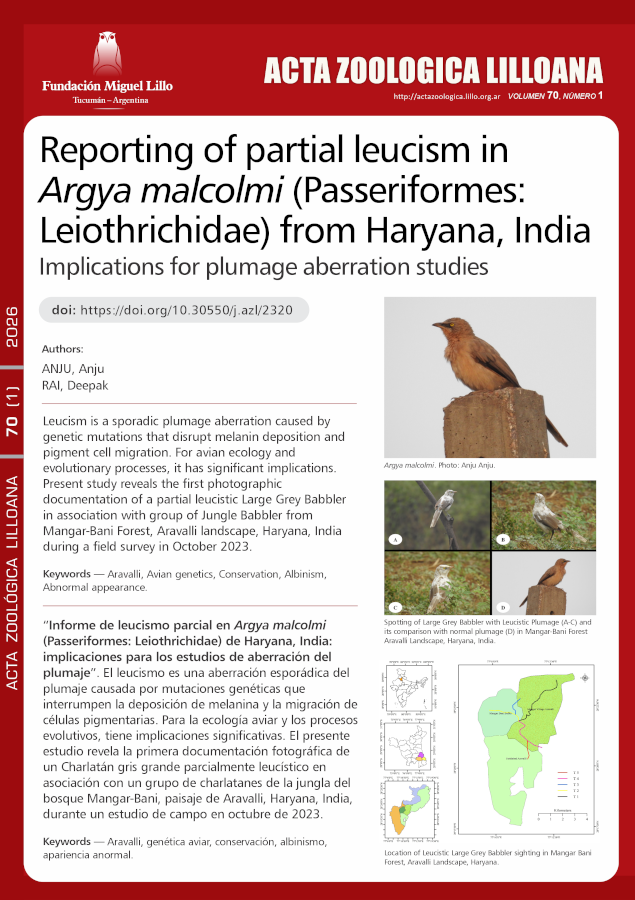
Undoubtedly, Leucism, a sporadic plumage aberration that is caused by genetic mutations which affect melanin deposition. It has significant implications for avian ecology and evolution of bird species. Present study represents the first photographic documentation of a leucistic Large Grey Babbler (Argya malcolmi) from the state of Haryana, India. A leucistic Large Grey Babbler was observed from Mangar-Bani Forest, Aravalli landscape, Haryana during a field survey in October 2023. The individual displayed predominantly white plumage with pale cream coloured spot on its remiges and tail, while the eyes, beak, and tarsi, retained distinctive pigmentation, distinguishing the condition from albinism. As per State of India’s Birds and IUCN Red List data, the species is classified as Least Concern, although moderate nationally declining population trend are reported. Behavioural observations displayed normal social integration and activity patterns within its flock, with no evidence of social exclusion or risk of predation. This record adds to the limited but growing evidence on leucism in avifauna and is consistent with recent global findings on the prevalence and ecological consequences of plumage abnormality. The study highlights the importance of systematic field documentation for understanding of genetic basis and evolutionary significance of such rare phenotypes. The presence of bird suffering from leucism in such fragmented habitats as Mangar-Bani emphasizes the importance of conservation of such landscapes. To further study the factors and consequences of leucism in wild bird populations, it is recommended to continue monitoring and implementation of genetic approaches.
Downloads
References
Ali, S., & Ripley S.D. (1995). Compact handbook of birds of India and Pakistan. Oxford University Press, Bombay.
Altmann, J. (1974). Observational study of behavior: sampling methods. Behaviour, 49, 227. DOI: https://doi.org/10.1163/156853974X00534
Avizanda, A. C., Ceballos, O., Urmeneta, A., & Donazar, J. A. (2010). First Case of Albinism in Egyptian Vultures. Journal of Raptor Research, 44(4), 328-330. DOI: https://doi.org/10.3356/JRR-10-12.1
Barnes, B.V., Zak, D.R., Denton, S.R., & Spurr, S.H. (1980). Forest ecology. USA: Oxford University Press.
BirdLife International (2016). Argya malcolmi. The IUCN Red List of Threatened Species, 2016:e.T22716361A94492467
Buckley, P.A. (1969). Diseases of Cage and Aviary Birds, Lea & Febiger, Philadelphia, USA. Genetics, 23-43.
Cai T., Cibois, A., Alstrom, P., Moyle, R.G., Kennedy, J.D., Shao, S., Zhang, R., Irestedt, M., Ericson, P.G.P., Gelang, M., Qu, Y., Lei, F., & Fjeldsa, J. (2018). Near-complete phylogeny and taxonomic revision of the world’s babblers (Aves: Passeriformes). Molecular Phylogenetics and Evolution, 145-150. DOI: https://doi.org/10.1016/j.ympev.2018.10.010
Chopra, G., Rai, D., & Jyoti J. (2017). Avian diversity and their status in and around Bhindawas Bird Sanctuary, Haryana (India). Journal of Applied and Natural Science, 9(3), 1475-1481. DOI: https://doi.org/10.31018/jans.v9i3.1387
Dudgeon, G. C. (1904). Albinism in a Shrike. Journal of the Bombay Natural History Society, 16(1), 179.
Goyal, P., Rai, D., & Kumar, S. (2025). Changing land use and land cover dynamics in Chhilchhila Wildlife Sanctuary, Haryana, India: a winter migratory bird study. Environmental Monitoring and Assessment, 197(10), 1-19. https://doi.org/10.1007/s10661-025-14523-3 DOI: https://doi.org/10.1007/s10661-025-14523-3
Grimmett, R., & Inskipp, T. (2019). Birds of Northern India. Christopher Helm, London.
Grouw, H.V. (2021). What’s in a name? Nomenclature for colour aberrations in birds reviewed. Bulletin of the British Ornithologists’ Club, 141(3), 276-299. https://doi.org/10.25226/bboc.v141i3.2021.a5 DOI: https://doi.org/10.25226/bboc.v141i3.2021.a5
Grouw, H.V., Mahabal, A., Sharma, R. M., & Thakur, S. (2016). How common is albinism really? Colour aberrations in Indian birds reviewed. Dutch Birding, 38(5), 301-309.
Gupte, A. P. (1969). An albino Jungle Babbler. Newsletter for Birdwatchers, 9(12), 3. DOI: https://doi.org/10.2307/forhis/12.4.3
Gurusami, V. (1992). Albinism in the Black Crowned Night Heron. Blackbuck, 8(1), 21-22.
Inglis, C. M. (1903). Late stay of the Sheldrake (Tadorna- cornuta) in the Tirhut and peculiar form of albinism in the Common Heron (Ardea cinerea). Journal of the Bombay Natural History Society, 15, 350.
IUCN. (2025). The IUCN Red List of Threatened Species, version 2025-1, 2025. https://www.iucnredlist.org. Accessed August 31, 2025.
Javed, S. (1992). Albinism in Little Brown Dove. Newsletter for Birdwatchers, 32(3-4), 12.
Koparde, P., Bangal, P., & Grouw, H.V. (2014). Brown kites and white crows: understanding colour aberration in birds. Hornbill, 10-13.
Mahabal, A. (1991). Cases of albinism in House and Jungle Crows. Newsletter for Birdwatchers, 31(9-10), 14.
McGraw, K J., Hill, G.E., & Parker, R.S. (2003). Carotenoid pigments in a mutant Cardinal: Implications for the Genetic and Enzymatic Control Mechanisms of Carotenoid Metabolism in Birds, The Condor: Ornithological Applications, 105(3), 587-592. https://doi.org/10.1093/condor/105.3.587 DOI: https://doi.org/10.1093/condor/105.3.587
Newnham, A. T. H. (1886). On the frequency of albinoism in Cutch & C. (With notes by Mr. E.H. Aitken). Journal of the Bombay Natural History Society, 1(2), 71-72.
Pande, S., Amit, P., & Anil, M. (2005). Melanism in Spotted Owlet Athene brama. Indian Birds. 1(4), 86-87.
Pawashe, A., Pande, S., & Mahabal, A. (2006). Occurrence of isabelline cum partial albino Ashy-crowned Sparrow-Lark (Eremopterix griseus), near Pune, India. Newsletter for Birdwatchers, 46(5), 72-73.
Rai, D., & Vanita. (2022). Bird Community Composition and Current Status in and around Selected Wetlands of District Sirsa, Haryana (India). Indian Forester, 148(2), 223-230. DOI: https://doi.org/10.36808/if/2022/v148i2/160962
Rai, D., & Vanita. (2023). Structural Assemblages of Avian Community in and around Ottu Reservoir Sirsa, Haryana (India). Indian Forester, 149(10), 1048-1060. DOI: https://doi.org/10.36808/if/2023/v149i10/169258
Rai, D., & Yadav, A. (2023). Avian Community Composition in and around Mandothi Wetlands, Haryana, India. Journal of Applied and Natural Science, 15(1), 408-421. DOI: https://doi.org/10.31018/jans.v15i1.4385 DOI: https://doi.org/10.31018/jans.v15i1.4385
Rai, D., Vats, P., & Gulia, R. (2017). Avifaunal status of Kalesar National Park, Haryana (India). Journal of Experimental Zoology, India, 20(2), 827-833.
Rani, S., Rani, A., & Rai, D. (2023). Assessment of Diversity and IUCN Status of Birds at Sultanpur National Park (Haryana) India. Biology Bulletin, 50(6), 1304–1315. https://doi.org/10.1134/S1062359023600 DOI: https://doi.org/10.1134/S1062359023600915
Sage, B.L. (1962). Albinism and melanism in birds. British Birds, 55, 201-225.
Sani, T., & Kasambe, R. (2007). Photographic record of leucistic Jungle Babbler Turdoides striata. Indian Birds, 3(3), 112.
Sathiyaselvam, P. (2003). Leucism in Indian Peafowl Pavo cristatus. Newsletter for Birdwatchers, 43(3), 34.
Sinha, A., & Gupta, R. (2023). Leucism in Red-vented Bulbul Pycnonotus cafer. Journal of Avian Biology, 54(1), e02839.
Sinha, A., & Gupta, P. (2023). First record of leucistic Jungle Babbler (Turdoides striata) from Lucknow, Uttar Pradesh. Rivista italiana di Ornitologia, 93, 27-30. DOI: https://doi.org/10.4081/rio.2023.699
SoIB. (2023). State of India’s Birds, 2023: Range, trends and conservation status. The SoIB Partnership, 50.
Sutherland, W.J., Newton, I., & Green, R.E. (2005). Bird Ecology and Conservation: A Handbook of Techniques. New York: Oxford University Press.
Yadav, A., & Rai, D. (2024). Diversity and IUCN Status of Winter Migratory Avifauna of Mandothi Wetlands, Haryana (India). Biology Bulletin, 51(4), 1197–1205. https://doi.org/10.1134/S1062359023606572 DOI: https://doi.org/10.1134/S1062359023606572
Yadav, A., Rai, D., Goyal, P., Anju, A., Bhura, R.P., & Arya, A.K. (2025). First photographic record of Red-breasted Parakeet Psittacula alexandri (Linnaeus, 1758) (Psittaciformes: Psittaculidae) from Haryana state in India. Rivista Italiana Di Ornitologia, 95(2), 24-29. https://doi.org/10.4081/rio.2025.903 DOI: https://doi.org/10.4081/rio.2025.903
Downloads
Published
How to Cite
Issue
Section
License
Copyright (c) 2026 Acta Zoológica Lilloana

This work is licensed under a Creative Commons Attribution-NonCommercial-NoDerivatives 4.0 International License.