Diet of the Yellow-chevroned Parakeet (Brotogeris chiriri) in an urban environment where it has been introduced
Authors
-
Facundo Xavier Palacio
Sección Ornitología, División Zoología Vertebrados, Museo de La Plata, Facultad de Ciencias Naturales y Museo, Universidad Nacional de La Plata, CONICET
 https://orcid.org/0000-0002-6536-1400
-
Diego Montalti
Sección Ornitología, División Zoología Vertebrados, Museo de La Plata, Facultad de Ciencias Naturales y Museo, Universidad Nacional de La Plata, CONICET
https://orcid.org/0000-0002-9727-8425
DOI:
 https://doi.org/10.30550/j.azl/2304
Keywords:
Urban birds, introduced birds, foraging behavior, trophic ecology, PsittacidaeAbstract
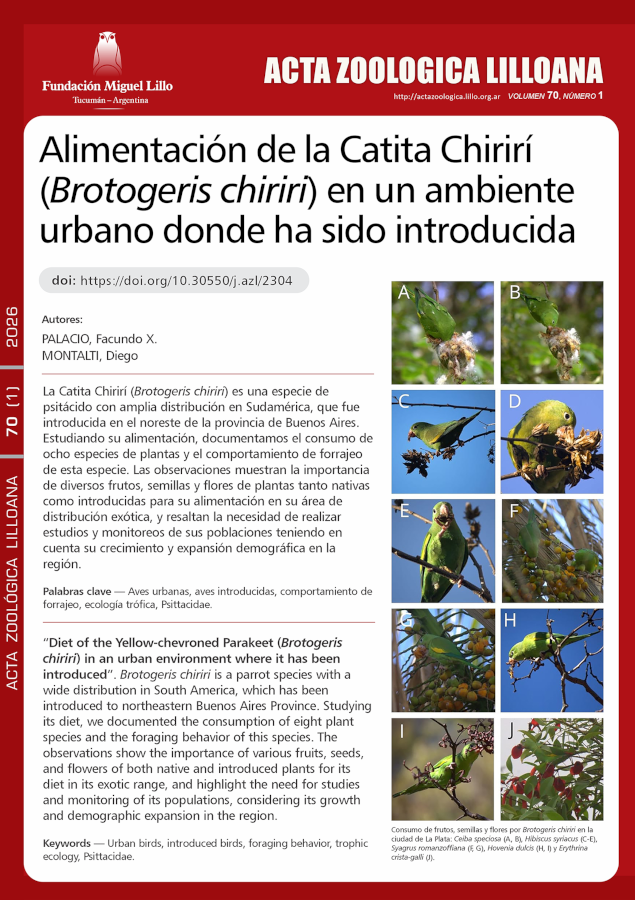
The Yellow-chevroned Parakeet (Brotogeris chiriri) is a psittacid species widely distributed in South America, introduced in northeastern Buenos Aires Province. However, knowledge of its trophic ecology, particularly in urban areas where it has been introduced, is scarce. Through focal observations, we document the consumption of eight plant species and the foraging behavior of the Yellow-chevroned Parakeet in La Plata, Buenos Aires Province. Two of these species were native (Syagrus romanzoffiana, and Erythrina crista-galli), whereas the other six were introduced ornamentals (Ceiba speciosa, Phoenix canariensis, Hibiscus syriacus, Hovenia dulcis, Tipuana tipu, and Araucaria angustifolia). Its foraging behavior was typical of other psittacids, displaying three main behaviors: (1) pecking the fruit attached to the plant, (2) removing the fruit from the plant with the bill and consuming it, and (3) removing the fruit with the bill and holding it with the foot while it was pecked. These observations show the importance of diverse fruits, seeds and flowers of both native and introduced plants for their diet in their exotic distribution area, and highlight the need to carry out studies and monitor their populations taking into account their growth and demographic expansion in the region.
Downloads
References
Altmann, J. (1974). Observational study of behavior: sampling methods. Behaviour, 49, 227–267. DOI: https://doi.org/10.1163/156853974X00534
Arrowood, P. C. (1981). Importation and status of Canary-winged Parakeets (Brotogeris versicolurus) in California. En Conservation of New World Parrots (425-429). Washington, D.C: ICBP Tech. Pub. 1. Smithson. Inst. Press.
Benavidez, A., Palacio, F. X., Rivera, L. O., Echevarria, A. L. & Politi, N. (2018). Diet of Neotropical parrots is independent of phylogeny but correlates with body size and geographical range. Ibis, 160, 742-754. https://doi:10.1111/ibi.12630 DOI: https://doi.org/10.1111/ibi.12630
Blanco, G., Bravo, C., Pacifico, E. C., Chamorro, D., Speziale, K. L., Lambertucci, S. A., Hiraldo, F. & Tella, J. L. (2016). Internal seed dispersal by parrots: an overview of a neglected mutualism. PeerJ, 4, e1688. https://doi.org/10.7717/peerj.1688 DOI: https://doi.org/10.7717/peerj.1688
Bodrati, A. & Haene, E. (2008). Plantas que atraen aves: chal-chal o koku. Naturaleza y Conservación, 23, 16-17.
Brightsmith, D., Burgio, K. R., Hiller, B. J., Block, K. E., Pyle, P. & Patten, M. A. (2020). Yellow-chevroned Parakeet (Brotogeris chiriri), version 1.0. En Birds of the World (P. G. Rodewald, Editor). Ithaca, NY, USA: Cornell Lab of Ornithology. https://doi.org/10.2173/bow.yecpar.01 DOI: https://doi.org/10.2173/bow.yecpar.01
Brown, C. & Magat, M. (2011). Cerebral lateralization determines hand preferences in Australian parrots. Biology Letters, 7, 496–498 https://doi:10.1098/rsbl.2010.1121 DOI: https://doi.org/10.1098/rsbl.2010.1121
Burgos-Gallardo, F. y Grilli, P. (2018). Distribución de la Catita Chirirí (Brotogeris chiriri) y primer registro de nidificación en Argentina. Nuestras Aves, 63, 38-43 https://doi.org/10.56178/na.vi63.197 DOI: https://doi.org/10.56178/na.vi63.197
Butler, C. J. (2005). Feral parrots in the continental United States and United Kingdom: past, present, and future. Journal of Avian Medicine and Surgery, 19, 142-149 https://doi:10.1647/183 DOI: https://doi.org/10.1647/183
Camerino, M. & Nos, R. (1981). Estudio comparado de la estructura social de un grupo heteroespecífico de Psitácidos (Aves, Psittacidae) en cautividad. Miscellània Zoològica, 7, 145-164.
Castrillon, R. G., Helm, C. V. & Mathias, A. L. (2023). Araucaria angustifolia and the pinhão seed: starch, bioactive compounds and functional activity-a bibliometric review. Ciência Rural, 53:e20220048 https://doi.org/10.1590/0103-8478cr20220048 DOI: https://doi.org/10.1590/0103-8478cr20220048
Clark, G. A. (1973). Holding food with the feet in passerines. Bird Banding, 44, 91-99. DOI: https://doi.org/10.2307/4511942
Collar, N. J. (1997). Family Psittacidae (parrots). En Handbook of the Birds of the World (280-477). Barcelona: Lynx Edicions.
Darrieu, C. A. (1981). Distribución y características diferenciales de las razas geográficas de Brotogeris versicolurus (Muller) (Aves, Psittacidae). Revista de la Asociación de Ciencias Naturales del Litoral, 12, 60-69. DOI: https://doi.org/10.14409/natura.v1i12.3386
Darrieu, C. A. & Camperi, A. R. (2001). Nueva lista de las aves de la provincia de Buenos Aires. COBIOBO (Comisión de Biodiversidad Bonaerense) N°3. PROBIOTA (Programa para el Estudio y Uso Sustentable de la Biota Austral) N°2.
Darrieu, C. A., Camperi, A. R., Piloni, G. & Bogado, N. (2013). Lista actualizada de las aves de la provincia de Buenos Aires. Buenos Aires: Vázquez Mazzini Editores, Fundación Historia Natural Félix de Azara.
Del Claro, K. (2004). Comportamento Animal - Uma introdução à ecologia comportamental. Jundiaí, Brasil: Livraria Conceito.
Delucchi, G., Hernández, M. P. & Rodríguez-Cravero, J. F. (2025). Historia del Paseo del Bosque. En Árboles y arbustos del Paseo del Bosque (La Plata, Buenos Aires) (13-18). La Plata: Edulp, Editorial de la Universidad Nacional de La Plata.
Djouab, A., Benamara, S., Gougam, H., Amellal, H. & Hidous, K. (2016). Physical and antioxidant properties of two Algerian date fruit species (Phoenix dactylifera L. and Phoenix canariensis L.). Emirates Journal of Food and Agriculture, 28, 601 https://doi.org/10.9755/ejfa.2015-12-1056 DOI: https://doi.org/10.9755/ejfa.2015-12-1056
eBird. (2025). eBird: An online database of bird distribution and abundance [web application]. eBird, Cornell Lab of Ornithology, Ithaca, New York. http://www.ebird.org (acceso: 20 de abril de 2025).
Faria, I. P., Abreu, T. D. S. & Bianchi, C. A. (2007). Seed and fruit predation of Kielmeyera (Guttiferae) and Qualea (Vochysiaceae) species by six psittacid species in the Brazilian cerrado. Ecotropica, 13, 75-79.
Forshaw, J. M. (1977). Parrots of the world. Neptune: T.F.H. Publications.
Forshaw, J. M. (2011). Parrots of the world. Collingwood: CSIRO Publishing. DOI: https://doi.org/10.1515/9781400836208
Freire, S. E. y Urtubey, E. (2025). Árboles y arbustos del paseo del bosque (La Plata, Buenos Aires). La Plata: Edulp, Editorial de la Universidad Nacional de La Plata. DOI: https://doi.org/10.35537/10915/177366
Galetto, L., Bernardello, G., Isele, I. C., Vesprini, J., Speroni, G. & Berduc, A. (2000). Reproductive biology of Erythrina crista-galli (Fabaceae). Annals of the Missouri Botanical Garden, 87, 127-145 https://doi:10.2307/2666157 DOI: https://doi.org/10.2307/2666157
Garrett, K. L., Mabb, K. T. & Collins, C. T. (1997). Food items of naturalized parrots in southern California. Western Birds, 28, 196–201.
Gavareski, C. A. (1976). Relation of park size and vegetation to urban bird populations in Seattle, Washington. Condor, 78, 375-385 https://doi.org/10.2307/1367699 DOI: https://doi.org/10.2307/1367699
Goudel, F., Shibata, M., Coelho, C. M. M. & Miller, P. R. M. (2013). Fruit biometry and seed germination of Syagrus romanzoffiana (Cham.) Glassm. Acta Botanica Brasilica, 27, 147-154 https://doi.org/10.1590/S0102-33062013000100015 DOI: https://doi.org/10.1590/S0102-33062013000100015
Haene, E. (2006). Invasión de loros en la ciudad. Naturaleza y Conservación, 19, 17-23.
Ibañez, L. M., Girini, J. M., Palacio, F. X. & Montalti, D. (2014). Nidificación y alimentación de psittácidos introducidos en el noreste de la provincia de Buenos Aires, Argentina. Hornero, 29, 13-22. https://doi.org/10.56178/eh.v29i1.620 DOI: https://doi.org/10.56178/eh.v29i1.620
Ibañez, L. M., Girini, J. M., Palacio, F. X., Fiorini, V. D. & Montalti, D. (2017). Interacciones entre el estornino pinto (Sturnus vulgaris) y aves nativas de Argentina por el uso de cavidades. Revista Mexicana de Biodiversidad, 88, 477–479. https://doi.org/10.1016/j.rmb.2017.03.009 DOI: https://doi.org/10.1016/j.rmb.2017.03.009
Korschgen, L. J. (1987). Procedimientos para el análisis de los hábitos alimentarios. En Manual de técnicas de gestión de vida silvestre (119-134). Bethesda: Wildlife Society.
Latorre, F., Rotundo, C., Abud-Sierra, M. L. & Fassola, H. (2023). Comparación de fases reproductivas de Araucaria angustifolia en dos regiones de Argentina con clima diferente. Bosque (Valdivia), 44, 563-571. http://dx.doi.org/10.4067/s0717-92002023000300563 DOI: https://doi.org/10.4067/s0717-92002023000300563
Lehner, P. N. (1979). Handbook of Ethological Methods. New York, USA: Garland STPM Press.
Leoni, A. M., Reis, M. G. & Dias Filho, M. M. (2023). A food interaction network between psittacines and plants in an urban area in the city of São Carlos–SP, southeastern Brazil. Brazilian Journal of Biology, 83, e269353. https://doi.org/10.1590/1519-6984.269353 DOI: https://doi.org/10.1590/1519-6984.269353
Maieves, H. A., Ribani, R. H., Morales, P. & de Cortes Sánchez-Mata, M. (2015). Evolution of the nutritional composition of Hovenia dulcis Thunb. pseudofruit during the maturation process. Fruits, 70, 181-187. http://dx.doi.org/10.1051/fruits/2015011 DOI: https://doi.org/10.1051/fruits/2015011
Maragliano, R. E. & Montalti, D. (1997). Estatus de residencia, caracterización trófica y abundancia de aves en el Zoológico de La Plata, Argentina. Doñana, Acta Vertebrata, 24, 103-114.
Marques, C. P, do Amaral, D. F., Batista, V. G., Franchin, A. G. & Júnior, O. M. (2018). Exploração de recursos alimentares por psitacídeos (Aves: Psittaciformes) em uma área urbana no Brasil. Biotemas, 31, 33-46 http://dx.doi.org/10.5007/2175-7925.2018v31n2p33 DOI: https://doi.org/10.5007/2175-7925.2018v31n2p33
Martin, P. & Bateson, P. (1986). Measuring behavior: An introductory guide. Cambridge: Cambridge University Press.
Martins, M. A. G. &, Oliveira, D. (2001). Morfo-anatomia e ontogênese do fruto e da semente de Tipuana tipu (Benth.) O. Kuntze (Fabaceae: Faboideae). Brazilian Journal of Botany, 24, 109-121. DOI: https://doi.org/10.1590/S0100-84042001000100012
Marzinek, J. & Mourão K. S. (2003). Morphology and anatomy of the fruit and seed in development of Chorisia speciosa A. St.-Hil. -Bombacaceae. Brazilian Journal of Botany, 26, 23-34. DOI: https://doi.org/10.1590/S0100-84042003000100004
McNeil, R. & Martínez, A. (1967). Asymetrie bilaterale des os longs des membres du pigeon Columba livia et du perroquet Amazona amazonica. Reveu Canadienne de Biologie, 26, 273-286.
Mizera, T. (1988). An ecological study of the synanthropic avifauna of the Solacz district of Poznan in 1975-1984. Acta Zoologica Cracoviensia, 31, 3-64.
Moermond, T. C. &, Denslow, J. S. (1985). Neotropical avian frugivores: patterns of behavior, morphology, and nutrition, with consequences for fruit selection. En Neotropical Ornithology. Ornithological Monographs, 36, 865-897. DOI: https://doi.org/10.2307/40168322
Montaldo, N. H. (2015). ¿Qué comen los loros en la ciudad de Buenos Aires? Naturaleza y Conservación, 42, 22-23.
Montalti, D. & Kopij, G. (2001). Bird community of inner La Plata City, Argentina. Acta Ornithologica, 36, 161-164. https://doi.org/10.3161/068.036.0209 DOI: https://doi.org/10.3161/068.036.0209
Morello, J., Matteucci, S. D., Rodríguez, A. F. & Silva, M. E. (2012). Ecorregiones y complejos ecosistémicos Argentinos. Buenos Aires: Facultad de Arquitectura, Diseño y Urbanismo, Grupo de Ecología del Paisaje y Medio Ambiente, UBA.
Mostafa, A., Eisa, S. S., Mohamed, A. A. & Al-Shamey, I. (2020). Taxonomic Revision and Numerical Analysis of Hibiscus L. Egypt. Arab Universities Journal of Agricultural Sciences, 28, 117-130. https://doi:10.21608/ajs.2020.21108.1142 DOI: https://doi.org/10.21608/ajs.2020.21108.1142
Motta-Junior, J. C., Monteiro Fidelis, R. A., de Souza Bambirra, B. L., dos Santos Filho J. C. M., de Macedo, K. L. S., Valadares Ribeiro, L. de A., Marinho Carvalho, G. M., Ritter, A. C. C., Miranda, N. C., Jin, L. D., Gent, L., Guerini Ferreira, V. C., Monteiro Ferreira & R., Kilsztajn Y. (2025). Diet of parrots in an urban area of São Paulo, Southeast Brazil. Revista do Instituto Florestal, 37, e969. https://doi.org/10.24278/rif.2025.37e969 DOI: https://doi.org/10.24278/rif.2025.37e969
Navas, J. R. & Bó, N. A. (1996). Distribución geográfica y situación actual de Brotogeris versicolurus en la Argentina. Hornero, 14, 90-92. https://doi.org/10.56178/eh.v14i3.1011 DOI: https://doi.org/10.56178/eh.v14i3.1011
Nielsen, A. B., Van Den Bosch, M., Maruthaveeran, S. & van den Bosch, C. K. (2014). Species richness in urban parks and its drivers: a review of empirical evidence. Urban Ecosystems, 17, 305-327. https://doi:10.1007/s11252-013-0316-1 DOI: https://doi.org/10.1007/s11252-013-0316-1
Nos, R. & Camerino, M. (1984). Conducta de alimentación de cinco especies de cotorritas (Aves, Psittacidae). Miscellània Zoològica, 8, 245-252.
Nunes, A. P. & Santos-Junior, A. (2011). Itens alimentares consumidos por psitacídeos no Pantanal e planaltos do entorno, Mato Grosso do Sul. Atualidades Ornitologicas, 162, 42-50.
Palacio, F. X., Ibañez, L. M., Maragliano, R. E., Montalti, D. (2018). Urbanization as a driver of taxonomic, functional, and phylogenetic diversity losses in bird communities. Canadian Journal of Zoology, 96, 1114-1121. https://doi:10.1139/cjz-2018-0008 DOI: https://doi.org/10.1139/cjz-2018-0008
Palacio, F. X. & Montalti, D. (2023). Local bird traits match fruit traits of two alien plants in urban fruit-frugivore interactions. Ecología Austral, 33, 043-052. https://doi.org/10.25260/EA.23.33.1.0.1947 DOI: https://doi.org/10.25260/EA.23.33.1.0.1947
Pantoja, W. S., Paca-Condori, A. C., Velásquez-Noriega, P. & Montenegro, M. A. (2022). Avifauna del Parque Urbano Laguna Guapilo de Santa Cruz, Bolivia. Cotinga, 44, 60-72.
Paranhos, S. J. & Marcondes-Machado, L. O. (2000). Comportamento reprodutivo de Brotogeris versicolorus chiriri (Aves, Psittacidae) em São Paulo, Brasil. Iheringia. Série Zoologia, 88, 61-66.
Paranhos, S. J., Araújo, C. B. & Marcondes-Machado, L. O. (2007). Comportamento alimentar do Periquito-de-encontro-amarelo (Brotogeris chiriri) no interior do estado de São Paulo, Brasil. Revista Brasileira de Ornitologia, 15, 95-101.
Pérez, J. H. (1990). Catita chirirí (Brotogeris versicolurus) en Capital Federal. Nuestras Aves, 21, 27-28. https://doi.org/10.56178/na.vi21.751 DOI: https://doi.org/10.56178/na.vi21.751
Pérez, M. B. & Caruso, M. A. (2020). Contribución al conocimiento de la distribución de aves poco comunes de los talares del noreste de la provincia de Buenos Aires. Acta Zoológica Lilloana, 64, 187-201. https://doi:10.30550/j.azl/2020.64.2/8 DOI: https://doi.org/10.30550/j.azl/2020.64.2/8
Pranty, B. & Epps, S. (2002). Distribution, population status, and documentation of exotic parrots in Broward County, Florida. Florida Field Naturalist, 30, 111-131.
Previatto, D. M., de Souza Dainezi, D. I. & Posso, S. R. (2016). Exploitation of Ceiba pubiflora flowers by birds. Revista Brasileira de Ornitologia, 24, 21-26. DOI: https://doi.org/10.1007/BF03544324
Ragusa-Netto, J. (2004). Flowers, fruits, and the abundance of the yellow-chevroned parakeet (Brotogeris chiriri) at a gallery forest in the South Pantanal (Brazil). Brazilian Journal of Biology, 64, 867-877. https://doi.org/10.1590/S1519-69842004000500017 DOI: https://doi.org/10.1590/S1519-69842004000500017
Randler, C., Braun, M. & Lintker, S. (2011). Foot preferences in wild-living ring-necked parakeets (Psittacula krameri, Psittacidae). Laterality, 16, 201-206. DOI: https://doi.org/10.1080/13576500903513188
Rosenberg, K. V. & Cooper, R. J. (1988). Approaches to avian diet analysis. En Avian foraging: Theory, methodology, and applications. Studies in Avian Biology, 13: 80-90.
Santiago, S. M., Paes Cavalcante, N. & Leveau, L. M. (2023). What drives the alien parrot richness and occurrence in urban green spaces along the annual cycle in Buenos Aires City, Argentina? Animals, 13, 3426. https://doi.org/10.3390/ani13213426 DOI: https://doi.org/10.3390/ani13213426
Scheffer, M., Cremaschi, L., Montalti, D. & Grilli, P. G. (2015). Los loros exóticos del Parque provincial Pereyra Iraola y comentarios sobre su presencia en la ribera platense. Nuestras Aves, 60, 3-8. https://doi.org/10.56178/na.vi60.247 DOI: https://doi.org/10.56178/na.vi60.247
Schubart, O., Aguirre, Á. C. & Sick, H. (1965). Contribuição para o conhecimento da alimentação das aves brasileiras. Arquivos de Zoologia Sao Paulo, 12, 95–249. https://doi.org/10.11606/issn.2176-7793.19651295-249 DOI: https://doi.org/10.11606/issn.2176-7793.19651295-249
Servicio Meteorológico Nacional (2025). Estadísticas climáticas normales período 1991-2020. https://www.smn.gob.ar/observaciones
Shea, K. & Chesson, P. (2002). Community ecology theory as a framework for biological invasions. Trends in Ecology and Evolution, 17, 170–176. https://doi.org/10.1016/S0169-5347(02)02495-3 DOI: https://doi.org/10.1016/S0169-5347(02)02495-3
Silva, P. (2007). Predação de sementes por periquitos Brotogeris chiriri (Psittacidae) em Chorisia speciosa (Bombacaceae). Revista Brasileira de Ornitologia, 15, 127-129.
Silva, P. A. (2008). Periquitos (Aratinga aurea e Brotogeris chiriri, Psittacidae) como potenciais polinizadores de Mabea fistulifera Mart. (Euphorbiaceae). Revista Brasileira de Ornitologia, 16, 23-28.
Smith, G. A. (1972). “Handedness” in parrots. Ibis, 114, 109-110. https://doi.org/10.1111/j.1474-919X.1972.tb02597.x DOI: https://doi.org/10.1111/j.1474-919X.1972.tb02597.x
Smith, G. A. (1975). Systematics of parrots. Ibis 117, 18-68. https://doi.org/10.1111/j.1474-919X.1975.tb04187.x DOI: https://doi.org/10.1111/j.1474-919X.1975.tb04187.x
Spennemann, D. H. (2019). The connective potential of vertebrate vectors responsible for the dispersal of the Canary Island date palm (Phoenix canariensis). Flora, 259, 151468. https://doi.org/10.1016/j.flora.2019.151468 DOI: https://doi.org/10.1016/j.flora.2019.151468
Stor, T., Rebstock, G. A., García Borboroglu, P. & Dee Boersma, P. (2019). Lateralization (handedness) in Magellanic penguins. PeerJ, 7, e6939 DOI 10.7717/peerj.6936. DOI: https://doi.org/10.7717/peerj.6936
Tella, J. L., Baños-Villalba, A., Hernández-Brito, D., Rojas, A., Pacífico, E. C., Díaz-Luque, J. A., Carrete, M., Blanco, G. & Hiraldo, F. (2015). Parrots as overlooked seed dispersers. Frontiers in Ecology and the Environment, 13, 338-339. https://doi.org/10.1890/1540-9295-13.6.338 DOI: https://doi.org/10.1890/1540-9295-13.6.338
Tella, J. L., Blanco, G., Dénes, F. V. & Hiraldo, F. (2019). Overlooked parrot seed dispersal in Australia and South America: insights on the evolution of dispersal syndromes and seed size in Araucaria trees. Frontiers in Ecology and Evolution, 7, 82. https://doi.org/10.3389/fevo.2019.00082 DOI: https://doi.org/10.3389/fevo.2019.00082
Uehling, J. J., Tallant, J. & Pruett-Jones, S. (2019). Status of naturalized parrots in the United States. Journal of Ornithology, 160, 907-921. https://doi.org/10.1007/s10336-019-01658-7 DOI: https://doi.org/10.1007/s10336-019-01658-7
Yang, B., Wu, Q., Luo, Y., Yang, Q., Chen, G., Wei, X. & Kan, J. (2019). Japanese grape (Hovenia dulcis) polysaccharides: new insight into extraction, characterization, rheological properties, and bioactivities. International Journal of Biological Macromolecules, 134, 631-644. https://doi.org/10.1016/j.ijbiomac.2019.05.079 DOI: https://doi.org/10.1016/j.ijbiomac.2019.05.079
Zapata, A. R. P. (1996). Las aves de la ciudad de La Plata, provincia de Buenos Aires. Situación ambiental de la provincia de Buenos Aires. Rev. C.I.C. provincia de Buenos Aires, La Plata.
Zonneveld, B. J. M. (2012). Genome sizes of all 19 Araucaria species are correlated with their geographical distribution. Plant Systematics and Evolution, 298, 1249-1255. https://DOI:10.1007/s00606-012-0631-7 DOI: https://doi.org/10.1007/s00606-012-0631-7
Downloads
Published
How to Cite
Issue
Section
License
Copyright (c) 2026 Acta Zoológica Lilloana

This work is licensed under a Creative Commons Attribution-NonCommercial-NoDerivatives 4.0 International License.