Records of nocturnal feeding in urban birds
Authors
-
Lucas Matias Leveau
Departamento de Ecología, Genética y Evolución, Facultad de Ciencias Exactas y Naturales, Univer- sidad de Buenos Aires—IEGEBA (CONICET–UBA)
 https://orcid.org/0000-0002-9860-5969
DOI:
 https://doi.org/10.30550/j.azl/2295
Keywords:
Birds, Global South, Latin America, artificial light at night (ALAN), urbanizationAbstract
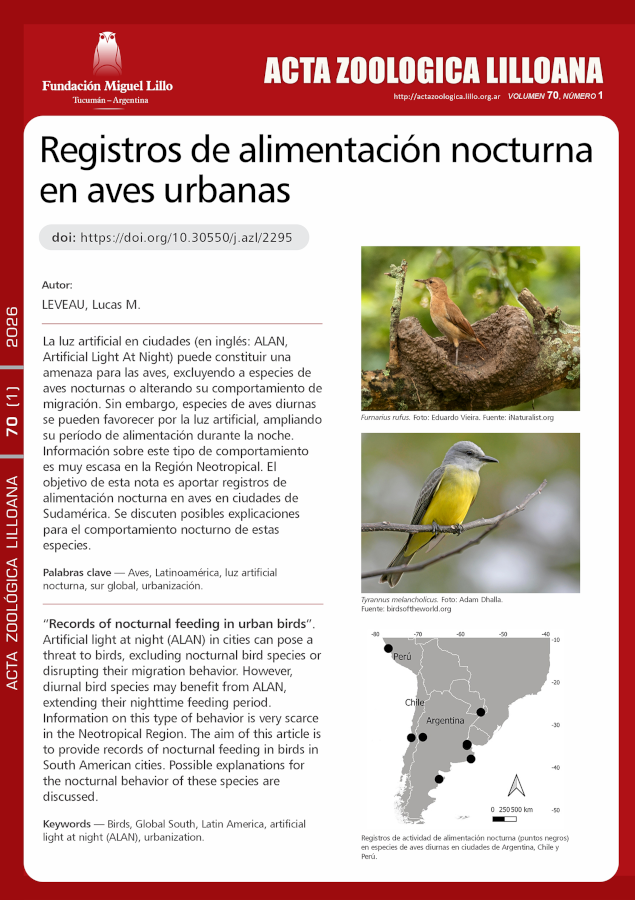
Artificial light at night (ALAN) in cities can pose a threat to birds, excluding nocturnal bird species or disrupting their migration behavior. However, other diurnal bird species may benefit from ALAN, extending their nighttime feeding period. Information on this type of behavior is very scarce in the Neotropical Region. The aim of this article is to provide records of nocturnal feeding in birds in South American cities. Records are provided for nine bird species in eight cities in Argentina, Chile, and Peru. The largest number of records were for the Rufous-bellied Thrush (Turdus rufiventris) and the Tropical Kingbird (Tyrannus melancholichus). The nocturnal feeding records for the Rufous Hornero (Furnarius rufus), the Chalk-browed Mockingbird (Mimus saturninus), the Creamy-bellied Thrush (Turdus amaurochalinus), Turdus rufiventris, and the Austral Thrush (Turdus falcklandii) seem new for the region. Possible explanations for the nocturnal behavior of these species are discussed.
Downloads
References
Basilio, L. G., Moreno, D. J., & Piratelli, A. J. (2020). Main causes of bird-window collisions: a review. Anais da Academia Brasileira de Ciências, 92, e20180745. DOI: https://doi.org/10.1590/0001-3765202020180745
Camín, S., Figini, I., & Marone, L. (2022). ¿Predicen los rasgos biológicos de las aves su ocupación del gradiente de urbanización en el Área Metropolitana de Mendoza? Ecología Austral, 32(3), 1078-1088. DOI: https://doi.org/10.25260/EA.22.32.3.0.1862
Davies, R. G., Orme, C. D. L., Storch, D., Olson, V. A., Thomas, G. H., Ross, S. G., ... & Gaston, K. J. (2007). Topography, energy and the global distribution of bird species richness. Proceedings of the Royal Society B: Biological Sciences, 274(1614), 1189-1197. DOI: https://doi.org/10.1098/rspb.2006.0061
Dominoni, D. M., Helm, B., Lehmann, M., Dowse, H. B., & Partecke, J. (2013). Clocks for the city: circadian differences between forest and city songbirds. Proceedings of the Royal Society B: Biological Sciences, 280(1763), 20130593. DOI: https://doi.org/10.1098/rspb.2013.0593
Faggi, A., & Perepelizin, P. (2006). Riqueza de aves a lo largo de un gradiente de urbanización en la ciudad de Buenos Aires. Revista del Museo Argentino de Ciencias Naturales, 8(2), 289-297. DOI: https://doi.org/10.22179/REVMACN.8.327
Curzel, F. E., & Leveau, L. M. (2021). Bird taxonomic and functional diversity in three habitats in Buenos Aires City, Argentina. Birds, 2(2), 217-229. DOI: https://doi.org/10.3390/birds2020016
Galiano, L., Leveau, C. M., & Leveau, L. M. (2024). Long-Term Changes in Bird Communities in the Urban Parks of Mar del Plata City, Argentina. Birds, 5(4), 814-831. DOI: https://doi.org/10.3390/birds5040054
Gantz, A., Sade, S., & Rau, J. (2009). Winter diet and feeding preferences of the southern lapwing (Vanellus chilensis, Molina 1782) in pastures of southern Chile. Boletín Chileno de Ornitología, 15(2), 87-93.
J?dro, g., & J?dro, M. (2018). Unusual feeding behaviour of the house sparrow Passer domesticus in Slowinski National Park, Poland. International Studies on Sparrows, 42, 15-16.
Köppen, W. (1900). Versuch einer Klassifikation der Klimate, vorzugsweise nach ihren Beziehungen zur Pflanzenwelt (Intento de clasificación climática en relación con las distribuciones vegetales.) Geogr. Zeitschrift, 6, 593-611, 657-679.
Leveau, L. M. (2018). Urbanization, environmental stabilization and temporal persistence of bird species: a view from Latin America. PeerJ, 6, e6056. DOI: https://doi.org/10.7717/peerj.6056
Leveau, L. M. (2020). Artificial light at night (ALAN) is the main driver of nocturnal feral pigeon (Columba livia f. domestica) foraging in urban areas. Animals, 10(4), 554. DOI: https://doi.org/10.3390/ani10040554
Leveau, L. M., & Leveau, C. M. (2016). Does urbanization affect the seasonal dynamics of bird communities in urban parks?. Urban ecosystems, 19(2), 631-647. DOI: https://doi.org/10.1007/s11252-016-0525-5
Linares Arroyo, H., Abascal, A., Degen, T., Aubé, M., Espey, B. R., Gyuk, G., ... & Kyba, C. C. (2024). Monitoring, trends and impacts of light pollution. Nature Reviews Earth & Environment, 5(6), 417-430. DOI: https://doi.org/10.1038/s43017-024-00555-9
Longcore, T., & Rich, C. (2004). Ecological light pollution. Frontiers in Ecology and the Environment, 2(4), 191-198. DOI: https://doi.org/10.1890/1540-9295(2004)002[0191:ELP]2.0.CO;2
Macedo-Bedoya, J., & Macedo-Pinedo, J. C. (2026). Registro de forrajeo nocturno de Tyrannus Melancholicus Vieillot, 1819 asociado a luz artificial en la ciudad de Iquitos, Perú. BIOTEMPO, 1(23). DOI: https://doi.org/10.31381/biotempo.v1i23.7899
Marín-Gómez, O. H., & MacGregor-Fors, I. (2019). How early do birds start chirping? Dawn chorus onset and peak times in a Neotropical city. Ardeola, 66(2), 327-341. DOI: https://doi.org/10.13157/arla.66.2.2019.ra5
Olson, D. M., Dinerstein, E., Wikramanayake, E. D., Burgess, N. D., Powell, G. V., Underwood, E. C., ... & Kassem, K. R. (2001). Terrestrial Ecoregions of the World: A New Map of Life on Earth: A new global map of terrestrial ecoregions provides an innovative tool for conserving biodiversity. BioScience, 51(11), 933-938. DOI: https://doi.org/10.1641/0006-3568(2001)051[0933:TEOTWA]2.0.CO;2
Ortiz, C. (2013). Nocturnal feeding of the Chiguanco Thrush Turdus Chiguanco (Turdidae) under artificial light. The Biologist, 11(2), 331-332.
Russ, A., Rüger, A., & Klenke, R. (2015). Seize the night: European Blackbirds (Turdus merula) extend their foraging activity under artificial illumination. Journal of Ornithology, 156(1), 123-131. DOI: https://doi.org/10.1007/s10336-014-1105-1
Shanahan, D. F., Strohbach, M. W., Warren, P. S., & Fuller, R. A. (2014). The challenges of urban living. Avian urban ecology, 3-20. DOI: https://doi.org/10.1093/acprof:osobl/9780199661572.003.0001
Sick, H., & Teixeira, D. M. (1981). Nocturnal activities of Brazilian hummingbirds and flycatchers at artificial illumination. The Auk, 98(1), 31.
Ursino, C., Rebolo Ifrán, N., & Gorleri, F. (2022). Impactos de la contaminación lumínica en las aves con especial foco en la Argentina. El hornero, 37(2), 4-4. DOI: https://doi.org/10.56178/eh.v37i2.393
Villaseñor, N. R., Chiang, L. A., Hernández, H. J., & Escobar, M. A. (2021). Contribución del espacio verde informal a la conservación de aves en ciudades: Un estudio comparativo sobre la diversidad de la comunidad de aves en sitios baldíos, parques urbanos y áreas residenciales. Ornitol. Neotrop, 32, 179-187. DOI: https://doi.org/10.58843/ornneo.v32i2.751
Wilman, H., Belmaker, J., Simpson, J., De La Rosa, C., Rivadeneira, M. M., & Jetz, W. (2014). EltonTraits 1.0: Species?level foraging attributes of the world's birds and mammals: Ecological Archives E095?178. Ecology, 95(7), 2027-2027. DOI: https://doi.org/10.1890/13-1917.1
Weaving, M. J., White, J. G., Isaac, B., & Cooke, R. (2011). The distribution of three nocturnal bird species across a suburban-forest gradient. Emu-Austral Ornithology, 111(1), 52-58. DOI: https://doi.org/10.1071/MU09117
Downloads
Published
How to Cite
Issue
Section
License
Copyright (c) 2026 Acta Zoológica Lilloana

This work is licensed under a Creative Commons Attribution-NonCommercial-NoDerivatives 4.0 International License.