Altitudinal morphometric variation in Rufous-collared Sparrow Zonotrichia capensis (Aves: Passerellidae) in the southwestern Peruvian Andes
Authors
-
Mayori Soto Huaira
Facultad de Ciencias Biológicas, Universidad Nacional Mayor de San Marcos, Lima, Perú
 https://orcid.org/0000-0002-9760-9132
-
Diego Evangelista Vargas
Facultad de Ciencias Biológicas, Universidad Nacional Mayor de San Marcos, Lima, Perú
https://orcid.org/0000-0002-9017-5183
-
Víctor Gamarra Toledo
Área de Ornitología, Colección Científica, Museo de Historia Natural (MUSA), Universidad Nacional de San Agustín de Arequipa, Av. Alcides Carrión s/n, Arequipa, Perú
https://orcid.org/0000-0001-5458-2438
DOI:
 https://doi.org/10.30550/j.azl/2260
Keywords:
Bergmann's rule, Allen's rule, phenotypic variation, altitudinal gradient, Andean birdAbstract
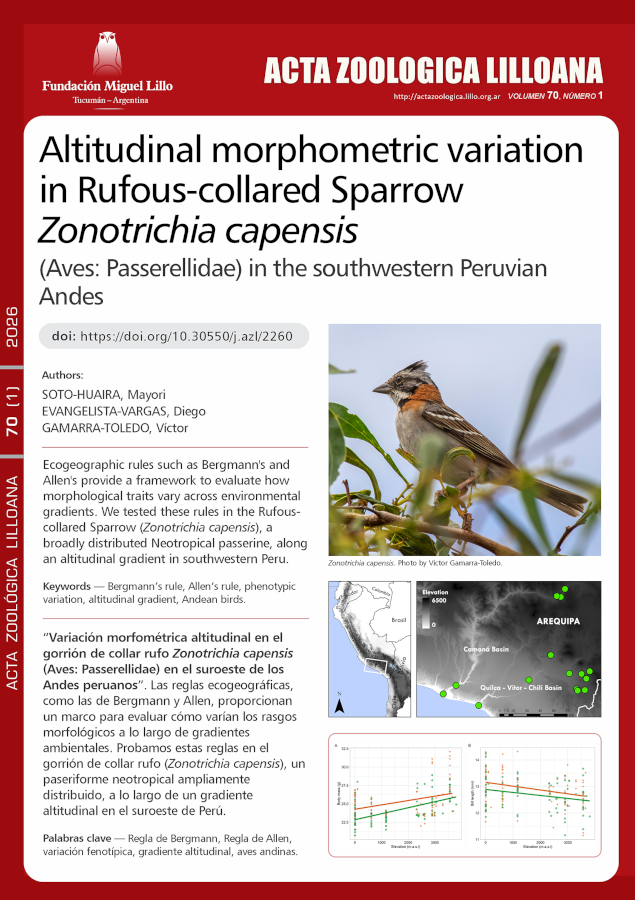
Ecogeographic rules such as Bergmann's and Allen's provide a framework to evaluate how morphological traits vary across environmental gradients. We tested these rules in the Rufous-collared Sparrow (Zonotrichia capensis), a broadly distributed Neotropical passerine, along an altitudinal gradient in southwestern Peru. We conducted morphometric analysis on 192 individuals from 16 localities distributed across two river basins in the Arequipa region, covering elevations from sea level to 3800 m. Seven morphological traits were measured, including body mass (to test Bergmann's rule) and appendages such as bill length, width, and height, wing length, tarsus length, and tail length (to assess Allen's rule). Generalized linear mixed models were used to evaluate the effects of sex, elevation, and river basin. Our results support Bergmann's rule: body mass increased significantly with altitude. However, we found only partial support for Allen's rule—bill length decreased with elevation, while other appendages showed no clear pattern. Additionally, males exhibited larger body size and longer bills than females. These findings suggest that Z. capensis populations exhibit altitude-associated morphological variation consistent with thermoregulatory expectations, although non-thermal ecological and biological factors may also shape phenotypic diversity across elevations.
Downloads
References
Allen, J. A. (1877). The influence of physical conditions in the genesis of species. Radical review, 1, 108-140.
Amézquita, A., Lima, A. P., Jehle, R., Castellanos, L., Ramos, Ó., Crawford, A. J., Gasser, H., Hödl, W. (2009). Calls, colours, shape, and genes: A multi-trait approach to the study of geographic variation in the Amazonian frog Allobates femoralis. Biological Journal of the Linnean Society, 98: 826–838. https://doi.org/10.1111/j.1095-8312.2009.01324.x DOI: https://doi.org/10.1111/j.1095-8312.2009.01324.x
Andrade-González, V. M., Vázquez-Miranda, H., Ornelas-García, C. P., Sosa-López, J. R. (2023). Ecological factors drive the divergence of morphological, colour and behavioural traits in cactus wrens (Aves, Troglodytidae). Proceedings of the Royal Society B: Biological Sciences, 290, 20230215. https://doi.org/10.1111/j.1600-0587.1996.tb00001.x DOI: https://doi.org/10.1098/rspb.2023.0215
Ashton, K. G. (2002). Patterns of within-species body size variation of birds: strong evidence for Bergmann's rule. Global Ecology and Biogeography, 11: 505-523. https://doi.org/10.1046/j.1466-822X.2002.00313.x DOI: https://doi.org/10.1046/j.1466-822X.2002.00313.x
Ballentine, B., Horton, B., Brown, E., Greenberg, R. (2013). Divergent selection on bill morphology contributes to nonrandom mating between swamp sparrow subspecies. Animal Behaviour, 86: 467-473. https://doi.org/10.1016/j.anbehav.2013.06.002 DOI: https://doi.org/10.1016/j.anbehav.2013.06.002
Bates, D., Maechler, M., Bolker, B., Walker, S., Christensen, R. H. B., Singmann, H., ..., Bolker, M. B. (2015). Package ‘lme4’. convergence, 12(1), 2.
Bears, H.,Drever, H. M. C., Martin, K. (2008). Comparative morphology of dark-eyed juncos Junco hyemalis breeding at two elevations: A common aviary experiment. Journal Avian Biology. 39: 152–162. https://doi.org/10.1111/j.2008.0908-8857.04191.x DOI: https://doi.org/10.1111/j.2008.0908-8857.04191.x
Bedoya-Cuno, M., Dillon, M. O., Quipuscoa, V. (2024). Análisis taxonómico del género Stevia (Asteraceae, Eupatorieae) en Arequipa, Perú. Acta Botánica Mexicana 131: e2368. https://doi.org/10.21829/abm131.2024.2368 DOI: https://doi.org/10.21829/abm131.2024.2368
Bergmann, C. (1847). Über die verhältnisse der Wärmeökonomie der thiere zu ihrer grosse. Gött. Studien 1: 595–708.
Blackburn, T., Ruggiero, A. (2001). Latitude, elevation and boddy mass variation in Andean passerine birds. Global Ecology & Biogeography 10: 245-259. DOI: https://doi.org/10.1046/j.1466-822X.2001.00237.x
Blackburn, T.M. Gaston, K. J. (2001) Linking patterns in macroecology. Journal of Animal Ecology, 70, 338–352. https://doi.org/10.1111/j.1600-0587.1996.tb00001.x DOI: https://doi.org/10.1111/j.1365-2656.2001.00484.x
Boyle, A., Sandercock, B. K., Martin, K. (2016). Patterns and drivers of intraspecific variation in avian life history along elevational gradients: A meta-analysis. Biological Reviews, 91: 469–482. https://doi.org/10.1111/brv.12180 DOI: https://doi.org/10.1111/brv.12180
Brack, A., Mendiola, C. (2010). Ecología del Perú. 3era. Edición. Editorial Bruño. Lima.
Bülau, S. E., Kretschmer, R., Gunski, R. J., Garnero, A. D. V., O’Brien, P., Ferguson-Smith, M. A., ..., Freitas, T. R. O. D. (2018). Chromosomal polymorphism and comparative chromosome painting in the rufous-collared sparrow (Zonotrichia capensis). Genetics and molecular biology, 41, 799-805. https://doi.org/10.1590/1678-4685-GMB-2017-0367 DOI: https://doi.org/10.1590/1678-4685-gmb-2017-0367
Bulgarella, M., Wilson, R., Kopuchian, C., Valqui, T., McCraken, K. (2007). Elevational variation in body size of Crested ducks (Lophonetta specularoides) from the Central high Andes, Mendoza, and Patagonia. Ornitologia Neotropical. 18:587-602. http://hdl.handle.net/11336/59918
Busi, A., Cardona-Salazar, L., Gómez, D., Ossa-López, P., Rivera-Páez, F., Vásquez, R., Castaño-Villa, G. (2020). Morphological differences in a population of Rufous-collared Sparrow (Zonotrichia capensis, Statius Müller, 1776) (Passerine, Emberizidae) at different elevations in the Tropical Andes. Biota Neotropica 20: e20190867. https://doi.org/10.1590/1676-0611-BN-2019-0867 DOI: https://doi.org/10.1590/1676-0611-bn-2019-0867
Cadena, C. D., Cheviron, Z. A., Funk, W. C. (2011). Testing the molecular and evolutionary causes of a “leapfrog” pattern of geographical variation in coloration. Journal of Evolutionary Biology, 24: 402–414. https://doi.org/10.1111/j.1420-9101.2010.02175.x DOI: https://doi.org/10.1111/j.1420-9101.2010.02175.x
Cardilini, A., Buchanan, K., Sherman, C., Cassey, P., Symonds, R. (2016). Tests of ecogeographical relationships in a non-native species: what rules avian morphology? Oecologia, 181:783-793. DOI: https://doi.org/10.1007/s00442-016-3590-9
Castro, G., Carey, C., Whittembury, J., Monge, C. (1985). Comparative responses of sea level and montane rufous-collared sparrows, Zonotrichia capensis, to hypoxia and cold. Comparative Biochemistry and Physiology Part A: Physiology, 82(4), 847-850. DOI: https://doi.org/10.1016/0300-9629(85)90493-1
Castro, A., Dávila, C., Laura, W., Cubas Saucedo, F., Ávalos, G., López, C., ...,Marín, D. (2021). Climas del Perú: mapa de clasificación climática nacional. (pp. 70-70).
Chapman, F. (1940). The post-glacial history of Zonotrichia capensis. Bulletin of the American Museum of Natural History. 77: 381–439.
Cheviron, Z., Whitehead, A., Brumfield, R. (2008). Transcriptomic variation and plasticity in Rufous-Collared Sparrows (Zonotrichia capensis) along an antitudinal gradient. Molecular Ecology, 17: 4556-4569. https://doi.org/10.1111/j.1365-294X.2008.03942.x DOI: https://doi.org/10.1111/j.1365-294X.2008.03942.x
Dangol, D., Khanal, L., Pandey, N., Ghimire, A., Kyes, R. (2022). Test of Ecogeographical Rules on Sparrows (Passer spp.) along the Elevation Gradient of Himalaya in Central Nepal. Ecologies, 3:480-491. https://doi.org/10.3390/ecologies3040034 DOI: https://doi.org/10.3390/ecologies3040034
Danner, J., Fleischer, R., Danner, R., Moore, I. (2017). Genetic population structure in an equatorial sparrow: roles for culture and geography. Journal of Evolutionary Biology. 30: 1078-1093. https://doi.org/10.1111/jeb.13065 DOI: https://doi.org/10.1111/jeb.13065
Davis, K. M., Burtt, E. H. (2019). Size increase with altitude in the Rufous-collared Sparrow (Zonotrichia capensis). Wilson Journal of Ornithology 131:135-139. https://doi.org/10.1676/17-19 DOI: https://doi.org/10.1676/17-19
Delhey, K. (2019). A review of Gloger’s rule, an ecogeographical rule of colour: definitions, interpretations and evidence. Biological Reviews, 94:1294-1316. https://doi.org/10.1111/brv.12503 DOI: https://doi.org/10.1111/brv.12503
Díaz, A., Bautista, E., McCracken, K. (2023). Geographic variation in body size and hematology of the Slate-Colored Coot (Fulica ardesiaca) along the Andes of Peru. Waterbirds, 46: 146-160. https://doi.org/10.1675/063.046.0406 DOI: https://doi.org/10.1675/063.046.0406
Fan, L., Cai, T., Xiong, Y., Song, G., Lei, F. (2019). Bergmann's rule and Allen's rule in two passerine birds in China. Avian Research, 10, 1-11. https://doi.org/10.1186/s40657-019-0172-7 DOI: https://doi.org/10.1186/s40657-019-0172-7
Fjeldså, J., Bowie, R. C., Rahbek, C. (2012). The role of mountain ranges in the diversification of birds. Annual Review of Ecology, Evolution, and Systematics, 43, 249-265. https://doi.org/10.1146/annurev-ecolsys-102710-145113 DOI: https://doi.org/10.1146/annurev-ecolsys-102710-145113
Freeman, B. G. (2016). Little evidence for Bergmann's rule body size clines in passerines along tropical elevational gradients. Journal of biogeography 44: 502–510. https://doi.org/10.1111/jbi.12812 DOI: https://doi.org/10.1111/jbi.12812
Friedman, N. R., Miller, E. T., Ball, J. R., Kasuga, H., Remeš, V., Economo, E. P. (2019). Evolution of a multifunctional trait: shared effects of foraging ecology and thermoregulation on beak morphology, with consequences for song evolution. Proceedings of the Royal Society B, 286: 20192474. https://doi.org/10.1098/rspb.2019.2474 DOI: https://doi.org/10.1098/rspb.2019.2474
Fröhlich, A., Kotowska, D., Martyka, R., Symonds, M. R. E. (2023). Allometry reveals trade-offs between Bergmann's and Allen's rules, and different avian adaptive strategies for thermoregulation. Nature Communications, 14: 1101. https://doi.org/10.1038/s41467-023-36676-w DOI: https://doi.org/10.1038/s41467-023-36676-w
Goldenberg, J., Bisschop, K., D’Alba, L., Shawkey, M. (2022). The link between body size, colouration and thermoregulation and their integration into ecogeographical rules: a critical appraisal in light of climate change. Oikos, e09152. https://doi.org/10.1111/oik.09152 DOI: https://doi.org/10.1111/oik.09152
Greenberg, R., Danner, R., Olsen, B., Luther, D. (2012). High summer temperature explains bill size variation in salt marsh sparrows. Ecography, 35, 146e152.
https://doi.org/10.1111/j.1600-0587.2011.07002.x DOI: https://doi.org/10.1111/j.1600-0587.2011.07002.x
Guo, Q., Qian, H., Liu, P., Zhang, J. (2024). Bergmann's rule in global terrestrial vertebrates. Biological Journal of the Linnean Society, 143(2), blae092. DOI: https://doi.org/10.1093/biolinnean/blae092
Gutiérrez-Pinto, N., McCraken, K. G., Alza, L., Tubaro, P., Kopuchian, C., Astie, A., Cadena, C. D. (2014). The validity of ecogeographical rules is context-dependent: Testing for Bergmann's and Allen's rules by latitude and elevation in a widespread Andean duck. Biological Journal of the Linnean Society. 111: 850–862. https://doi.org/10.1111/bij.12249 DOI: https://doi.org/10.1111/bij.12249
Herzog, S. K., Kattan, G. H. (2011). Patterns of diversity and endemism in the birds of the tropical Andes. Climate change and biodiversity in the tropical Andes, 245-259.
Ibarguchi, G. (2011). Biogeography and diversification of the Andean Seedsnipes (Thinocoridae): an Antartic avian linage? (Doctoral dissertation, Queen's University).
Jiménez, P. C., Villasante, J. F., Talavera, B. C., Villegas, L. N. (2006). Ecosistemas de Arequipa. Oferta Ambiental y Desarrollo Sostenible. Zonas Áridas 7: 118-132. DOI: https://doi.org/10.21704/za.v7i1.721.
Lee, C. C., Fu, Y., Yeh, C., Yeung, C. K. L, Hung, H., Yao, Y., Lee, P. L., Li, S. H. (2021). Morphological variations in a widely distributed Eastern Asian passerine cannot be consistently explained by ecogeographic rules. Ecology and Evolution 11: 15249-15260. https://doi.org/10.1002/ece3.8208 DOI: https://doi.org/10.1002/ece3.8208
Lee, K. H., Shaner, P. J. L., Lin, Y. P., Lin, S. M. (2016). Geographic variation in advertisement calls of a microhylid frog—Testing the role of drift and ecology. Ecology and Evolution, 6:3289–3298. https://doi.org/10.1002/ece3.2116 DOI: https://doi.org/10.1002/ece3.2116
Llerena, C. (2018). Caracteres morfométricos implicados en la determinación del sexo en aves sin dicromatismo sexual (Orden Passeriformes) presentes en Arequipa. [Tesis de grado, Universidad Nacional de San Agustín de Arequipa, Perú].
López, J. P., Stiles, F. G., Parra, J. L. (2015). Protocolo para la medición de rasgos funcionales en aves. pp 80-125. En: Salgado-Negret, B. (ed). La ecología funcional como aproximación al estudio, manejo y conservación de la biodiversidad: protocolos y aplicaciones. Instituto de Investigación de Recursos Biológicos Alexander von Humboldt. Bogotá, D. C. Colombia. 236 p.
Lougheed S. C., Campagna, L., Dávila, J. A., Tubaro, P. L., Lijtmaer, D. A, Handford, P. (2013). Continental phylogeography of an ecologically and morphologically diverse Neotropical songbird, Zonotrichia capensis. BMC Evolutionary Biology 2013 13:58. DOI: https://doi.org/10.1186/1471-2148-13-58
Maestri, M., Luza, A., de Barros, L., Hartz, S., Ferrari, A., de Freitas, T., Duarte, L. (2016). Geographical variation of body size in sigmodontine rodents depends on both environment and phylogenetic composition of communities. Journal of Biogeography, 43: 1192-1202. https://doi.org/10.1111/jbi.12718 DOI: https://doi.org/10.1111/jbi.12718
Martin, K., De Zwaan, D. R., Scridel, D., Tomás, A. (2023). 2· Avian Adaptations to High Mountain Habitats. Ecology and Conservation of Mountain Birds, 35. Chamberlain, D., Lehikoinen, A., & Martin, K. (Eds.). (2023). Ecology and Conservation of Mountain Birds. Cambridge University Press. DOI: https://doi.org/10.1017/9781108938570.003
Mayr, E. (1963). Animal Species and Evolution. Cambridge, Massachusetts: Harvard University Press. DOI: https://doi.org/10.4159/harvard.9780674865327
Meiri, S., Dayan, T. (2003). On the validity of Bergmann's rule. Journal of Biogeography, 30:331–351. https://doi.org/10.1046/j.1365-2699.2003.00837.x DOI: https://doi.org/10.1046/j.1365-2699.2003.00837.x
Meiri, S. (2011). Bergmann's Rule–what's in a name? Global Ecology and Biogeography, 20: 203-207. https://doi.org/10.1111/j.1466-8238.2010.00577.x DOI: https://doi.org/10.1111/j.1466-8238.2010.00577.x
Meiri, S., Yom-Tov, Y., Geffen, E. (2007). What determines conformity to Bergmann's rule? Global Ecology and Biogeography 16: 788–794. https://doi.org/10.1111/j.1466-8238.2007.00330.x DOI: https://doi.org/10.1111/j.1466-8238.2007.00330.x
Miller, C., Latimer, C., Zuckerberg, B. (2018). Bill size variation in northern cardinals associated with anthropogenic drivers across North America. Ecology and Evolution, 8: 4841-4851. https://doi.org/10.1002/ece3.4038 DOI: https://doi.org/10.1002/ece3.4038
Moreno, N. (2017). Análisis de la variación morfológica y climática en aves de alta montaña en 24 años. Tesis para obtar el grado de Magister en Conservación en uso de biodiversidad. Pontificia Universidad Javeriana, Colombia.
Ocampo-Peñuela, N. (2024). Context-dependent bird body mass responses to climate change. Trends in Ecology & Evolution. DOI: https://doi.org/10.1016/j.tree.2024.02.010
Olson, V. A., Davies, R. G., Orme, C. D. L., Thomas, G. H., Meiri, S., Blackburn, T. M., ..., Bennett, P. M. (2009). Global biogeography and ecology of body size in birds. Ecology Letters, 12, 249-259. https://doi.org/10.1111/j.1461-0248.2009.01281.x DOI: https://doi.org/10.1111/j.1461-0248.2009.01281.x
Paulo, P., Teófilo, F. H., Bertuol, C., Polo, É., Moncrieff, A. E., Bandeira, L. N., ..., Anciães, M. (2023). Geographic drivers of genetic and plumage color diversity in the blue-crowned manakin. Evolutionary Biology, 50, 413-431. https://doi.org/10.1007/s11692-023-09613-4 DOI: https://doi.org/10.1007/s11692-023-09613-4
Poblete, Y., Contreras, C., Fernández, C., Flores, C., Vega, P., Ávila, M., Sabat, P. (2023). Geographic variation in the altitudinal migration patterns, body size, oxidative status and exploratory behavior in a neotropicl bird. Ecology and Evolution, 13: e9941. https://doi.org/10.1002/ece3.9941 DOI: https://doi.org/10.1002/ece3.9941
Podos, J. (2001). Correlated evolution of morphology and vocal signal structure in Darwin's finches. Nature, 409: 185–188. DOI: https://doi.org/10.1038/35051570
R CORE TEAM. (2024). R: A language and environment for statistical computing. R Found. Stat. Comput. Vienna. Austria. Available at https://cran.r-project.org
Ralph, C. J., Geupel, G. R., Pyle, P., Martin, T. E., DeSante, D. F., Milá, B., ..., David, F. (1996). Manual de métodos de campo para el monitoreo de aves terrestres. Pacific Southwest Research Station, Forest Service. US Department of Agriculture, Washington, DC. DOI: https://doi.org/10.2737/PSW-GTR-159
Romano, A., Séchaud, R., Roulin, A. (2019). Geographical variation in bill size provides evidence for Allen's rule in a cosmopolitan raptor. Global Ecology and Biogeography 29: 65–75. https://doi.org/10.1111/geb.13007 DOI: https://doi.org/10.1111/geb.13007
Schulenberg, T. S., Stotz, D. F., Lane, D. F., O’Neill, J. P., Parker III, T.A. (2010). Birds of Peru. Revised and updated edition. Second printing, and first paperback printing, revised and updated. Princeton University Press, Princeton, New Jersey, pp. 1-664
Searcy, W. A. (1979). Sexual selection and body size in male red-winged blackbirds. Evolution, 649-661. DOI: https://doi.org/10.1111/j.1558-5646.1979.tb04718.x
Seeholzer, G. F., Brumfield, R. T. (2018). Isolation by distance, not incipient ecological speciation, explains genetic differentiation in an Andean songbird (Aves: Furnariidae: Cranioleuca antisiensis, Line?cheeked Spinetail) despite near threefold body size change across an environmental gradient. Molecular Ecology, 27, 279-296. https://doi.org/10.1111/mec.14429 DOI: https://doi.org/10.1111/mec.14429
Servino, L. M., Ferrarini, J. M. G., Nogueira, C. D. C., Barbo, F. E., Sawaya, R. J. (2024). Are Bergmann's and Jordan's rules valid for a neotropical pitviper? Journal of Zoology, 323, 346-355. https://doi.org/10.1111/jzo.13193 DOI: https://doi.org/10.1111/jzo.13193
Sun, Y., Li, M., Song, G., Lei, F., Li, D., Wu, Y. (2017). The role of climate factors in geographic variation in body mass and wing length in a passerine bird. Avian Res, 8: 1-9. DOI: https://doi.org/10.1186/s40657-016-0059-9
Symonds, M. R., Tattersall, G. J. (2010). Geographical variation in bill size across bird species provides evidence for Allen's rule. American Naturalist 176:188–197. DOI: https://doi.org/10.1086/653666
Tattersall, G. J., Andrade, D. V., Abe, A. S. (2009). Heat exchange from the toucan bill reveals a controllable vascular thermal radiator. Science 325:468–470. DOI: https://doi.org/10.1126/science.1175553
VanderWerf, E. A. (2012). Ecogeographic patterns of morphological variation in Elepaios (Chasiempis spp.): Bergmann's, Allen's and Gloger’s Rules in a Microcosm –. Ornithological Monographs, 73, 1–34. DOI: https://doi.org/10.1525/om.2011.73.1.1
Xu, Y, Price, M,. Que, P., Zhang, K., Sheng, S., He, X., Wen, Z., Wang, B. (2023). Ecological predictors of interspecific variation in bird bill and leg lengths on a global scale. Proceedings of the Royal Society B: Biological Sciences 290: 20231387. https://doi.org/10.1098/rspb.2023.1387 DOI: https://doi.org/10.1098/rspb.2023.1387
Zamorano, T. F. (2023). Muda y crianza: análisis comparativo de la temporalidad de la muda de Zonotrichia capensis en función del sexo. Tesis para obtar grado de Magister en Ciencias Biológicas, Universidad de Chile.
Zeballos, H., Pacheco, V., Baraybar, L. (2001). Diversidad y conservación de los mamíferos de Arequipa, Perú. Revista Peruana de Biología, 8:94-104. DOI: https://doi.org/10.15381/rpb.v8i2.6564
Zink, R. M., Remsen, J. V. (1986). Evolutionary processes and patterns of geographic variation in birds. Current Ornithology, 4, 1–6. https://doi.org/10.1111/geb.12522 DOI: https://doi.org/10.1111/geb.12522
Downloads
Published
How to Cite
Issue
Section
License
Copyright (c) 2026 Acta Zoológica Lilloana

This work is licensed under a Creative Commons Attribution-NonCommercial-NoDerivatives 4.0 International License.