Informe de leucismo parcial en Argya malcolmi (Passeriformes: Leiothrichidae) de Haryana, India: implicaciones para los estudios de aberración del plumaje
Autores/as
-
Anju Anju
Department of Zoology, Kurukshetra University, Kurukshetra–136119, Haryana, India
 https://orcid.org/0009-0008-2863-7907
-
Deepak Rai
Department of Zoology, Kurukshetra University, Kurukshetra–136119, Haryana, India
https://orcid.org/0000-0001-8539-961X
DOI:
 https://doi.org/10.30550/j.azl/2320
Palabras clave:
Aravalli, genética aviar, conservación, albinismo, apariencia anormalResumen
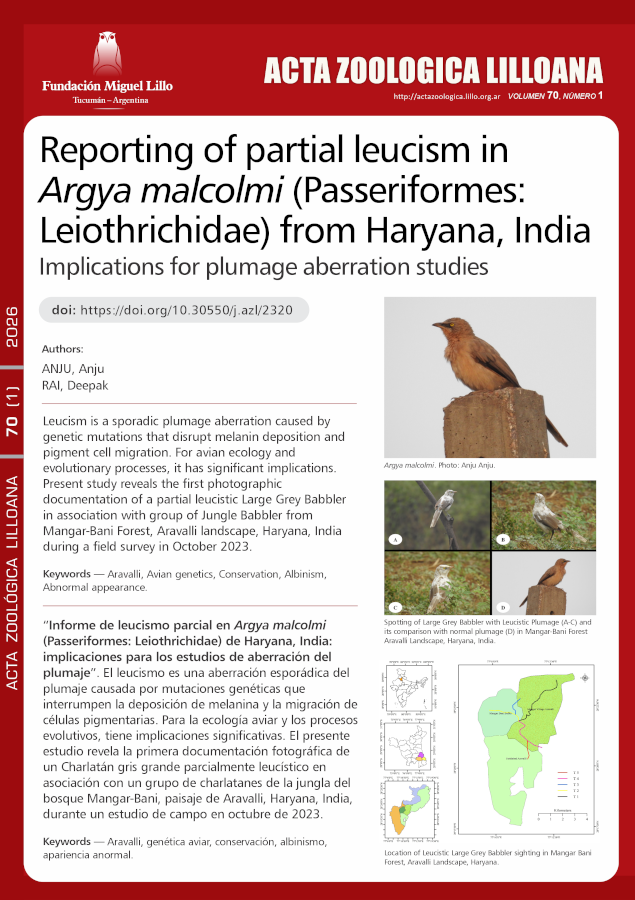
El leucismo es una aberración esporádica del plumaje causada por mutaciones genéticas que interrumpen la deposición de melanina y la migración de células pigmentarias. Para la ecología aviar y los procesos evolutivos, tiene implicaciones significativas. El presente estudio revela la primera documentación fotográfica de un charlatán gris grande parcialmente leucístico en asociación con un grupo de charlatanes de la jungla del bosque Mangar-Bani, paisaje de Aravalli, Haryana, India, durante un estudio de campo en octubre de 2023. El individuo con plumaje blanco y mancha de color crema pálido en sus plumas, mientras que los ojos, el pico y los tarsos conservaron una pigmentación distintiva, diferenciando la condición del albinismo. Según los datos de State of India’s Birds y la Lista Roja de la UICN, la especie de charlatán gris grande está clasificada como de Preocupación Menor, aunque se informa una tendencia moderada a la disminución de la población en India. Las observaciones de comportamiento significan una integración social normal y patrones de
actividad sin evidencia de exclusión social o riesgo de depredación natural. Este registro fotográfico aporta evidencia limitada, pero importante, y cada vez mayor, sobre el leucismo aviar y concuerda con hallazgos globales recientes sobre la prevalencia y las consecuencias ecológicas de las anomalías del plumaje. El estudio destaca la importancia de la documentación sistemática de campo para comprender la base genética y la importancia evolutiva de estos fenotipos raros. La presencia de aves con leucismo parcial en hábitats tan fragmentados como Mangar-Bani enfatiza la importancia de la conservación de
Descargas
Citas
Ali, S., & Ripley S.D. (1995). Compact handbook of birds of India and Pakistan. Oxford University Press, Bombay.
Altmann, J. (1974). Observational study of behavior: sampling methods. Behaviour, 49, 227. DOI: https://doi.org/10.1163/156853974X00534
Avizanda, A. C., Ceballos, O., Urmeneta, A., & Donazar, J. A. (2010). First Case of Albinism in Egyptian Vultures. Journal of Raptor Research, 44(4), 328-330. DOI: https://doi.org/10.3356/JRR-10-12.1
Barnes, B.V., Zak, D.R., Denton, S.R., & Spurr, S.H. (1980). Forest ecology. USA: Oxford University Press.
BirdLife International (2016). Argya malcolmi. The IUCN Red List of Threatened Species, 2016:e.T22716361A94492467
Buckley, P.A. (1969). Diseases of Cage and Aviary Birds, Lea & Febiger, Philadelphia, USA. Genetics, 23-43.
Cai T., Cibois, A., Alstrom, P., Moyle, R.G., Kennedy, J.D., Shao, S., Zhang, R., Irestedt, M., Ericson, P.G.P., Gelang, M., Qu, Y., Lei, F., & Fjeldsa, J. (2018). Near-complete phylogeny and taxonomic revision of the world’s babblers (Aves: Passeriformes). Molecular Phylogenetics and Evolution, 145-150. DOI: https://doi.org/10.1016/j.ympev.2018.10.010
Chopra, G., Rai, D., & Jyoti J. (2017). Avian diversity and their status in and around Bhindawas Bird Sanctuary, Haryana (India). Journal of Applied and Natural Science, 9(3), 1475-1481. DOI: https://doi.org/10.31018/jans.v9i3.1387
Dudgeon, G. C. (1904). Albinism in a Shrike. Journal of the Bombay Natural History Society, 16(1), 179.
Goyal, P., Rai, D., & Kumar, S. (2025). Changing land use and land cover dynamics in Chhilchhila Wildlife Sanctuary, Haryana, India: a winter migratory bird study. Environmental Monitoring and Assessment, 197(10), 1-19. https://doi.org/10.1007/s10661-025-14523-3 DOI: https://doi.org/10.1007/s10661-025-14523-3
Grimmett, R., & Inskipp, T. (2019). Birds of Northern India. Christopher Helm, London.
Grouw, H.V. (2021). What’s in a name? Nomenclature for colour aberrations in birds reviewed. Bulletin of the British Ornithologists’ Club, 141(3), 276-299. https://doi.org/10.25226/bboc.v141i3.2021.a5 DOI: https://doi.org/10.25226/bboc.v141i3.2021.a5
Grouw, H.V., Mahabal, A., Sharma, R. M., & Thakur, S. (2016). How common is albinism really? Colour aberrations in Indian birds reviewed. Dutch Birding, 38(5), 301-309.
Gupte, A. P. (1969). An albino Jungle Babbler. Newsletter for Birdwatchers, 9(12), 3. DOI: https://doi.org/10.2307/forhis/12.4.3
Gurusami, V. (1992). Albinism in the Black Crowned Night Heron. Blackbuck, 8(1), 21-22.
Inglis, C. M. (1903). Late stay of the Sheldrake (Tadorna- cornuta) in the Tirhut and peculiar form of albinism in the Common Heron (Ardea cinerea). Journal of the Bombay Natural History Society, 15, 350.
IUCN. (2025). The IUCN Red List of Threatened Species, version 2025-1, 2025. https://www.iucnredlist.org. Accessed August 31, 2025.
Javed, S. (1992). Albinism in Little Brown Dove. Newsletter for Birdwatchers, 32(3-4), 12.
Koparde, P., Bangal, P., & Grouw, H.V. (2014). Brown kites and white crows: understanding colour aberration in birds. Hornbill, 10-13.
Mahabal, A. (1991). Cases of albinism in House and Jungle Crows. Newsletter for Birdwatchers, 31(9-10), 14.
McGraw, K J., Hill, G.E., & Parker, R.S. (2003). Carotenoid pigments in a mutant Cardinal: Implications for the Genetic and Enzymatic Control Mechanisms of Carotenoid Metabolism in Birds, The Condor: Ornithological Applications, 105(3), 587-592. https://doi.org/10.1093/condor/105.3.587 DOI: https://doi.org/10.1093/condor/105.3.587
Newnham, A. T. H. (1886). On the frequency of albinoism in Cutch & C. (With notes by Mr. E.H. Aitken). Journal of the Bombay Natural History Society, 1(2), 71-72.
Pande, S., Amit, P., & Anil, M. (2005). Melanism in Spotted Owlet Athene brama. Indian Birds. 1(4), 86-87.
Pawashe, A., Pande, S., & Mahabal, A. (2006). Occurrence of isabelline cum partial albino Ashy-crowned Sparrow-Lark (Eremopterix griseus), near Pune, India. Newsletter for Birdwatchers, 46(5), 72-73.
Rai, D., & Vanita. (2022). Bird Community Composition and Current Status in and around Selected Wetlands of District Sirsa, Haryana (India). Indian Forester, 148(2), 223-230. DOI: https://doi.org/10.36808/if/2022/v148i2/160962
Rai, D., & Vanita. (2023). Structural Assemblages of Avian Community in and around Ottu Reservoir Sirsa, Haryana (India). Indian Forester, 149(10), 1048-1060. DOI: https://doi.org/10.36808/if/2023/v149i10/169258
Rai, D., & Yadav, A. (2023). Avian Community Composition in and around Mandothi Wetlands, Haryana, India. Journal of Applied and Natural Science, 15(1), 408-421. DOI: https://doi.org/10.31018/jans.v15i1.4385 DOI: https://doi.org/10.31018/jans.v15i1.4385
Rai, D., Vats, P., & Gulia, R. (2017). Avifaunal status of Kalesar National Park, Haryana (India). Journal of Experimental Zoology, India, 20(2), 827-833.
Rani, S., Rani, A., & Rai, D. (2023). Assessment of Diversity and IUCN Status of Birds at Sultanpur National Park (Haryana) India. Biology Bulletin, 50(6), 1304–1315. https://doi.org/10.1134/S1062359023600 DOI: https://doi.org/10.1134/S1062359023600915
Sage, B.L. (1962). Albinism and melanism in birds. British Birds, 55, 201-225.
Sani, T., & Kasambe, R. (2007). Photographic record of leucistic Jungle Babbler Turdoides striata. Indian Birds, 3(3), 112.
Sathiyaselvam, P. (2003). Leucism in Indian Peafowl Pavo cristatus. Newsletter for Birdwatchers, 43(3), 34.
Sinha, A., & Gupta, R. (2023). Leucism in Red-vented Bulbul Pycnonotus cafer. Journal of Avian Biology, 54(1), e02839.
Sinha, A., & Gupta, P. (2023). First record of leucistic Jungle Babbler (Turdoides striata) from Lucknow, Uttar Pradesh. Rivista italiana di Ornitologia, 93, 27-30. DOI: https://doi.org/10.4081/rio.2023.699
SoIB. (2023). State of India’s Birds, 2023: Range, trends and conservation status. The SoIB Partnership, 50.
Sutherland, W.J., Newton, I., & Green, R.E. (2005). Bird Ecology and Conservation: A Handbook of Techniques. New York: Oxford University Press.
Yadav, A., & Rai, D. (2024). Diversity and IUCN Status of Winter Migratory Avifauna of Mandothi Wetlands, Haryana (India). Biology Bulletin, 51(4), 1197–1205. https://doi.org/10.1134/S1062359023606572 DOI: https://doi.org/10.1134/S1062359023606572
Yadav, A., Rai, D., Goyal, P., Anju, A., Bhura, R.P., & Arya, A.K. (2025). First photographic record of Red-breasted Parakeet Psittacula alexandri (Linnaeus, 1758) (Psittaciformes: Psittaculidae) from Haryana state in India. Rivista Italiana Di Ornitologia, 95(2), 24-29. https://doi.org/10.4081/rio.2025.903 DOI: https://doi.org/10.4081/rio.2025.903
Descargas
Publicado
Cómo citar
Número
Sección
Licencia
Derechos de autor 2026 Acta Zoológica Lilloana

Esta obra está bajo una licencia internacional Creative Commons Atribución-NoComercial-SinDerivadas 4.0.