Revisión: el rol del torpor y la hibernación en la supervivencia de los murciélagos
Autores/as
-
Daniela Miotti
Facultad de Ciencias Naturales e Instituto Miguel Lillo, Universidad Nacional de Tucumán
 https://orcid.org/0000-0002-0862-9861
-
Carlos Agustín Varela Roig
Facultad de Ciencias Naturales e Instituto Miguel Lillo, Universidad Nacional de Tucumán
https://orcid.org/0009-0009-3659-1379
-
Ana Sofía Dip
Facultad de Ciencias Naturales e Instituto Miguel Lillo, Universidad Nacional de Tucumán
https://orcid.org/0009-0008-0276-0704
DOI:
 https://doi.org/10.30550/j.azl/2466
Palabras clave:
Chiroptera, termorregulación, letargo, metabolismo energético, reproducciónResumen
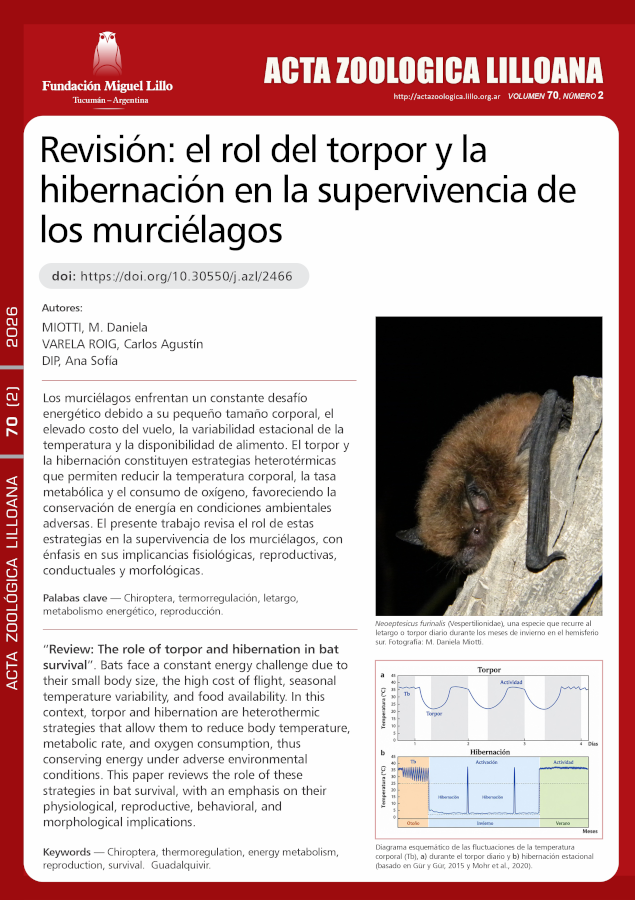
Los murciélagos enfrentan un constante desafío energético debido a su pequeño tamaño corporal, el elevado costo del vuelo, la variabilidad estacional de la temperatura y la disponibilidad de alimento. En este contexto, el torpor y la hibernación constituyen estrategias heterotérmicas que permiten reducir la temperatura corporal, la tasa metabólica y el consumo de oxígeno, favoreciendo la conservación de energía en condiciones ambientales adversas. El presente trabajo revisa el rol de estas estrategias en la supervivencia de los murciélagos, con énfasis en sus implicancias fisiológicas, reproductivas, conductuales y morfológicas. Sintetiza evidencias que muestran que el uso del letargo no se restringe a especies de zonas templadas del hemisferio norte, sino que también ocurre en murciélagos tropicales, subtropicales y del hemisferio sur, incluyendo registros recientes en Sudamérica. También analiza la interacción entre termorregulación y reproducción, destacando que el torpor puede coexistir con la gestación y la lactancia, modular los tiempos reproductivos y favorecer la sincronización de nacimientos con períodos de mayor disponibilidad de recursos. Además, revisa la importancia de la selección de refugios, la termorregulación social y el comportamiento gregario como mecanismos complementarios de ahorro energético. Finalmente, se aborda el papel del tejido adiposo marrón en el recalentamiento posterior al letargo y sus posibles vínculos con la reproducción y la inmunidad. En conjunto, la evidencia disponible indica que el torpor y la hibernación son estrategias plásticas y multifuncionales, cuyo estudio resulta clave para comprender la ecología fisiológica de los murciélagos.
Descargas
Citas
Alegre, E. A., Ramirez, G. V., Salinas, F. M., Burguener, F., Ruiz, R. M. (2024). Identificación y descripción de la grasa parda en murciélagos de la ciudad de Corrientes. Revista Veterinaria, 35(2). https://doi.org/10.30972/vet.3527863
Angell, R. L., Butlin, R. K., Altringham, J. D. (2013). Sexual segregation and flexible mating patterns in temperate bats. PloS One, 8(1), e54194. https://doi.org/10.1371/journal.pone.0054194
Arévalo, F., Burgos, M. J., Del Hoyo, N., López-Luna, P. (1990). Seasonal variations in the lipid composition of white and brown tissues in the bat Pipistrellus pipistrellus. Comparative Biochemistry and Physiology Part B: Comparative Biochemistry, 95(3), 535-539.
Audet, D., Thomas, D. W. (1997). Facultative hypothermia as a thermoregulatory strategy in the phyllostomid bats, Carollia perspicillata and Sturnira lilium. Journal of Comparative Physiology B, 167(2), 146-152.
Ayala-Berdon, J., Solís-Cárdenas, V. (2017). New record and site characterization of a hibernating colony of Myotis velifer in a mountain ecosystem of central Mexico. Therya, 8(2), 171-174. https://doi.org/10.12933/therya-17-469
Ayala-Berdon, J., Medina-Bello, K. I., Carballo-Morales, J. D., Saldaña-Vázquez, R. A., Villalobos, F. (2025)a. Thermal energetics of bats of the family Vespertilionidae: an evolutionary approach. Zoology, 170, 126271. https://doi.org/10.1101/2024.01.03.574072
Ayala-Berdon, J., Medina-Bello, K. (2023). Torpor energetics are related to the interaction between body mass and climate in bats of the family Vespetilionidae. bioRxiv 2023-09. https://doi.org/10.1101/2023.09.30.560312
Ayala-Berdon, J., Orozco-Lugo, L., Medina-Bello, K. I. (2025)b. Coping with seasons: morphological and physiological adjustments along the year in vampire bats (Desmodus rotundus) from central Mexico. https://doi.org/10.21203/rs.3.rs-5800286/v1
Benedetti, P., Dip, A. S., Miotti, M. D. (2026). Rol del tejido adiposo en el ciclo reproductivo de murciélagos: un estudio comparativo entre especies frugívoras e insectívoras en Las Yungas de Tucumán. En 36 Jornadas Argentinas de Mastozoología 2025. Libro de resúmenes (p. 160). UNPA edita.
Bergeson, S. M., Brigham, R. M., O’Keefe, J. M. (2021). Free-ranging bats alter thermoregulatory behavior in response to reproductive stage, roost type, and weather. Journal of Mammalogy, 102(3), 705-717. https://doi.org/10.1093/jmammal/gyab049
Bernard, R. F., Willcox, E. V., Jackson, R. T., Brown, V. A., McCracken, G. F. (2021). Feasting, not fasting: winter diets of cave hibernating bats in the United States. Frontiers in Zoology, 18(1), 48. https://10.1186/s12983-021-00434-9
Bernard, R. T. F., Cumming, G. S. (1997). African bats: evolution of reproductive patterns and delays. The Quarterly Review of Biology, 72(3), 253-274.
Bernard, R. T. F., Hodgson, A. N. (1989). Ultrastructural changes in the seminiferous epithelium of two seasonally reproducing bats (Mammalia: Chiroptera). Journal of morphology, 199(3), 249-258.
Bieber, C., Turbill, C., Ruf, T. (2018). Effects of aging on timing of hibernation and reproduction. Scientific reports, 8(1), 13881. https://doi.org/10.1038/s41598-018-32311-7
Blomberg, A. S., Vasko, V., Meierhofer, M. B., Johnson, J. S., Eeva, T., Lilley, T. M. (2021). Winter activity of boreal bats. Mammalian Biology, 101(5), 609-618. https://doi.org/10.1007/s42991-021-00111-8
Boyles, J. G., Dunbar, M. B., Storm, J. J., Brack Jr, V. (2007). Energy availability influences microclimate selection of hibernating bats. Journal of Experimental Biology, 210(24), 4345-4350. https://doi.org/10.1242/jeb.007294
Brack Jr, V., Twente, J. W. (1985). The duration of the period of hibernation of three species of vespertilionid bats. I. Field studies. Canadian journal of Zoology, 63(12), 2952-2954.
Bronson, F. H. (2009). Climate change and seasonal reproduction in mammals. Philosophical transactions of the royal society B: Biological Sciences, 364(1534), 3331-3340. https://doi.org/10.1098/rstb.2009.0140
Burns, L. E., Broders, H. G. (2015). Who swarms with whom? Group dynamics of Myotis bats during autumn swarming. Behavioral ecology, 26(3), 866-876. https://doi.org/10.1093/beheco/arv017
Currie, S. E., Stawski, C., Geiser, F. (2018). Cold-hearted bats: uncoupling of heart rate and metabolism during torpor at sub-zero temperatures. Journal of Experimental Biology, 221(1). https://doi.org/10.1242/jeb.170894
Currie, S. E., Körtner, G., Geiser, F. (2022). Pronounced differences in heart rate and metabolism distinguish daily torpor and short-term hibernation in two bat species. Scientific Reports, 12(1), 21721. https://doi.org/10.1038/s41598-022-25590-8
Czenze, Z. J., Dunbar, M. B. (2017). Hot bats go cold: heterothermy in neotropical bats. Canadian Journal of Zoology, 95(12), 909-912. https://doi.org/10.1139/cjz-2016-0318
Czenze, Z. J., Brigham, R. M., Hickey, A. J., Parsons, S. (2017). Stressful summers? Torpor expression differs between high-and low-latitude populations of bats. Journal of Mammalogy, 98(5), 1249-1255. https://doi.org/10.1093/jmammal/gyx071
Czenze, Z. J., Parsons, S., Brigham, R. M. (2026). Do Energetic Challenges Mimicking Missed Foraging Encourage Torpor Use by a Neotropical Bat? Biotropica, 58(2), e70163. https://doi.org/10.1111/btp.70163
De Bruyn, L., Gyselings, R., Kirkpatrick, L., Rachwald, A., Apozna?ski, G., Kokurewicz, T. (2021). Temperature driven hibernation site use in the Western barbastelle Barbastella barbastellus (Schreber, 1774). Scientific Reports, 11(1), 1464. https://doi.org/10.1038/s41598-020-80720-4
Denault, L. K., McFarlane, D. A. (1995) Reciprocal altruism between male vampire bats, Desmodus rotundus. Animal Behaviour, 49:855-856. https://doi.org/10.1016/0003-3472(95)80220-7
Dzal, Y. A., Brigham, R. M. (2012). The tradeoff between torpor use and reproduction in little brown bats (Myotis lucifugus). Journal of Comparative Physiology B, 183(2), 279-288. https://doi.org/10.1007/s00360-012-0705-4
Eghbali, H., Sharifi, M. (2023). Impacts of inter-annual climate variability on reproductive phenology and postnatal development of morphological features of three sympatric bat species. Scientific Reports, 13(1), 8716. https://doi.org/10.1038/s41598-023-35781-6
Ewing, W. G., Studier, E. H., O’farrell, M. J. (1970). Autumn fat deposition and gross body composition in three species of Myotis. Comparative Biochemistry and Physiology 36, 119–129.
Farias, T. D. O., Viana, P. I. M., Kluck, G. E. G., Amaral, P. H. R., Baliza, V. A. C. G., De Paiva, V. H. S., González Pérez, J. C., Talamonio, S. A., Correa Atella, G., Jardim Costa G. M. (2026). Reproductive Importance of Brown Adipose Tissue in the Neotropical Sperm-Storing Vespertilionid Bat Yellowish Myotis: AI Analysis, Lipid Profile, and Androgenic Function. Molecular Reproduction and Development, 93(2), e70087. https://doi.org/10.1002/mrd.70087
Findlay-Robinson, R., Deecke, V. B., Weatherall, A., Hill, D. L. (2023). Effects of climate change on life-history traits in hibernating mammals. Mammal Review, 53(2), 84-98. https://doi.org/10.1111/mam.12308
Fjelldal, M. A., Sørås, R., Stawski, C. (2022). Universality of torpor expression in bats. Physiological and Biochemical Zoology, 95(4), 326-339. https://doi.org/10.1086/720273
Fjelldal, M. A., Wright, J., Stawski, C. (2021). Nightly torpor use in response to weather conditions and individual state in an insectivorous bat. Oecologia, 197(1), 129-142. https://link.springer.com/content/pdf/10.1007/s00442-021-05022-6.pdf
Fleming, T. H. (1971). Artibeus jamaicensis: delayed embryonic development in a neotropical bat. Science, 171(3969), 402-404.
Fontúrbel, F. E., Franco, L. M., Bozinovic, F., Quintero-Galvis, J. F., Mejías, C., Amico, G. C., Vázquez, S., Sabat, P., Sánchez-Hérnandez, J. P., Watson, D. M., Sáenz-Agudelo, P., Nespolo, R. F. (2022). The ecology and evolution of the monito del monte, a relict species from the southern South America temperate forests. Ecology and Evolution, 12(3), e8645. https://doi.org/10.1002/ece3.8645
Geiser, F. (2004). Metabolic rate and body temperature reduction during hibernation and daily torpor. Annual Review of Physiology, 66(1), 239-274.
Geiser, F. (2020). Seasonal expression of avian and mammalian daily torpor and hibernation: not a simple summer-winter affair. Frontiers in Physiology, 11, 436. https://doi.org/10.3389/fphys.2020.00436
Geiser, F. (2021). Ecological physiology of daily torpor and hibernation (Vol. 317). Springer, Cham.
Geiser, F., Ruf, T. (2023). Long-term survival, temperature, and torpor patterns. Scientific Reports, 13(1), 6673. https://doi.org/10.1038/s41598-023-33646-6
Geiser, F., Stawski, C. (2011). Hibernation and torpor in tropical and subtropical bats in relation to energetics, extinctions, and the evolution of endothermy. Integrative and comparative biology, 51(3), 337-348. https://doi.org/10.1093/icb/icr042
Giroud, S., Habold, C., Nespolo, R. F., Mejías, C., Terrien, J., Logan, S. M., Henning, R. H., Storey, K. B. (2021). The torpid state: recent advances in metabolic adaptations and protective mechanisms. Frontiers in Physiology, 11, 623665. https://doi.org/10.3389/fphys.2020.623665
Gür, K. M., Gür, H. (2015). Age and sex differences in hibernation patterns in free-living Anatolian ground squirrels. Mammalian Biology, 80(4), 265-272. http://dx.doi.org/10.1016/j.mambio.2015.02.006
Hadj-Moussa, H., Moggridge, J. A., Luu, B. E., Quintero-Galvis, J. F., Gaitán-Espitia, J. D., Nespolo, R. F., Storey, K. B. (2016). The hibernating South American marsupial, Dromiciops gliroides, displays torpor-sensitive microRNA expression patterns. Scientific Reports, 6(1), 24627. https://doi.org/10.1038/srep24627
Ha?at, Z., Dechmann, D. K., Zegarek, M., Ruczy?ski, I. (2020). Male bats respond to adverse conditions with larger colonies and increased torpor use during sperm production. Mammalian Biology, 100(6), 611-620. https://doi.org/10.1007/s42991-020-00071-5
Hall, M. (1832) Sobre la hibernación. Philosophical Transactions of the Royal Society, 122:335–360. https://doi.org/10.1098/rstl.1832.0017
Hamilton, I. M., Barclay, R. M. (1994). Patterns of daily torpor and day-roost selection by male and female big brown bats (Eptesicus fuscus). Canadian Journal of Zoology, 72(4), 744-749.
Heideman, P. D. (1988). The timing of reproduction in the fruit bat Haplonycteris fischeri (Pteropodidae): geographic variation and delayed development. Journal of Zoology, 215(4), 577-595.
Hernández-Aguilar, I., Santos-Moreno, A. (2020). Reproduction and population dynamics of cave-dwelling bats in Costa of Oaxaca, México. Revista de Biología Tropical, 68(3), 785-802. http://dx.doi.org/10.15517/rbt.v68i3.41590
Hirakawa, H., Nagasaka, Y. (2018). Evidence for Ussurian tube-nosed bats (Murina ussuriensis) hibernating in snow. Scientific Reports 8(1), 12047. https://doi.org/10.1038/s41598-018-30357-1
Hock, R. J. (1951). The metabolic rates and body temperatures of bats. The Biological Bulletin, 101(3), 289-299.
Ito, T., Tanuma, Y., Yamada, M., Yamamoto, M. (1991). Morphological studies on brown adipose tissue in the bat and in humans of various ages. Archives of Histology and Cytology, 54(1), 1-39. https://doi.org/10.1679/aohc.54.1. PMID: 2039657.
Jonasson, K. A., Willis, C. K. (2011). Changes in body condition of hibernating bats support the thrifty female hypothesis and predict consequences for populations with white-nose syndrome. PLoS One, 6(6), e21061. https://doi.org/10.1371/journal.pone.002106
Kalka, M., Kalko, E. K. (2006). Gleaning bats as underestimated predators of herbivorous insects: diet of Micronycteris microtis (Phyllostomidae) in Panama. Journal of Tropical Ecology, 22(1), 1-10. https://doi.org/10.1017/S0266467405002920
Katsis, L. K., Linton, D. M., Macdonald, D. W. (2020). The effect of group size, reproductive condition and time period on sexual segregation patterns in three vespertilionid bat species. Journal of Zoology, 313(2), 135-144. https://doi.org/10.1111/jzo.12843
Kelm, D. H., Toelch, U., Jones, M. M. (2021). Mixed-species groups in bats: non-random roost associations and roost selection in neotropical understory bats. Frontiers in Zoology, 18(1), 53. https://doi.org/10.1186/s12983-021-00437-6
Kunz, T. H. (1973). Resource utilization: temporal and spatial components of bat activity in central Iowa. Journal of Mammalogy, 54(1), 14-32.
Langguth, A., Wu, N. C., Villada-Cadavid, T., Brannelly, L. A., Hufschmid, J., Czirják, G. Á., Turbill, C. (2026). Emergence from torpor rapidly elevates suppressed blood immune parameters in a bat species hibernating in a moderate climate. Journal of Experimental Biology, 229(9), jeb251962. https://doi.org/10.1242/jeb.251962
Linton, D. M., Macdonald, D. W. (2019). Roost composition and sexual segregation in a lowland population of Daubenton’s bats (Myotis daubentonii). Acta Chiropterologica, 21(1), 129-137. https://doi.org/10.3161/15081109ACC2019.21.1.010
López-Roig, M., Piera, E., Serra-Cobo, J. (2024). Thinner bats to face hibernation as response to climate warming. Scientific Reports, 14(1), 2117. https://doi.org/10.1038/s41598-024-52459-9
Lyman, C. P., Wimsatt, W. A. (1966) Temperature regulation in the vampire bat, Desmodus rotundus. Physiol Zool 39:101–109. https://doi.org/10.1086/physzool.39.2.30152422
Marín, G., Ramos-H., D., Cafaggi, D., Sierra-Durán, C., Gallegos, A., Romero-Ruiz, A., Medellín, R. A. (2021). Challenging hibernation limits of hoary bats: the southernmost record of Lasiurus cinereus hibernating in North America. Mammalian Biology, 101(3), 287-291.
McAllan, B. M., Geiser, F. (2014). Torpor during reproduction in mammals and birds: dealing with an energetic conundrum. American Zoologist, 54(3), 516-532. https://doi.org/10.1093/icb/icu093
Mejsnar, J., Janský, L. (1970). Shivering and nonshivering thermogenesis in the bat (Myotis myotis Borkh.) during arousal from hibernation. Canadian Journal of Physiology and Pharmacology, 48(2), 102-106. https://doi.org/10.1139/y70-017
Micalizzi, E. W., Forshner, S. A., Low, E. B., Johnston, B., Skarsgard, S. A., Barclay, R. M. R. (2023). Female little brown bats require both building and natural roosts in a mountainous environment with short summers. Ecosphere 14(12):1-14. https://doi.org/10.1002/ecs2.4731
Miotti, M. D. (2020). Variaciones latitudinales en los patrones reproductivos de cuatro especies de murciélagos frugívoros de las yungas argentinas. Publicaciones Especiales N° 5, PIDBA (Programa de Investigaciones de Biodiversidad Argentina).
Miotti, M. D., M. I. Mollerach, Mangione, S. (2016). Bases morfológicas de un fenómeno: Torpor vs hibernación en murciélagos. Revista Argentina de Ciencias del Comportamiento, 8(2):35-36.
Mohr, S. M., Bagriantsev, S. N., Gracheva, E. O. (2020). Cellular, molecular, and physiological adaptations of hibernation: the solution to environmental challenges. Annual review of cell and developmental biology, 36(1), 315-338. https://doi.org/10.1146/annurev-cellbio-012820- 095945
Montoya, J., Lee, Y., Salles, A. (2022). Social communication in big brown bats. Frontiers in ecology and evolution, 10, 903107. https://doi.org/10.3389/fevo.2022.903107
Morales, J. O., Walker, N., Warne, R. W., Boyles, J. G. (2021). Heterothermy as a mechanism to offset energetic costs of environmental and homeostatic perturbations. Scientific reports, 11(1), 19038. https://doi.org/10.1038/s41598-021-96828-0
Morrow, G., Nicol, S. C. (2009). Cool sex? Hibernation and reproduction overlap in the echidna. PLoS One, 4(6), e6070. https://doi.org/10.1371/journal.pone.0006070
Muthersbaugh, M. S., Ford, W. M. Silvis, A., Powers K. E. (2019). Activity patterns of cave-dwelling bat species during pre-hibernation swarming and post-hibernation emergence in the central Appalachians. Diversity 11(9):159. https://doi.org/10.3390/d11090159
Nedergaard, J., Bengtsson, T., Cannon, B. (2007). Unexpected evidence for active brown adipose tissue in adult humans. American Journal of Physiology-Endocrinology and Metabolism, 293(2), E444-E452. https://doi.org/10.1152/ajpendo.00691.2006
Nowack, J., Levesque, D. L., Reher, S., Dausmann, K. H. (2020). Variable climates lead to varying phenotypes: “Weird” mammalian torpor and lessons from non-holarctic species. Frontiers in Ecology and Evolution, 8, 60. https://doi.org/10.3389/fevo.2020.00060
Odon, A., Freire, C. A., Brigham, R. M., Bordignon, M. O., Monteiro-Filho, E. L. (2023). Brazilian sleeping beauty: First evidence of hibernation by a bat in South America. Biotropica, 55(3), 573-578. https://doi.org/10.1111/btp.13224
Ossa, G., Lilley, T. M., Waag, A. G., Meierhofer, M. B., Johnson, J. S. (2020). Roosting ecology of the southernmost bats, Myotis chiloensis and Histiotus magellanicus, in southern Tierra del Fuego, Chile. Austral Ecology, 45(8), 1169-1178. https://doi.org/10.1111/aec.12950
Oxberry, B. A. (1979). Female reproductive patterns in hibernating bats. Reproduction, 56(1), 359-367.
Pérez-García, C., Bernal-Contreras, K., Ramírez-Castellanos, D. M., Buitrago-Valenzuela, D. C., Ceballos-Ladino, L. A. Sánchez-Barrera, F. (2019). Predios usados como abrigos de morcegos no campus universitario nos contrafortes orientais da Colômbia. Orinoquia, 23(2), 109-120. https://doi.org/10.22579/20112629.574
Pretzlaff, I., Kerth, G., Dausmann, K. H. (2010). Communally breeding bats use physiological and behavioural adjustments to optimise daily energy expenditure. Naturwissenschaften, 97(4), 353-363. https://doi.org/10.1007/s00114-010-0647-1
Racey, P. A., Entwistle, A. C. (2000). Life- history and reproductive strategies of bats. En E. G. Grichton y P. H. Krutzsch (Eds.), Reproductive Biology of Bats (pp.363-414). Academic Press.
Racey, P. A., Swift, S. M. (1985). Feeding ecology of Pipistrellus pipistrellus (Chiroptera:Vespertilionidae) during pregnancy and lactation. I. Foraging behaviour. The Journal of Animal Ecology, 205-215.
Ramos-H, D., Marín, G., Cafaggi, D., Sierra-Durán, C., Romero-Ruíz, A., Medellín, R. A. (2024). Hibernacula of bats in Mexico, the southernmost records of hibernation in North America. Journal of Mammalogy, 105(4), 823-837. https://doi.org/ 10.1093/jmammal/gyae027
Reusch, C., Gampe, J., Scheuerlein, A., Meier, F., Grosche, L., Kerth, G. (2019). Differences in seasonal survival suggest species-specific reactions to climate change in two sympatric bat species. Ecology and Evolution, 9(14), 7957-7965.
Rodríguez-Herrera, B., Víquez-R, L., Cordero-Schmidt, E., Sandoval, J. M., Rodríguez-Durán, A. (2015). Energetics of tent roosting in bats: the case of Ectophylla alba and Uroderma bilobatum (Chiroptera: Phyllostomidae). Journal of Mammalogy, 97(1), 246–252. https://doi.org/10.1093/jmammal/gyv173
Ruczy?ski, I., Barto?, K. A. (2020). Seasonal changes and the influence of tree species and ambient temperature on the fission-fusion dynamics of tree-roosting bats. Behavioral Ecology and Sociobiology, 74(5), 63. https://doi.org/10.1007/s00265-020-02840-1
Ruf, T., Bieber, C. (2023). Why hibernate? Predator avoidance in the edible dormouse. Mammal Research, 68(1), 1-11. https://doi.org/10.1007/s13364-022-00652-4
Ruf, T., Geiser, F. (2015). Daily torpor and hibernation in birds and mammals. Biological Reviews, 90(3), 891-926. https://doi/pdfdirect/10.1111/brv.12137?
Ruf, T., Giroud, S., Geiser, F. (2022). Hypothesis and theory: a two-process model of torpor-arousal regulation in hibernators. Frontiers in Physiology, 13, 901270. https://doi.org/10.3389/fphys.2022.901270
Ruiz, A., Soriano, P. J., Machado, M. (2024). Termorregulación y tasas metabólicas de murciélagos nectarívoros del género Anoura (Chiroptera:Phyllostomidae) en una selva nublada de Los Andes Venezolanos. Ecotropicos, 35. https://doi.org/10.53157/ecotropicos.682a-rbtc
Sato, T., Sugiyama, T., Sekijima, T. (2023). Mating in the cold. Prolonged sperm storage provides opportunities for forced copulation by male bats during winter. Frontiers in Physiology, 14, 1241470. https://doi.org/10.3389/fphys.2023.1241470
Smalley, R. L., Dryer, R. L. (1963). Brown fat: thermogenic effect during arousal from hibernation in the bat. Science, 140(3573), 1333-1334. https://doi.org/10.1126/science.140.3573.1333
Sørås, R., Fjelldal, M. A., Bech, C., van der Kooij, J., Skåra, K. H., Eldegard, K., Stawski, C. (2022). State dependence of arousal from torpor in brown long-eared bats (Plecotus auritus). Journal of Comparative Physiology B, 192(6), 815-827. https://doi.org/10.1007/s00360-022-01451-8
Speakman, J. R., Rowland, A. (1999). Preparing for inactivity: how insectivorous bats deposit a fat store for hibernation. Proceedings of the Nutrition Society, 58(1), 123-131.
Speakman, J. R., Thomas, D. W. (2003). Physiological ecology and energetics of bats. En T. H. Kunz y M. B. Fenton (Eds.), Bat ecology (pp. 430-490). University of Chicago Press.
Stapelfeldt, B., Tress, C., Koch, R., Tress, J., Kerth, G., Scheuerlein, A. (2023). Long-term field study reveals that warmer summers lead to larger and longer-lived females only in northern populations of Natterer’s bats. Oecologia, 201(3), 853-861. https://doi.org/10.1007/s00442-023-05318-9
Stawski, C., Willis, C. K. R., Geiser, F. (2014). The importance of temporal heterothermy in bats. Journal of Zoology, 292(2), 86-100. https://doi.org/ doi/pdf/10.1111/jzo.12105
Turbill, C. (2008). Winter activity of Australian tree-roosting bats: Influence of temperature and climatic patterns. Journal of Zoology, 276(3), 285-290. https://doi.org/10.1111/j.1469-7998.2008.00487.x
Twente, J. W., Twente, J., Brack Jr, V. (1985). The duration of the period of hibernation of three species of vespertilionid bats. II. Laboratory studies. Canadian Journal of Zoology, 63(12), 2955-2961.
Wells, H. J., Makita, M., Wells, W. T., Krutzsch, P. H. (1965). A comparison of the lipid composition of brown adipose tissue from male and female bats (Myotis lucifugus) during hibernating and non-hibernating seasons. Biochimica et Biophysica Acta (BBA)-Lipids and Lipid Metabolism, 98(2), 269-277.
Willis, C. K. (2006). Daily heterothermy by temperate bats using natural roosts. Functional and evolutionary ecology of bats. Oxford University Press, New York.
Willis, C. K., Brigham, R. M., Geiser, F. (2006). Deep, prolonged torpor by pregnant, free-ranging bats. Naturwissenschaften, 93: 80-83.
Willis, C. K., Brigham, R. M. (2007). Social thermoregulation exerts more influence than microclimate on forest roost preferences by a cavity-dwelling bat. Behavioral Ecology and Sociobiology, 62:97-108. https://doi.org/10.1007/s00265-007-0442-y
Wimsatt, W. A. (1969) Transient behavior, nocturnal activity patterns, and feeding e ciency of vampire bats (Desmodus rotundus) under natural conditions. Journal of Mammalogy, 50: 233-244.
Descargas
Publicado
Cómo citar
Número
Sección
Licencia
Derechos de autor 2026 Acta Zoológica Lilloana

Esta obra está bajo una licencia internacional Creative Commons Atribución-NoComercial-SinDerivadas 4.0.